Free Walking Tour Bruges: Belfry, Canals, Michelangelo

Start under the Belfry, cross the counts' old Burg, stand before Michelangelo's Madonna and finish at the cathedral, with a family brewery on the way.

11 Stops 2.6 km ~35 min walking
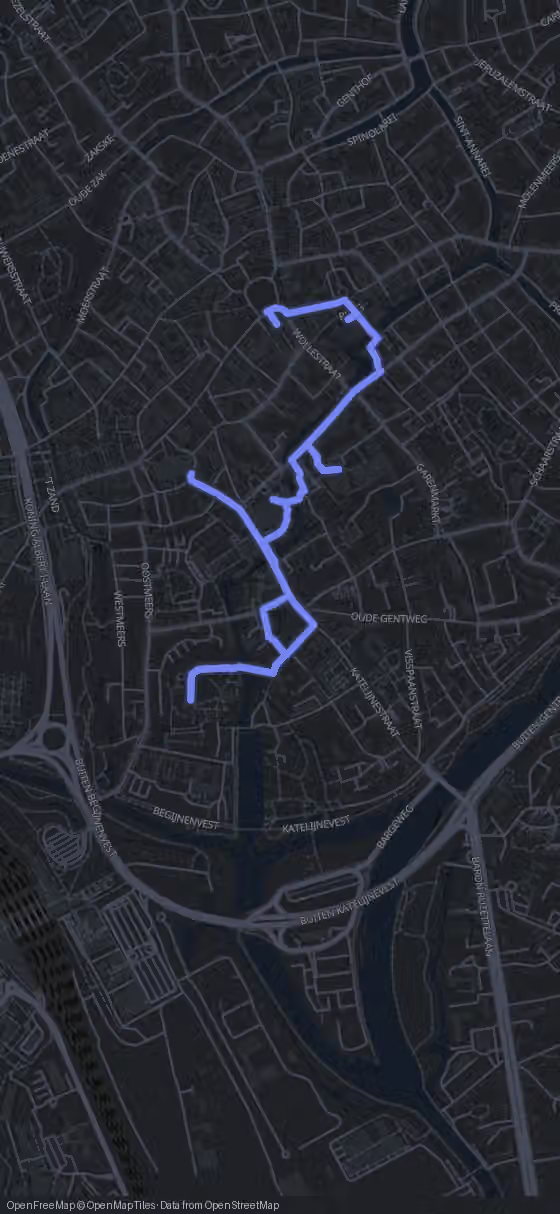
Route map for the Bruges walking tour
Stop 1 of 11
40 m·1 min
Market Square
Head south-east toward the Belfry of Bruges
Welcome to Bruges. I'm Alex, and our first story begins with a sculpture that crossed the Alps during its creator's lifetime.
Try this tour with Alex

What This Bruges Walk Covers

Eleven stops lead from Market Square to St. Saviour's Cathedral: 2.6 km and 35 minutes of pure walking. With the Belfry of Bruges and one or two interiors, plan on half a day.

The squares, the canal views and the church naves are free; the Groeninge Museum, De Halve Maan Brewery, the Belfry and the museum sections of the Basilica of the Holy Blood and the Church of Our Lady charge entry. Route, map and GPS navigation are free in your browser; the AI Tour Guide is optional.

Open free GPS & optional AI Tour Guide
This short shows highlights of the route. All 11 stops follow below.

The Route

Walking Map of Bruges, from the Markt to the Cathedral

11 stops 2.6 km 35 min walking
Tap to load interactive map

The 11 stops along this route

  1. Market Square in Bruges, stop 1 on the self-guided walking tour
    1Market Square
  2. Belfry of Bruges, stop 2 on the self-guided walking tour
    2Belfry of Bruges
  3. Burg Square in Bruges, stop 3 on the self-guided walking tour
    3Burg Square
  4. Basilica of the Holy Blood in Bruges, stop 4 on the self-guided walking tour
    4Basilica of the Holy Blood
  5. Rozenhoedkaai in Bruges, stop 5 on the self-guided walking tour
    5Rozenhoedkaai
  6. Groeninge Museum in Bruges, stop 6 on the self-guided walking tour
    6Groeninge Museum
  7. Bonifacius Bridge in Bruges, stop 7 on the self-guided walking tour
    7Bonifacius Bridge
  8. Church of Our Lady in Bruges, stop 8 on the self-guided walking tour
    8Church of Our Lady
  9. De Halve Maan Brewery in Bruges, stop 9 on the self-guided walking tour
    9De Halve Maan Brewery
  10. Begijnhof in Bruges, stop 10 on the self-guided walking tour
    10Begijnhof
  11. St. Saviour's Cathedral in Bruges, stop 11 on the self-guided walking tour
    11St. Saviour's Cathedral
  12. That's the full route.

    Walk it with an AI Tour Guide talking you through every one of these streets.

    Start free in your browser
    You made it

Your Bruges Walking Tour, from Belfry to Sint-Salvator

  1. 1

    Market Square

    Market Square in Bruges, stop 1 on the self-guided walking tour

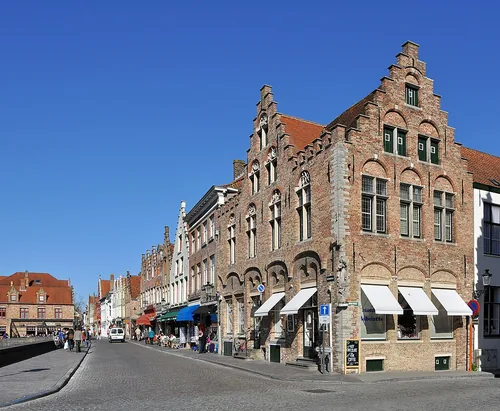
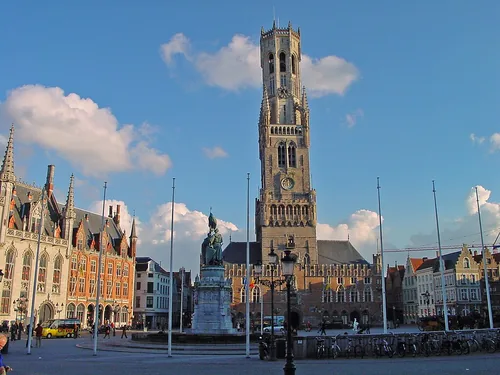
    Stand in the middle of the Markt and turn slowly. This square of about one hectare has drawn people since the 10th century, and around 1200 it hosted the city's first international annual fair. On the south side rises the Belfry with the old market hall wrapped around its base; at number 3 stands the Provincial Court, a classicist building that replaced the medieval Waterhall after 1787 and served as the provincial court from 1850.

    That Waterhall is worth picturing. It was built over the Reie on the east side of the square as a covered place where boats from Damme unloaded and stored their goods; before that, cargo was handled in the open air at the Reiekaai right here on the square. Merchants first sold from small wooden halls on the south side around 1220. A larger hall with a wooden tower followed around 1240, burned in 1280 and was rebuilt in stone between 1291 and 1296.

    Fish was traded here from 1396, with the fishmongers' craft house on the north side near St. Christopher's Church, until the fish market moved to the Braamberg in 1745 and the corn market came the other way. The square also staged jousts, tournaments and executions, all of which drew large crowds. Its name followed the rulers: from 1807 to 1810 it was the Place Napoléon, then the Grote Markt, and only from 1936 simply the Markt.

    What you walk on today is the result of the 1995 to 1996 renovation, which removed the parking spaces and made the square mostly traffic-free; it reopened in 1996 with a concert by Helmut Lotti. Your next stop is just 40 metres away: the tower you have been looking at all along.
    Hours
    Open 24/7
    Price
    Free
  2. 2

    Belfry of Bruges

    Belfry of Bruges, stop 2 on the self-guided walking tour

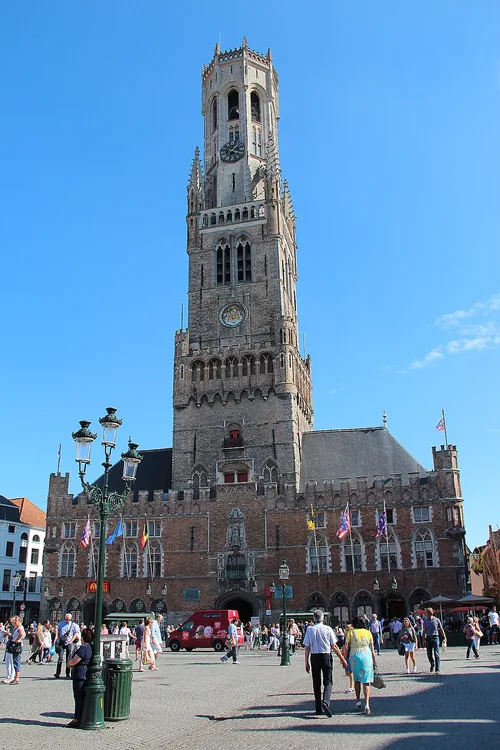
    The Belfry of Bruges was added to the Markt around 1240, when the city was a major centre of the Flemish cloth industry. It did far more than ring bells: it held the treasury and the municipal archives and served as a lookout for fires and other dangers. Look at the square lower part first, then at the octagonal upper stage added between 1483 and 1487.

    Fire runs through its whole story. In 1280 a blaze destroyed the city archives for good, and the upper half had to be largely rebuilt. A wooden spire crowned with Saint Michael, banner in hand and dragon underfoot, burned after a lightning strike in 1493 and took the bells with it. Its successor stood for about two and a half centuries until flames took it in 1741. It was never replaced, which is why the tower measures 83 metres today instead of 102; the openwork stone parapet on top dates from 1822. Longfellow put it into verse: "Thrice consumed and thrice rebuilded, still it watches o'er the town."

    Two details to look for: the tower leans 87 centimetres to the east, and the market hall behind it is only 44 metres wide but 84 metres deep, built around an inner courtyard, which is why the tower is also called the Halletoren. Since 1999 it has been UNESCO World Heritage as one of the Belfries of Belgium and France.

    Going up is worth it if you want to see Bruges from above. The climb costs admission, and booking ahead is recommended. Then walk 210 metres, about 3 minutes, to the Burg.

    Local name
    Belfort van Brugge
    Hours
    1 Apr–2 Nov: daily 09:00–20:00; 3 Nov–31 Mar: Mon–Fri and Sun 10:00–18:00, Sat 09:00–20:00; last entry 1 hour before closing
    Price
    16 EUR (15 EUR on weekdays 3 Nov–31 Mar), under 18 14 EUR (13 EUR), under 7 free; booking ahead recommended
  3. 3

    Burg Square

    Burg Square in Bruges, stop 3 on the self-guided walking tour

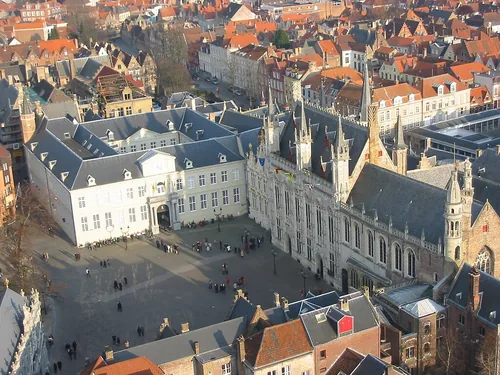
    Where the Markt was about trade, the Burg was about power. This square grew out of a walled fortress with gates, set where a possibly Roman road met the Reie, and it belongs to the oldest core of the city. Count Arnulf I, who lived from 889 to 965, expanded it into a seat of power with imperial ambitions. From the 11th to the end of the 13th century, one of the residences of the Counts of Flanders, Het Steen, stood on its west side.

    The fortress had two halves: the southern one served civil purposes, the northern one the church. On the north side stood the church of Our Lady and St. Donatian, which became a cathedral when Bruges became a diocese in 1559. It was demolished in 1799, and since then the square has roughly doubled to about 1.1 hectares, larger than the Markt, though you can still sense its two connected parts. Part of the cathedral's foundations can be seen in the cellars of the Crowne Plaza Hotel.

    Today the Burg is framed by the City Hall, the former Liberty of Bruges, the former Civil Registry, the former Provostry of St. Donatian and the Basilica of the Holy Blood with the Chapel of St. Basil. In the night of 13 to 14 February 1967 a bomb went off at the gate of the courthouse. Nobody died, but the stained glass of the City Hall, the courthouse and the basilica was completely destroyed. Despite dozens of house searches and interrogations, the case was never solved.

    The square is also a favourite stage for performances. Your next stop stands on the Burg itself, 50 metres on.

    Hours
    Open 24/7
    Price
    Free
  4. 4

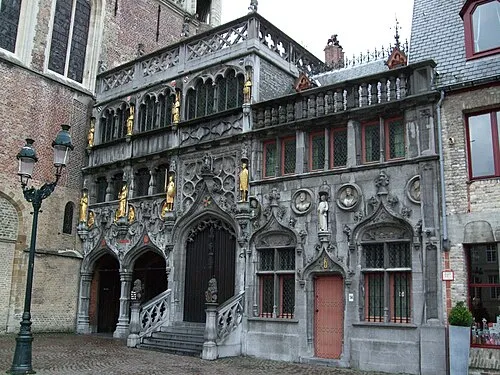
    Basilica of the Holy Blood

    Basilica of the Holy Blood in Bruges, stop 4 on the self-guided walking tour

    The Basilica of the Holy Blood is really two chapels stacked on top of each other, built between 1134 and 1157 as the private double chapel of the Count of Flanders, next to the Oud Steen, the counts' first residence, which later became the town hall. It was raised to a minor basilica in 1923. Entry to the basilica is free.

    Start in the lower chapel, dedicated to St. Basil the Great, whose relic Count Robert II brought back from Caesarea in Cappadocia. Built from 1134 to 1149, it is a dark Romanesque space that has barely changed and one of the best preserved Romanesque churches in West Flanders. Look for the 12th-century baptism of Saint Basil in the tympanum over the entrance to the annex, and in the right nave for a painted wooden seated Madonna and Child from the early 14th century. Two wooden statues from around 1900, Jesus on the Cold Stone and a Pietà, are carried in the procession every year.

    The upper chapel holds the relic itself. Tradition says Joseph of Arimathea collected the Holy Blood and that Thierry of Alsace, who went on the Second Crusade in 1147, brought it home to Bruges on 7 April 1150. The chapel took the name Chapel of the Holy Blood in the first half of the 13th century, was rebuilt in Gothic style in the 16th century and renovated in Gothic Revival style in the 19th.

    The museum and treasury charge admission. Go in if relics and church treasures interest you; otherwise the two chapels alone tell the story. From here it is 210 metres, about 3 minutes, to the water at the Rozenhoedkaai.

    Local name
    Heilig-Bloedbasiliek
    Hours
    Daily 10:00–17:15 (closed Jan 12–17, 2026)
    Price
    Basilica free; museum/treasury 5 EUR (under 12 free)
  5. 5

    Rozenhoedkaai

    Rozenhoedkaai in Bruges, stop 5 on the self-guided walking tour

    This quay along the Reie is the most photographed spot in Bruges, so take your picture, then think about the name. For centuries it was called the Zoutdijk, the salt dyke: a record from 1390 mentions a salt jetty here, probably the landing where ships delivering salt were unloaded.

    The name Rozenhoedkaai only came into use in the 18th century, after the stalls set up on this spot selling rosaries. Why Bruges said quay or dyke here instead of the more common word "rei" is something linguists have never looked into.

    Literature lives here too: Georges Rodenbach had the main character of his novel Bruges-la-Morte live on this quay. The Rozenhoedkaai runs from the Dijver to the Braambergstraat, and the Groeninge Museum on the Dijver is 280 metres on, about 4 minutes.

    Hours
    Open 24/7
    Price
    Free
  6. 6

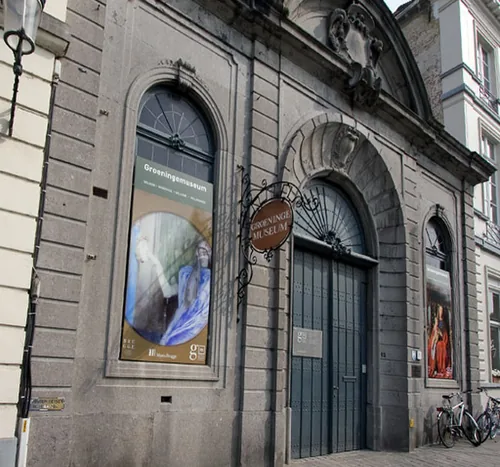
    Groeninge Museum

    Groeninge Museum in Bruges, stop 6 on the self-guided walking tour

    The Groeninge Museum is the city's museum of fine arts, covering six centuries of Flemish and Belgian painting, from Jan van Eyck to Marcel Broodthaers. Its Flemish Primitives are known internationally and have formed the basis of major exhibitions in recent decades; alongside them hang works by the lesser masters active in Bruges in the 15th and 16th centuries.

    From there the collection moves through time: a small group of Baroque paintings, 18th and 19th-century works from Neoclassicism to Realism, milestones of Belgian Symbolism and modernism, masterpieces of Flemish Expressionism and post-war Belgian art. Since 2019 the museum has been part of Musea Brugge.

    The collection has a dramatic origin. When the French occupied the Southern Netherlands in 1794, churches, monasteries and public buildings were stripped, and revolutionary art commissioners seized more than 200 Flemish works within a few months and shipped them to Paris. What stayed behind was gathered in the former Dunes Abbey on the Potterierei, forming the Museum of the Central School of the Lys department with some 500 confiscated works. Several of the Groeninge's top pieces come from that collection.

    The museum charges admission, but if painting matters to you, this is the interior to make time for. Afterwards, the Bonifacius Bridge is 240 metres, about 3 minutes, away.

    Hours
    1 Apr–2 Nov: Tue–Sun 10:00–18:00; 3 Nov–31 Mar: Tue–Sun 09:30–17:00; closed Mon
    Price
    15 EUR, under 26 13 EUR, under 18 7 EUR, under 13 free
  7. 7

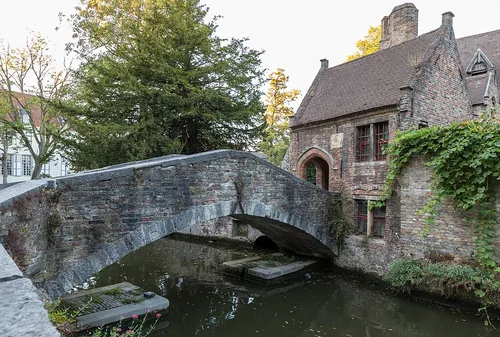
    Bonifacius Bridge

    Bonifacius Bridge in Bruges, stop 7 on the self-guided walking tour

    Not every stop needs a chapter. The Bonifacius Bridge is a small public bridge between the Groeninge Museum and the Church of Our Lady, free to cross. You are across in about a minute.

    Pause in the middle anyway: it links the paintings you have just seen with the church ahead, whose tower waits only 50 metres on.

    Hours
    Daily: 07:00–20:00
    Price
    Free
  8. 8

    Church of Our Lady

    Church of Our Lady in Bruges, stop 8 on the self-guided walking tour

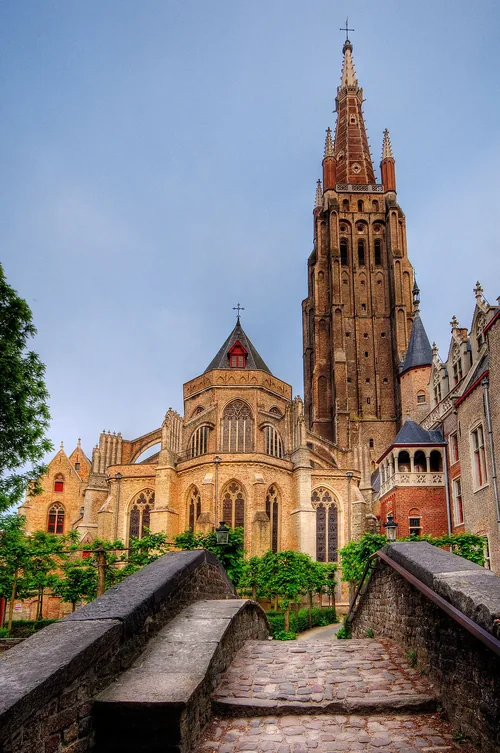
    The Church of Our Lady dates mainly from the 13th, 14th and 15th centuries. Its tower, 115.6 metres high, is still the tallest structure in Bruges and the third tallest brick church tower in the world, after St. Mary's in Lübeck and St. Martin's in Landshut. Outside, look at the flying buttresses, built in the 1270s and 1280s.

    Inside, the nave has cross vaults and a black and white tiled floor, while the side aisles and chancel turn heavily ornamented Baroque. One chapel was created in 1482 for the wealthy Lodewijk van Gruuthuse as his private place of worship.

    The great treasure stands in the large chapel of the southern aisle: a white marble Madonna and Child by Michelangelo, made around 1504, set in an 18th-century Baroque altarpiece. Behind the high altar lie Charles the Bold, last Valois Duke of Burgundy, and his daughter Mary, both crowned, in gilded bronze on polished black stone. Charles wears full armour and the Order of the Golden Fleece; around Mary's tomb, made by Jan Borman, runs a genealogy, and glass over the tomb openings lets you see the frescoes on the walls beneath. The heart of Philip the Handsome is buried here, while the rest of him lies in Granada, and Mary Lovel, founder of the English convent in Antwerp, was laid to rest by the high altar in 1628.

    The church itself is free; the museum section with the Madonna and the tombs charges admission. To stand in front of a Michelangelo in Bruges, that ticket is money well spent. Afterwards it is 370 metres, about 5 minutes, to De Halve Maan Brewery.

    Local name
    Onze-Lieve-Vrouwekerk
    Hours
    Mon–Sat: 09:30–17:00 | Sun: 13:30–17:00
    Price
    Church free; museum section (Michelangelo's Madonna and Child, tombs) 10 EUR, under 26 9 EUR, under 18 5 EUR, under 13 free
  9. 9

    De Halve Maan Brewery

    De Halve Maan Brewery in Bruges, stop 9 on the self-guided walking tour

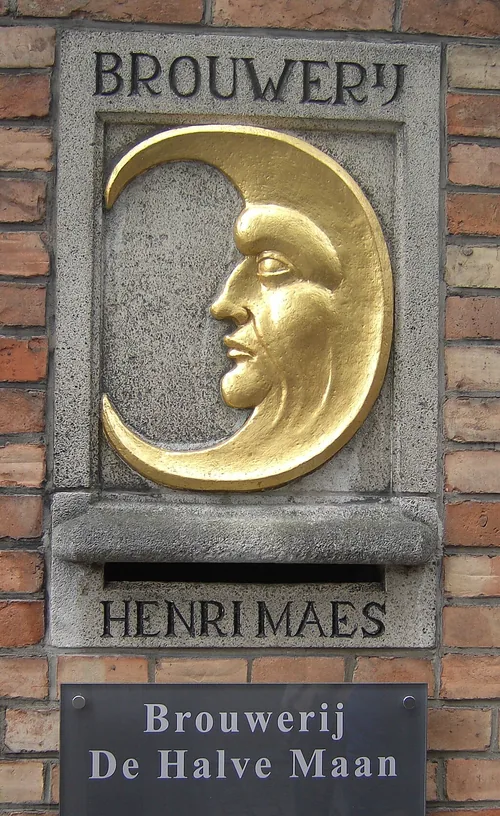
    De Halve Maan has been a family brewery since 1856 and is run today by the sixth generation. Brewing on this spot goes back further: the city register mentions a brewery called Die Maene on the Walplein as early as 1564, though nobody knows what happened in the centuries after.

    In 1856 Henri Maes bought the site and, with help from his uncle, Canon Petrus-Johannes Maes, turned Die Maene into a modern brewery called De Halve Maan, the Half Moon. The beer back then was cloudy, kept only briefly and went out to the inns in wooden barrels. After his death in 1867 his sons Henri II and Achère took over. Henri II learned new techniques in English breweries, built a malt house on the site and brewed stout and pale ale; in the 1880s a steam boiler let the brothers keep up with rising demand.

    When the brothers died in the early 20th century, their widows ran the brewery until Henri III became manager in 1919. He studied German brewing, came back around 1927 with bottom fermentation, built a cooling plant and began brewing bock, which lifted sales. Soon the brewery also made cola, lemonade and water, delivered by its own horse carts.

    The guided tours are paid: the standard tour includes one tasting, the XL tour three. Tour times you find out at the brewery. If you like beer and a family story, this is a good break from churches. The Begijnhof is 340 metres, about 5 minutes, further on.

    Local name
    Brouwerij De Halve Maan
    Price
    16 EUR standard tour (incl. 1 beer tasting); children 7-15: 8.50 EUR, under 6: free; XL tour 26 EUR (incl. 3 tastings, weekends only)
  10. 10

    Begijnhof

    Begijnhof in Bruges, stop 10 on the self-guided walking tour

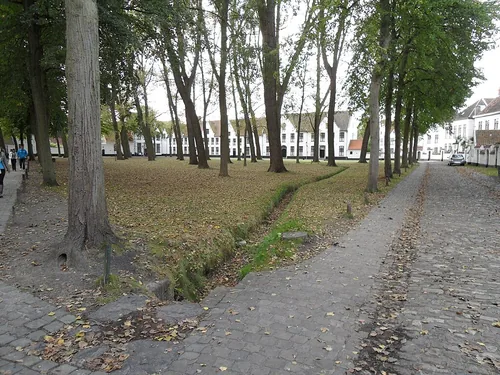
    The Begijnhof is the quiet stop of the route. Entry to the grounds is free; only the small Begijnhuisje museum charges admission, which you pay at the door. The courtyard is open during the daytime and the gates close between sunset and sunrise, so do not leave it too late.

    Come in March or April and you find daffodils here in numbers worth planning around.

    Use it as your pause: what follows is the longest leg of the walk, 790 metres, about 11 minutes, through streets with no stop in between, to St. Saviour's Cathedral.

    Hours
    Courtyard open during daytime; gates close between sunset and sunrise
    Price
    Free (only the small Begijnhuisje museum charges admission)
  11. 11

    St. Saviour's Cathedral

    St. Saviour's Cathedral in Bruges, stop 11 on the self-guided walking tour

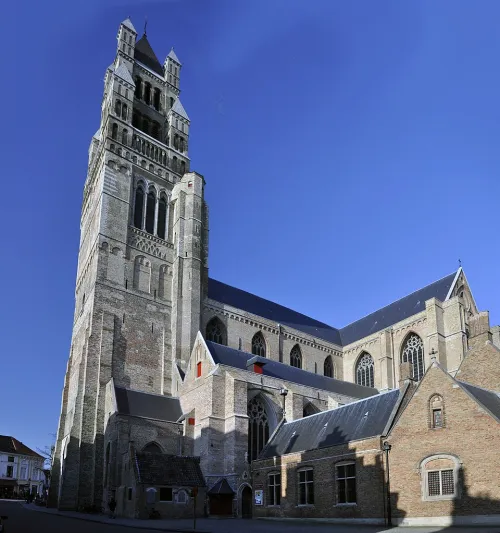
    St. Saviour's Cathedral, dedicated to the risen Saviour and Saint Donatian of Reims, is the main church of Bruges, yet it was never built to be a cathedral. From the 10th century it was an ordinary parish church; the cathedral then was St. Donatian's on the Burg, opposite the City Hall. After a fire in 1116, work on a larger Romanesque church began in 1127, and the present church was started in 1250, taking about a century.

    It is one of the few buildings in Bruges to have come through the ages without damage, though not without changes. At the end of the 18th century the French occupiers expelled the bishop and destroyed St. Donatian's, the cathedral whose foundations lie under the Burg. In 1834, soon after Belgian independence, a new bishop was installed and St. Saviour's became the cathedral, even though it looked smaller and less imposing than the nearby Church of Our Lady.

    The answer was meant to be a taller tower. After the roof collapsed in a fire in 1839, the English architect Robert Chantrell, known for neo-Gothic restorations of English churches, was asked to restore the church and to design a tower that would rise above the Church of Our Lady. On the oldest surviving part, the 12th-century base, he chose a very personal Romanesque design instead of neo-Gothic. Look up and compare it with the brick tower you saw earlier, which still holds the height record.

    Entry is free, so step inside before you finish. This is where the walk ends.

    Local name
    Sint-Salvatorskathedraal
    Hours
    Mon–Fri: 10:00–13:00, 14:00–17:30 | Sat: 10:00–13:00, 14:00–15:30 | Sun: 14:00–17:00
    Price
    Free
Walking tour route map of Bruges Route loaded
Market SquareBelfry of BrugesBurg SquareBasilica of the Holy Blood+7
All 11 stops are already on the map.
You just press start.
AI Tour Guide

You've read the route. Now walk Bruges with a guide in your ear.

Press start wherever you are, even hundreds of kilometres from Bruges, and the guide begins telling its stories right away. In the city, pick any of the 11 stops to start from: it leads you there, then talks with you the whole route, asking, listening, remembering, and shaping the tour around your answers.

11stops 2.6km 35 minwalking 13languages
▶Start the tour free

Free to start · Runs in your browser · No app, no download

Shorter Ways to Walk Bruges

Not everyone has a whole day. These cuts keep the walk in order and simply start or stop at a different place.

The old centre for a first look

Stops: 1, 2, 3, 4, 5

For a short stopover: Market Square to the Rozenhoedkaai, 510 metres and about 8 minutes on foot. The Belfry is the only real ticket here; the basilica is free and its treasury optional.

From the Markt to Michelangelo

Stops: 1, 2, 3, 4, 5, 6, 7, 8

For art lovers who skip the beer and the quiet end: 1,080 metres and about 16 minutes of walking. Paid options are the Belfry, the basilica treasury, the Groeninge Museum and the museum section of the Church of Our Lady.

The southern half

Stops: 6, 7, 8, 9, 10, 11

If you already know the Markt and the Burg: from the Groeninge Museum to the cathedral, 1,790 metres and about 25 minutes on foot. Entry costs come from the museum, the Michelangelo room and the brewery tour.

How Long Does This Bruges Tour Take with Visits?

Pure walking time is 35 minutes, and the legs are short: from the Markt to the Burg and on to the basilica you barely walk at all, and only the final stretch from the Begijnhof to the cathedral is noticeably longer.

Looking at every stop from outside and stepping into the free churches, two hours is comfortable. Each paid visit adds real time: the Belfry, the Groeninge Museum, the Michelangelo room and a brewery tour together turn the walk into a full day, so pick the one or two that match your interests. Each of the shorter versions fits into a morning or an afternoon even with an interior or two.

Before You Set Off in Bruges

  • Start: Market Square is the recommended start and the order here the recommended one, but you can join at any stop.
  • Finish: St. Saviour's Cathedral. The walk runs one way, not as a loop.
  • Best day and time: Start in the morning if you plan several interiors, so you have time for all of them and reach the cathedral while it is still open.
  • Costs: The walk itself costs nothing. Only the interiors charge entry, and children pay much less or nothing.
Walking tour route map of Bruges
AI Tour Guide

Your Bruges guide is ready when you are.

Press start and a voice AI Tour Guide takes it from here: leading the route through Bruges, telling the stories, and turning your walk into a real back-and-forth conversation. No app or download is needed; it runs in your browser.

11stops 2.6km 35 minwalking 13languages
▶Start the tour free

Free to start · Runs in your browser · No app, no download

What the AI Tour Guide Adds on This Route

This route jumps between counts, crusaders, French looters, painters and brewers. The AI Tour Guide leads you through it as a conversation: it greets you on the Markt, tells the stories at each place, asks what caught your eye and remembers it, so by the Church of Our Lady it knows whether you want more art or more power politics. Wonder what life inside a béguinage was like, or how the Flemish Primitives got their colours so bright, and it takes the conversation there; you can interrupt it at any time. Route, map and GPS navigation stay free; the guide starts with 100 free credits, then €19.99 for this tour with no time limit, or €5 per hour.

A Real Conversation A voice AI Tour Guide greets you, leads the whole route, and tells the stories and facts as you walk, asking what you want to see and keeping a real conversation going. Not a recording you press play on.
Map Navigation Follow the route on the map and walk at your own pace. You choose where to start and when to move to the next stop.
Ask Anything Curious about a building you pass? Ask your AI Tour Guide on the spot and the conversation carries on.
13 Languages Switch language anytime. No separate tour needed.
Start free in your browser

Common Questions about Bruges on Foot

Can I walk this route in the evening?

The Markt, the Burg and the Rozenhoedkaai are open around the clock, so the outside views work at any hour. The interiors are a daytime affair, so plan any visits inside for earlier in the day.

How do I get back to the Market Square from the cathedral?

If you want, the GPS navigation in your browser leads you from St. Saviour's Cathedral back to the start.

Where else can I walk from Bruges?

Ghent is 39 km away and has its own walking route, as do Ostend at 21 km and Lille at 64 km. For a longer day, Antwerp and Brussels each have one too.

Is the tour really free?

Yes. The whole tour is free: the route, the interactive map and the navigation cost you nothing. Only the voice AI Tour Guide is optional and paid: you test it with 100 free credits, then you pay either €5 per hour or €19.99 for this whole tour, with no time limit. Admission to 3 of the 11 stops is not included: Belfry of Bruges, Groeninge Museum and De Halve Maan Brewery charge their own entry fees.

Do I need to download an app?

No. Everything runs in your phone browser. Open the route and start walking, no download and no sign-up required.

Do I need to book the walking tour in advance?

No booking needed. This self-guided tour is available anytime. Open the route in your browser and start walking. The AI Tour Guide works instantly, no app, no reservation required.

What languages is the AI Tour Guide available in?

The AI Tour Guide speaks 13 languages, so you take the tour in your own language and can switch at any time.

Can I skip stops or change the route?

Yes. Skip any stop, spend extra time at places you like, or start the route from any point. It is your walk, you set the pace.
Image credits
▶ Start free in your browser Runs in your browser, no app, no download