Free Walking Tour Ghent: Three Towers to the Graslei

Start under the cathedral tower, stand before the Van Eyck panels, pass the counts' castle and finish on the bridge where Ghent's three towers line up.

9 Stops 1.7 km ~23 min walking
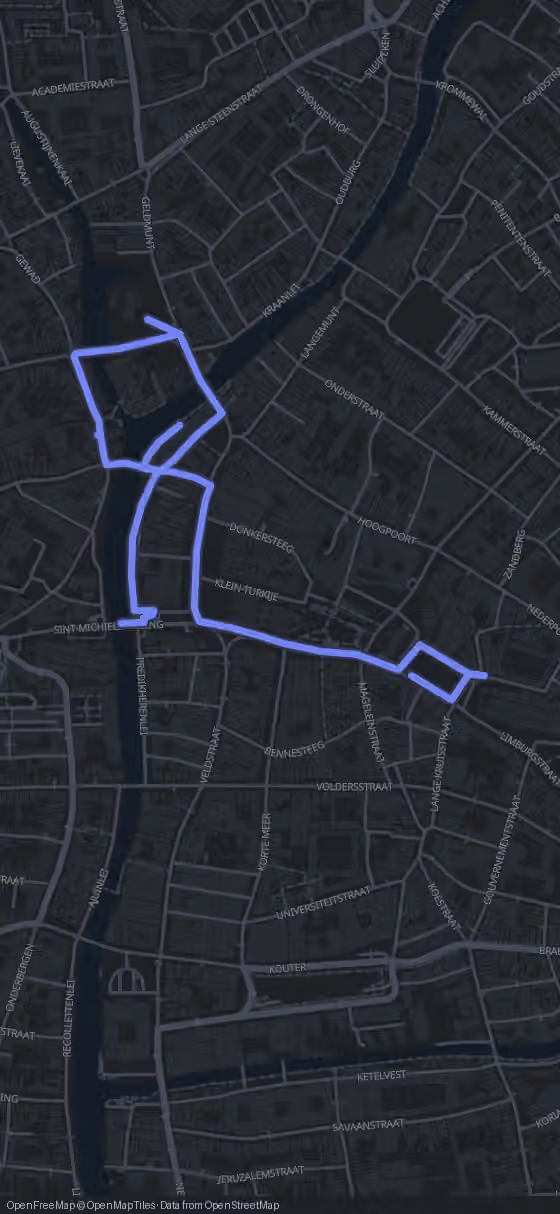
Route map for the Ghent walking tour
Stop 1 of 9
110 m·1 min
Saint Bavo's Square
Head east toward the Ghent Altarpiece
Welcome to Ghent. I'm Alex, and one medieval castle was built to frighten people inside the city, not beyond it.
Try this tour with Alex

This Ghent Route at a Glance

Nine stops lead from Saint Bavo's Square to Saint Michael's Bridge: 1.7 km and 23 minutes of pure walking. With the Ghent Altarpiece, the Belfry of Ghent and Gravensteen Castle seen from inside, plan about four hours.

The squares, the waterfront and St. Nicholas' Church are free; those three sights charge admission. Route, map and GPS navigation in your browser cost nothing, and the AI Tour Guide can come along if you want the stories told as you walk.

Open free GPS & optional AI Tour Guide
This short shows highlights of the route. All 9 stops follow below.

The Route

Walking Map of Ghent, Cathedral to Canal

9 stops 1.7 km 23 min walking
Tap to load interactive map

The 9 stops along this route

  1. Saint Bavo's Square in Ghent, stop 1 on the self-guided walking tour
    1Saint Bavo's Square
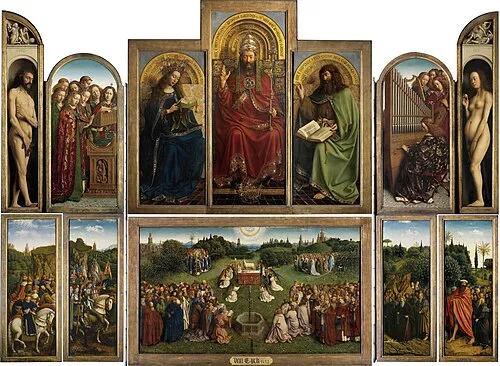
  2. Ghent Altarpiece, stop 2 on the self-guided walking tour
    2Ghent Altarpiece
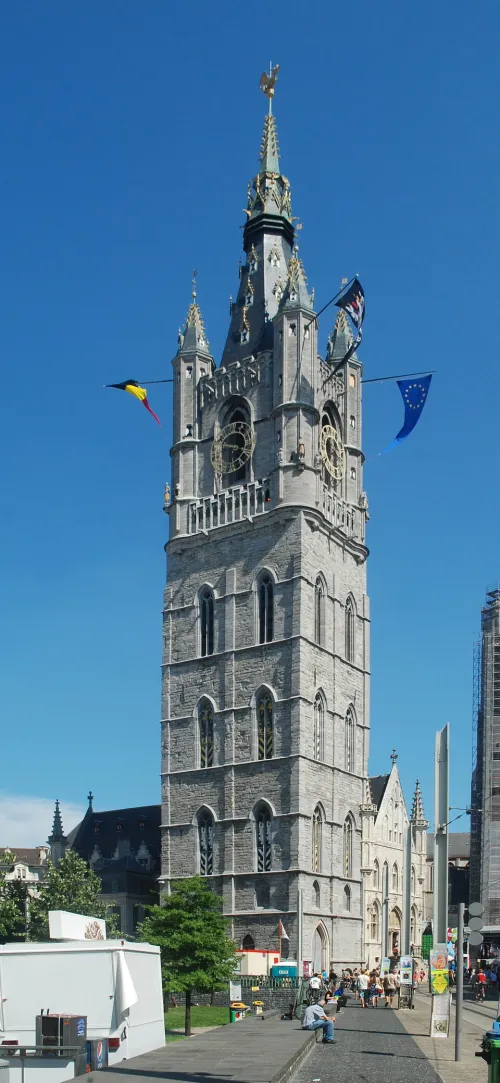
  3. Belfry of Ghent, stop 3 on the self-guided walking tour
    3Belfry of Ghent
  4. St. Nicholas' Church in Ghent, stop 4 on the self-guided walking tour
    4St. Nicholas' Church
  5. Groot Vleeshuis in Ghent, stop 5 on the self-guided walking tour
    5Groot Vleeshuis
  6. Gravensteen Castle in Ghent, stop 6 on the self-guided walking tour
    6Gravensteen Castle
  7. Design Museum in Ghent, stop 7 on the self-guided walking tour
    7Design Museum
  8. Graslei Waterfront in Ghent, stop 8 on the self-guided walking tour
    8Graslei Waterfront
  9. Saint Michael's Bridge in Ghent, stop 9 on the self-guided walking tour
    9Saint Michael's Bridge
  10. That's the full route.

    Walk it with an AI Tour Guide talking you through every one of these streets.

    Start free in your browser
    You made it

Your Ghent Walking Tour, Nine Stops in Order

  1. 1

    Saint Bavo's Square

    Saint Bavo's Square in Ghent, stop 1 on the self-guided walking tour

    You start on Saint Bavo's Square, the open paving in front of St Bavo's Cathedral. Look up and turn around once: two of the three towers that shape Ghent's skyline stand within a minute of you, the cathedral's own and the Belfry's on this same square. The third belongs to St. Nicholas' Church, a short walk further on. Keep that picture in mind, because the walk keeps circling those three towers and the final stop shows all of them in one frame.

    The square is public and free at any hour. The opening times you see posted around here belong to the cathedral, not to the square.

    Before you move, settle one thing: the Ghent Altarpiece inside works with timed tickets, and in high summer the good slots are gone days ahead. Book yours now, standing here, then walk the 110 metres, about two minutes, to the cathedral entrance and the panels.
    Local name
    Sint-Baafsplein
    Price
    Free
  2. 2

    Ghent Altarpiece

    Ghent Altarpiece, stop 2 on the self-guided walking tour

    Inside St Bavo's Cathedral waits the reason many people come to Ghent at all: the Adoration of the Mystic Lamb, Het Lam Gods in Dutch. It is a huge folding polyptych, begun in the mid 1420s and finished by 1432, attributed to the brothers Hubert and Jan van Eyck. Some call it the first major oil painting, and it marks the moment where medieval art turns towards the Renaissance.

    Read it in two rows. Up top sits God, flanked by the Virgin Mary and John the Baptist, then angels making music, and on the outer edges Adam and Eve. Below, saints, sinners, clergy and soldiers gather around the Lamb of God under the dove of the Holy Spirit. When the wings are closed you see a different world: the Annunciation, prophets and sibyls, two painted stone figures of the two Saints John, and the donors Joost Vijdt and his wife Lysbette Borluut, who paid for it all.

    Who painted what is still open. Hubert most likely designed the structure before 1422 and Jan painted the panels, but nobody has convincingly separated their hands; Jan may simply have finished what his brother began.

    You choose between the panels alone, a 25 minute visit, or the slightly pricier AR tour plus the panels, which takes 60 minutes. If you only go inside once on this walk, make it here. Back outside, the Belfry is just 100 metres away, a one minute walk.

    Local name
    Het Lam Gods
    Hours
    Panels/Lam Gods visible 10:15–17:15; visitor centre/ticket area Mon–Sat 10:00–17:00, Sun 13:00–17:00. Last AR tour slot 16:00.
    Price
    12.50 EUR (Lam Gods Only, 25 min) up to 16 EUR (AR tour + Lam Gods, 60 min)
  3. 3

    Belfry of Ghent

    Belfry of Ghent, stop 3 on the self-guided walking tour

    The Belfry is the middle of Ghent's three towers and, at 91 metres, the tallest belfry in Belgium. Together with its attached buildings it belongs to the Belfries of Belgium and France, a UNESCO World Heritage Site. Look for the gilded dragon at the very top. Legend says it was brought from Bruges, but it was made in Ghent and placed up there in 1377.

    Building started in 1313 to a design by master mason Jan van Haelst, whose plans still survive in the Ghent City Museum. Wars, plagues and political turmoil kept interrupting the work until 1380. The top has been rebuilt again and again, partly to fit more bells: a Baroque spire was drawn in 1684 but never built, a spire followed in 1771, a cast iron neo-Gothic one in 1851, and between 1911 and 1913 the present stone spire, inspired by the original 14th century design.

    The tower was more than a clock. It was a fortified watchtower, it rang warnings, and it guarded the documents proving the city's privileges. Its alarm bell Roland arrived in 1325 and from 1378 also struck the hours, announced by three smaller bells: the ancestor of the carillon.

    The Belfry charges admission. It is worth it if bells and civic history interest you; otherwise the outside tells the story well. From here it is 200 metres, three minutes, to St. Nicholas' Church, passing the Belfort en Lakenhalle complex on the way.

    Local name
    Belfort van Gent
    Hours
    Daily 10:00–18:00 (last tickets 17:00); closed 24, 25 and 31 December and 1 January
    Price
    13 EUR; ages 19–25 6.50 EUR; ages 13–18 2.60 EUR; children up to 12 free
  4. 4

    St. Nicholas' Church

    St. Nicholas' Church in Ghent, stop 4 on the self-guided walking tour

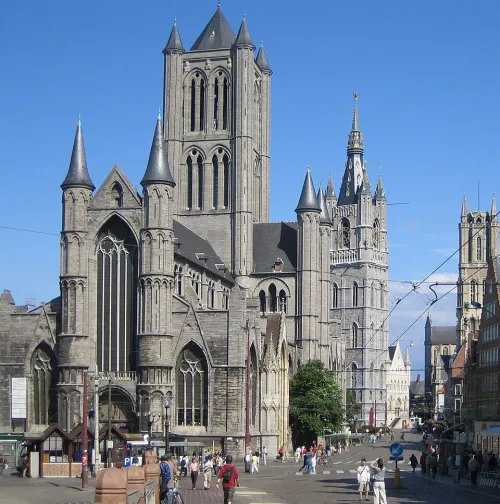
    St. Nicholas' Church is one of Ghent's oldest landmarks, begun in the early 13th century to replace a Romanesque church. Notice the blue grey stone from the Tournai area, the single big tower over the crossing and the slim turrets at the corners: the hallmarks of Scheldt Gothic, named after the nearby river.

    It stands in the old trade centre beside the Korenmarkt, the wheat market, and the guilds who did business here loved it. They added their own chapels along the sides in the 14th and 15th centuries. The central tower, partly paid for by the city, was a lookout and carried the town bells until the Belfry took over.

    For centuries the building slowly decayed. Cracks were plastered over, windows bricked up to hold the walls, and in the 18th century little houses and shops were built against the crumbling facades. Interest returned around 1840, and around 1900 the houses came down and the long restoration began.

    Go in, it is free. Music lovers should look for the organ by the French builder Aristide Cavaillé-Coll, one of the most important Romantic organs in Belgium. Then walk 370 metres, five minutes, to the Groot Vleeshuis.

    Local name
    Sint-Niklaaskerk
    Hours
    Mon 14:30–17:00; Tue–Sun 10:00–17:00
    Price
    Free admission
  5. 5

    Groot Vleeshuis

    Groot Vleeshuis in Ghent, stop 5 on the self-guided walking tour

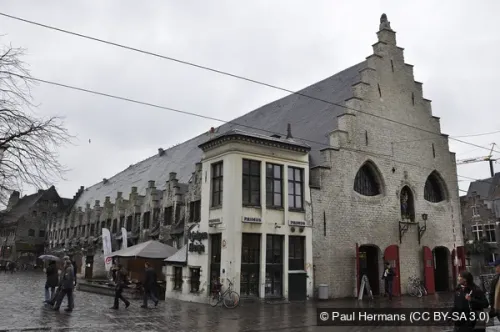
    The long Gothic hall of the Groot Vleeshuis was built between 1408 and 1417 as the covered meat market and guild house of Ghent's butchers. It is currently closed, so take it in from outside.

    In the Middle Ages meat could not be sold from home; every sale went through a meat hall where it could be controlled. Ghent's butchers had a hall here at the old fish market, today's Groentenmarkt, long before this building: a much smaller wooden house is mentioned in the 1330s and possibly as early as 1251. When it was falling apart around 1400, the guild had city architect Gillis de Suttere build a hall large enough to rent every member his own meat stall. Between 1446 and 1448 a chapel with a meeting room, dedicated to Saint Hubert, was added at one end.

    Look at the river side. Fish still had to reach the market, so four channels were built under the hall for the flat fish boats coming in from the Leie; their vaults are still clearly visible there. In 1543 sixteen small shops were added along the walls to sell offal, fat and poultry, which were not allowed inside. The hall stood empty by the end of the 19th century, when a new one was built elsewhere. Gravensteen Castle is 320 metres away, about four minutes on foot.

    Status
    Currently closed
  6. 6

    Gravensteen Castle

    Gravensteen Castle in Ghent, stop 6 on the self-guided walking tour

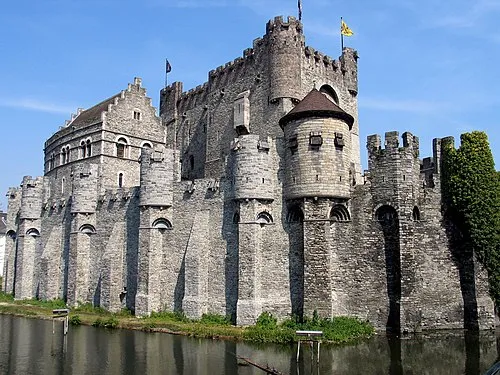
    The Gravensteen, the counts' stone castle, rises out of its moat fed by the Lys. Walk along the oval outer wall and count the small corner turrets: there are 24 of them, around a big central keep and a residence.

    The site between two branches of the river was fortified around 1000, first in wood, then in stone. The castle you see dates from 1180, built by Philip of Alsace after the earlier one burned around 1176, perhaps inspired by crusader castles he had seen on the Second Crusade. It was meant to protect the count and also to intimidate the burghers of Ghent, who often challenged his authority. A wolf's foot once nailed to the gate is the last known trace of the wolf in Flanders.

    The counts of Flanders lived here until 1353, when Louis of Male moved the court to the Hof ten Walle. Then the decline began: court and prison until the 18th century, the city's mint from 1353 to 1491, private houses built on the old walls, and during the Industrial Revolution even a cotton mill. At one point it was due to be demolished. The restoration of 1893 to 1903 saved it, and today it is a museum.

    The castle charges admission, and for families and anyone who likes castles this is the second inside visit to choose after the altarpiece. Then it is 260 metres, four minutes, to the Design Museum.

    Hours
    Open daily, last tickets at the counter at 16:40
    Price
    15 EUR (base price adults)
  7. 7

    Design Museum

    Design Museum in Ghent, stop 7 on the self-guided walking tour

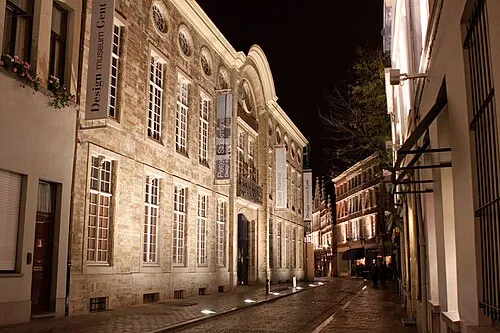
    Design Museum Gent is currently closed, but the building is worth a pause. It combines an 18th century mansion, the Hotel de Coninck on the Jan Breydelstraat, with a modern wing by architect Willy Verstraete that opened in May 1992.

    The museum began as a private initiative: in 1903 a group of design and art lovers founded an association and a museum of models, starting with about a hundred pieces of furniture plus ceramics, metalwork and textiles. Purchases at Ghent's 1913 World Exhibition made the collection outgrow its rooms, and in 1922 it moved into this mansion, which the city had bought shortly before.

    In the 1950s director Adelbert Van de Walle staged salons where local makers showed modern furniture in furnished rooms and took orders from visitors, a way to bring affordable design into homes. By 1958 the costs were too much for the association and the city took over. From here the Graslei is only 160 metres away, two minutes.

    Local name
    Design Museum Gent
    Status
    Currently closed
  8. 8

    Graslei Waterfront

    Graslei Waterfront in Ghent, stop 8 on the self-guided walking tour

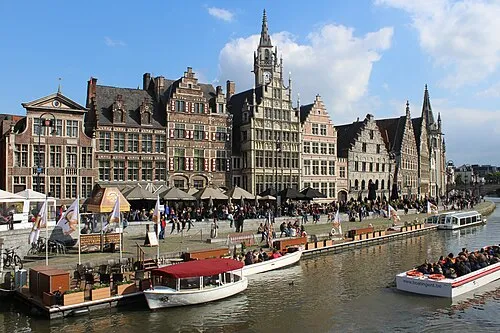
    The Graslei is the quay on one bank of the Leie, facing the Korenlei across the water. From the 11th century this was the city's port. Ghent held the grain staple right, so all grain imported into the County of Flanders had to pass through here, and these quays and the Korenmarkt became the centre of the Flemish grain trade.

    The houses along the water are survivors of that time, adapted in the 18th and 19th centuries and thoroughly restored for the 1913 World Exhibition. Walk the row and read it like a timeline. At number 10 stands the Korenstapelhuis, the grain store, originally from around 1200, with a staggered gable said to be the oldest of its type in the world. Number 9 is the first house of the grain measurers from 1435, number 11 a small toll house from 1682, and number 12 the grain measurers' second guild house from 1698, in Baroque style. The Gothic guild house of the Free Boatmen at number 14 dates from 1531. Number 8, the masons' guild house, is a 1912 reconstruction; the original stands elsewhere in the city.

    The whole scene of both quays has been protected since 1952, with the surrounding buildings added in 1994. Take your time here, it is free, then walk 180 metres, three minutes, to the last stop, Saint Michael's Bridge.

  9. 9

    Saint Michael's Bridge

    Saint Michael's Bridge in Ghent, stop 9 on the self-guided walking tour

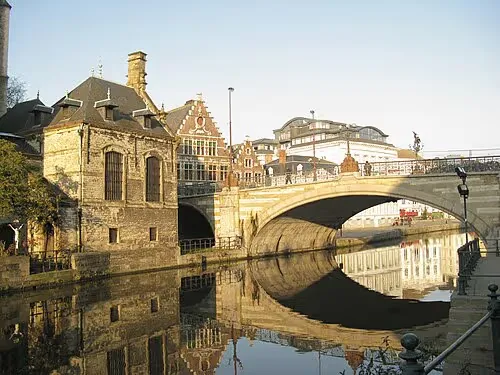
    You end on Saint Michael's Bridge, a stone arched bridge over the Leie. Look one way along the Graslei and the Korenlei with Gravensteen Castle in the distance. Turn the other way and there they are, the picture promised at the start: St. Nicholas' Church, the Belfry and St Bavo's Cathedral in a single line.

    The bridge was built between 1905 and 1909, after the Old Post Office beside it; both are the work of architect Louis Cloquet. Before that a flat swing bridge crossed here. St Michael's Church stands at the far end, and the bridge itself has been a protected monument since 1983.

    It is open at all hours and free, so come back in the evening if you like. From here the GPS navigation in your browser can take you back to Saint Bavo's Square, or you simply stay and let the three towers do the talking.

    Local name
    Sint-Michielsbrug
    Hours
    Open 24/7
    Price
    Free
Walking tour route map of Ghent Route loaded
Saint Bavo's SquareGhent AltarpieceBelfry of GhentSt. Nicholas' Church+5
All 9 stops are already on the map.
You just press start.
AI Tour Guide

You have the route. Now walk Ghent with a guide in your ear.

Press start wherever you are, even hundreds of kilometres from Ghent, and the guide begins telling its stories right away. In the city, pick any of the 9 stops to start from: it leads you there, then talks with you the whole route, asking, listening, remembering, and shaping the tour around your answers.

9stops 1.7km 23 minwalking 13languages
▶Start the tour free

Free to start · Runs in your browser · No app, no download

Shorter Ways Through Old Ghent

Not every day has room for three ticketed visits. These cuts keep the walk coherent and tell you what you pay.

Outside only, about an hour

Stops: 1, 2, 3, 4, 5, 6, 7, 8, 9

For a first look or a short stopover. You walk the full 23 minutes, see the cathedral, the Belfry and the castle from outside and step into St. Nicholas' Church, which is free. No tickets at all.

Van Eyck and the towers

Stops: 1, 2, 3, 4

For art lovers with a morning to spare. Six minutes of walking in total, with the Ghent Altarpiece and the Belfry of Ghent as the two paid visits and St. Nicholas' Church as a free finish. Count on a little under two hours.

Castle and waterfront

Stops: 6, 7, 8, 9

For families and anyone drawn to castles. Nine minutes of walking from Gravensteen Castle past the Design Museum to the Graslei and the bridge, with the castle as the only ticket. Just under two hours with a proper castle visit.

How Long Does This Ghent Walk Take with Tickets?

The walking itself takes 23 minutes, because the stops sit close together: the first three are barely a few minutes apart. The time goes into the visits. With the short altarpiece ticket, a visit inside the Belfry, a look into St. Nicholas' Church and a good hour and a quarter in the castle, you need about four hours; the AR tour at the altarpiece adds roughly half an hour.

A workable plan: be on the square at 10:00, take an early slot at the altarpiece, enter the Belfry around 10:40, reach St. Nicholas' Church before 11:30 and Gravensteen Castle shortly before noon. After the castle, the Design Museum, the Graslei and the bridge bring you to the end at about 13:50. The outside-only version fits into an hour; each of the two half routes takes a little under two hours.

Before You Set Off in Ghent

  • Start and finish: Saint Bavo's Square is the recommended start, but you can join at any stop. The walk ends on Saint Michael's Bridge; the GPS navigation in your browser leads you back to the start if you want.
  • Best day and time: A morning start suits the route best. Pick a day when the altarpiece and St. Nicholas' Church are both open early, since their opening times vary across the week.
  • Last entries: If you start in the afternoon, don't linger too long at the first stops, so you still get tickets for the Belfry, the castle and the AR tour at the altarpiece.
  • Costs: The walk is free. If you go inside everywhere it can, you pay for the altarpiece, the Belfry and the castle; St. Nicholas' Church charges nothing.
Walking tour route map of Ghent
AI Tour Guide

Your guide is ready when you reach Saint Bavo's Square.

Press start and a voice AI Tour Guide takes it from here: leading the route through Ghent, telling the stories, and turning your walk into a real back-and-forth conversation. No app or download is needed; it runs in your browser.

9stops 1.7km 23 minwalking 13languages
▶Start the tour free

Free to start · Runs in your browser · No app, no download

What the AI Tour Guide Adds Between the Towers

On this route the AI Tour Guide talks with you rather than at you. It greets you on the square, tells the stories of each place as you arrive, asks what caught your eye and remembers it: linger over the Van Eyck panels and it goes deeper into the painting, stop at the castle moat and the counts and their quarrels with the burghers take over. You can interrupt whenever a question comes up, in one of 13 languages. You start with 100 free credits; after that you choose between this tour all-inclusive for €19.99 with no time limit, or €5 per hour.

A Real Conversation A voice AI Tour Guide greets you, leads the whole route, and tells the stories and facts as you walk, asking what you want to see and keeping a real conversation going. Not a recording you press play on.
Map Navigation Follow the route on the map and walk at your own pace. You choose where to start and when to move to the next stop.
Ask Anything Curious about a building you pass? Ask your AI Tour Guide on the spot and the conversation carries on.
13 Languages Switch language anytime. No separate tour needed.
Start free in your browser

Common Questions Before Walking Ghent

Are there reduced tickets at the Belfry?

Yes. Children go in free, and teenagers and young adults pay a reduced price.

Can I do this walk over Christmas and New Year?

The walk itself, yes. The Belfry closes on some of the holidays, so check before you plan its visit.

Can I combine Ghent with another Flemish city?

Easily. Bruges is 39 km away and has its own belfry to compare, while Antwerp and Brussels each make a good second day.

Is the tour really free?

Yes. The whole tour is free: the route, the interactive map and the navigation cost you nothing. Only the voice AI Tour Guide is optional and paid: you test it with 100 free credits, then you pay either €5 per hour or €19.99 for this whole tour, with no time limit. Admission to 3 of the 9 stops is not included: Ghent Altarpiece, Belfry of Ghent and Gravensteen Castle charge their own entry fees.

Do I need to download an app?

No. Everything runs in your phone browser. Open the route and start walking, no download and no sign-up required.

Do I need to book the walking tour in advance?

No booking needed. This self-guided tour is available anytime. Open the route in your browser and start walking. The AI Tour Guide works instantly, no app, no reservation required.

What languages is the AI Tour Guide available in?

The AI Tour Guide speaks 13 languages, so you take the tour in your own language and can switch at any time.

Can I skip stops or change the route?

Yes. Skip any stop, spend extra time at places you like, or start the route from any point. It is your walk, you set the pace.
Image credits
▶ Start free in your browser Runs in your browser, no app, no download