The Route at a Glance: 15 Stops, 9.2 km, from the Vleeshuis to the Old Fortress
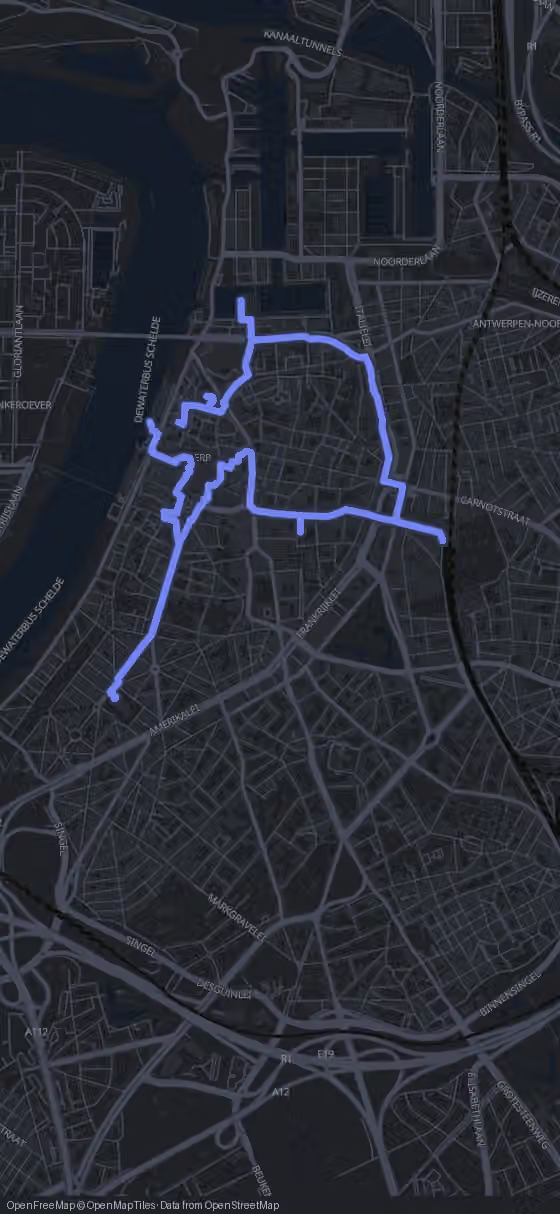
15 stops from the Great Butchers' Hall to Het Steen: 9.2 km with 2 h 6 min of pure walking. A short look at every stop takes about four and a half hours; with museums it becomes a full day, best split in two.
Your Antwerp Walking Tour, Stop by Stop: Guildhalls, Rubens and the Cathedral
1
Great Butchers' Hall
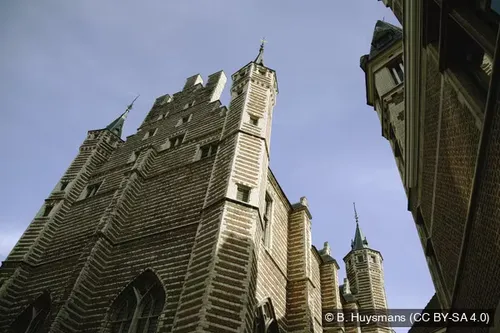
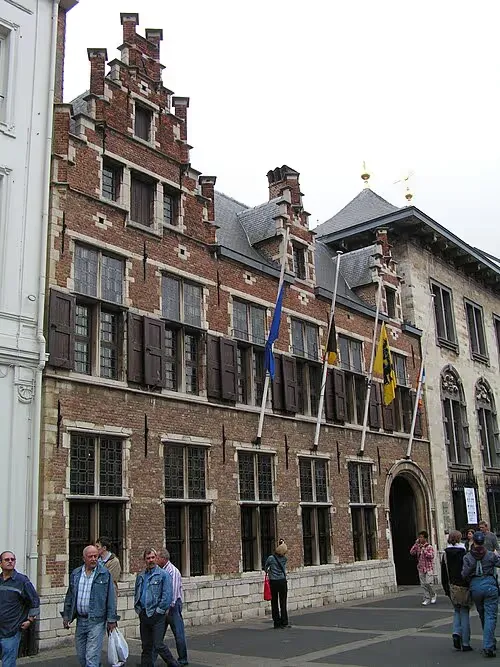
The walk opens at a former guildhall. The Great Butchers' Hall, in Dutch the Vleeshuis, literally the Meat House, belonged to Antwerp's butchers and later became a museum. The slope where Drie Hespenstraat meets Burchtgracht was once known as the Bloedberg, the Blood Mountain, a name that leaves little doubt about the trade practised here.
The museum is currently closed for restoration, with only occasional events, so this is an outside stop: take in the building from the surrounding streets, then walk 390 m, about 5 minutes, to St. Paul's Church.
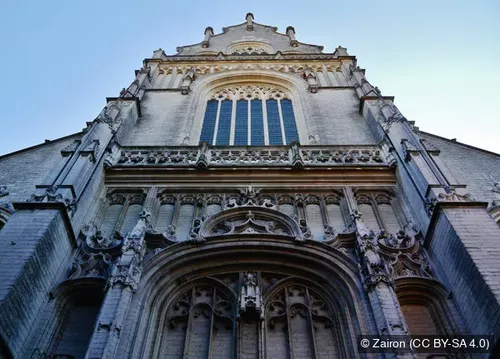
St. Paul's Church stands on the Veemarkt with a mainly Gothic body and a Baroque tower. Before you even go in, look at the Calvary outside: 63 life-size statues and nine reliefs, staged in a popular, almost theatrical style that was meant to move ordinary churchgoers.
Inside, the Baroque goes all the way. The walls carry paintings by Antwerp's leading artists, Peter Paul Rubens, Anthony van Dyck and Jacob Jordaens, among a wealth of sculpture and church furniture by Artus Quellinus the Elder, Pieter Verbrugghen I and other Antwerp sculptors. Entry is free, but the doors only open in the afternoon. If you love Baroque art, this is the best value on the whole route; on a morning walk you'll have to settle for the Calvary.
From here it's 950 m, 13 minutes, to the Museum aan de Stroom.
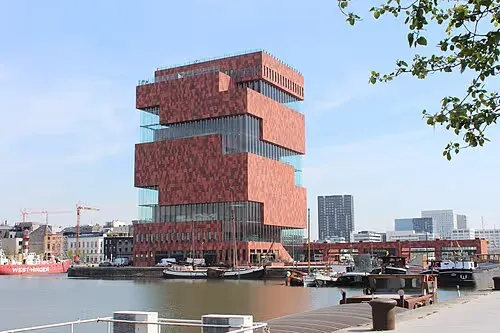
The MAS opened on 14 May 2011 and is about one theme: how Antwerp is tied to the rest of the world. Eight exhibition spaces draw on a collection of around 600,000 objects, telling the history of the port city, its trade and shipping, alongside art and culture from Europe, Africa, Asia, the Americas and Oceania.
The MAS charges admission. Go in if the port and world trade interest you and you can give it an hour and a half; if you're mainly here for Rubens and the old town, save your time for later.
Lunch in the docklands around the museum makes sense now, because the next leg is the longest of the day: 2,290 m, 32 minutes, to Antwerp Central Station.
Hours
Museum galleries Tue–Sun 10:00–17:00 (last admission 16:00); closed Mondays except Easter Monday and Whit Monday; closed 1 January, 1 May and 25 December; on 24 and 31 December closes at 15:00
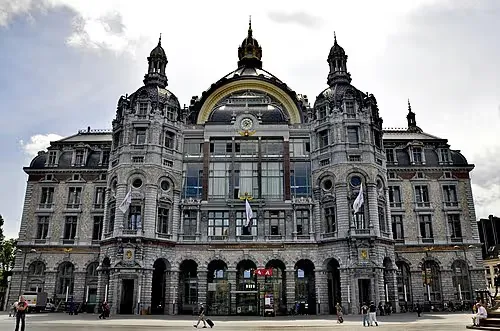
Antwerp Central Station on Koningin Astridplein goes by several names locally: Middenstatie, Centraal Station or simply the Spoorwegkathedraal, the railway cathedral. Stand in the hall and you'll understand the nickname.
From 1873 until early 2007 it was a terminus, where every train had to reverse to leave. On 23 March 2007 a tunnel with two through tracks opened beneath part of the city and the station itself, so trains now pass straight under the old hall.
The station is free to enter, and you can drop in at almost any hour. Rubens House is 940 m away, 13 minutes on foot.
This was Peter Paul Rubens's home in the city, on the Wapper, and it has been a municipal museum since 1946. Since 2024 your visit starts at Hopland 13, through a new building by the architects Robbrecht en Daem, so head there rather than to the old front door.
Rubens House charges admission, and if Rubens is the reason you came to Antwerp, this is the ticket to buy: you're walking through the place where he lived and worked. Allow about an hour.
Meir Shopping Street begins just 130 m away, 2 minutes on foot.
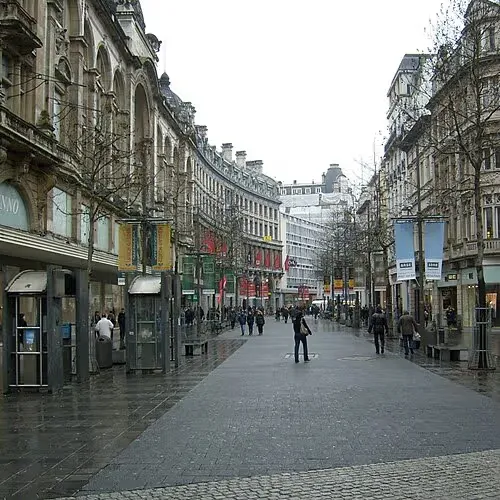
The Meir is one of Antwerp's main shopping streets. Together with De Keyserlei, Teniersplaats and Leysstraat it forms the link between the Central Station and the historic centre. It's free of cars, with the premetro running underneath, and lined with small shops as well as the big chains such as H&M, C&A and WE.
If you're not shopping, simply walk it and enjoy the breathing space; there's nothing to pay and nothing to queue for. From here it's 660 m, 9 minutes, to Hendrik Conscience Square.
Hendrik Conscience Square feels like a Baroque stage set, and that was the idea. The Jesuits encouraged the lavish style of the buildings around it as part of the Counter-Reformation, to draw people back into the churches. The showpiece is the Carolus Borromeus Church, once the Jesuit church; before 1883 the whole square was simply called the Jesuit Square.
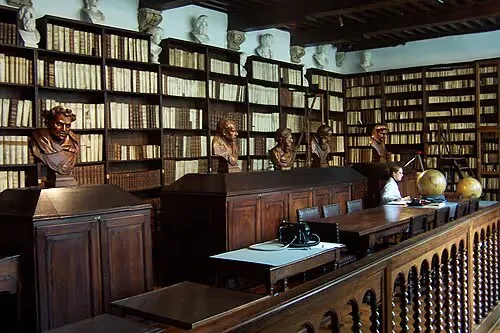
Since 1883 it has carried the name of the 19th century Flemish writer Hendrik Conscience, whose statue by Frans Joris stands here. In the same year the Hendrik Conscience Heritage Library moved into the former Sodality building.
The quiet you notice today has a story. In 1968 the action group VAGA, including the artists Hugo Heyrman and Panamarenko, staged a protest with blocks of ice; the city then redesigned the square without cars in 1972, its first car-free square. The job went to a young city architect, Dries Jageneau, who was himself a VAGA member.
Groenplaats Square is 370 m away, 5 minutes on foot.
Groenplaats Square is the green breather of the old town: trees, benches and café terraces around a statue of Rubens, designed by Willem Geefs in 1840 and unveiled in 1843. The south entrance of the Cathedral of Our Lady opens onto this square; you'll come back to the cathedral near the end of the walk.
Sit down for a moment if your feet need it, then continue 320 m, 4 minutes, to MoMu.
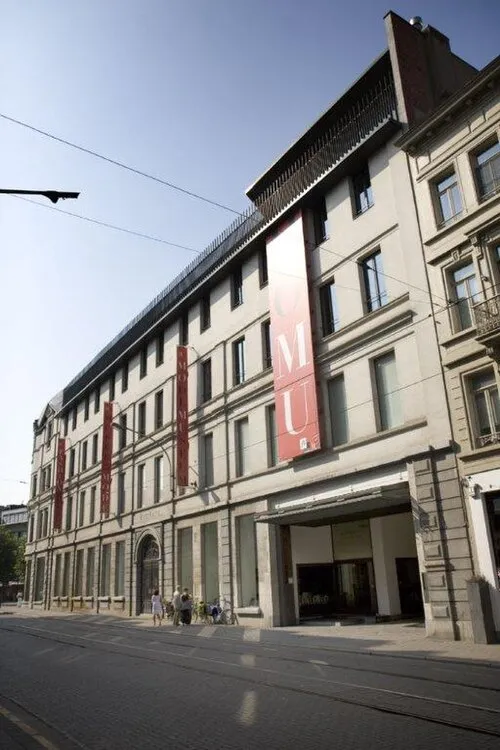
MoMu began life as the Provincial Costume and Textile Museum in Oelegem and has been in central Antwerp since 2002, in the ModeNatie building on Nationalestraat. It shares the house with the Flanders Fashion Institute and the Antwerp Fashion Academy, so this is the heart of the city's fashion scene.
The museum long focused on temporary exhibitions and had no room for its own large collection, so it closed in April 2018 for a thorough renovation. It reopened in September 2021, had to close again in January 2022 because of climate control problems, and finally reopened on 8 October 2022.
MoMu charges admission. Worth it if fashion is your thing; otherwise the building is enough. The Royal Museum of Fine Arts is 1,020 m away, 14 minutes on foot.
Local name
MoMu - ModeMuseum Antwerpen
Hours
Tue–Sun 10:00–18:00 (tickets sold until 17:00); closed Mondays; open on Easter Monday and Whit Monday; closed 1 January, 1 May and 25 December
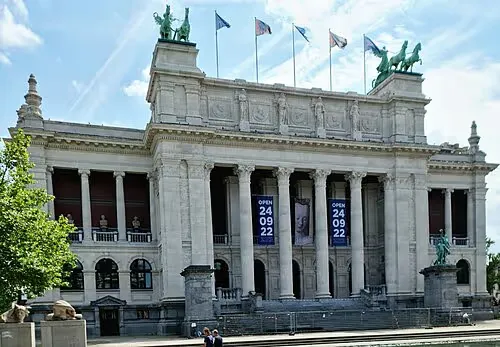
The KMSKA, as locals call the Royal Museum of Fine Arts, is the largest museum run by the Flemish Community. It sits in a stately building on Leopold de Waelplaats, begun in 1884 and finished in 1890 to designs by Jean-Jacques Winders and Frans Van Dijk.
The ticket is the most expensive on the route. It pays off if you have two hours and a real interest in art; on a tight schedule, admire the façade and keep your budget for Rubens House or the cathedral.
The next leg is 1,240 m, 17 minutes, back north to the Plantin-Moretus Museum.
Local name
Koninklijk Museum voor Schone Kunsten Antwerpen
Hours
Mon–Wed 10:00–17:00, Thu (KMSKA LAAT) 10:00–22:00 outside the summer and Christmas holidays, Fri 10:00–17:00, Sat–Sun and public holidays 10:00–18:00; closed Dec 25 and Jan 1
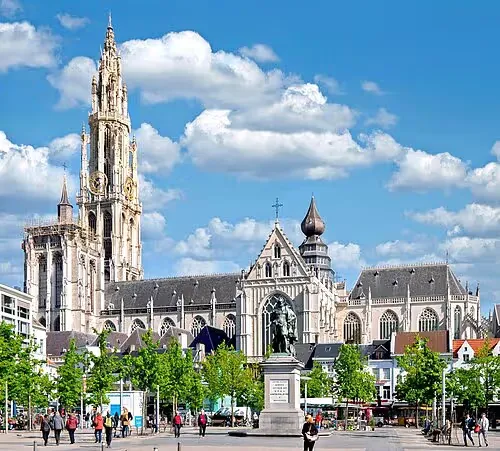
The Cathedral of Our Lady has three doors onto three different places: the main entrance faces the Handschoenmarkt, the south door Groenplaats Square and the north door the Torfbrug. It is the main church of the diocese of Antwerp, dedicated to Mary and known as the pilgrimage church of Our Lady of Antwerp. It was a cathedral from 1559 to 1803 and has been one again since 1961.
Its tower is one of 56 belfries in Belgium and France on the UNESCO World Heritage list, and the cathedral was the tallest building in Belgium until Brussels' Zuidertoren went up in 1967.
Going inside costs admission, and it's worth the ticket if you want to stand inside the church that topped the city for centuries.
Grote Markt is only 140 m away, 2 minutes on foot.
Local name
Onze-Lieve-Vrouwekathedraal
Hours
Mon–Fri 10:00–17:00, Sat 10:00–15:00, Sun 13:00–17:00; closed Jan 1 and on numerous exception days in 2026 (incl. Aug 15, Sep 1, Oct 2, Dec 20)
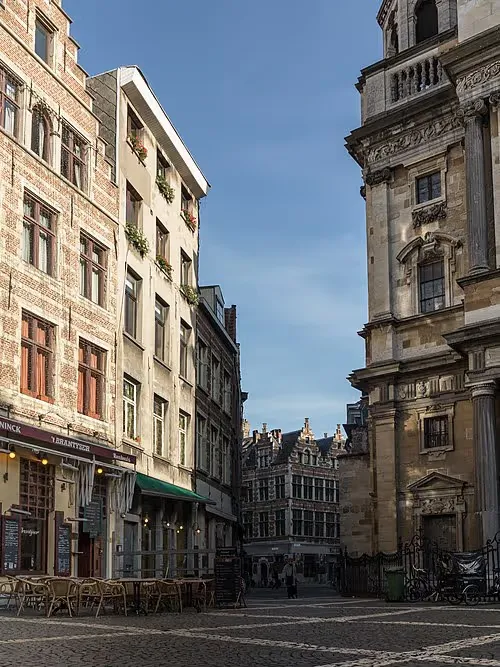
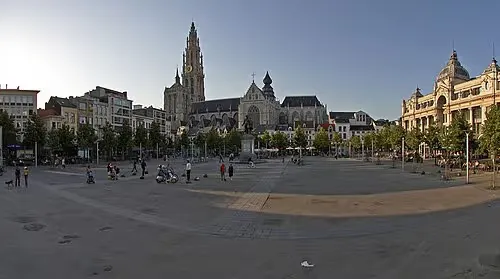
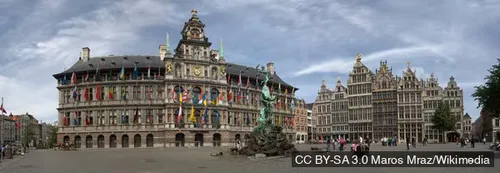
Grote Markt is the central square of the old city, framed by the Renaissance Town Hall and a row of guildhalls with elaborate façades. Look closely: most of them are reconstructions from the 19th and early 20th century, modelled on paintings of the square by Flemish artists. A few, like the façade of Sint-Joris, are genuine 16th century originals.
Every winter a Christmas market and an ice rink fill the square. For eating and drinking, look a street further away rather than at the terraces right here. DIVA is 130 m away, 2 minutes on foot.
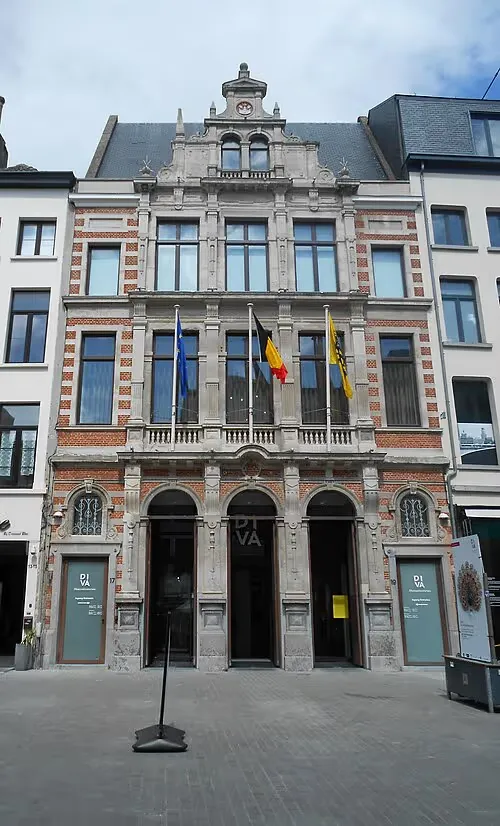
DIVA on the Suikerrui is Antwerp's museum of diamonds, silver and goldsmithing. It brought together the former Diamond Museum and the Silver Museum Sterckshof, which used to be elsewhere in the city. The name isn't an abbreviation; it's meant to make you think of a diva, a star.
DIVA charges admission. Go in if jewellery or the diamond trade fascinate you; otherwise carry on. The last leg is 290 m, 4 minutes, to Het Steen.
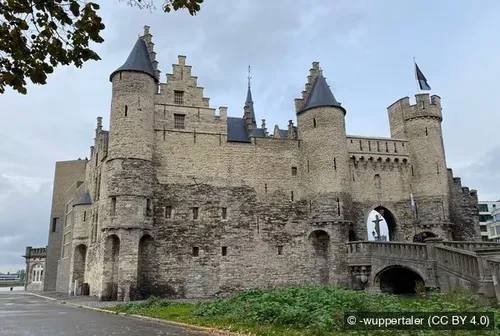
The route ends at Antwerp's oldest building. Het Steen was built between 1200 and 1225 as the gateway to a larger castle of the Dukes of Brabant, which was demolished in the 19th century. As the first stone fortification of the city, it stood at the core of the oldest settlement.
The name translates as "the rock", although the word's origin doesn't quite mean that. Het Steen is free, so if it's still open when you arrive, go in and finish your walk inside the walls where Antwerp began.
All 15 stops are already on the map. You just press start.
AI Tour Guide
You've read the Antwerp route. Now walk it with a guide in your ear.
Press start wherever you are, even hundreds of kilometres from Antwerp, and the guide begins telling its stories right away. In the city, pick any of the 15 stops to start from: it leads you there, then talks with you the whole route, asking, listening, remembering, and shaping the tour around your answers.
Free to start · Runs in your browser · No app, no download
Shorter Ways to Walk Antwerp
The full line is long, and the paid museums sit at both ends. These three cuts follow the same order and work on their own or as two halves of one longer visit.
Afternoon in the old port quarter
Stops: 1, 2, 3
For anyone who wants St. Paul's Church open and one big museum. Start in the early afternoon, when the church doors are open, and you have time for the Rubens and van Dyck paintings before the 13 minute walk to the MAS; just leave enough time to get there before last admission. Only 18 minutes of walking in total; St. Paul's is free, the MAS charges admission.
From the station to Het Steen
Stops: 4, 5, 6, 7, 8, 9, 10, 11, 12, 13, 14, 15
Ideal if you arrive by train: you begin inside Antwerp Central Station and walk 5.6 km, 1 h 17 min on foot, through the shopping streets, the squares and the old town to the fortress. Paid interiors on the way are Rubens House, MoMu, the Royal Museum of Fine Arts, the cathedral and DIVA; pick two at most if you want to finish relaxed.
The old town core in an hour
Stops: 12, 13, 14, 15
For a short visit or a first evening: the cathedral, Grote Markt, DIVA and Het Steen lie only 560 m apart, 8 minutes of walking. Het Steen is free; the cathedral and DIVA charge admission if you go in.
How Long Does This Antwerp Tour Take, With and Without Museums?
The 9.2 km take 2 h 6 min of pure walking. Most legs are short, often under five minutes; the big exception is the 2,290 m, 32 minute stretch from the MAS to Antwerp Central Station, and the museum detour south to the Royal Museum of Fine Arts adds two longer legs of 14 and 17 minutes.
Walked straight through with a few minutes at each stop, the route fills about four and a half hours. Each serious museum visit adds an hour or more: plan roughly an hour and a half for the MAS or the Royal Museum of Fine Arts, about an hour for Rubens House. With two interiors and a lunch break you're at about seven hours, and the cathedral, which doesn't stay open into the evening, comes late in the order. That is why the route works best in two parts: the old port quarter on one afternoon, the station to Het Steen on the next day.
The afternoon in the old port quarter needs 18 minutes of walking plus your time in St. Paul's and the MAS, around two and a half hours. From the station to Het Steen is 1 h 17 min on foot; with two interiors and lunch, plan around six hours. The old town core takes 8 minutes of walking and about an hour, more if you go inside the cathedral.
Before You Set Off in Antwerp
Start and finish: The recommended order begins at the Great Butchers' Hall and ends at Het Steen, but you can join at any stop and pick up the GPS route from there.
Best days: The paid museums don't all share the same rest day, and the cathedral keeps shorter hours at the weekend. Plan your day so the interiors you care about most are open.
Time of day: St. Paul's Church only opens its doors in the afternoon, so a morning start means you see it from outside. If its paintings matter to you, take the afternoon cut through the old port quarter.
Costs: Seven stops are free, and the closed Great Butchers' Hall and Plantin-Moretus Museum cost nothing to look at. Going into all six paid museums adds up quickly; most people choose one or two.
Frites, Coffee and Lunch: Food and Breaks Along the Route
Antwerp eats best a little away from the big squares: the docklands around the MAS for a relaxed lunch, the streets near the station for cheap Asian food, and the old town for frites, coffee and a beer at the end.
Het Eilandje waterfrontThe docklands around the MAS are trendy without being touristy: The Jane, Bistrot L'ilot, Fiskeskur, Bar Paniek and Felix Food Klub, whose harbourside patio looks at the MAS and serves tuna tartare with avocado and yuzu. The natural lunch stop before the long walk to the station. (Near Museum aan de Stroom (MAS))
ZilteChef Viki Geunes's restaurant with three Michelin stars sits at the top of the MAS building with panoramic views. Strictly a special occasion, not a quick refuel. (In Museum aan de Stroom (MAS))
ChinatownA real neighbourhood for authentic, inexpensive Asian food. Don't expect polished interiors; Fong Mei and Ni Shifu are the tips of chef Viki Geunes. (Near Antwerp Central Station)
The Chocolate LinePralines from the classic to the unusual, with a chocolate lab at the back. The sake-infused chocolate is the one to try. (Just off Meir Shopping Street)
Frites AtelierKorte Gasthuisstraat 32. Gourmet frites with toppings like stoofvlees, truffle mayo or curry ketchup. There's always a queue, but it moves fast, and the snack portion is good value.
Frituur No. 1Hoogstraat 1, the oldest frituur in Antwerp. A cone of frites with mayo, eaten standing, is the simplest lunch in town.
MadonnaA grand café during museum hours; in the evening it turns into a cocktail bar and fine dining restaurant. (Inside the Royal Museum of Fine Arts)
Rays Specialty CoffeeSleek, calm and serious about coffee, with rotating Nordic and European roasters and very good latte art. (Handschoenmarkt 13, in front of the Cathedral of Our Lady)
Cremerie GermaineOude Koornmarkt 3. Artisanal ice cream and sorbet; the speculoos flavour is the local favourite.
De MuzeA jazz café since the 1960s, brick-lined and laid-back, where musicians park their Belgian beers on the piano between sets. A good place to end the day. (Just off Grote Markt (Main Square))
Tourist Traps to Avoid in Antwerp, from Bolleke Prices to Fake Tickets
Terrace restaurants on the big squares: The restaurants spilling onto the squares in the centre are often overpriced and aimed at tourists. Genuine places such as Quinten Matsijs are close by. (Grote Markt (Main Square) and Meir Shopping Street)
Overpriced Bolleke: De Koninck's Bolleke in its round glass is Antwerp's signature beer. In tourist bars near the Grote Markt it can cost up to three times what you pay at the brewery or in local bars. (Around Grote Markt (Main Square))
Jenever served to the brim: The small glass of jenever filled to the very top looks harmless, but it's strong liquor. Sip it slowly.
Street ticket sellers: People with "Official Guide" badges sell discounted or skip-the-line tickets that may be fake, overpriced or for the wrong category. The MAS, the Royal Museum of Fine Arts and the cathedral sell tickets at their desks and on their official websites, so there's no reason to buy on the pavement.
Unlicensed taxis: Drivers without a licence wait outside the station and near the sights. Use the official taxi rank instead. (Outside Antwerp Central Station)
Phone on show: Keep your phone out of sight whenever you're not using it for the route. (Meir Shopping Street and around the Cathedral of Our Lady)
AI Tour Guide
Your guide is ready for Antwerp when you are.
Press start and a voice AI Tour Guide takes it from here: leading the route through Antwerp, telling the stories, and turning your walk into a real back-and-forth conversation. No app or download is needed; it runs in your browser.
Free to start · Runs in your browser · No app, no download
What the AI Tour Guide Adds on This Antwerp Route
The AI Tour Guide leads this walk as a conversation: it greets you at the Vleeshuis, tells the stories of each place, asks whether you came for Rubens, fashion, diamonds or the port, and remembers your answer so the later stops lean your way. Ask how the butchers' guild ran its trade, what working in the Plantin printing house was like or how a diamond travels from rough stone to ring, and it picks the thread up; you can interrupt whenever you like. The route stays as it is, and so does the free GPS navigation. You start with 100 free credits; after that you choose this tour all-inclusive for €19.99 with no time limit, or €5 per hour.
A Real Conversation
A voice AI Tour Guide greets you, leads the whole route, and tells the stories and facts as you walk, asking what you want to see and keeping a real conversation going. Not a recording you press play on.
Map Navigation
Follow the route on the map and walk at your own pace. You choose where to start and when to move to the next stop.
Ask Anything
Curious about a building you pass? Ask your AI Tour Guide on the spot and the conversation carries on.
13 Languages
Switch language anytime. No separate tour needed.
The outdoor part, yes: the Meir, Hendrik Conscience Square, Groenplaats Square and Grote Markt are open around the clock. Het Steen and the museums close before the evening, so after dark you see them from outside.
Are there discounts for young visitors?
Yes. Young visitors get into the MAS and MoMu free or at a reduced rate, the Royal Museum of Fine Arts has a cheaper ticket for young people, and the cathedral offers a reduced ticket too.
Where can I see Rubens without buying a ticket?
Inside St. Paul's Church, which is free in the afternoon and hangs paintings by Rubens next to van Dyck and Jordaens. On Groenplaats Square his statue stands in the middle of the trees.
Yes. The whole tour is free: the route, the interactive map and the navigation cost you nothing. Only the voice AI Tour Guide is optional and paid: you test it with 100 free credits, then you pay either €5 per hour or €19.99 for this whole tour, with no time limit. Admission to 6 of the 15 stops is not included: Museum aan de Stroom (MAS), Rubens House, MoMu Fashion Museum, Royal Museum of Fine Arts, Cathedral of Our Lady and DIVA Museum charge their own entry fees.
Do I need to download an app?
No. Everything runs in your phone browser. Open the route and start walking, no download and no sign-up required.
Do I need to book the walking tour in advance?
No booking needed. This self-guided tour is available anytime. Open the route in your browser and start walking. The AI Tour Guide works instantly, no app, no reservation required.
What languages is the AI Tour Guide available in?
The AI Tour Guide speaks 13 languages, so you take the tour in your own language and can switch at any time.
Can I skip stops or change the route?
Yes. Skip any stop, spend extra time at places you like, or start the route from any point. It is your walk, you set the pace.