Free Walking Tour Mechelen: Towers, Courts and Rubens

One loop through Mechelen: a cathedral tower planned at 167 metres, Margaret of Austria's Renaissance court, a Rubens triptych and the Kazerne Dossin memorial.

11 Stops 5.1 km ~1 h 9 min walking
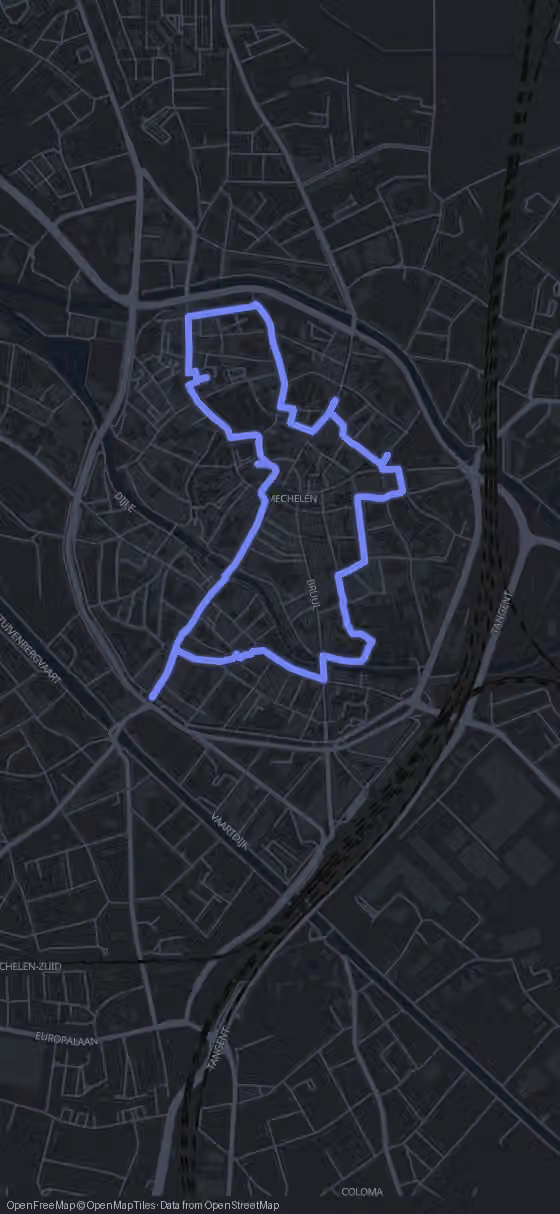
Route map for the Mechelen walking tour
Stop 1 of 11
990 m·12 min
St. Rumbold's Cathedral and Tower
Head south-west down the Hoogstraat toward the Brusselpoort, the only medieval gate left standing.
Welcome to Mechelen. I'm Alex, and this quiet city once helped shape the ruler of a continent-spanning empire.
Try this tour with Alex

Mechelen on Foot at a Glance

This loop links 11 stops, starting and ending at St. Rumbold's Cathedral and Tower. It covers 5.1 km with 1 h 9 min of pure walking. With church visits, a pause in the park and two museums, plan on about six and a half hours; without the museums, about four.

The cathedral, the churches and the park are free. You pay for the tower, the Hof van Busleyden Museum and the museum at the Kazerne Dossin Holocaust Memorial. The GPS route in your browser costs nothing; the AI Tour Guide is optional.

Open free GPS & optional AI Tour Guide
This short shows highlights of the route. All 11 stops follow below.

The Route

Walking Map of Mechelen: the 5.1 km Loop

11 stops 5.1 km 1 h 9 min walking
Tap to load interactive map

The 11 stops along this route

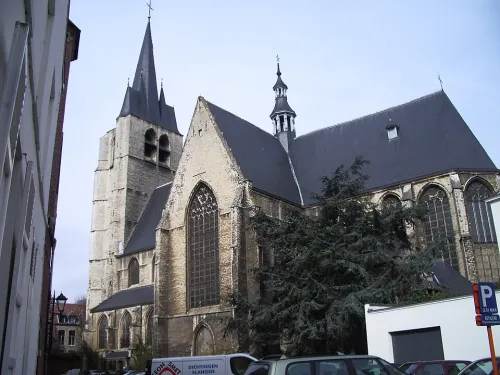
  1. St. Rumbold's Cathedral and Tower in Mechelen, stop 1 on the self-guided walking tour
    1St. Rumbold's Cathedral and Tower
  2. Brusselpoort in Mechelen, stop 2 on the self-guided walking tour
    2Brusselpoort
  3. Church of Our Lady across the Dyle in Mechelen, stop 3 on the self-guided walking tour
    3Church of Our Lady across the Dyle
  4. Kruidtuin Botanical Garden in Mechelen, stop 4 on the self-guided walking tour
    4Kruidtuin Botanical Garden
  5. Court of Margaret of Austria in Mechelen, stop 5 on the self-guided walking tour
    5Court of Margaret of Austria
  6. St. Peter and Paul Church in Mechelen, stop 6 on the self-guided walking tour
    6St. Peter and Paul Church
  7. Hof van Busleyden Museum in Mechelen, stop 7 on the self-guided walking tour
    7Hof van Busleyden Museum
  8. St. John's Church in Mechelen, stop 8 on the self-guided walking tour
    8St. John's Church
  9. Kazerne Dossin Holocaust Memorial in Mechelen, stop 9 on the self-guided walking tour
    9Kazerne Dossin Holocaust Memorial
  10. Sint-Katelijnekerk in Mechelen, stop 10 on the self-guided walking tour
    10Sint-Katelijnekerk
  11. Archbishop's Palace in Mechelen, stop 11 on the self-guided walking tour
    11Archbishop's Palace
  12. That's the full loop.

    Walk it with an AI Tour Guide talking you through every one of these streets.

    Start free in your browser
    You made it

Your Mechelen Walking Tour, from Cathedral to Archbishop's Palace

  1. 1

    St. Rumbold's Cathedral and Tower

    St. Rumbold's Cathedral and Tower in Mechelen, stop 1 on the self-guided walking tour

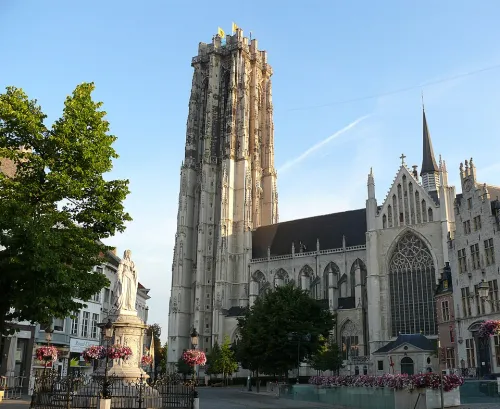
    Begin where Mechelen's skyline begins: St. Rumbold's Cathedral and its massive tower. Since 1999 the tower has been on the UNESCO World Heritage List as one of the Belfries of Belgium and France, recognised for its architecture and for its civic role as a watchtower. It belonged to the city as much as to the church: pilgrims paid for it first, and later the town itself, which owned it.

    Look up and picture what was planned. The builders aimed for 600 Mechlinian feet, about 167 metres, more than any church tower has ever reached. It went up between 1452 and 1520 on what had once been wetland, on foundations only three metres deep, and the site has held. Its chief architect, Andries I Keldermans, knew the risk of a sagging tower wrecking its church; on another of his projects that fear led to fully separate structures, a solution used here too.

    The church itself is older. Work started shortly after 1200 and it was consecrated in 1312, when part of it could be used. From 1324 the flying buttresses and the choir took on Brabantine Gothic features, distinct from French Gothic. After the city fire of 1342, master mason Jean d'Oisy led the repairs, and by his death in 1375 his work had become the prototype for that style. The nave vaults were finished by 1437, the choir vaults by 1451.

    Inside, find the shrine in the retro-choir. It holds the relics honoured as those of Saint Rumbold, the missionary and martyr who founded an abbey nearby. Modern examination showed a man of about 40 who died between 580 and 655, well before the traditional date of 775. The cathedral is free, so give it half an hour. The tower ascent is often not open yet in the morning, so keep it for later in the day.

    Right by the cathedral is the St. Rumbold's Tower Skywalk. From here the longest leg of the loop takes you 970 metres, about 14 minutes, to the Brusselpoort on the edge of the old centre.
    Local name
    Sint-Romboutskathedraal
    Hours
    Cathedral: Mon–Sat 08:30–17:30, Sun 13:00–17:30; Tower: Mon–Fri & Sun 13:00–18:00, Sat 10:00–18:00 (last ascent 17:00)
    Price
    Cathedral: free; Tower: 8 EUR adults, 6 EUR reduced / teachers, 3 EUR youth (4-27), 1 EUR UiTpas
  2. 2

    Brusselpoort

    Brusselpoort in Mechelen, stop 2 on the self-guided walking tour

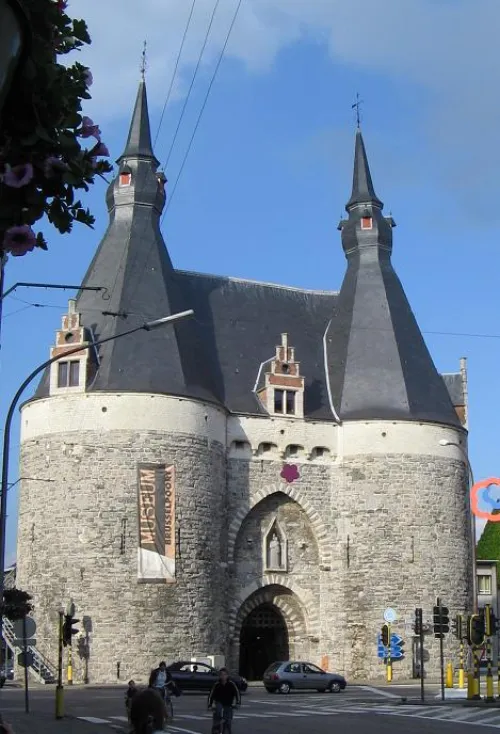
    The Brusselpoort is the last surviving city gate of Mechelen. It stands where the ring road crosses the Hoogstraat, right on the rim of the historic centre. The town walls were laid out between 1264 and 1268, and this 13th-century gate was the tallest of all the gates, which is why it was also called the Overste Poort.

    Look closely at the masonry. Around 1400 the gate was raised with a lighter-coloured stone, and the change is still visible against the older stone below. The style is Scheldt Gothic. In the 16th century the towers were lowered and the roof was rebuilt.

    Over the centuries the building served as a police office, a meeting room and the studio of the artist Alfred Ost, then as a museum of city history with documents and archaeological finds. Since 2010 it has been home to Het Firmament, a house for puppet theatre in Flanders. The interior is closed to visitors, so this is an outside stop: a few minutes is enough.

    When Mechelen tore down its walls, as most cities did, only this gate escaped. The open ground became boulevards that now form the R12, the small ring road, with the Brusselpoort sitting in the middle of the traffic. The Leien in Antwerp, the small ring in Brussels and the Ringvaart around Bruges all trace old walls the same way. From here it is 460 metres, about 6 minutes, to the Church of Our Lady across the Dyle.

    Hours
    Exterior view accessible 24/7 (interior closed to the public)
    Price
    Not accessible to public
  3. 3

    Church of Our Lady across the Dyle

    Church of Our Lady across the Dyle in Mechelen, stop 3 on the self-guided walking tour

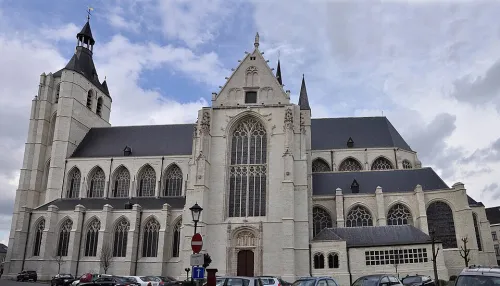
    Its local name, Onze-Lieve-Vrouw-over-de-Dijlekerk, simply means Our Lady across the Dyle. The parish was founded in 1236, the oldest mention of the church; before that its priest always came from the cathedral chapter. Nothing remains of the first building, which was probably lost in the city fire of 1342.

    What you see grew over three centuries. The oldest parts are the base of the tower, from the 14th century, and the facades of the aisles. The tower was raised in the early 15th century, the nave was completed between 1450 and 1480, the choir was begun in 1500, and the church was only finished towards the end of the 16th century. Like the cathedral, it is Brabantine Gothic. Look for the north portal, attributed to Rombout Keldermans; in the 17th century Jacob Franquart, architect of the Beguinage church, added three chapels.

    The 20th century hit this church hard. In 1914, during the German invasion, the south side was badly damaged. Then an Allied bombing raid on 19 April 1944, a storm on 7 September 1944 and a German V1 on 18 February 1945 largely destroyed the roof, the south transept facade, the windows and the organ.

    Between 1949 and 1952 the Mechelen architect Désiré Beeck restored the damaged parts. In 1953 the Royal Commission for Monuments and Sites judged that work sound but rejected his ideas for the next phase, and the dispute froze the restoration until 1961. Entry is free and the church is already open in the morning, so it suits an early visit; twenty minutes is enough for most visitors. Then walk 560 metres, about 7 minutes, to the Kruidtuin.

    Local name
    Onze-Lieve-Vrouw-over-de-Dijlekerk
    Hours
    Apr–Oct: Mon–Sat 10:00–17:00, Sun 13:00–17:00; Nov–Mar: Mon–Sat 10:00–16:00, Sun 13:00–16:00
    Price
    Free
  4. 4

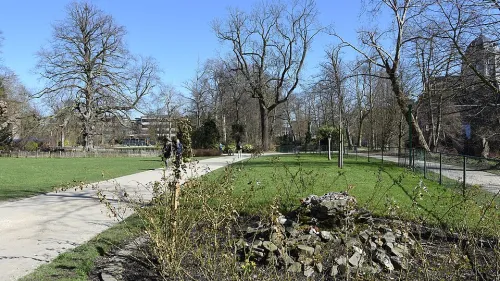
    Kruidtuin Botanical Garden

    Kruidtuin Botanical Garden in Mechelen, stop 4 on the self-guided walking tour

    The Kruidtuin, which locals call den Botanique, covers 30,640 m² and is the largest public park in Mechelen's historic centre. The main entrance is on the Bruul, and from inside you look out over the Binnendijle and the Fonteinbrug. It is free, a good place to sit for a while before the afternoon's visits.

    This ground has been a garden since the Middle Ages, first for the commandery of Pitzemburg. In 1580 Carolus Clusius planted potatoes here for the first time. After the knightly order was abolished, an English landscape garden was laid out in the 19th century for the members of the exclusive Société Royale d'Horticulture, and the public was let in only twice a week. The design you walk through dates from 1862 and is by Louis Fuchs; in 1912 the city took the park over and opened it to everyone.

    Take time for the trees. Some have reached monumental size: plane trees, beeches, a lime and a white horse chestnut. The real eye-catcher is a huge copper beech, cared for individually so it can live on as long as possible as a veteran tree. Among the exotic species are a Japanese walnut, an American oak and a magnolia.

    Look for the white marble statue of the botanist Rembert Dodoens by the Mechelen artist Jozef Tuerlinckx, unveiled in 1862; in 1980, 250 different herbs grew around it. In one of the beds stands the bronze group 'Young Girl with Greyhound' by Hendrik Van Perck. In summer the park hosts Parkpop, a series of free concerts. From here it is 810 metres, about 11 minutes, to the Court of Margaret of Austria.

    Hours
    Daily 09:00–21:00
    Price
    Free
  5. 5

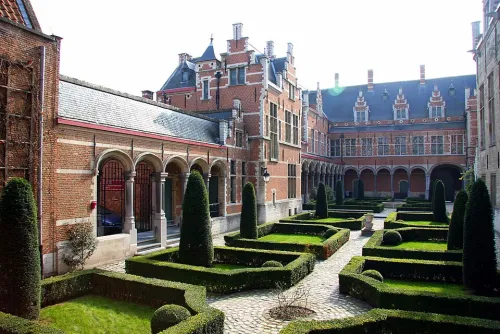
    Court of Margaret of Austria

    Court of Margaret of Austria in Mechelen, stop 5 on the self-guided walking tour

    The Court of Margaret of Austria, locally the Hof van Savoye, is one of the first Renaissance buildings in the Low Countries. Margaret governed the Netherlands from 1507 and lived in this palace until her death in 1530.

    It started as the town palace of the knight Hieronymus Lauweryn, her councillor and steward from a well-known humanist family. When his health failed, the house came to Margaret, but it soon proved too small. Rebuilding began in 1507, and a second campaign followed from 1517 under Rombout II Keldermans, who reshaped the side on the Keizerstraat.

    This was a European meeting place. Councillors such as Willem van Croÿ and Hendrik III of Nassau-Breda came here, and Albrecht Dürer, Erasmus and Thomas More were guests. In her library Margaret kept the Aztec treasures that Hernán Cortés had sent from the Americas.

    After her death the building lived several more lives. The explosion of the Zandpoort in 1546 damaged it. In 1561 it became the residence of Antoine Perrenot de Granvelle, the first archbishop of Mechelen and right hand of King Philip II, who stayed until 1565. In 1609 the city bought it back for the Great Council of Mechelen, the highest court of the Southern Netherlands, which moved in in 1616 and sat here until it was abolished in 1795. Between 1876 and 1885 the provincial architect Leonard Blomme 'improved' it in neo-Renaissance style, so look critically at what is original.

    Since the early 19th century it has been a courthouse, and it still is. The garden and the throne room are free to visit, and twenty minutes is enough. The next stop is just across the street: 160 metres, about 2 minutes, to St. Peter and Paul Church.

    Local name
    Hof van Savoye
    Hours
    Garden and Throne Room: Mon–Fri 08:00–16:00; Garden only: Sat 09:00–16:00; Sun closed
    Price
    Free
  6. 6

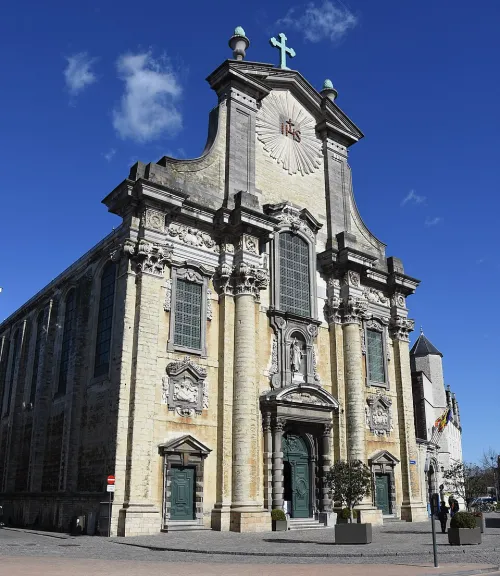
    St. Peter and Paul Church

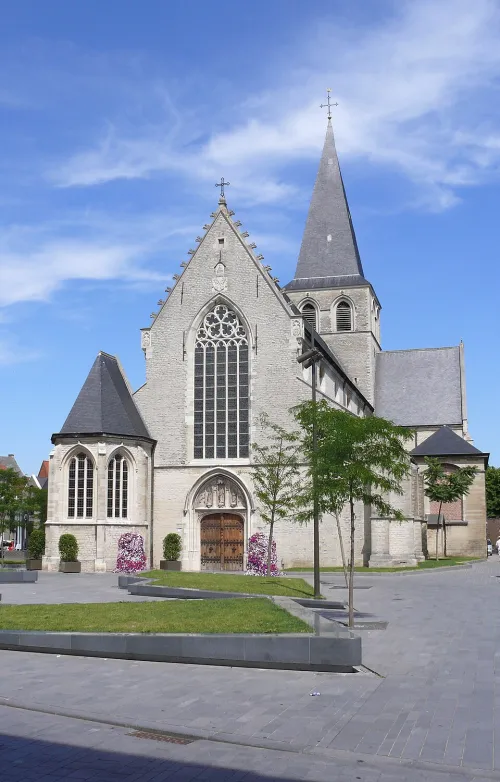
    St. Peter and Paul Church in Mechelen, stop 6 on the self-guided walking tour

    St. Peter and Paul Church on the Veemarkt is a Baroque Jesuit church, built between 1669 and 1694 to plans by the Jesuit Antoon Losson. Its official name is a mouthful: the Church of the Holy Apostles Peter and Paul visiting Saint Ignatius of Loyola and Saint Francis Xavier. Next to it stands the Hof van Kamerijk, once the residence of Margaret of York, and across the street the court of Margaret of Austria you have just seen.

    The money came from the Losson family, who had three brothers in the Jesuit order. In 1657 they proposed a second Jesuit church in Antwerp, but the city government and the chapter there blocked it, so the brothers Antoon and Andreas funded a church in Mechelen instead, where the Jesuits had been since 1580. Antoon designed it with help from the more experienced Willem van Hees, and the brothers helped lay the first stone in 1670.

    The facade was inspired by Jacques Francart's Jesuit church in Brussels. Look up at the top of the gable: added in 1709, it is the most original part of the design. The church came into use in May 1677 and was consecrated on 31 July 1694 by Archbishop Humbertus Guilielmus de Precipiano.

    When the Jesuit order was suppressed in 1773, many of its churches were torn down, but this one survived because it was handed to the parish in 1777. At the end of the 18th century the French turned it into a Temple of Reason; Napoleon's concordat reopened it for worship on 25 April 1802. In the high choir lie the entrails of Margaret of Austria, a quiet link to her palace across the street.

    The interior was thoroughly restored at the start of the 21st century. Entry is free. Then walk 340 metres, about 5 minutes, to the Hof van Busleyden Museum.

    Local name
    Sint-Pieters-en-Pauluskerk
    Hours
    Apr–Oct: Tue–Sun 13:00–17:00; Nov–Mar: Tue–Sun 13:00–16:00; closed Mon and 1 Jan, 24–25 & 31 Dec
    Price
    Free
  7. 7

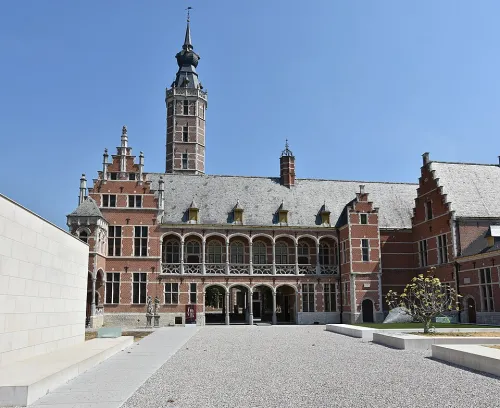
    Hof van Busleyden Museum

    Hof van Busleyden Museum in Mechelen, stop 7 on the self-guided walking tour

    The Hof van Busleyden is a town palace that has housed Mechelen's city museum since 1936, under the name Museum Hof van Busleyden since 2018. After a major restoration it reopened in spring 2024 with a new permanent display, replanted gardens and new temporary exhibitions. In 2025 it was announced that Flanders will take it over as part of the fine arts cluster of the KMSKA, under the new name Museum voor Schone Kunsten Mechelen, so you may come across both names.

    The museum tells the story of Mechelen in the Burgundian era, when the city was the capital of the Burgundian Netherlands. At the centre are the world of Hieronymus van Busleyden, born around 1470 and died in 1517, the governor Margaret of Austria, and the rich art of the 15th and 16th centuries.

    Two highlights stand out. One is a unique collection of Enclosed Gardens, the Besloten Hofjes. The other is the Mechelen Choirbook from Margaret's own collection, one of the finest and best-preserved music manuscripts of the 16th century. It was probably made between 1508 and 1519 in the Mechelen workshop of Petrus Alamire, copyist, singer, musician, composer and entrepreneur, for the Burgundian-Habsburg court. Its opening miniature most likely shows the young Charles V on a throne, surrounded by his brother and sisters.

    Also look for the religious sculpture by Maria Faydherbe, the oldest female sculptor known by name in European art history whose work survives. If Margaret's story caught you at the court, this is where it gets its depth: allow about 75 minutes. From here it is only 200 metres, about 3 minutes, to St. John's Church.

    Hours
    Wed–Sun 10:00–17:00, Mon–Tue closed
    Price
    15 EUR adult, 13 EUR youth (18-26) / Mechelen residents / groups (15+), 4 EUR youth (13-17) / disabled visitors, 3 EUR UiTpas, free children <= 12 and museumpas holders
  8. 8

    St. John's Church

    St. John's Church in Mechelen, stop 8 on the self-guided walking tour

    St. John's Church is a 15th-century Gothic church dedicated to both John the Baptist and John the Evangelist. A chapel to John the Baptist stood here as early as the 13th century and became a parish church in the same century. In the 14th century it gained a choir, a transept and aisles, and in the second half of the 15th century it grew into a full church, consecrated in 1483 by Bishop Hendrik van Bergen.

    Look at the spire: 55.5 metres high and ringed by four small turrets. According to tradition, it once crowned the tower of the cathedral.

    The church has had a rough history. The same Zandpoort explosion of 1546 that hit Margaret's court left it badly damaged. In 1566 iconoclasts plundered the interior, and in 1572 it even served as barracks for the troops of the Duke of Alba. From 1645 the Oratorians of the nearby monastery looked after it. In 1799, under French republican rule, the church was sold at public auction, but the buyer later gave it back. The exterior was restored first, and the interior restoration was completed in 2018.

    The reason to go inside is Peter Paul Rubens' Adoration of the Magi, the triptych on the high altar. The church council signed the contract with Rubens on 27 December 1616; he finished in 1617, retouching the painting himself on site. The price of 1,800 guilders was paid in instalments until 1624. Entry is free, and fifteen minutes in front of the Rubens is time well spent. Then walk 540 metres, about 7 minutes, to the Kazerne Dossin Holocaust Memorial.

    Local name
    Sint-Janskerk
    Hours
    Apr–Oct: Tue–Sun 13:00–17:00, Mon closed; Nov–Mar: Tue–Sun 13:00–16:00, Mon closed
    Price
    Free
  9. 9

    Kazerne Dossin Holocaust Memorial

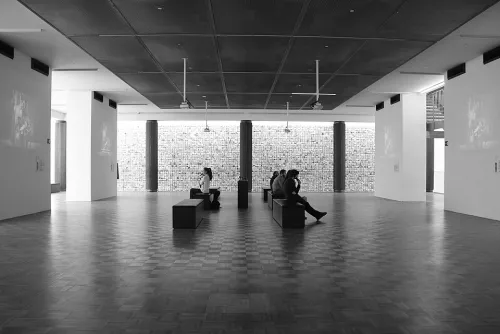
    Kazerne Dossin Holocaust Memorial in Mechelen, stop 9 on the self-guided walking tour

    This stop changes the tone of the walk. Between July 1942 and September 1944 the Dossin Barracks, a former infantry barracks, served as SS-Sammellager Mecheln, a Nazi collection and deportation camp in occupied Belgium. From here 25,274 Jews and 354 Roma were transported to Auschwitz-Birkenau and other camps in the east. Two thirds were killed on arrival. By the liberation, only 1,395 of them had survived.

    After the war the barracks was partly converted into housing. The Flemish Government, the Province of Antwerp and the City of Mechelen bought the ground floor and basement of the right wing, and in 1995 the Jewish Museum of Deportation and Resistance opened there. It covered the rise of the extreme right in the 1930s, the antisemitic policies of the German occupiers, Jewish resistance and the hiding of children, and the convoys that deported Belgian Jews.

    Today the memorial is the only part of Kazerne Dossin inside the old barracks. The museum and documentation centre are in a new building across the square, decided on in 2001 and opened in September 2012 under the present name. The balance between remembering the Holocaust and documenting today's human rights violations is still discussed: in 2019 the general director Christoph Busch resigned because he felt the focus leaned too far towards the memorial.

    The memorial is free. The museum charges admission; give it at least 75 minutes, and allow yourself a quiet moment afterwards. Then walk 480 metres, about 6 minutes, to Sint-Katelijnekerk.

    Hours
    Mon–Tue & Thu–Fri 09:00–17:00, Sat–Sun 09:30–17:00, Wed closed
    Price
    Memorial: free; Museum: 12 EUR adult (permanent exhibition), 16 EUR combi (permanent + temporary), 10 EUR group (15+), 5 EUR / 6 EUR youth (9-21) / students, free under 9 and museumpas holders
  10. 10

    Sint-Katelijnekerk

    Sint-Katelijnekerk in Mechelen, stop 10 on the self-guided walking tour

    Sint-Katelijnekerk, the church of St. Catherine, is a Gothic basilica that began as a chapel. That chapel was enlarged between 1279 and 1285 and became a parish church in 1305. The present church dates from 1336 and was consecrated in 1343; its Gothic shows the influence of the Scheldt and Dender styles.

    The choir, the transept and the top of the facade date from the 15th century, the time of Pope Nicholas V. Look for the papal coat of arms above the entrance, which marks that period. The plan is a cross-shaped basilica with three aisles, a square crossing tower, two side chapels and a baptismal chapel, all standing on a double plinth of sandstone.

    In the second half of the 16th century the church suffered badly at the hands of Spanish troops and the Geuzen; it was restored and reconsecrated in 1585. Later centuries kept changing it: Isabella Danesin had the St. Joseph Chapel built on the north side in 1643, a Baroque portal was inaugurated in 1659, and in 1771 the wooden vaults were replaced with brick. The church was sold publicly in 1797 and reopened in 1804, and the St. Anthony Chapel on the south side followed in 1834.

    In the last quarter of the 19th century Ph. Van Boxmeer restored it completely, aiming for the original Gothic look, which meant removing the Baroque portal and other additions. A further restoration followed in 1982 under the architect A. Roose. Entry is free. From here it is 380 metres, about 5 minutes, to the Archbishop's Palace.

    Hours
    Apr–Oct: Tue–Sun 13:00–17:00, Mon closed; Nov–Mar: Tue–Sun 13:00–16:00, Mon closed
    Price
    Free
  11. 11

    Archbishop's Palace

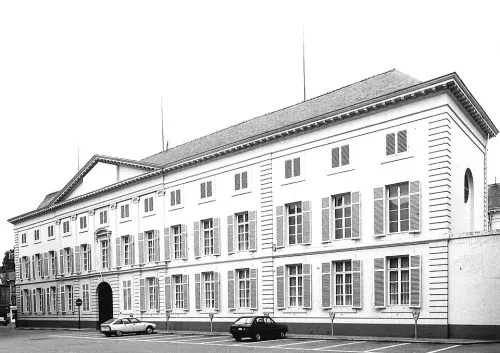
    Archbishop's Palace in Mechelen, stop 11 on the self-guided walking tour

    The Archbishop's Palace on the Wollemarkt, close to the cathedral, is the residence of the archbishops of Mechelen. The palace itself is closed to visitors and can only be seen inside by appointment, so you look at it from outside. The adjacent silence garden is free and open to visitors in season.

    What you see is classicism: sober facades, strong horizontal lines and three plastered, white-painted wings around a courtyard in a U-shaped plan. Cardinal Thomas Philippe d'Alsace had it built between 1719 and 1741 and chose an Italian architect, which explains the Italian influence. The layout follows the Barigioni plan of 1741.

    Before that, two patrician houses stood here, used as a refuge house of Affligem Abbey. After 1559, when the abbey was joined to the archdiocese, they became the archbishops' residence. The north wing was completed in 1779, but after the French Revolution the French occupiers sold the building as national property in 1798 and largely demolished the north wing and part of the east wing. Part of the palace even became a brewery.

    Between 1820 and 1823, under the United Kingdom of the Netherlands, the archdiocese got the palace back, and court architect Charles Vander Straeten restored it, giving the outer facades their late classicist look. Since 1832 it has been the archbishops' home without interruption; Engelbertus Sterckx was the first to move in after the rebuilding. From here it is only 170 metres, about 2 minutes, back to St. Rumbold's Cathedral, where the loop closes.

    Local name
    Aartsbisschoppelijk Paleis van Mechelen
    Hours
    Exterior view accessible 24/7 (interior closed to the public; adjacent palace silence garden open Wed/Sat/Sun seasonally)
    Price
    Free (silent garden), by appointment (interior)
Walking tour route map of Mechelen Route loaded
St. Rumbold's Cathedral and TowerBrusselpoortChurch of Our Lady across the DyleKruidtuin Botanical Garden+7
All 11 stops are already on the map.
You just press start.
AI Tour Guide

You've read the route. Now walk it with a guide in your ear.

Press start wherever you are, even hundreds of kilometres from Mechelen, and the guide begins telling its stories right away. In the city, pick any of the 11 stops to start from: it leads you there, then talks with you the whole route, asking, listening, remembering, and shaping the tour around your answers.

11stops 5.1km 1 h 9 minwalking 13languages
▶Start the tour free

Free to start · Runs in your browser · No app, no download

Shorter Ways to Walk Mechelen

Short on time or only interested in one side of the city? These three sections of the loop work well on their own.

Burgundian Mechelen in an afternoon

Stops: 5, 6, 7, 8

For anyone drawn to Margaret of Austria and the court era. Only 700 metres and about 10 minutes of walking. The Hof van Busleyden Museum is the one paid entry; the court garden and the two churches are free. Plan it for an afternoon when all four are open.

Gothic churches, the old gate and the park

Stops: 1, 2, 3, 4

For a relaxed morning with no tickets needed. About 2 km and 27 minutes of walking from the cathedral via the Brusselpoort and the Church of Our Lady across the Dyle to the Kruidtuin. Everything is free; only the cathedral tower costs extra.

Remembrance and the northern churches

Stops: 8, 9, 10, 11, 1

For visitors who want time at Kazerne Dossin. About 1.6 km and 20 minutes of walking from St. John's Church back to the cathedral. The memorial is free, the museum paid; plan at least an hour and a quarter there.

How Long the Mechelen Tour Takes, with and without Museums

The pure walking time is 1 h 9 min over 5.1 km, and most legs take under ten minutes; the longest is the first, 970 metres from the cathedral to the Brusselpoort. Realistically the whole loop takes about six and a half hours with the Hof van Busleyden Museum and the Kazerne Dossin museum, and about four hours if you only see the churches, the court and the park.

A day that works: cathedral at 10:30, Brusselpoort 11:14, Church of Our Lady across the Dyle 11:25, Kruidtuin 11:52 with a 40-minute pause, Court of Margaret of Austria 12:43, St. Peter and Paul Church 13:05, Hof van Busleyden Museum 13:30 for 75 minutes, St. John's Church 14:48, Kazerne Dossin 15:10 for 75 minutes, Sint-Katelijnekerk 16:31, Archbishop's Palace 16:51 and back at the cathedral at 16:58.

The shorter options: the Burgundian section needs about 10 minutes of walking plus museum time, the morning section with the gate and the park about 27 minutes, and the remembrance section about 20 minutes plus your time at Kazerne Dossin.

Before You Set Off in Mechelen

  • Start and finish: Start at St. Rumbold's Cathedral and Tower, where the loop also ends. You can join at any stop; this order is the recommended one.
  • Best day: Pick a day when everything is open. The Hof van Busleyden Museum, Kazerne Dossin, the Court of Margaret of Austria and several of the churches each have their own closing days.
  • Time of day: Start around 10:30. St. Peter and Paul Church, St. John's Church and Sint-Katelijnekerk only open in the afternoon, and the court closes before evening, so this order fits the day.
  • Costs: The route, the cathedral, the churches, the park and the court are free. Paid: the cathedral tower, the Hof van Busleyden Museum and the Kazerne Dossin museum, which charges extra for its temporary exhibition. The memorial itself is free.
Walking tour route map of Mechelen
AI Tour Guide

Your guide is ready whenever you set off.

Press start and a voice AI Tour Guide takes it from here: leading the route through Mechelen, telling the stories, and turning your walk into a real back-and-forth conversation. No app or download is needed; it runs in your browser.

11stops 5.1km 1 h 9 minwalking 13languages
▶Start the tour free

Free to start · Runs in your browser · No app, no download

What the AI Tour Guide Adds in Mechelen

On this loop the same names keep coming back: the Keldermans builders, Margaret of Austria, the 1546 explosion of the Zandpoort. The AI Tour Guide follows those threads as a conversation, notices whether Burgundian court life or wartime Mechelen holds your attention, and takes the story further in that direction; you can interrupt whenever you like. The free GPS route works without it. You start with 100 free credits; after that you choose this tour all-inclusive for €19.99 with no time limit, or €5 per hour.

A Real Conversation A voice AI Tour Guide greets you, leads the whole route, and tells the stories and facts as you walk, asking what you want to see and keeping a real conversation going. Not a recording you press play on.
Map Navigation Follow the route on the map and walk at your own pace. You choose where to start and when to move to the next stop.
Ask Anything Curious about a building you pass? Ask your AI Tour Guide on the spot and the conversation carries on.
13 Languages Switch language anytime. No separate tour needed.
Start free in your browser

Common Questions about Walking Mechelen

Are there reduced tickets for children, teenagers and students?

Yes. The Hof van Busleyden Museum, Kazerne Dossin and the cathedral tower all offer reduced tickets for young visitors and students, and young children go free at both museums.

What do the museumpas and UiTpas cover on this route?

With a museumpas, both the Hof van Busleyden Museum and the Kazerne Dossin museum are free. With UiTpas you pay a reduced price at Busleyden and for the cathedral tower.

Can I combine Mechelen with Antwerp or Brussels on the same day?

Mechelen lies 22 km from both Antwerp and Brussels. Without the museums the loop takes about four hours, which leaves room for a second city; with both museums, Mechelen fills the day.

What changes if I visit in winter?

The Church of Our Lady across the Dyle, St. Peter and Paul Church, St. John's Church and Sint-Katelijnekerk all close earlier. Visit the church interiors early in the afternoon and keep Kazerne Dossin for later, since it stays open longer.

Is the tour really free?

Yes. The whole tour is free: the route, the interactive map and the navigation cost you nothing. Only the voice AI Tour Guide is optional and paid: you test it with 100 free credits, then you pay either €5 per hour or €19.99 for this whole tour, with no time limit. Admission to one of the 11 stops is not included: Hof van Busleyden Museum charges its own entry fee.

Do I need to download an app?

No. Everything runs in your phone browser. Open the route and start walking, no download and no sign-up required.

Do I need to book the walking tour in advance?

No booking needed. This self-guided tour is available anytime. Open the route in your browser and start walking. The AI Tour Guide works instantly, no app, no reservation required.

What languages is the AI Tour Guide available in?

The AI Tour Guide speaks 13 languages, so you take the tour in your own language and can switch at any time.

Can I skip stops or change the route?

Yes. Skip any stop, spend extra time at places you like, or start the route from any point. It is your walk, you set the pace.
Image credits
▶ Start free in your browser Runs in your browser, no app, no download