Free Walking Tour Liège: From Saint-Martin to the Citadel

Start where Corpus Christi was first celebrated, cross the Meuse at its old bridge, browse a market from 1561 and finish on the Citadel, 111 m above the valley.

12 Stops 6.6 km ~1 h 34 min walking
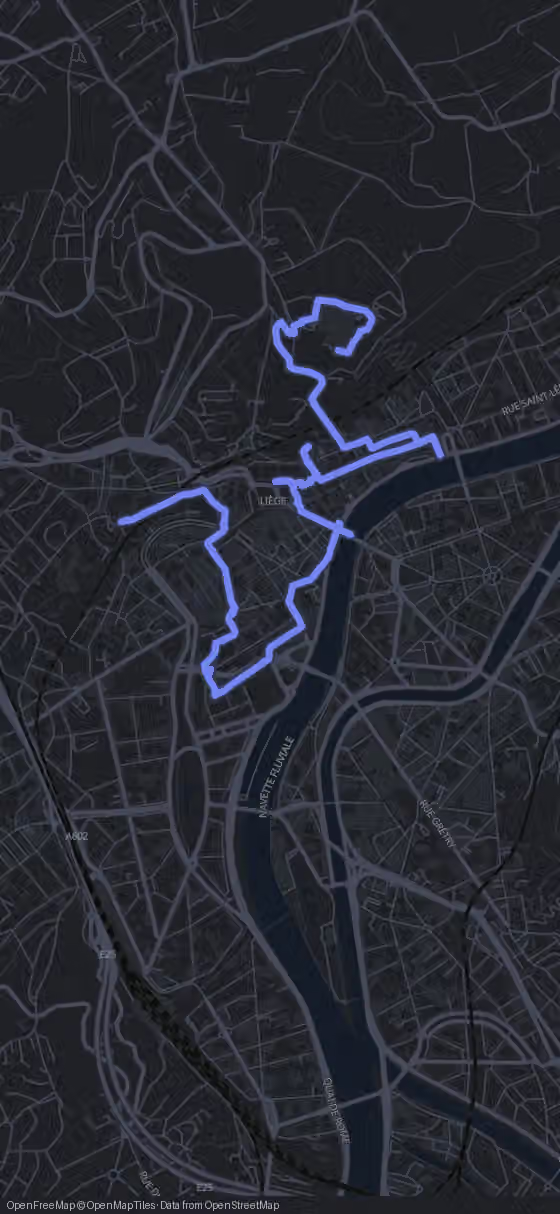
Route map for the Liège walking tour
Stop 1 of 12
1160 m·15 min
Saint-Martin's Basilica
Head south-east and downhill toward Saint Paul's Cathedral
Bonjour, welcome to Liège. I'm Alex, and one brutal staircase was designed to keep soldiers away from an ambush.
Try this tour with Alex

Liège on Foot at a Glance

Twelve stops take you from Saint-Martin's Basilica to the Citadel of Liège: 6.6 km, 1 h 34 min of pure walking, about four hours with short visits. Most stops are free; the Museum of Walloon Life, the Grand Curtius Museum and Saint Bartholomew's Church charge admission.

The route, map and GPS navigation from stop to stop run free in your browser. If you like, the optional AI Tour Guide walks with you as a conversation and tells the stories of each place.

Open free GPS & optional AI Tour Guide
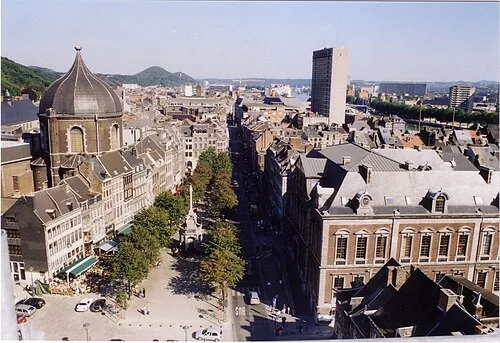
View of Liège

The Route

Walking Map of Liège: 12 Stops from Publémont to the Citadel

12 stops 6.6 km 1 h 34 min walking
Tap to load interactive map

The 12 stops along this route

  1. Saint-Martin's Basilica in Liège, stop 1 on the self-guided walking tour
    1Saint-Martin's Basilica
  2. Saint Paul's Cathedral in Liège, stop 2 on the self-guided walking tour
    2Saint Paul's Cathedral
  3. Saint James' Church in Liège, stop 3 on the self-guided walking tour
    3Saint James' Church
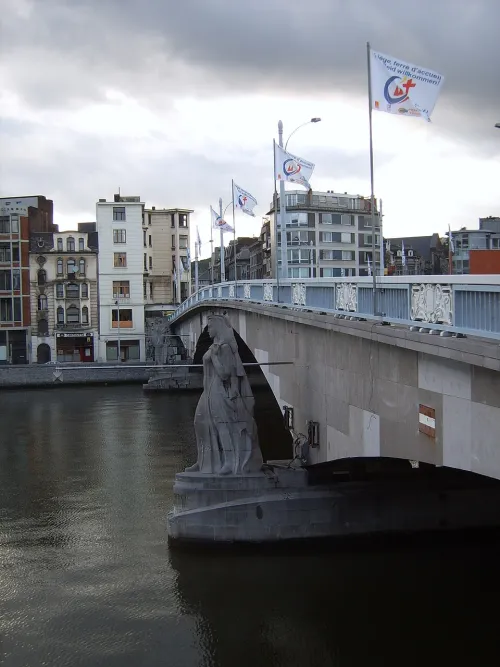
  4. Pont des Arches in Liège, stop 4 on the self-guided walking tour
    4Pont des Arches
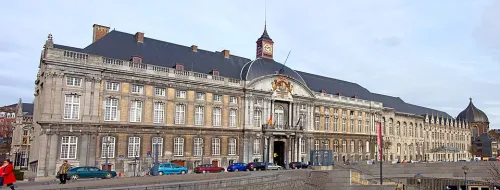
  5. Palace of the Prince-Bishops in Liège, stop 5 on the self-guided walking tour
    5Palace of the Prince-Bishops
  6. Place du Marché in Liège, stop 6 on the self-guided walking tour
    6Place du Marché
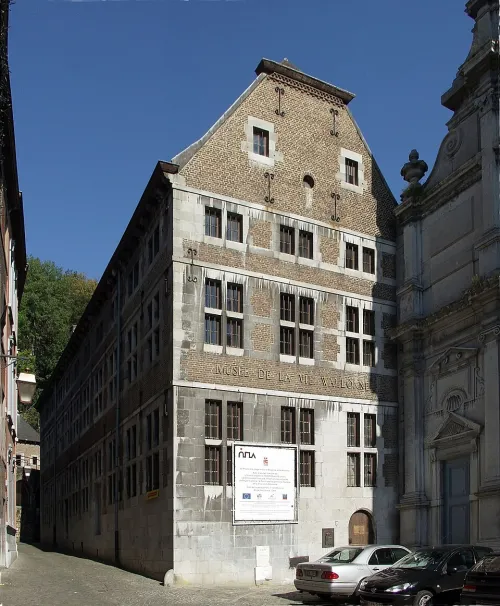
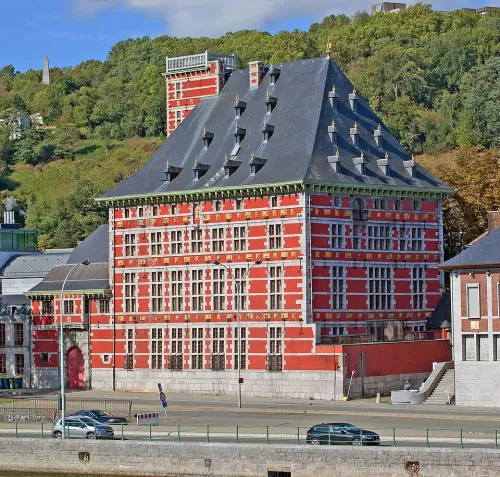
  7. Museum of Walloon Life in Liège, stop 7 on the self-guided walking tour
    7Museum of Walloon Life
  8. Grand Curtius Museum in Liège, stop 8 on the self-guided walking tour
    8Grand Curtius Museum
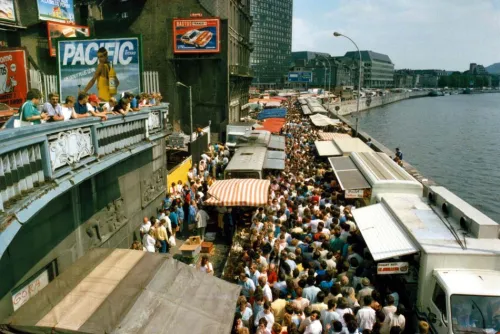
  9. La Batte Market in Liège, stop 9 on the self-guided walking tour
    9La Batte Market
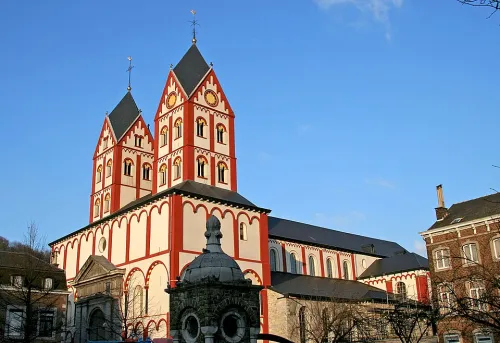
  10. Saint Bartholomew's Church in Liège, stop 10 on the self-guided walking tour
    10Saint Bartholomew's Church
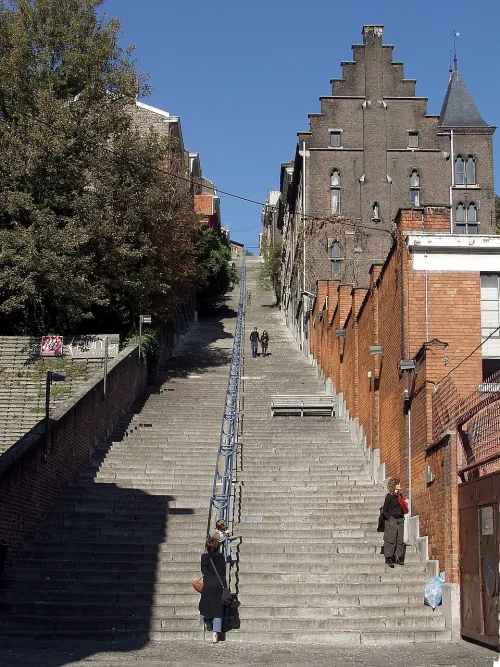
  11. Montagne de Bueren in Liège, stop 11 on the self-guided walking tour
    11Montagne de Bueren
  12. Citadel of Liège, stop 12 on the self-guided walking tour
    12Citadel of Liège
  13. That's the full route.

    Walk it with an AI Tour Guide talking you through every one of these streets.

    Start free in your browser
    You made it

Your Liège Walking Tour, Stop by Stop: Prince-Bishops, Markets and the Meuse

  1. 1

    Saint-Martin's Basilica

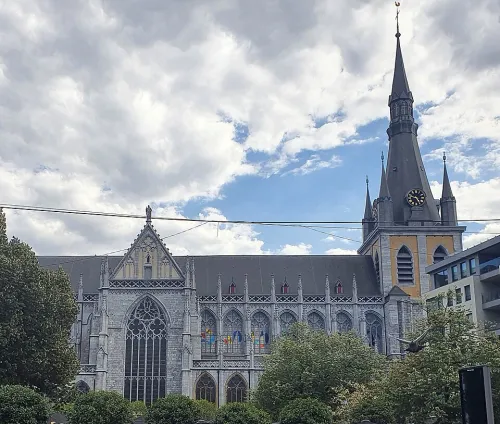
    Saint-Martin's Basilica in Liège, stop 1 on the self-guided walking tour

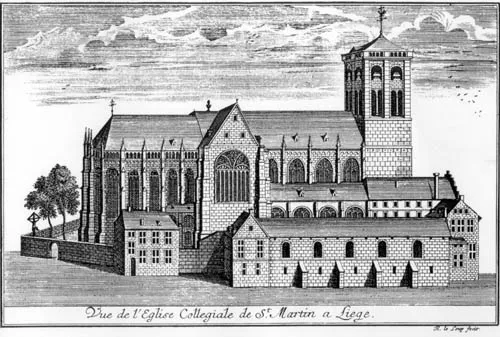
    You start on the Publémont hill, at a church that was meant to be the cathedral of Liège. Bishop Ebrachar laid the foundation stone on 2 June 965 and planned to dedicate it to the Virgin Mary and Saint Lambert. His successor Notger had other ideas: he gave it to Saint Martin of Tours and installed a college of canons. That is why the choir takes up a full third of the building's length; it was built for the canons' daily prayer.

    The story that matters most here is a quiet one. Juliana of Liège had visions that convinced her the Church lacked a feast honouring the Eucharist. In 1247 Bishop Robert de Turotte celebrated Corpus Christi for the very first time, in this church. A former archdeacon of Liège, by then Pope Urban IV, extended the feast to the whole Church in 1264. The cult of the Blessed Sacrament kept growing here, with its own confraternity and chapel, and in 1886 Pope Leo XIII made the pilgrimage church a minor basilica.

    Its darkest night came in August 1312. Townspeople, backed by the cathedral chapter, set fire to the church while several dozen nobles were sheltering inside; they died in the flames. Liège still remembers it as the Saint-Martin disaster. The late Gothic building you see replaced the old one between 1506 and 1542, under Prince-Bishop Érard de La Marck.

    Go inside if you can and look up in the choir: the star vault is by Arnold van Mulken, the master builder you'll meet again at the Palace of the Prince-Bishops. Entry is free, but the basilica opens only for a few hours on certain days, so you may find it shut. From here it's 1160 m, about 15 min, to Saint Paul's Cathedral, passing the Opéra Royal de Wallonie on the way.
    Local name
    Basilique Saint-Martin de Liège
    Hours
    Tue–Fri 12:30–15:00, Wed 10:00–12:30, Sat 10:00–12:30 and 15:00–17:30, Sun–Mon closed
    Price
    Free
  2. 2

    Saint Paul's Cathedral

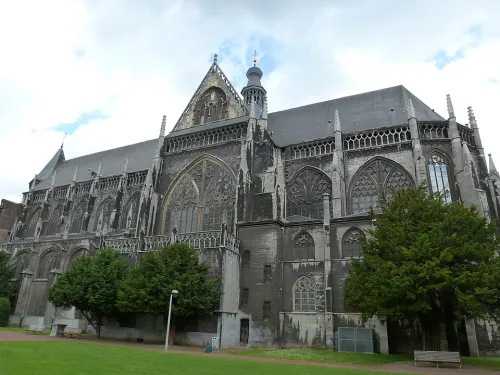
    Saint Paul's Cathedral in Liège, stop 2 on the self-guided walking tour

    Saint Paul's Cathedral became the cathedral almost by accident. During the French Revolution, Liège's ancient cathedral, Saint Lambert's, was destroyed in 1795. Once the upheaval was over, the former collegiate church of Saint Paul was raised in rank to take its place, and today it's the seat of the Diocese of Liège.

    Its origins go back to Bishop Eraclus, who conceived the project on his way home from Cologne, where he had attended the funeral of Archbishop Bruno the Great. He began building in 967 and installed twenty canons, but died when the walls had only reached the windows. Notger, the bishop who rededicated Saint-Martin's, finished the church and added ten more canons. What stands today was rebuilt between the 13th and 15th centuries and restored in the mid 19th century.

    Until the Liège Revolution of 1789, Saint Paul's was one of the city's seven collegiate churches, alongside Saint Peter's, Holy Cross, Saint John's, Saint Denis's, Saint Martin's and Saint Bartholomew's. Their canons formed the 'secondary clergy' of the prince-bishopric; the canons of Saint Lambert's were the primary one. You visit three of the seven on this walk.

    The cathedral is free and has generous opening hours, which makes it the easiest interior on the route to fit in. The treasury charges its own admission, payable on site; it's worth it if you want to see the original tomb of Bishop John, whose story waits at the next stop. Saint James' Church is 440 m away, 6 min on foot.

    Local name
    Cathédrale Saint-Paul de Liège
    Hours
    Mon–Sun 08:00–17:00
    Price
    Free (cathedral); treasury has separate admission
  3. 3

    Saint James' Church

    Saint James' Church in Liège, stop 3 on the self-guided walking tour

    Saint James' Church began as an abbey church, founded in 1015 by Prince-Bishop Balderic II, Notger's successor. The abbey's school soon became famous and the community flourished; its monks went on to found the monastery of Lubin in Poland and the priory of Saint-Léonard in the north of Liège.

    Note the dedication: Saint James the Less, not the apostle of Compostela, even though the two are often mixed up. After Saint Peter's collegiate church was destroyed, the abbey church became a collegiate church in its place, and after the Concordat of 1801 a parish church. The abbey buildings were pulled down and the main cloister became a public park.

    Look for the tomb of a foreign bishop named John: a tuff effigy lying in pontifical vestments, head under a canopy, feet resting on a console. What you see is a 1906 copy by the Louvain sculptor Paul Roemaet; the original is in the treasury of Saint Paul's Cathedral. Little is known about John except that he was an Italian bishop driven from his see, a painter whom Otto III called to decorate the church at Aachen. His epitaph, copied by the chronicler Gilles d'Orval around 1250, thanks the compassionate city that gave him asylum and claims the abbey was built on his advice: 'The tomb tells what I am, the inscription what I was.'

    Entry is free, though the opening hours change with the season. Next comes a longer leg, 1200 m and 17 min, down to the river and the Pont des Arches.

    Local name
    Église Saint-Jacques-le-Mineur de Liège
    Hours
    Mar 15 – Oct 31: Tue–Sat 10:00–17:00, Sun 10:00–13:00 and 14:00–16:00, Mon closed; Nov 1 – Mar 14: Tue–Fri 10:00–13:30, Sat 10:00–17:00, Sun 10:00–13:00, Mon closed
    Price
    Free
    Website
    upsl.be ↗
  4. 4

    Pont des Arches

    Pont des Arches in Liège, stop 4 on the self-guided walking tour

    For centuries this was the only bridge across the Meuse in Liège, linking the centre with the Outremeuse district on the road towards Aachen. It has been rebuilt many times since the 9th century and has carried other names: Souverain-Pont, and after the revolution, Pont de la Victoire.

    Legend credits the first bridge, a wooden one built in 785, to Ogier the Dane; the river swept it away. In 841 Bishop Hircaire built a sturdier one, the Souverain-Pont, which drifting ice kept damaging. Around 1034 Réginard rebuilt it in stone with seven arches, slightly away from today's line, and that bridge stood for nearly four centuries.

    The 14th-century chronicler Jean d'Outremeuse adds a lovely detail. When the stone bridge went up, the builders found a spring at the bottom of the Meuse and brought its water up onto the bridge, to the delight of the poor. It kept flowing, he says, until the people of Liège started selling beer there.

    If you know Jan van Eyck's Virgin of Chancellor Rolin, look again at the bridge in its background: it is probably this one. Remains of the old second arch on the left bank survive in the basements of a shop on Rue de la Cité. Walking on to the Palace of the Prince-Bishops, 460 m and 6 min, you pass the Cour Saint-Antoine.

    Hours
    always accessible
    Price
    Free (public space)
  5. 5

    Palace of the Prince-Bishops

    Palace of the Prince-Bishops in Liège, stop 5 on the self-guided walking tour

    The long facade on Place Saint-Lambert belongs to the Palace of the Prince-Bishops, seat of the men who ruled Liège as both bishops and princes. The square in front, where Saint Lambert's Cathedral once stood, is the commercial heart of the city. Today the palace houses the provincial services and the courthouse.

    It's the third palace on this spot. Notger built the first around the year 1000 as part of the fortifications; it burned in 1185. Its successor, rebuilt under Raoul de Zähringen, was badly damaged when the Burgundians of Charles the Bold sacked the city in 1468, and burned again in 1505. That same year Érard de La Marck became prince-bishop, found a ruin and in 1526 handed the new building to Arnold van Mulken; work went on until the end of the century.

    Later layers are easy to spot. After a fire in 1734 the main south facade was rebuilt in Louis XIV Régence style by the Brussels architect Jean-André Anneessens. In 1849 Jean-Charles Delsaux added a neo-Gothic west wing for the provincial government. In both world wars the German occupiers used the palace as their Kommandantur.

    Don't miss the great courtyard: arcaded galleries on 60 swelling columns with richly carved capitals, and the variety of their decoration is remarkable, so take time to compare them. The courtyard is free to enter while the courts and offices are working. The interior, including a second, more intimate courtyard, can only be seen on occasional free guided tours, and you must reserve ahead. Place du Marché is right next door, 150 m and 2 min away.

    Local name
    Palais des princes-évêques de Liège
    Hours
    Courtyard open during court/business hours; interior guided tours 1st Sunday of month: 11:00–12:00, 13:00–14:00, 14:15–15:15, 15:30–16:30 (advance reservation required)
    Price
    Free (courtyard and first-Sunday guided tours)
  6. 6

    Place du Marché

    Place du Marché in Liège, stop 6 on the self-guided walking tour

    Place du Marché is the oldest square in the city, and it holds the two symbols of the Cité: the Perron and the town hall, nicknamed la Violette. It took shape in the 8th century, as the growing cult of Saint Lambert turned Liège into a sizeable town.

    Look at its outline: smaller than half a hectare, an irregular trapezoid that seems to grow out of Rue Féronstrée, which opens onto it from the east. A fountain stands in the middle. To the south, Rue En Neuvice runs down to the Meuse and the Pont des Arches you just crossed. In the Middle Ages two branches of the Légia stream flowed through the square, and a parish church, Saint-André, stood on its north side from at least the mid 13th century.

    As the name says, this was the trading centre of Liège. From the second half of the 10th century its role grew with the rise of the merchant class. By the mid 15th century 51 buildings lined the square, most of them shops, with halls nearby where butchers, tanners, haberdashers and winegrowers sold their goods. Some houses also hosted meetings of the guilds, which in Liège are called métiers.

    There's no ticket and no closing time here, so linger as long as you like. The Museum of Walloon Life is 250 m away, about 4 min on foot.

    Hours
    always accessible
    Price
    Free (public space)
  7. 7

    Museum of Walloon Life

    Museum of Walloon Life in Liège, stop 7 on the self-guided walking tour

    Set in the former convent of the Friars Minor, the Museum of Walloon Life is one of the richest ethnology museums in Wallonia. Its collections gather everything that has shaped daily life in the region, and the visit traces Wallonia and its people from the 19th century to today.

    The idea took a while to stick. An exhibition of Congolese ethnography at the Liège Conservatoire in 1891 made scholars such as Eugène Monseur realise how urgently local crafts and objects needed saving. A first attempt, the Musée du Vieux-Liège of 1894, soon folded for lack of support. In 1909 the Society for Walloon Language and Literature wanted a collection of objects so it could define words precisely and illustrate its publications, and in March 1913 the museum was finally founded, with Joseph-Maurice Remouchamps as its first director.

    The highlight for many visitors is the puppet theatre, where Tchantchès, Charlemagne, Nanesse, Roland and the other characters of the traditional Liège repertoire come to life.

    Go in if you want to understand the people of this region rather than its princes; it also works well with children. Admission is charged, with reductions for seniors, students and children and a family ticket. The Grand Curtius Museum is 670 m on, 9 min, past the Ansembourg Museum (MAD).

    Local name
    Musée de la vie wallonne
    Hours
    Tue–Sun 09:30–18:00, Mon closed; closed Jan 1, May 1, Nov 1, Dec 25, and the week following Christmas school holidays
    Price
    7 EUR adult, 5 EUR senior (>65) & student (>18), 5 EUR child (6-18), free under 3 and first Sunday of month; 15 EUR family ticket
  8. 8

    Grand Curtius Museum

    Grand Curtius Museum in Liège, stop 8 on the self-guided walking tour

    The Grand Curtius Museum opened in 2009 and brings together what used to be several separate museums: archaeology and decorative arts, religious and Mosan art, weapons, glass, and the former Egyptology collection of the University of Liège. Around 5000 objects are spread over more than 5000 m² in several historic houses, the Curtius palace among them.

    The name comes from Jean de Corte, known as Jean Curtius, a manufacturer and arms dealer who grew rich supplying munitions and weapons to the Spanish army. Between 1597 and 1610 he built himself a private palace on the bank of the Meuse, paying 140,000 Brabant guilders for the house and 200,000 for its furniture and fittings. He died in 1628.

    The collections have their own stories. The city took over the palace in 1901, and after a long restoration by the architect Joseph Lousberg the archaeological museum opened there on 1 August 1909. The glass collection began with the Baar family, whose widow handed it over in 1946. The weapons museum goes back to a gift from Pierre-Joseph Lemille, a leading Liège gunmaker, a tradition still alive at the national arms factory in nearby Herstal.

    Choose this museum if art, arms or glass interest you more than folk life. Admission is charged, with reductions for seniors and free entry for young visitors. La Batte is just 140 m away, 2 min on foot.

    Hours
    Mon, Wed–Sun 10:00–18:00, Tue closed; closed Jan 1, May 1, Nov 1-2, Nov 11, Dec 25
    Price
    9 EUR adult, 5 EUR senior / groups / jobseekers, free under 26 and first Sunday of month; 1.25 EUR with an Article 27 ticket
  9. 9

    La Batte Market

    La Batte Market in Liège, stop 9 on the self-guided walking tour

    Locals simply call it la Batte: a Sunday market along the left bank of the Meuse, dating from 1561. It is the oldest market in the country and, with millions of visitors a year, one of the largest in Europe.

    The name tells its history. In Walloon, batte first meant a cofferdam, then a dike or quay. Around 1549 the city built a water wall here so boats could tie up, and it became the main river port of Liège. The parish of Saint-Jean-Baptiste turned into the centre of trade, with a commercial exchange, a grain market, a great hall for grain and wine, a meat hall and the public weighhouse along the river.

    In 1561 the cattle market moved here from the right bank, and fruit and vegetable sellers followed a few years later. From 1594 Prince-Bishop Ernest of Bavaria added an annual fair in September in honour of Saint Lambert, bringing hawkers, acrobats, actors, quack remedy sellers and tooth-pullers. A Liège historian credits them with the city's first public theatres. That fair stayed on the quay until 1859 and survives today as the Foire de Liège.

    The market only happens on Sundays; on other days you walk along the quay where it all began. Saint Bartholomew's Church is 210 m away, 3 min.

    Hours
    Sun 08:00–14:30
    Price
    Free (public open-air market)
    Website
    liege.be ↗
  10. 10

    Saint Bartholomew's Church

    Saint Bartholomew's Church in Liège, stop 10 on the self-guided walking tour

    Saint Bartholomew's Church was founded outside the city walls and built in coal sandstone, from the chancel in the late 11th century to the massive westwork with its twin towers in the late 12th; the towers were rebuilt in 1876. Despite later changes, its character is still deeply Mosan Romanesque and Ottonian. Like Saint Paul's and Saint-Martin's, it was one of the seven collegiate churches of Liège.

    The 18th century added two more aisles, a neoclassical portal in the westwork walls and a French Baroque makeover inside. The western section has since been restored to its original look, and in 2006 the church emerged from seven years of work in which 10,000 stones were replaced and the painted colours of the walls brought back.

    The reason most visitors come is the baptismal font attributed to the goldsmith Renier de Huy, one of the best known works of Mosan church art. Abbot Hellin commissioned it in 1107 or 1108 for the church of Notre-Dame-aux-Fonts, where Liège traditionally baptised its children. That church is gone; the font survived the French Revolutionary army and was installed here in 1804. Take time too for The Glorification of the Holy Cross by Bertholet Flemalle, The Crucifixion by Englebert Fisen and a statue of Saint Roch by Renier Panhay de Rendeux.

    For the font alone, the visit is worth it. Admission is charged, with reductions for seniors, groups and students and free entry for young children, and you can also book a tour of the organ, the carillon and the font. The Montagne de Bueren is 510 m away, 8 min.

    Local name
    Collégiale Saint-Barthélemy de Liège
    Hours
    Mon–Sat 10:30–12:30 and 13:30–16:30, Sun 13:30–16:30; in Sep 2026 Tuesday morning visits suspended
    Price
    3 EUR adult, 2.50 EUR senior / groups (10+), 2 EUR student (12-18), free under 12; 5 EUR organ/carillon + font tour
  11. 11

    Montagne de Bueren

    Montagne de Bueren in Liège, stop 11 on the self-guided walking tour

    From Rue Hors-Château, the Montagne de Bueren climbs straight up the hillside, with the Ursuline convent on one side and the Impasse des Ursulines winding off on the other. The whole street is 260 m long and climbs at an average gradient of nearly 28 percent towards Au Péri and the Citadel.

    It keeps alive the memory of Vincent de Bueren, a nobleman from Guelders who died in 1505. At the head of the Six Hundred Franchimontois, he was among the most stubborn defenders of Liège against Charles the Bold, Duke of Burgundy, the same duke whose troops wrecked the palace you saw earlier. Some Liégeois wrongly call the climb 'Lès sî cin grés', confusing it with those six hundred men.

    The climb once followed the inside of the city rampart, which has since disappeared. Landings at regular intervals let you catch your breath, and there used to be benches on them for enjoying the view as it opens up: first the Îlot Saint-Georges and the administrative quarter, then the Meuse flowing under the Pont des Arches.

    Take it at your own pace; it costs nothing and never closes. At the top, the route continues 1440 m, about 22 min, to the Citadel of Liège.

    Hours
    always accessible
    Price
    Free (public space)
  12. 12

    Citadel of Liège

    Citadel of Liège, stop 12 on the self-guided walking tour

    You finish 111 m above the Meuse valley, at what was the central fortification of Liège until the end of the 19th century. Together with the fortresses of Dinant, Huy and Namur, it belongs to the group known as the Meuse citadels.

    The first citadel went up on these heights in 1255. Prince-Bishop Maximilian Henry of Bavaria rebuilt it as a pentagon in 1650; France destroyed it shortly afterwards, and it was rebuilt in 1684. During the Napoleonic Wars it received five bastions in the style of Vauban. Long before, the city's defences had a rough history: in May 1212 troops of Henry I, Duke of Brabant, scaled the unfinished walls and sacked Liège, and the townsmen only completed them in 1215.

    By the late 19th century the citadel was obsolete, replaced by the twelve forts of the Fortified Position of Liège, though it remained a barracks and a command post. In the 1970s a hospital was built on the site and most of the fortress disappeared. The southern walls still stand, with 20th-century bunkers on the south side.

    On the north side, an area is a memorial to the Belgians executed here by German occupiers in both world wars. Give it a quiet moment before you head back down. The site is open at all times and free.

    Hours
    Always open
    Price
    Free
Walking tour route map of Liège Route loaded
Saint-Martin's BasilicaSaint Paul's CathedralSaint James' ChurchPont des Arches+8
All 12 stops are already on the map.
You just press start.
AI Tour Guide

You've read the route. Now walk Liège with a guide in your ear.

Press start wherever you are, even hundreds of kilometres from Liège, and the guide begins telling its stories right away. In the city, pick any of the 12 stops to start from: it leads you there, then talks with you the whole route, asking, listening, remembering, and shaping the tour around your answers.

12stops 6.6km 1 h 34 minwalking 13languages
▶Start the tour free

Free to start · Runs in your browser · No app, no download

Shorter Ways to Walk Liège

Not every visit has room for the full walk. These three cuts follow the same order and keep the legs as they are.

Old town and the river

Stops: 4, 5, 6, 7, 8, 9, 10

For a compact half day with museums. From the Pont des Arches to Saint Bartholomew's Church you walk 1880 m, just 26 min, past the palace courtyard and the market square. Admission applies at the Museum of Walloon Life, the Grand Curtius Museum and Saint Bartholomew's Church; everything else is free.

Churches of the prince-bishops

Stops: 1, 2, 3, 4, 5, 6

For anyone drawn to medieval Liège and its collegiate churches. From Saint-Martin's Basilica to Place du Marché you cover 3410 m in 46 min of walking. No admission anywhere, apart from the cathedral treasury if you choose to go in.

Sunday market and the climb

Stops: 9, 10, 11, 12

For a Sunday morning with energy to spare. Begin among the stalls of La Batte, look into Saint Bartholomew's Church once it opens, then head up the Montagne de Bueren to the Citadel: 2160 m and 33 min of walking. Only Saint Bartholomew's charges admission.

How Long This Liège Tour Takes, Museums Included

The pure walking time is 1 h 34 min over 6.6 km, but most of it comes in short legs: from the Pont des Arches to Saint Bartholomew's Church no leg takes longer than 9 min. The two long stretches are the 17 min from Saint James' Church to the river and the final 22 min from the Montagne de Bueren to the Citadel, which is also the steepest part of the day.

With short looks inside the free churches and the palace courtyard, plan on roughly four hours. Each of the two museums deserves about an hour and a half, so with both you're looking at a full day. If you do that, keep moving so you reach Saint Bartholomew's while it's still open.

Before You Set Out in Liège

  • Start and finish: The recommended start is Saint-Martin's Basilica; you can join at any stop and the route picks up from there. The walk ends at the Citadel of Liège, high above the city.
  • Best weekday: Not every interior on the route is open on the same days, so choose your day with care. Start early at Saint-Martin's, which opens only for a few hours.
  • Sundays: La Batte only runs on Sundays. Start early and you can fit in the Museum of Walloon Life and still reach the market before it packs up.
  • Costs: The walk itself costs nothing. Only three sights charge admission, plus the cathedral treasury if it tempts you. Young visitors get into the Grand Curtius Museum free.
Walking tour route map of Liège
AI Tour Guide

Your guide is ready when you reach Saint-Martin's.

Press start and a voice AI Tour Guide takes it from here: leading the route through Liège, telling the stories, and turning your walk into a real back-and-forth conversation. No app or download is needed; it runs in your browser.

12stops 6.6km 1 h 34 minwalking 13languages
▶Start the tour free

Free to start · Runs in your browser · No app, no download

What the AI Tour Guide Adds on This Walk

This route jumps from Corpus Christi to an arms dealer's palace to a Sunday market, and the AI Tour Guide ties those threads together as you walk. It notices whether you lean towards the prince-bishops, the art or everyday Walloon life, and shapes the stories that way. Ask it what the text leaves open, such as what the Perron means to the people of Liège or who Tchantchès is in local lore, and interrupt whenever something catches your eye. You start with 100 free credits; after that, this tour costs €19.99 all-inclusive with no time limit, or €5 per hour.

A Real Conversation A voice AI Tour Guide greets you, leads the whole route, and tells the stories and facts as you walk, asking what you want to see and keeping a real conversation going. Not a recording you press play on.
Map Navigation Follow the route on the map and walk at your own pace. You choose where to start and when to move to the next stop.
Ask Anything Curious about a building you pass? Ask your AI Tour Guide on the spot and the conversation carries on.
13 Languages Switch language anytime. No separate tour needed.
Start free in your browser

Common Questions About Walking Liège

Which museum should I choose if I only have time for one?

Pick the Museum of Walloon Life if you're curious about how people in the region lived, spoke and played, puppets included. Pick the Grand Curtius Museum for art, weapons, glass and archaeology, especially if you're under 26 and get in free.

Is the Montagne de Bueren ever decorated or lit up?

Yes. On the first Saturday of October, during the Nocturne des Coteaux de la Citadelle held since 1994, thousands of candles light it in the dark. In June of even-numbered years, Bueren en Fleurs covers it with a floral design of around 25,000 plants laid out by the city's planting service.

Can I combine Liège with Maastricht or Aachen?

Easily, both are close: Maastricht is 24 km away and Aachen 39 km. Each has its own free walking route if you want a second day.

Are the other Meuse citadels worth a trip?

If the Citadel of Liège leaves you wanting more fortress, Namur and Dinant both belong to the same group of Meuse citadels and have their own walking routes.

Is the tour really free?

Yes. The whole tour is free: the route, the interactive map and the navigation cost you nothing. Only the voice AI Tour Guide is optional and paid: you test it with 100 free credits, then you pay either €5 per hour or €19.99 for this whole tour, with no time limit. Admission to 3 of the 12 stops is not included: Museum of Walloon Life, Grand Curtius Museum and Saint Bartholomew's Church charge their own entry fees.

Do I need to download an app?

No. Everything runs in your phone browser. Open the route and start walking, no download and no sign-up required.

Do I need to book the walking tour in advance?

No booking needed. This self-guided tour is available anytime. Open the route in your browser and start walking. The AI Tour Guide works instantly, no app, no reservation required.

What languages is the AI Tour Guide available in?

The AI Tour Guide speaks 13 languages, so you take the tour in your own language and can switch at any time.

Can I skip stops or change the route?

Yes. Skip any stop, spend extra time at places you like, or start the route from any point. It is your walk, you set the pace.
Image credits
▶ Start free in your browser Runs in your browser, no app, no download