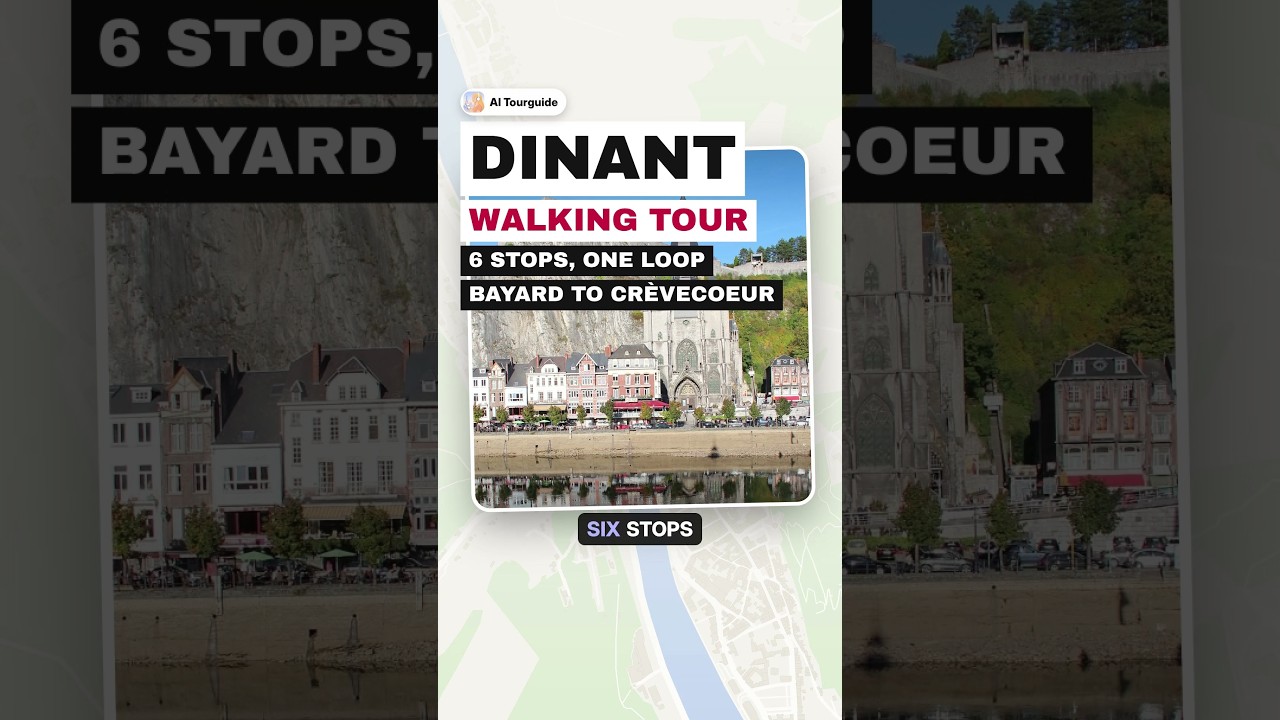
Free Walking Tour Dinant: Sax, Citadel and Rocher Bayard

Cross the Meuse, walk past the Rocher Bayard, sit beside Adolphe Sax and explore two strongholds on a free 11.6 km loop around Dinant.

6 Stops 11.6 km ~2 h 53 min walking
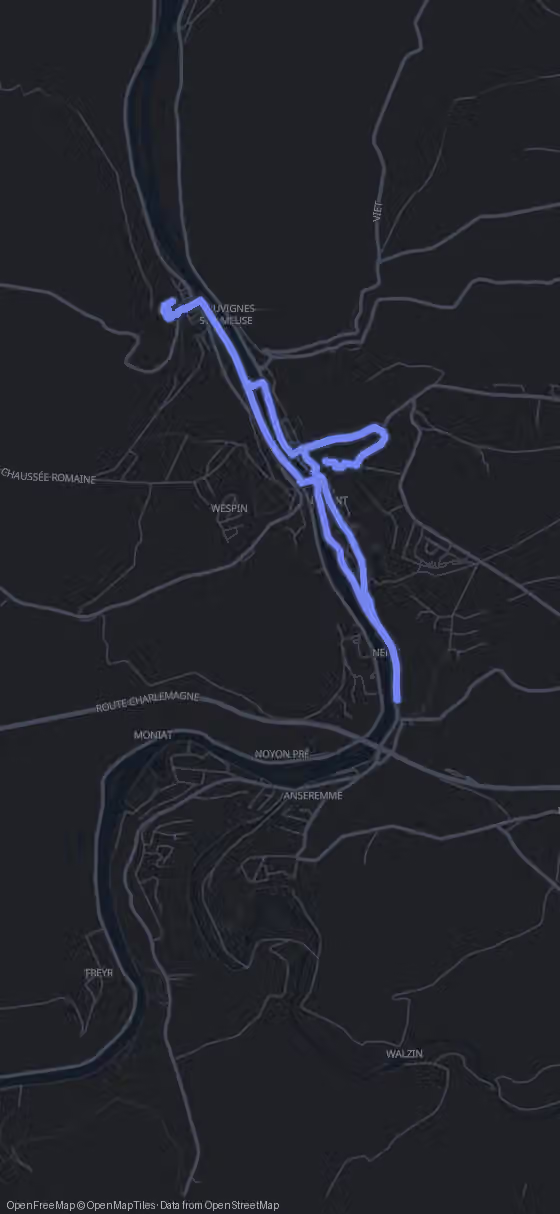
Route map for the Dinant walking tour
Stop 1 of 6
2050 m·26 min
Charles de Gaulle Bridge
Head south-east along the river toward the Rocher Bayard
Bonjour, welcome to Dinant. I’m Alex, and this small riverside town changed the sound of music around the world.
Try this tour with Alex

What This Dinant Walk Covers

Six stops on one loop: Charles de Gaulle Bridge, Rocher Bayard, Collegiate Church of Notre-Dame de Dinant, Maison de Monsieur Sax, Citadel of Dinant and Crèvecoeur Tower Ruins, then back to the bridge. It is 11.6 km with 2 h 53 min of pure walking; with visits, plan just over six hours.

Only the citadel charges entry; everything else is free. The GPS route runs free in your browser, and the optional AI Tour Guide can lead the walk as a conversation.

Open free GPS & optional AI Tour Guide
This short shows highlights of the route. All 6 stops follow below.

The Route

Dinant Walking Map: The Meuse Loop

6 stops 11.6 km 2 h 53 min walking
Tap to load interactive map

The 6 stops along this route

  1. Charles de Gaulle Bridge in Dinant, stop 1 on the self-guided walking tour
    1Charles de Gaulle Bridge
  2. Rocher Bayard in Dinant, stop 2 on the self-guided walking tour
    2Rocher Bayard
  3. Collegiate Church of Notre-Dame de Dinant, stop 3 on the self-guided walking tour
    3Collegiate Church of Notre-Dame de Dinant
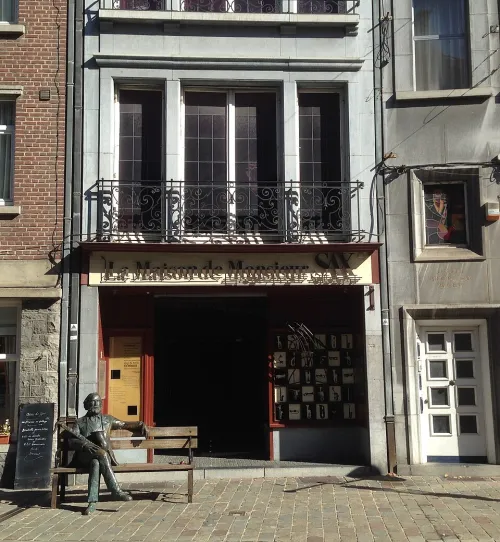
  4. Maison de Monsieur Sax in Dinant, stop 4 on the self-guided walking tour
    4Maison de Monsieur Sax
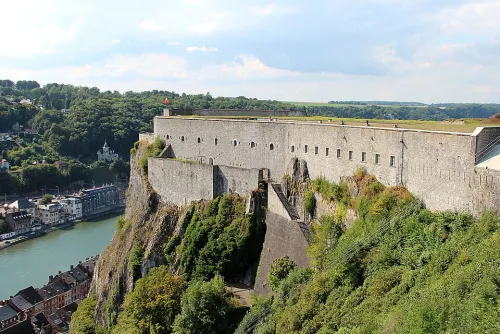
  5. Citadel of Dinant, stop 5 on the self-guided walking tour
    5Citadel of Dinant
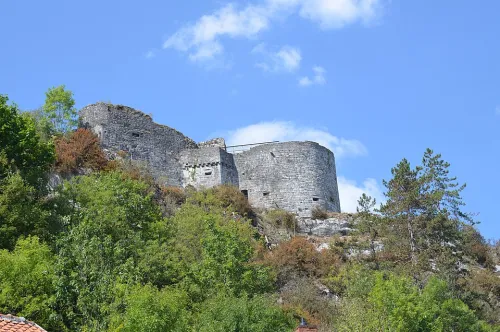
  6. Crèvecoeur Tower Ruins in Dinant, stop 6 on the self-guided walking tour
    6Crèvecoeur Tower Ruins
  7. That's the full loop.

    Walk it with an AI Tour Guide talking you through every one of these streets.

    Start free in your browser
    You made it

Stop by Stop Along the Dinant Walking Tour

  1. 1

    Charles de Gaulle Bridge

    Charles de Gaulle Bridge in Dinant, stop 1 on the self-guided walking tour

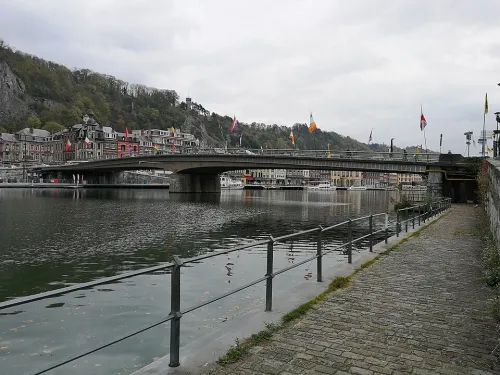
    Begin in the middle of the Charles de Gaulle Bridge, where the road crosses the Meuse for about 215 metres and joins Dinant's left and right banks. It looks like an ordinary road bridge, but it matters more than it seems: for some ten kilometres up and down the river it is the only bridge for cars at bank level, so much of the town's life funnels across it. Look along both sides for the huge, brightly coloured saxophone sculptures, Dinant's greeting to its most famous son.

    The name recalls a morning in the First World War. On 15 August 1914 a French regiment charged across the bridge toward the citadel, then held by German troops. One of its officers, a young lieutenant called Charles de Gaulle, was wounded right here, decades before he became France's post-war president.

    People have crossed at this spot for more than a thousand years. The first reliable trace of a bridge dates from the 9th century, and a Roman one may have stood here before it. Floods carried that early bridge away; a stone bridge with six arches replaced it in 1080, and in 1360 came a new one with a movable deck, guarded by two towers on the left bank.

    That medieval bridge also saw disaster. In 1466 its main arch gave way under a crowd, and 800 people of Dinant fell into the river. Keep that in mind as you stand above the water today.

    From here the loop heads out along the river to the Rocher Bayard: 2060 m, about 28 minutes on foot.
    Hours
    Always open
    Price
    Free
  2. 2

    Rocher Bayard

    Rocher Bayard in Dinant, stop 2 on the self-guided walking tour

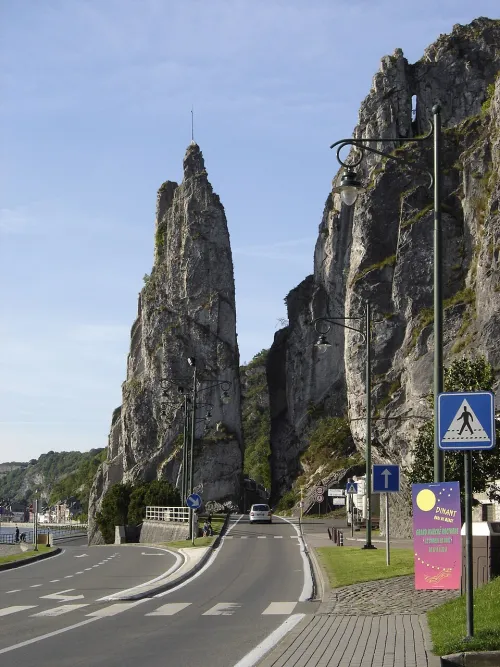
    The Rocher Bayard is a needle of rock about 40 metres high, standing right at the edge of the Meuse on the right bank, between Dinant and Anseremme. The road squeezes through the gap between the needle and the cliff behind it, and that is what makes the spot so striking: you walk past a stone spire that seems to have been cut loose from the mountain.

    Bayard was the horse of the four sons of Duke Aymon, prince of the Ardennes. In the medieval epic, beloved across the Ardennes, the brothers Renaud, Richard, Alard and Guichard fled Charlemagne's court after a quarrel that cost the emperor's nephew his life, all four riding the one horse. Cornered on the heights above the Meuse, they rode to the tip of the ridge. Just as the emperor thought he had them, Bayard struck the rock with his hooves and leapt across the river, splitting the stone in two. Locals will tell you the hoof print is still visible.

    The real story is more down to earth. There was once a small peak here, and soldiers of Louis XIV cut it off from the mountain when they invaded Dinant, to build an easy road along the Meuse. That road was later widened for cars, which is why you now pass through the gap.

    The rock has drawn writers and painters. In July 1838 Victor Hugo described a pyramid of rock, sharp and bold as a cathedral spire, rising at a bend in the road, with the road running between the mountain and this colossal marker. Around 1856 Gustave Courbet painted it during a journey through the Meuse valley.

    Take your photos, then walk back toward the centre to the Collegiate Church of Notre-Dame de Dinant: 2040 m, about 28 minutes.

    Hours
    Open 24/7
    Price
    Free
  3. 3

    Collegiate Church of Notre-Dame de Dinant

    Collegiate Church of Notre-Dame de Dinant, stop 3 on the self-guided walking tour

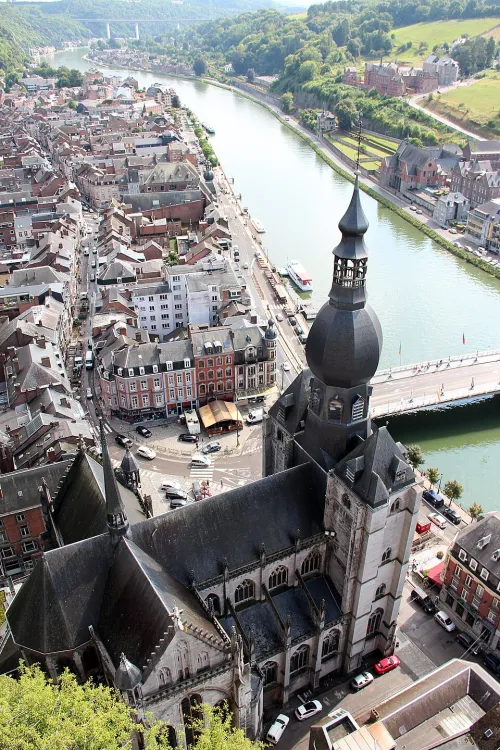
    The Collegiate Church of Notre-Dame stands on the right bank of the Meuse with the rock face rising straight behind it. Look up at the baroque cap crowning the Gothic west front. The church is 50 metres long and 30 metres wide at the transept. The priest Jean Lejeune saw the contrast between fragile building and towering cliff as a metaphor for the frailty of everything human.

    That cliff is also why the church looks the way it does. Its Romanesque predecessor collapsed in 1227 when a huge block of rock fell on it. Dinant rebuilt in local limestone, following models from Burgundy and Champagne, and the result became one of the most representative buildings of Mosan Gothic, the style that spread through the former Prince-Bishopric of Liège in the 13th century. The chapter is first recorded as such in 1086, but a religious community had already lived here for more than 200 years, possibly as Benedictine monks.

    The building has been badly hit again and again: in the sack of Dinant by Philip the Good in 1466, when the Duke of Nevers' troops marched through in 1554, and during the French Revolution, when the chapter was dissolved and the church desecrated and robbed. In the 19th century the architects Schoonejans, Jules-Jacques Van Ysendyck and Auguste Van Assche restored it to recover its 13th-century unity. Then in 1914 German shelling and fire, during the massacre of Dinant, wrecked it once more, and Chrétien Veraart rebuilt it between 1919 and 1923.

    Entry is free, so step inside even if you only have a few minutes; twenty minutes is plenty to take in the Gothic interior after all those rebuildings. Then it is just 120 m, about 2 minutes, to the Maison de Monsieur Sax.

    Local name
    Collégiale Notre-Dame de Dinant
    Hours
    1 Apr-31 Oct: daily 09:00–18:00; 1 Nov-31 Mar: daily 09:00–17:00
    Price
    Free
  4. 4

    Maison de Monsieur Sax

    Maison de Monsieur Sax in Dinant, stop 4 on the self-guided walking tour

    You will spot the Maison de Monsieur Sax by the brass statue of Adolphe Sax sitting on a bench out front; there is room beside him, and few visitors resist the photo. The entrance is decorated with earthenware tiles, a hint that this small museum likes to play with its space.

    Inside, the rooms are tiny, and the museum makes the most of it: instruments and objects hang on the walls and even the ceiling, and an oversized book walks you through Sax's life. The best part is listening. You can hear different saxophones and the instrument in a range of musical styles, with images on a screen to go with them. Entry is free and the house opens every day, so it is worth half an hour for music lovers and an easy win with children.

    Sax, born in 1814 and died in 1894, is remembered above all for the saxophone, but he built far more than that. He ran a factory geared to production and at one point employed more than two hundred workers. For a time he was the main supplier of brass instruments to the army of King William I of the Netherlands, who in those years reigned over Belgium too. Dinant has not forgotten him: artworks around town recall the link, and the tourist leaflet is called Sax and the City.

    From the house it is 1460 m, about 25 minutes, up to the Citadel of Dinant.

    Hours
    Daily: 09:00–19:00
    Price
    Free
  5. 5

    Citadel of Dinant

    Citadel of Dinant, stop 5 on the self-guided walking tour

    The Citadel of Dinant sits on a high rock above the Meuse, right in the town centre, about 100 metres above the river. Since 1956 a cable car has bridged that height difference. From the top you get a commanding view over Dinant and the river winding through it.

    There was a castle here long before the fortress. It was built between 1041 and 1050 under Théoduin, Prince-Bishop of Liège, and largely destroyed by Burgundian troops in the 15th century. In 1523 the people of Dinant began rebuilding it at the bishop's request, only for French units to plunder it again before leaving the town at the end of the 17th century.

    What you explore today is mostly the work of the Dutch. After Napoleon's defeat, the Congress of Vienna handed the region to the Netherlands in 1815, and between 1818 and 1821 the Dutch raised thick walls toward the river and the land, dug a moat, installed a drawbridge and carved a system of rooms into the rock where the garrison lived and worked. In 1830 the whole fortress passed to Belgian rebels without a fight. The state demilitarised it in 1868 and sold it at public auction; for a while it stored archaeological finds, and after the Second World War the town turned it into a museum. Its structures were reconstructed at the end of the 20th century.

    This is the only paid stop of the loop. If fortress history and the view over the valley matter to you, it is worth it; plan about an hour and a half. If you are short on time or budget, the free stops carry the walk well on their own.

    Next comes the longest leg: 3620 m, about 56 minutes, to the Crèvecoeur Tower Ruins in Bouvignes-sur-Meuse. In Bouvignes you pass the Maison du Patrimoine Médiéval Mosan, a museum on the way.

    Hours
    April–September: 10:00–18:00 | October–March: 10:00–16:30
    Price
    15.00 EUR adults, 13.00 EUR children (4-12 years)
  6. 6

    Crèvecoeur Tower Ruins

    Crèvecoeur Tower Ruins in Dinant, stop 6 on the self-guided walking tour

    The Crèvecoeur Tower Ruins crown a cliff 80 metres above the Meuse in Bouvignes-sur-Meuse, today part of Dinant. The castle belongs to the Walloon Region, and its grounds are open freely all year, day and night, with no ticket.

    The name means broken heart, and the legend behind it is grim. During a siege around 1430, three knights are said to have died defending the castle and their wives. The wives took up arms to avenge them and were killed too. Believing all was lost, the ladies of the castle put on long white robes, climbed the parapet and jumped together to their deaths. Since at least 1778 the story has been retold as part of the French siege of 1554, drifting away from its original setting.

    Look for the square keep from around 1320, the core of Crèvecoeur, and the semicircular bastion from the 15th century that juts out beside it; by about 1430 the castle reached its full length of forty metres. Below it lie the ruins of the older count's castle, three times as long and spread over three terraces. The highest holds the Romanesque keep, 15 by 11.5 metres. Five metres lower was the farmstead, with a cellar still remarkably well preserved, along with St Catherine's Chapel, the mint and the great hall that served as town hall. The lowest terrace reached the church of St Lambert.

    The story goes back further still. At the end of the 11th century Godfrey I, Count of Namur, built a fortress at Bouvignes, and his son Henry the Blind ringed it with heavy walls. Fire marks found by archaeologists are linked to the siege of 1188 by Baldwin V, Count of Hainaut, when knights from Champagne came to help defend it. In 1214 Waleran III, Duke of Limburg, besieged it on behalf of Ermesinde, Countess of Luxembourg, and this time the castle held.

    Give yourself half an hour on the terraces, then close the loop: 2240 m, about 34 minutes, back to the Charles de Gaulle Bridge.

    Local name
    Château de Crèvecœur
    Hours
    Open 24/7
    Price
    Free
Walking tour route map of Dinant Route loaded
Charles de Gaulle BridgeRocher BayardCollegiate Church of Notre-Dame de DinantMaison de Monsieur Sax+2
All 6 stops are already on the map.
You just press start.
AI Tour Guide

You know the route. Now walk it with a guide in your ear.

Press start wherever you are, even hundreds of kilometres from Dinant, and the guide begins telling its stories right away. In the city, pick any of the 6 stops to start from: it leads you there, then talks with you the whole route, asking, listening, remembering, and shaping the tour around your answers.

6stops 11.6km 2 h 53 minwalking 13languages
▶Start the tour free

Free to start · Runs in your browser · No app, no download

Shorter Ways to Walk Dinant

The loop splits easily, because the church, Sax's house and the citadel sit close together while the rock and the ruins lie further out.

The full Meuse loop

Stops: 1, 2, 3, 4, 5, 6

For a whole day with good shoes and curiosity for legends and fortresses. 2 h 53 min of pure walking, back to the bridge at the end; the citadel is the only ticket.

Bridge, rock and citadel

Stops: 1, 2, 3, 4, 5

For anyone who wants the Rocher Bayard and the town's highlights but not the long stretch to Bouvignes. 1 h 23 min of walking, ending at the citadel; again only the citadel costs entry.

Dinant centre in a couple of hours

Stops: 3, 4, 5

For a short stopover: church, saxophone museum and fortress with just 27 minutes on foot. Church and Sax's house are free, the citadel is paid.

How Long the Dinant Loop Takes

The full loop adds up to 11.6 km and 2 h 53 min of pure walking. Most of that sits in three legs: out to the Rocher Bayard, back into town to the collegiate church (28 minutes each), and the 56 minutes from the citadel over to Bouvignes.

A realistic day: start at the bridge at 9:30, reach the Rocher Bayard at 10:13, the church at 10:56 and Sax's house at 11:23. Arrive at the citadel at 12:18, give it an hour and a half, reach Crèvecoeur at 14:44 and stand on the bridge again around 15:48.

Skip the citadel's interior and the day shrinks by about an hour and a half. The shorter variants need only their walking time plus whatever you spend inside the church, the Sax museum and the fortress.

Before You Set Off in Dinant

  • Start and finish: The loop starts and ends at the Charles de Gaulle Bridge. You can join at any stop; the church and Sax's house, only 120 m apart, make an easy alternative start in the centre.
  • Best day and time: Any day works. Start in the morning so the long visit to the citadel fits comfortably into your day.
  • Costs: The bridge, the Rocher Bayard, the church, Sax's house and the Crèvecoeur ruins are free; only the citadel charges entry. The GPS route is free; the AI Tour Guide starts with 100 free credits, after that you choose this tour all-inclusive for €19.99 with no time limit, or €5 per hour.
Walking tour route map of Dinant
AI Tour Guide

Your guide is waiting by the Meuse

Press start and a voice AI Tour Guide takes it from here: leading the route through Dinant, telling the stories, and turning your walk into a real back-and-forth conversation. No app or download is needed; it runs in your browser.

6stops 11.6km 2 h 53 minwalking 13languages
▶Start the tour free

Free to start · Runs in your browser · No app, no download

What the AI Tour Guide Adds in Dinant

On this loop the long legs are where a conversation earns its place, above all the near hour from the citadel to Bouvignes. The AI Tour Guide greets you wherever you start, tells the stories of each place, asks what caught your eye and remembers it, so a moment at the saxophones can come back when you reach the knights' ruins. Cut in whenever you like, for instance to ask how the people of Dinant lived through the sack of 1466, or what daily life in the Dutch garrison's rock rooms was like.

A Real Conversation A voice AI Tour Guide greets you, leads the whole route, and tells the stories and facts as you walk, asking what you want to see and keeping a real conversation going. Not a recording you press play on.
Map Navigation Follow the route on the map and walk at your own pace. You choose where to start and when to move to the next stop.
Ask Anything Curious about a building you pass? Ask your AI Tour Guide on the spot and the conversation carries on.
13 Languages Switch language anytime. No separate tour needed.
Start free in your browser

Questions About Dinant

Did Adolphe Sax actually live in Dinant?

He was born here, but he spent only a few years in the town and lived most of his life in Paris.

Can a group visit the Maison de Monsieur Sax?

Yes. The house organises no official visits, but groups are welcome with their own guide, and entry stays free.

Are there other fortresses like Dinant's along the Meuse?

Dinant's citadel belongs to the Meuse citadels together with those of Huy and Namur. Namur, 23 km away, has its own walking tour if you want to see the next one.

Is the tour really free?

Yes. The whole tour is free: the route, the interactive map and the navigation cost you nothing. Only the voice AI Tour Guide is optional and paid: you test it with 100 free credits, then you pay either €5 per hour or €19.99 for this whole tour, with no time limit. Admission to one of the 6 stops is not included: Citadel of Dinant charges its own entry fee.

Do I need to download an app?

No. Everything runs in your phone browser. Open the route and start walking, no download and no sign-up required.

Do I need to book the walking tour in advance?

No booking needed. This self-guided tour is available anytime. Open the route in your browser and start walking. The AI Tour Guide works instantly, no app, no reservation required.

What languages is the AI Tour Guide available in?

The AI Tour Guide speaks 13 languages, so you take the tour in your own language and can switch at any time.

Can I skip stops or change the route?

Yes. Skip any stop, spend extra time at places you like, or start the route from any point. It is your walk, you set the pace.
Image credits
▶ Start free in your browser Runs in your browser, no app, no download