Free Walking Tour Lisbon: Castle to Alfama Views

Ten stops, 4.8 km: from the Moorish castle walls down to the riverside square and back up to the terraces over Alfama, with free GPS navigation in your browser.

10 Stops 4.8 km ~1 h 13 min walking
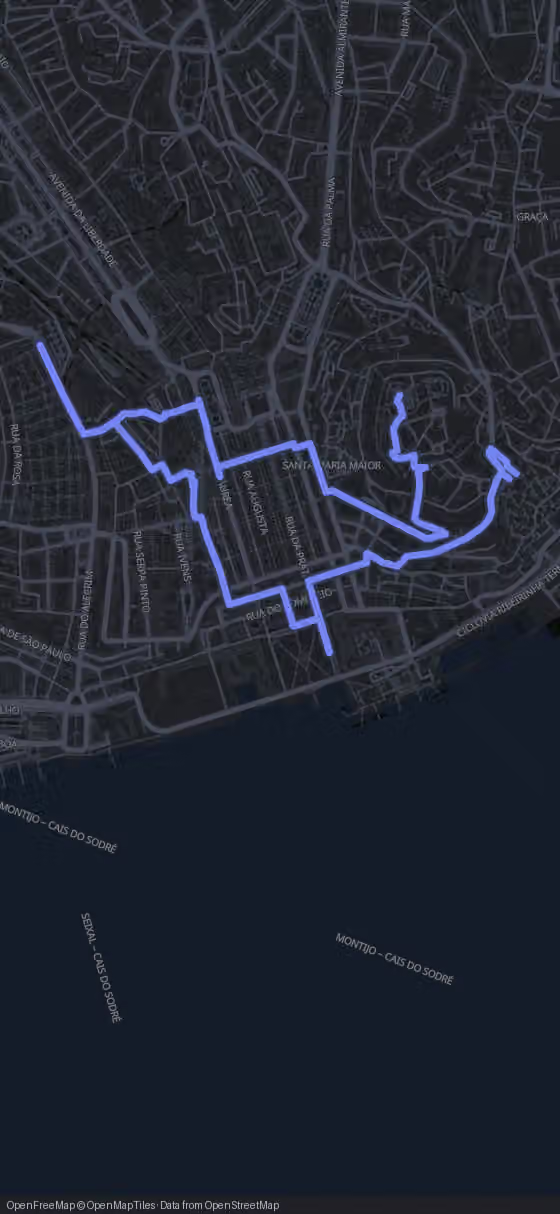
Route map for the Lisbon walking tour
Stop 1 of 10
1.2 km·15 min
São Jorge Castle
Head south-west and downhill toward the Santa Justa Elevator
Olá, welcome to Lisbon. I'm Alex, and one morning in 1755 changed the face of this city forever.
Try this tour with Alex

What This Lisbon Route Covers

Ten stops lead from São Jorge Castle down through the Baixa and back up to Miradouro de Santa Luzia with its view over Alfama: 4.8 km with 1 h 13 min of pure walking. With the worthwhile interiors, plan about five and a half hours.

The squares and viewpoints are free; São Jorge Castle, Convento do Carmo, Lisbon Cathedral and the Rua Augusta Arch rooftop charge entry, and the Santa Justa Elevator is currently closed. The GPS route in your browser costs nothing, and the AI Tour Guide is optional.

Open free GPS & optional AI Tour Guide
This short shows highlights of the route. All 10 stops follow below.

The Route

Walking Map of Lisbon: Castle, Baixa and Alfama

10 stops 4.8 km 1 h 13 min walking
Tap to load interactive map

The 10 stops along this route

  1. São Jorge Castle in Lisbon, stop 1 on the self-guided walking tour
    1São Jorge Castle
  2. Santa Justa Elevator in Lisbon, stop 2 on the self-guided walking tour
    2Santa Justa Elevator
  3. Rossio Square in Lisbon, stop 3 on the self-guided walking tour
    3Rossio Square
  4. Miradouro de São Pedro de Alcântara in Lisbon, stop 4 on the self-guided walking tour
    4Miradouro de São Pedro de Alcântara
  5. Convento do Carmo in Lisbon, stop 5 on the self-guided walking tour
    5Convento do Carmo
  6. Rua Augusta Arch in Lisbon, stop 6 on the self-guided walking tour
    6Rua Augusta Arch
  7. Praça do Comércio in Lisbon, stop 7 on the self-guided walking tour
    7Praça do Comércio
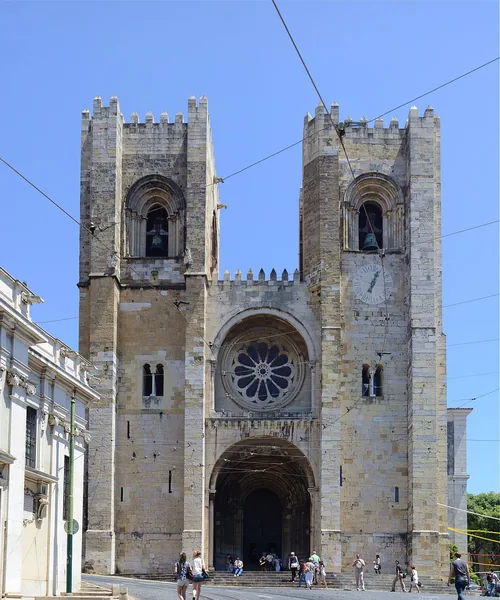
  8. Lisbon Cathedral, stop 8 on the self-guided walking tour
    8Lisbon Cathedral
  9. Miradouro das Portas do Sol in Lisbon, stop 9 on the self-guided walking tour
    9Miradouro das Portas do Sol
  10. Miradouro de Santa Luzia in Lisbon, stop 10 on the self-guided walking tour
    10Miradouro de Santa Luzia
  11. That's the full route.

    Walk it with an AI Tour Guide talking you through every one of these streets.

    Start free in your browser
    You made it

Your Lisbon Walking Tour, Stop by Stop from Castle to River

  1. 1

    São Jorge Castle

    São Jorge Castle in Lisbon, stop 1 on the self-guided walking tour

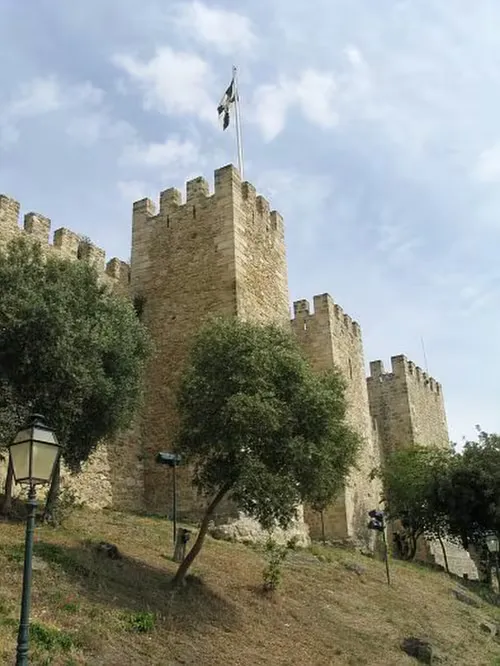
    Start where Lisbon itself started. People lived on this hill at least as early as the 8th century BC, and its strategic value never faded: Celtic tribes used it first, then Phoenicians, Greeks and Carthaginians held it as a defensive outpost, and after them came Romans, Suebi, Visigoths and Moors. The first real fortification probably went up around 48 BC, when Lisbon was classed as a Roman municipality.

    The walls you walk along today go back to the Moors, who built them in the 10th century as the Cerca Moura, the Moorish Encirclement. In 1147 Afonso Henriques took castle and city with northern European knights who were on the Second Crusade; it became the only notable success of that otherwise failed crusade. The siege has its own legend, retold ever since: the knight Martim Moniz saw a castle door standing open and threw his own body into the gap so the defenders couldn't shut it, letting the Christian soldiers in at the cost of his life.

    After the conquest the castle kept changing roles: royal palace, military barracks, home of the Torre do Tombo national archive, and now a national monument and museum. The castle charges admission, with reductions for young visitors and seniors and free entry for children. It's worth it if you want to walk the Moorish walls and understand where the city began; give it about an hour and a half.

    The castle opens early every day, which makes it a natural first stop before you head down into the city.

    From the castle comes the longest leg of the day: 1350 m, about 19 minutes, down through Alfama into the lower town to the Santa Justa Elevator.
    Hours
    Daily 09:00–21:00 (1 March – 31 October, last admission 20:30); daily 09:00–18:00 (1 November – end of February, last admission 17:30); closed only 1 Jan, 1 May, 24/25/31 Dec
    Price
    17 EUR; ages 13–25 8.50 EUR; seniors 65+ 14 EUR; under 12 free
  2. 2

    Santa Justa Elevator

    Santa Justa Elevator in Lisbon, stop 2 on the self-guided walking tour

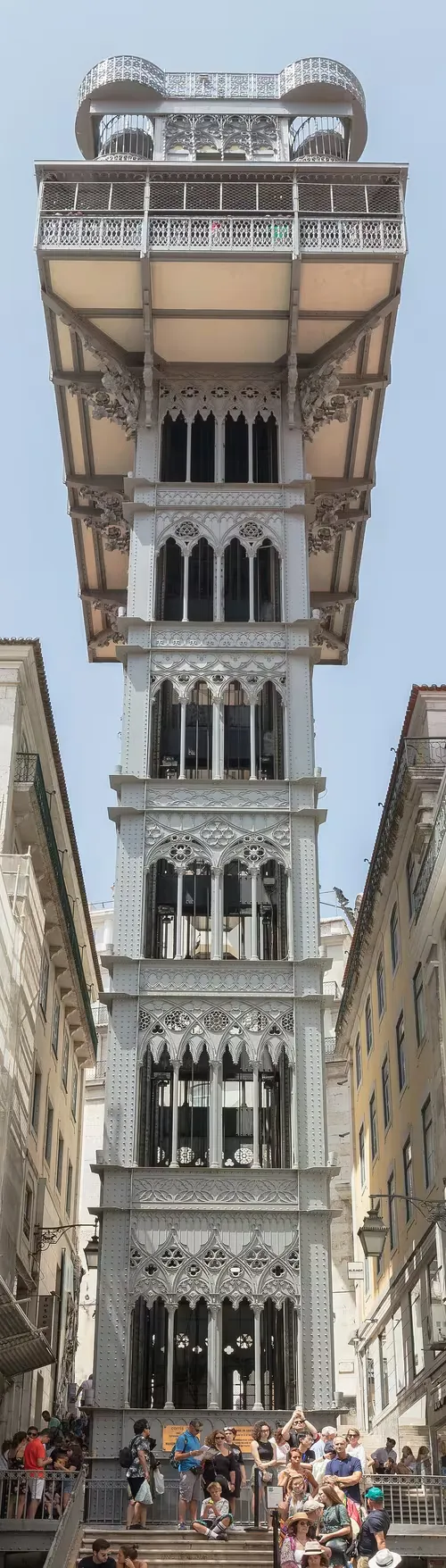
    At the end of Rua de Santa Justa stands the lift that links the lower streets of the Baixa with Largo do Carmo, higher up. Locals also call it the Carmo Lift. The Santa Justa Elevator is currently closed, so this is a stop for looking up from the street rather than riding.

    It's worth that look because it's unique: of Lisbon's urban lifts, Santa Justa is the only remaining vertical one. The Elevador da Glória and the Elevador da Bica are really funicular railways, and the other lift built around the same time, the Elevator of São Julião, has been demolished.

    The problem it solves is as old as the city's hills: getting from the Baixa up to Carmo Square. Engineer Roberto Arménio put a project to the council in 1874, and a proposal from 1876 even imagined rails with cars hauled up an incline by animals. The man who finally got it built was Raoul Mesnier du Ponsard, a Porto-born engineer of French parentage, who received a licence on 1 June 1882 to explore mechanical solutions. When he asked for the concession in 1896, Henry Lusseau contested it, but the city's public works department backed Mesnier, and even then it took two more years to obtain a provisional construction licence.

    Take your photo from the street and move on: Rossio Square is just 210 m away, about 3 minutes on foot.

    Local name
    Elevador de Santa Justa
    Status
    Currently closed
  3. 3

    Rossio Square

    Rossio Square in Lisbon, stop 3 on the self-guided walking tour

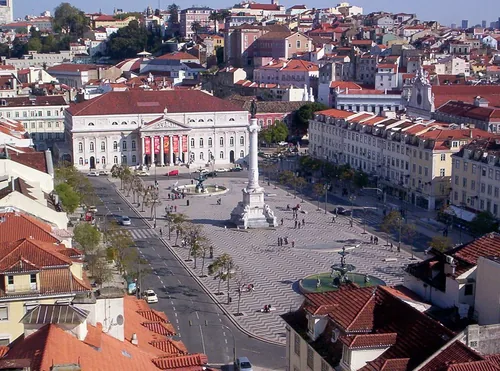
    Officially this is Praça de D. Pedro IV, named after King Pedro IV, whose column stands in the middle. Most people simply call it Rossio, a word close to the English “commons”: land that belonged to everyone. It has been one of Lisbon's main squares since the Middle Ages, when the city spread down from the castle hill into the lower ground, and today it's where locals and visitors alike arrange to meet. It's free and open around the clock.

    That easygoing role hides a harsh past. Rossio has seen popular revolts and celebrations, bullfights and executions. Around 1450 the Palace of Estaus was built on the north side to lodge foreign dignitaries and noblemen; once the Inquisition was installed in Lisbon, the palace became its seat and the square its stage for public executions. The first auto-da-fé took place in 1540.

    The eastern side once held something kinder: the All-Saints Royal Hospital, ordered by King John II in 1492 and finished in 1504 under Manuel I. Old pictures show a long building with an arched gallery, and the portal of its chapel, facing the square, had a magnificent Manueline façade. The Convent of St Dominic had been founded by the Rossio as early as the 13th century.

    Look toward the northeastern corner for a red early 18th century façade, strictly speaking on the neighbouring St Domingo Square. This is the Palace of the Almadas, where Portuguese noblemen met in 1640 to conspire against Spain; their plot led to Portugal's independence from Spanish rule, which is why the building is also called the Palace of Independence.

    From here the route climbs 630 m, about 11 minutes, to Miradouro de São Pedro de Alcântara, passing Sao Roque Church on the way.

    Local name
    Praça de D. Pedro IV
    Hours
    Open 24/7
    Price
    Free
  4. 4

    Miradouro de São Pedro de Alcântara

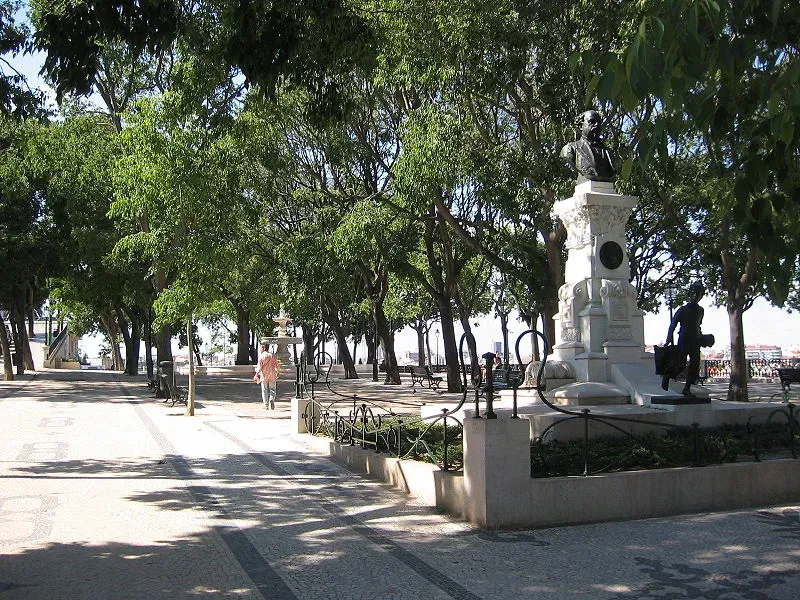
    Miradouro de São Pedro de Alcântara in Lisbon, stop 4 on the self-guided walking tour

    After the climb you reach a garden laid out on two terraces, with benches, shady trees, a small pond and a balustrade looking out over the city: part of the Baixa at your feet and the south bank of the Tagus beyond. It's free, open around the clock and a good place to sit for a quarter of an hour.

    Use the azulejo map by the balustrade to pick out the landmarks. The walls of São Jorge Castle rise among trees, and you can find the 12th century Sé, Lisbon Cathedral, which you'll reach later on the walk. Further along stand the 18th century church of Penha de França and the large complex of the Graça church, while São Vicente de Fora is easy to recognise by the symmetrical towers framing its white façade.

    The spot almost never became a garden. In the 18th century King João V had a 20 m wall built here for a Mãe de Água, a monumental reservoir that would have extended the Águas Livres aqueduct to Graça, following a design by João Pedro Ludovice, son of the architect of Mafra. The 1755 earthquake set other priorities, and for years the ground served as a dump where dead animals were thrown off the wall. In 1830 the Royal Police Guard, quartered close by, turned it into their vegetable patch; five years later, after the victory of Liberalism, the city council claimed it as a public garden, built in 1864 on the two terraces you see today.

    Before you leave, find Costa Motta's 1904 monument to Eduardo Coelho, founder of the Diário de Notícias newspaper, with a newsboy at his feet crying out the paper. If you come back another day and would rather not walk up, the Elevador da Glória leaves you close to the miradouro.

    Next is Convento do Carmo, 670 m and about 9 minutes away.

    Local name
    Jardim de São Pedro de Alcântara
    Hours
    Open 24/7
    Price
    Free
  5. 5

    Convento do Carmo

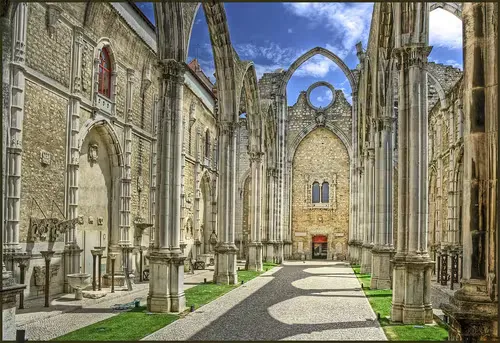
    Convento do Carmo in Lisbon, stop 5 on the self-guided walking tour

    The Gothic church of Convento do Carmo was ruined in the wake of the 1755 earthquake, and what remains is the main trace of that disaster still visible in the old city. Where most stops on this walk show you how Lisbon rebuilt, this one shows you what was lost.

    The convent was founded in 1389 by the Constable Nuno Álvares Pereira, the king's supreme military commander, on land acquired from his sister Beatriz Pereira and the admiral Pessanha. Building began in 1393; by 1407 the presbytery and apse were finished and the first services were held, and by 1423 the friars' cells were ready for Carmelites from Moura. Among them was Father Nuno de Santa Maria, none other than the Constable himself, who gave his wealth to the convent and entered it. By 1551 it housed 70 clergy and 10 servants.

    The earthquake destroyed the library with its roughly 5000 volumes, and the 126 clerics living here had to leave, first for Cotovia, then for Campo Grande. What followed was a string of makeshift uses: roof tiles repaired in 1800, the Royal Police Guard moving in ten years later, a sharpshooter battalion garrisoned in 1814 and the militia in 1831, and in 1834 an adaptation to house a district law court.

    Entry is charged, with reductions for students, seniors and residents of Portugal, and children enter free. Allow about 45 minutes. It's worth it for anyone who wants to stand inside the earthquake's story rather than just read about it.

    From Carmo the route drops back into the Baixa: 660 m, about 9 minutes, to the Rua Augusta Arch, where you'll meet Nuno Álvares Pereira again, this time in stone.

    Hours
    Nov–Apr: Mon–Sat 10:00–18:00 (last admission 17:40); May–Oct: Mon–Sat 10:00–19:00 (last admission 18:40); Sundays, Christmas, New Year and 1 May closed
    Price
    7 EUR; students, seniors 65+ and residents of Portugal 5 EUR; under 15 free
  6. 6

    Rua Augusta Arch

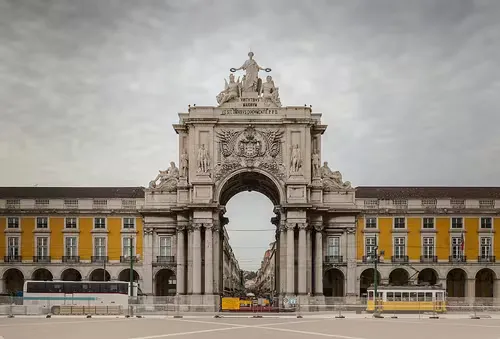
    Rua Augusta Arch in Lisbon, stop 6 on the self-guided walking tour

    The triumphal arch spans Rua Augusta on the north side of Praça do Comércio and works as the gateway to the Baixa. It was planned in 1759 as part of the Pombaline rebuilding after the 1755 earthquake, to a design by Eugénio dos Santos.

    It took its time. Composite columns went up in 1815, but until 1843 the arch only reached as far as its cornice, still waiting for its crown. A competition for the finish was won by the architect Veríssimo José da Costa; photographs show the arch already closed in 1862 for the wedding of King Luís I, yet the work was only completed in 1873.

    Look up at the sculpture. At the top, figures by Célestin Anatole Calmels show Glory crowning Genius and Valour. Lower down, Vítor Bastos carved Nuno Álvares Pereira, Viriato, Vasco da Gama and the Marquis of Pombal, plus two reclining rivers: the Tagus on the left, the Douro on the right, the rivers said to frame the land of the ancient Lusitanians. The Latin inscription reads VIRTVTIBVS MAIORVM VT SIT OMNIBVS DOCVMENTO.PPD, “to the virtues of the great, as a lesson to all, dedicated at public expense”, a nod to the grandeur of the Portuguese empire.

    Since 9 August 2013 a viewpoint at the top has been open to visitors, and 130,000 people went up in its first year; in 2021 the city took over the arch from the national government. The rooftop has a small entry fee. It's worth it if you want a raised look at the river end of the Baixa; if you've already had your fill of views at the castle and São Pedro de Alcântara, the free view from the square is enough.

    Walk through the arch: Praça do Comércio is only 180 m away, about 2 minutes.

    Local name
    Arco da Rua Augusta
    Hours
    Daily 10:00–19:00, last admission 18:30
    Price
    Arch rooftop visit: 5 EUR ; viewing the exterior from the public square is free.
  7. 7

    Praça do Comércio

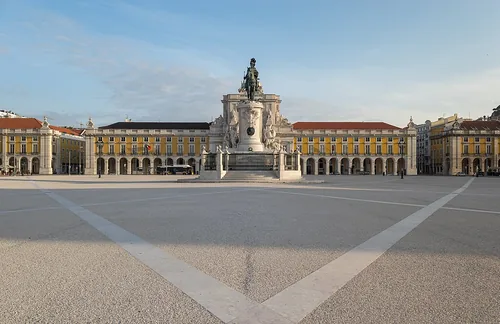
    Praça do Comércio in Lisbon, stop 7 on the self-guided walking tour

    Many people still call this square by its old name, Terreiro do Paço, the palace yard. It opens onto the Tagus, covers about 36,000 m², roughly 180 by 200 m, and counts among the largest squares in Europe; 79 arches line its sides. It's free and open at all hours.

    The name tells the story. In 1511 King Manuel I moved his residence from São Jorge Castle, where you started this morning, down to the river, and for about two centuries the royal Paço da Ribeira stood here. The 1755 earthquake destroyed it together with its library of 70,000 volumes. In the rebuilding, coordinated by Eugénio dos Santos, the square became the centrepiece of the Marquis of Pombal's plan. In the middle rides King José, an equestrian statue unveiled on 6 June 1775 by Joaquim Machado de Castro, the leading Portuguese sculptor of the 18th century.

    The south side, with its two square towers, faces the Tagus. For a long time this was Lisbon's noble entrance: at the Cais das Colunas, heads of state and other notable guests came ashore from the river and were received. After the 1910 revolution the buildings were painted pink; recently they've gone back to their original yellow. For decades they housed ministries, and today government departments share them with cultural venues, hotels, restaurants and cafés, among them Martinho da Arcada, the oldest café in Lisbon and a favourite of Fernando Pessoa.

    Hard to picture now, but the square served as a car park until the 1990s; today the open space hosts cultural events and shows. Enjoy it from the middle, and save your lunch money for a tasca rather than the terraces here.

    Lisbon Cathedral is 540 m away, about 9 minutes on foot.

    Hours
    Open 24/7
    Price
    Free
  8. 8

    Lisbon Cathedral

    Lisbon Cathedral, stop 8 on the self-guided walking tour

    The Sé is the oldest church in Lisbon, begun in 1147, the year the castle fell. After the reconquest an English crusader, Gilbert of Hastings, was installed as bishop, and the new cathedral rose on the site of the city's main mosque. Lisbon had been a bishopric since the 4th century, but from the 8th to the 12th century the city was under Moorish rule, though Christians were allowed to live there.

    The first building, in Late Romanesque style, was finished in the early decades of the 13th century, when the relics of St Vincent of Saragossa, Lisbon's patron saint, were brought here from southern Portugal. In the late 13th century King Dinis added a Gothic cloister, and his successor Afonso IV turned the main chapel into a Gothic royal pantheon for himself and his family. The cathedral has survived many earthquakes and been altered and restored several times, which is why you see a mix of styles. It's the seat of the Patriarchate of Lisbon and a National Monument since 1910.

    One chapel of the cloister holds a quieter piece of history: in 1498 Queen Eleanor of Viseu founded a brotherhood there that grew into the Santa Casa da Misericórdia de Lisboa, a Catholic charity that spread to other cities and played a major role in Portugal and its colonies.

    The cathedral charges adults for entry, and half an hour is enough to see the cloister and the royal chapel if medieval Lisbon interests you.

    From the cathedral the lane climbs again: 390 m, about 7 minutes, to Miradouro das Portas do Sol.

    Local name
    Sé de Lisboa
    Hours
    Nov–Apr: Mon–Sat 10:00–18:00; May–Oct: Mon/Tue/Thu/Fri 09:30–19:00, Wed+Sat 10:00–18:00; Sundays and church holidays closed
    Price
    7 EUR adults
  9. 9

    Miradouro das Portas do Sol

    Miradouro das Portas do Sol in Lisbon, stop 9 on the self-guided walking tour

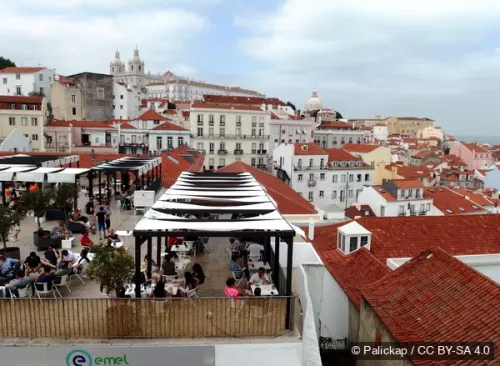
    Miradouro das Portas do Sol is the first of two farewell terraces on this walk, and after the ticketed cathedral it asks nothing of you except to stand still for a moment. It's free and always open.

    Catch your breath here before the finish. The last stretch runs only 200 m, about 3 minutes along the hill, to Miradouro de Santa Luzia.

    Hours
    Open 24/7
    Price
    Free
  10. 10

    Miradouro de Santa Luzia

    Miradouro de Santa Luzia in Lisbon, stop 10 on the self-guided walking tour

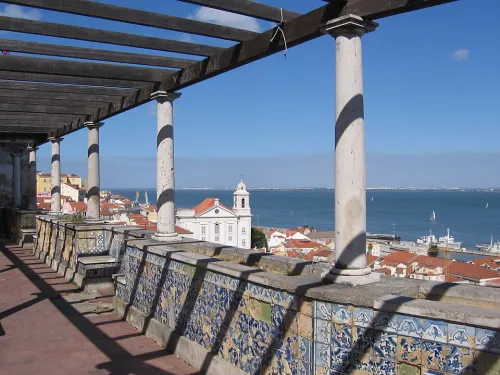
    The walk ends with a wide view over Alfama and the Tagus. Read the skyline from left to right: the dome of Santa Engrácia, the church of Santo Estêvão and the two white towers of the church of São Miguel. It's free and open around the clock.

    Look at the terrace wall before you look out. Two modern azulejo panels tie the whole walk together: one shows Praça do Comércio as it was before the earthquake, the other the Christians storming São Jorge Castle, the siege where your morning began. Both are by António Quaresma and were made at the Fábrica Viúva Lamego.

    The small church here is the Igreja de Santa Luzia e São Brás, once head of the old commandery of São Brás and today the national seat of the Portuguese Assembly of the Knights of the Sovereign Military Order of Malta.

    This is the end of the route. Stay for the view as long as you like; when you're ready, the GPS navigation in your browser can guide you back to the castle.

    Hours
    Open 24/7
    Price
    Free
Walking tour route map of Lisbon Route loaded
São Jorge CastleSanta Justa ElevatorRossio SquareMiradouro de São Pedro de Alcântara+6
All 10 stops are already on the map.
You just press start.
AI Tour Guide

You know the way from the castle to Santa Luzia. Now walk it with a guide in your ear.

Press start wherever you are, even hundreds of kilometres from Lisbon, and the guide begins telling its stories right away. In the city, pick any of the 10 stops to start from: it leads you there, then talks with you the whole route, asking, listening, remembering, and shaping the tour around your answers.

10stops 4.8km 1 h 13 minwalking 13languages
▶Start the tour free

Free to start · Runs in your browser · No app, no download

Shorter Ways to Walk Lisbon

Not every day has five hours to spare. These three cuts follow the same streets in the same order, so the GPS route still works for each of them.

Baixa and Carmo in a morning

Stops: 2, 3, 4, 5, 6, 7

For anyone who wants the lower town, a big viewpoint and the earthquake ruin without the castle. Start at the Santa Justa Elevator and finish on Praça do Comércio: 34 minutes of walking. Entry costs come from Convento do Carmo and, if you want it, the arch rooftop.

From the river to the Alfama viewpoints

Stops: 7, 8, 9, 10

For a short afternoon or a first evening: the great square, the cathedral and two free terraces. Only 19 minutes of walking; the one ticket is Lisbon Cathedral.

Lisbon without a single ticket

Stops: 2, 3, 4, 5, 6, 7, 8, 9, 10

For a tight budget: skip the castle and see Convento do Carmo, the arch and the cathedral from outside. 53 minutes of walking from the Santa Justa Elevator to Santa Luzia, and every stop costs nothing.

How Long This Lisbon Tour Takes, Castle Visit Included

The pure walking time is 1 h 13 min. Add about an hour and a half for the castle, 45 minutes for Convento do Carmo, half an hour for the cathedral, 20 minutes on the arch rooftop and short pauses at the free stops, and you're looking at about five and a half hours without lunch. Start at the castle at 09:00 and you'll reach Convento do Carmo shortly before 11:50, pass under the Rua Augusta Arch around 12:40 and stand on Praça do Comércio a little after 13:00, right at lunchtime, so plan your meal at a tasca rather than on the square. You arrive at Santa Luzia shortly after 14:15; a sit-down lunch adds about an hour.

The cuts are much lighter. The Baixa and Carmo morning takes about two hours with both tickets, the river to Alfama stretch about an hour and a half with the cathedral, and the ticket-free version a little over two hours with pauses.

Before You Set Off in Lisbon

  • Start and finish: The recommended start is São Jorge Castle, though you can join at any stop. The walk ends at Miradouro de Santa Luzia, and the GPS navigation in your browser can guide you back to the start if you wish.
  • Best day and time: Pick a day when Convento do Carmo and Lisbon Cathedral are open. Begin in the morning, as soon as the castle is open.
  • Entry costs: Four visits charge admission: castle, Carmo, arch rooftop and cathedral. Rossio, Praça do Comércio and the three viewpoints cost nothing.
  • Getting to the start: If you ride tram 28E, load a Zapping card beforehand: each ride costs far less than paying the driver.

Food and Breaks Along the Lisbon Route

Lunch, coffee and water decide what this walk really costs you, and the good value sits in neighbourhood tascas and pastelarias rather than on the showpiece squares.

Prato do dia at a tascaAround Praça do Comércio a tourist restaurant lunch is expensive; a full dish of the day at a tasca in Mouraria or Intendente costs far less. Check what the daily offer includes, drink and portion size, before you order. One address is Zé dos Cornos at Beco dos Surradores 5, where you can order ribs with rice or salad.
Galão at a pastelaria counterA café on Praça do Comércio charges far more for a galão, Portugal's milky coffee, than a local counter does; pick a pastelaria with a posted price list and enjoy a slice of everyday Lisbon breakfast culture.
Refill your water bottleLisbon's tap water is safe to drink. Fill your own bottle from the tap or at a designated drinking fountain (the water company EPAL maps them), never at decorative fountains, instead of paying for a small bottle at a tourist kiosk.

Tourist Traps to Avoid in Lisbon's Baixa

  • Imperial on a tourist terrace: A small draught beer, an imperial, costs far more on the terraces here than in a neighbourhood tasca. It's the same Super Bock or Sagres; just compare the glass size. (Rua Augusta)
  • Paying for a rooftop view: Some rooftop bars ask a minimum spend per person before you see their panorama. On this walk Miradouro de São Pedro de Alcântara and Miradouro de Santa Luzia give you roofs and river for nothing.
  • Decorative sardine tins: Designer tins in souvenir shops cost far more than standard Portuguese sardines in a supermarket. If you want to eat them, compare ingredients, origin and weight; if the pretty design is the point, that's a different purchase.
Walking tour route map of Lisbon
AI Tour Guide

Your guide is ready whenever you reach the first stop.

Press start and a voice AI Tour Guide takes it from here: leading the route through Lisbon, telling the stories, and turning your walk into a real back-and-forth conversation. No app or download is needed; it runs in your browser.

10stops 4.8km 1 h 13 minwalking 13languages
▶Start the tour free

Free to start · Runs in your browser · No app, no download

What the AI Tour Guide Adds on Lisbon's Hills

This route keeps crossing two great stories, the conquest of 1147 and the earthquake of 1755, and the AI Tour Guide follows whichever one hooks you. It greets you at the castle, tells the stories as you walk, asks what you're curious about and remembers it at the next stop. It's also there for what the walk raises but doesn't settle: who Viriato was and why he stands on the arch, what an auto-da-fé on Rossio actually involved, or what Fernando Pessoa wrote in his Lisbon years. You start with 100 free credits; after that it's €19.99 for this tour with no time limit, or €5 per hour.

A Real Conversation A voice AI Tour Guide greets you, leads the whole route, and tells the stories and facts as you walk, asking what you want to see and keeping a real conversation going. Not a recording you press play on.
Map Navigation Follow the route on the map and walk at your own pace. You choose where to start and when to move to the next stop.
Ask Anything Curious about a building you pass? Ask your AI Tour Guide on the spot and the conversation carries on.
13 Languages Switch language anytime. No separate tour needed.
Start free in your browser

Common Questions Before Walking Lisbon

Is the Lisboa Card worth it for this walk?

Only if you also visit the Jerónimos Monastery within the same 24 hours. The 24h Lisboa Card covers the castle, the monastery and public transport, and bought separately those three cost more than the card. For the castle plus transport alone you'd pay less without the card, so skip it then. Note that the card has to be collected in person.

Should I buy a 24-hour ticket for trams and metro?

The Carris/Metro 24h ticket covers metro, regular buses and trams. Compared with Zapping fares it only pays off from five separately charged rides. A new card costs a little extra.

What's a good trip from Lisbon after this walk?

Sintra is only 24 km away and has its own self-guided route. With more time, Porto or Coimbra make a fine next city.

Is the tour really free?

Yes. The whole tour is free: the route, the interactive map and the navigation cost you nothing. Only the voice AI Tour Guide is optional and paid: you test it with 100 free credits, then you pay either €5 per hour or €19.99 for this whole tour, with no time limit. Admission to 3 of the 10 stops is not included: São Jorge Castle, Convento do Carmo and Lisbon Cathedral charge their own entry fees.

Do I need to download an app?

No. Everything runs in your phone browser. Open the route and start walking, no download and no sign-up required.

Do I need to book the walking tour in advance?

No booking needed. This self-guided tour is available anytime. Open the route in your browser and start walking. The AI Tour Guide works instantly, no app, no reservation required.

What languages is the AI Tour Guide available in?

The AI Tour Guide speaks 13 languages, so you take the tour in your own language and can switch at any time.

Can I skip stops or change the route?

Yes. Skip any stop, spend extra time at places you like, or start the route from any point. It is your walk, you set the pace.
Image credits
▶ Start free in your browser Runs in your browser, no app, no download