



Historic Charleston City Market
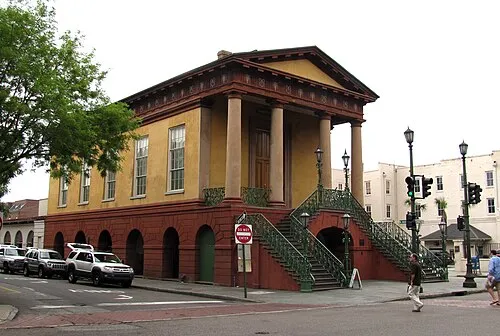
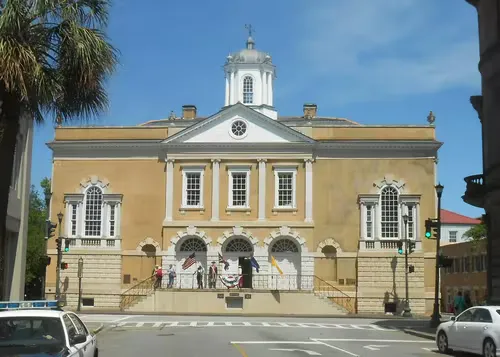
You begin at Market Hall, the temple-like building facing Meeting Street. It sits on a raised, rusticated arcade, and its portico is carried by four Roman Doric columns under a pediment. The cornice and the capitals are red sandstone. Now look up at the frieze: between the triglyphs, ox skulls alternate with rams' heads. They were a signboard in stone, telling everyone this was a meat market. Charleston architect Edward B. White designed the hall in the early 1840s, borrowing from Greek and Roman temples such as the Temple of Portunus in Rome.
The market itself is older. It was set up in the 1790s as the Centre Market, replacing the city's Beef Market, which burned in 1796 on the spot where City Hall stands today. Behind the hall, a continuous line of one-story sheds runs for four city blocks until it ends at East Bay Street. Through the 19th century, farms and plantations sold beef and produce here, and locals came as much to talk as to shop. Since 1899 Market Hall has also held Charleston's Confederate Museum.
One thing worth knowing before you walk through: enslaved people were never sold in the City Market. It is a widespread misconception. Those sales happened at the Old Slave Mart, a different building that is now a museum.
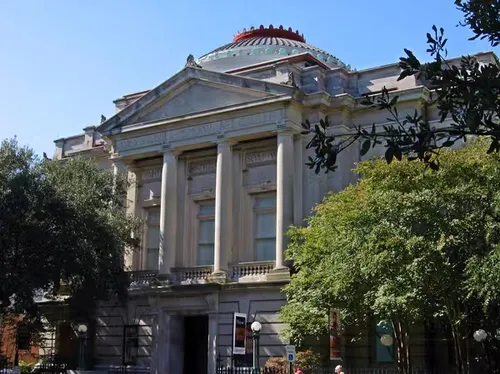
Today the sheds are lined with vendors selling souvenirs, jewelry and Gullah sweetgrass baskets. The whole complex, hall and sheds, is a National Historic Landmark, and walking through is free. Give it about 20 minutes. From here it is 320 m, 4 minutes on foot, to the Gibbes Museum of Art.