Free Walking Tour Washington, D.C.: Capitol to Lincoln

Fifteen stops around the National Mall, from Congress to Lincoln's classical temple, with free museums, presidential history and memorials at your own pace.

15 Stops 11.6 km ~2 h 41 min walking
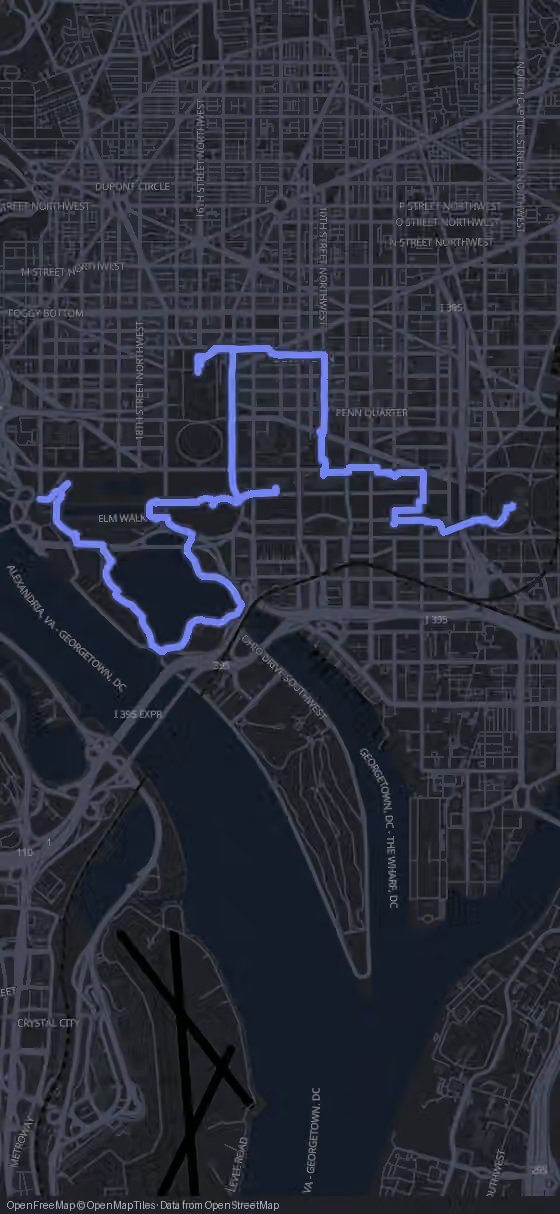
Route map for the Washington, D.C. walking tour
Stop 1 of 15
1.1 km·14 min
United States Capitol

Head west toward the National Air and Space Museum
Welcome to Washington, D.C. I'm Alex, and one of the Mall's most powerful memorials began with a student.
Try this tour with Alex

The Route at a Glance: Capitol Hill to the Lincoln Memorial

Fifteen stops on foot from the United States Capitol to the Lincoln Memorial: 11.6 km, 2 h 41 min of pure walking, and realistically a full day once you go inside a museum or two. Every stop is free to enter; Ford's Theatre and the Washington Monument only charge a small fee if you reserve online.

The route, map and GPS navigation are free in your browser and lead you from stop to stop. If you want company, the optional AI Tour Guide tells the stories as you walk, asks what interests you and follows your lead.

Open free GPS & optional AI Tour Guide
View of Washington, D.C.

The Route

Walking Map of Washington, D.C.: Capitol, Museums and Memorials

15 stops 11.6 km 2 h 41 min walking
Tap to load interactive map

The 15 stops along this route

  1. United States Capitol in Washington, D.C., stop 1 on the self-guided walking tour
    1United States Capitol
  2. National Air and Space Museum in Washington, D.C., stop 2 on the self-guided walking tour
    2National Air and Space Museum
  3. National Gallery of Art in Washington, D.C., stop 3 on the self-guided walking tour
    3National Gallery of Art
  4. National Archives Museum in Washington, D.C., stop 4 on the self-guided walking tour
    4National Archives Museum
  5. National Museum of Natural History in Washington, D.C., stop 5 on the self-guided walking tour
    5National Museum of Natural History
  6. Ford's Theatre in Washington, D.C., stop 6 on the self-guided walking tour
    6Ford's Theatre
  7. White House in Washington, D.C., stop 7 on the self-guided walking tour
    7White House
  8. National Museum of American History in Washington, D.C., stop 8 on the self-guided walking tour
    8National Museum of American History
  9. Washington Monument in Washington, D.C., stop 9 on the self-guided walking tour
    9Washington Monument
  10. World War II Memorial in Washington, D.C., stop 10 on the self-guided walking tour
    10World War II Memorial
  11. Jefferson Memorial in Washington, D.C., stop 11 on the self-guided walking tour
    11Jefferson Memorial
  12. Martin Luther King Jr. Memorial in Washington, D.C., stop 12 on the self-guided walking tour
    12Martin Luther King Jr. Memorial
  13. Korean War Veterans Memorial in Washington, D.C., stop 13 on the self-guided walking tour
    13Korean War Veterans Memorial
  14. Vietnam Veterans Memorial in Washington, D.C., stop 14 on the self-guided walking tour
    14Vietnam Veterans Memorial
  15. Lincoln Memorial in Washington, D.C., stop 15 on the self-guided walking tour
    15Lincoln Memorial
  16. That's the full route.

    Walk it with an AI Tour Guide talking you through every one of these streets.

    Start free in your browser
    You made it

Your Washington, D.C. Walking Tour, From Congress to Lincoln

  1. 1

    United States Capitol

    United States Capitol in Washington, D.C., stop 1 on the self-guided walking tour

    Start at the white neoclassical building that Washington literally counts from. The United States Capitol, seat of Congress, sits on Capitol Hill at the eastern end of the National Mall. It is no longer at the geographic center of the city, but it is still the origin point of the street numbering and of the four quadrants, so every NW or SW address you pass today is measured from here. Above it rises the massive dome, completed around 1866, just after the Civil War.

    The central sections were ready in 1800, and on November 17 of that year the 6th Congress met here for the first time, which moved the national capital from Philadelphia to Washington. Only fourteen years later British forces set the building partly on fire during the Burning of Washington in 1814; within five years it was fully restored. As new states joined the union, the wings grew outward for the two chambers: the House of Representatives in the south wing, the Senate in the north wing.

    Both long sides are formally called fronts. The east front was the one meant to receive visitors and dignitaries, and its portico was extended in 1958; the west front is where presidential inauguration ceremonies take place today. Building and grounds are looked after by the Architect of the Capitol, who also oversees the surrounding Capitol Complex.

    Going inside is free and begins at the Visitors Center, added in the early 21st century. If you want to see where the country's laws are made, give it around an hour. From here the route heads down the Mall for 1110 m, about 15 minutes, to the National Air and Space Museum, passing the National Museum of the American Indian on the way.
    Hours
    Mon–Sat 08:30–16:30, Sun closed
    Price
    Free
  2. 2

    National Air and Space Museum

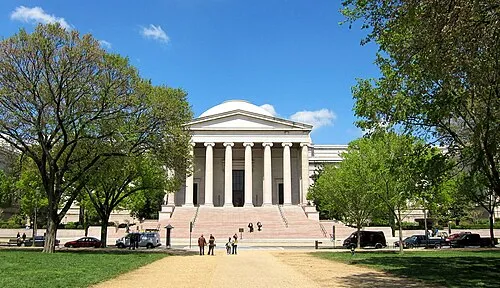
    National Air and Space Museum in Washington, D.C., stop 2 on the self-guided walking tour

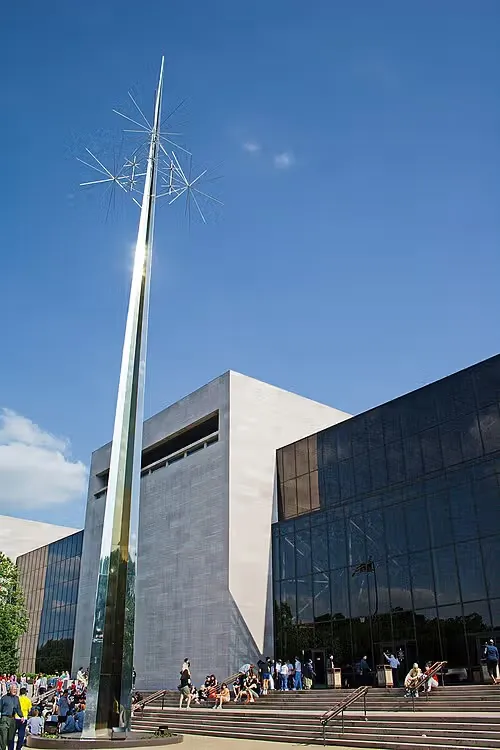
    Almost every aircraft and spacecraft in this museum is the real thing: original craft or their backups, not replicas. Near the entrance waits the Wright brothers' Wright Flyer. The collection also includes the Apollo 11 Command Module Columbia, the Friendship 7 capsule John Glenn flew, Charles Lindbergh's Spirit of St. Louis and, for science fiction fans, the model of the starship Enterprise used in Star Trek: The Original Series.

    The Smithsonian founded it in 1946 as the National Air Museum, and the building on the Mall near L'Enfant Plaza opened in 1976. It is also a research center for the history and science of aviation and spaceflight, for planetary science and for the geology and geophysics of our own planet. In 2023 it welcomed 3.1 million visitors, the fourth-highest number of any museum in the United States.

    Since 2018 the Mall building has been going through a major renovation, with galleries reopening in phases, so what you see depends on which halls are open when you visit. In October 2025 the federal government shutdown closed the museum for a while before it reopened.

    Entry is free, and it is the obvious pick for families and anyone who ever wanted to fly; even a short loop past the Wright Flyer is worth it. Then walk 800 m, about 11 minutes, to the National Gallery of Art.

    Hours
    Daily 10:00–17:30, Dec 25 closed
    Price
    Free
  3. 4

    National Archives Museum

    National Archives Museum in Washington, D.C., stop 4 on the self-guided walking tour

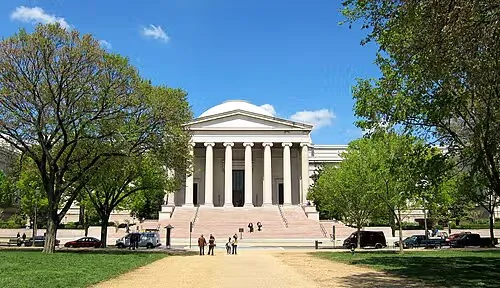
    After the big museums, this is the easiest stop of the day: entry is free, you need no ticket, and reservations are optional, though worth making when the Mall is at its busiest. What this building keeps is the national record.

    In 2026, the nation's 250th anniversary year, the America 250 festival places its Independence programming on this stretch of Constitution Avenue, with exhibits tied to the Declaration of Independence. If your visit falls on an anniversary weekend, this usually quiet block can become the center of the city for a few days.

    The National Museum of Natural History is just 300 m away, about 4 minutes on foot.

    Hours
    Daily 10:00–17:30, Thanksgiving and Dec 25 closed
    Price
    Free
  4. 5

    National Museum of Natural History

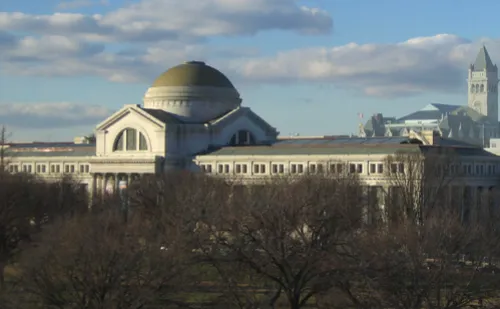
    National Museum of Natural History in Washington, D.C., stop 5 on the self-guided walking tour

    More than 148 million specimens of plants, animals, fossils, minerals, rocks, meteorites, human remains and cultural artifacts make this the largest natural history collection in the world. Most of the building is working space rather than galleries: of its 1.5 million square feet, 325,000 are for exhibitions and the public. Behind the scenes work over 1,000 employees, among them about 185 professional scientists, the largest group in the world devoted to natural and cultural history.

    The museum's roots go back to 1846, when the United States National Museum was founded as part of the Smithsonian. Its collections first lived in the Smithsonian Castle, and a formal exhibit hall opened in 1858. Then came the National Museum Building, today the Arts and Industries Building, built in just 15 months and opened in March 1881.

    The collection kept growing, and on June 28, 1902, Congress authorized yet another building. A committee soon asked for a much larger structure than first planned, the regents chose a site on the north side of B Street NW, and the D.C. firm Hornblower & Marshall designed it. It opened in 1910 as one of the first Smithsonian buildings made purely for the national collections and research.

    Entry is free, and with 3.3 million visits in 2025 you will not have it to yourself. Rather than trying to see everything, pick one theme and let the rest go. Then walk 560 m, about 8 minutes, to Ford's Theatre.

    Hours
    Daily 10:00–17:30, Dec 25 closed
    Price
    Free
  5. 6

    Ford's Theatre

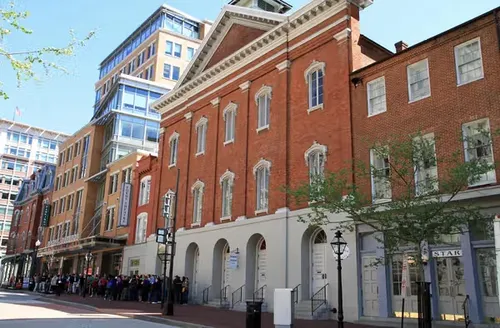
    Ford's Theatre in Washington, D.C., stop 6 on the self-guided walking tour

    The building began as a house of worship: built in 1833 as the second meeting house of the First Baptist Church of Washington, with Obadiah Bruen Brown as pastor. When the congregation moved in 1861, John T. Ford bought the old church and turned it into a theater, first called Ford's Athenaeum. Fire destroyed it in 1862; he rebuilt, and the new house opened in 1863.

    On April 14, 1865, five days after General Lee's surrender at Appomattox Court House, Abraham Lincoln came to see Tom Taylor's play Our American Cousin. John Wilkes Booth entered the presidential box and shot him in the back of the head with a derringer. Booth stabbed Major Henry Rathbone, who came at him, leapt from the box onto the stage and escaped through the back of the theater, stabbing orchestra leader William Withers Jr. on the way. About 1,700 people saw it happen, possibly including five-year-old Samuel J. Seymour, who claimed to be the last living witness until his death in 1956.

    The unconscious president was carried across the street to the Petersen House, where he died the next day. The theater afterwards served as a warehouse and government offices, and in 1893 part of its interior floor collapsed, killing 22 people. It became a museum in 1932 and a working theater again in 1968; in 2012 the Center for Education and Leadership opened next to the Petersen House. Theater and house are preserved together as a National Historic Site run by the National Park Service.

    Walk-up entry is free; reserving a time online carries a small fee. If the Lincoln story draws you in, going inside is a must. Next comes a 1450 m walk, about 21 minutes, to the White House, passing the National Museum of Women in the Arts.

    Hours
    Daily 09:00–17:00, Thanksgiving and Dec 25 closed
    Price
    Free walk-up, $5 online reservation fee
  6. 7

    White House

    White House in Washington, D.C., stop 7 on the self-guided walking tour

    At 1600 Pennsylvania Avenue NW stands the home and workplace of every American president since John Adams, who moved in in 1800 when the capital came from Philadelphia. The name also stands for the Executive Office of the President. The Irish-born architect James Hoban designed it in neoclassical style and modeled it on Leinster House in Dublin, which today houses the Irish legislature. Its walls are Aquia Creek sandstone, painted white.

    Construction began in 1792 and was finished in 1800. When Thomas Jefferson moved in in 1801, he and his architect Benjamin Henry Latrobe added low colonnades on each wing to hide what were then stables and storage. The British fire of 1814 destroyed the interior and charred much of the outside; rebuilding started almost at once, and James Monroe moved into the partly reconstructed house in October 1817. The semicircular South Portico followed in 1824, the North Portico in 1829.

    The house kept changing with its occupants. Theodore Roosevelt, short of room, moved all offices into the new West Wing in 1901; in 1909 William Howard Taft enlarged it and created the first Oval Office, later moved and expanded. The attic became living quarters in 1927, the new East Wing was finished in 1946, and by 1948 engineers found the load-bearing walls and wooden beams close to failure.

    Visits inside are free but offered only at limited times, so check the current schedule well in advance; otherwise the outside and its story are reason enough to come. The walk to the National Museum of American History is the longest leg of the day: 1860 m, about 25 minutes.

    Hours
    Tue–Thu 07:30–11:30, Fri–Sat 07:30–13:30, Sun–Mon closed
    Price
    Free
  7. 8

    National Museum of American History

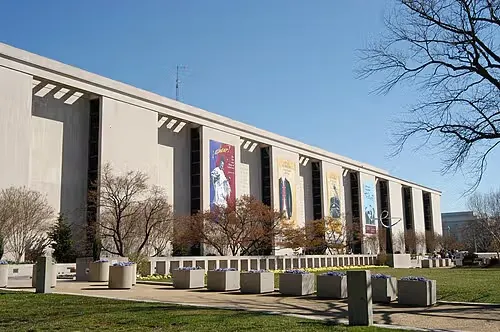
    National Museum of American History in Washington, D.C., stop 8 on the self-guided walking tour

    The star of this museum is a single object: the original Star-Spangled Banner. Around it the museum collects the social, political, cultural, scientific and military heritage of the United States. It stands on the Mall at 14th Street and Constitution Avenue NW, and in 2023 it drew 2.1 million visitors.

    It opened in 1964 as the Museum of History and Technology, one of the last buildings by the firm McKim Mead & White, on a site that had held two temporary war buildings from 1942. In 1980 it took its current name to reflect its mission: objects that tell of the experience of the American people.

    History did not always leave the museum alone. In 1973, representatives of the Committee to Re-elect the President forced it to temporarily close the Right to Vote exhibit, designed by historian Edith Mayo, ahead of Richard Nixon's second inauguration. Between September 2006 and November 2008 the museum closed for a full renovation that added a five-story skylit atrium ringed by artifacts, a welcome center, six landmark objects to help you find your way and new galleries such as the Jerome and Dorothy Lemelson Hall of Invention.

    Entry is free. Even if you only have time to see the flag, it is worth going in. Then walk 570 m, about 8 minutes, to the Washington Monument.

    Hours
    Daily 10:00–17:30, Dec 25 closed
    Price
    Free
  8. 9

    Washington Monument

    Washington Monument in Washington, D.C., stop 9 on the self-guided walking tour

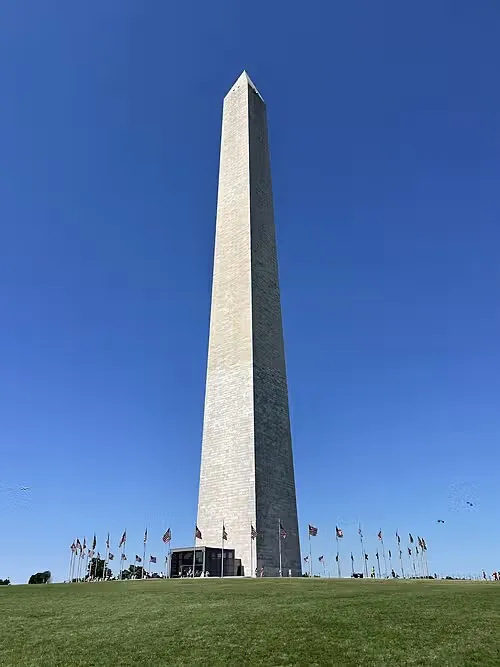
    Look closely at the white marble outside and you will notice it is not all the same: the facing uses three different kinds of marble, because construction kept stopping and starting. Work began in 1848, stalled in 1854 over money, a fight for control of the Washington National Monument Society and then the Civil War, and only resumed in 1877.

    Robert Mills from South Carolina drew the original design with a colonnade around the base, but funds ran out and the builders went ahead with a bare obelisk instead. The stone structure was finished in 1884, dedicated on February 21, 1885, and opened to the public on October 9, 1888. For a few years it was the tallest structure in the world, until the Eiffel Tower in Paris overtook it in 1889.

    The numbers are striking: a hollow Egyptian-style obelisk, 555 feet (169 m) tall, with a 500-foot column topped by a 55-foot pyramidion. The walls taper as they rise, and at the very top sits a marble capstone with a small aluminum pyramid inscribed on all four sides. It is the third tallest monumental column in the world. After the 2011 Virginia earthquake it closed for repairs until 2014, and again between 2016 and 2019.

    Walk-up entry is free; reserving online costs a small fee. From here it is 590 m, about 8 minutes, to the World War II Memorial.

    Hours
    Daily 09:00–17:00, Jul 4 and Dec 25 closed
    Price
    Free walk-up, $1 online reservation fee
    Website
    nps.gov ↗
  9. 10

    World War II Memorial

    World War II Memorial in Washington, D.C., stop 10 on the self-guided walking tour

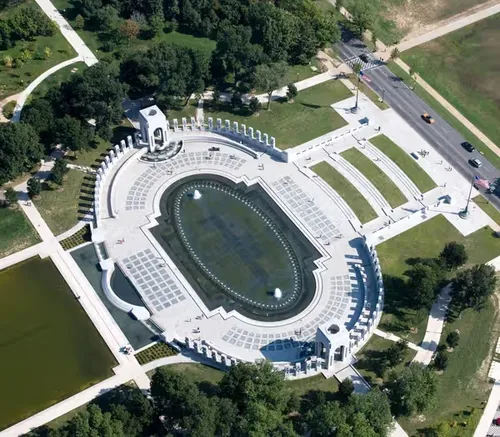
    You enter an oval plaza sunk 6 feet below the ground around it, with a fountain at its center. Around it stand 56 granite pillars, each 17 feet tall and hung with bronze laurel wreaths, one for each of the 48 states of 1945, the District of Columbia and the territories of the time, from Alaska and Hawaii to the Philippines, Puerto Rico, Guam, American Samoa and the U.S. Virgin Islands. Two 43-foot triumphal arches face each other: “Atlantic” on the north, “Pacific” on the south.

    On the short axis, in its own pool, is a wall of gold stars representing the fallen. Two-thirds of the 7.4-acre site is landscaping and water, and the memorial took the place of the Rainbow Pool at the eastern end of the Reflecting Pool.

    The memorial honors Americans who served in the armed forces and as civilians during the war. Austrian-American architect Friedrich St. Florian submitted the initial design; it opened on April 29, 2004, and President George W. Bush dedicated it on May 29, 2004. More than 4.6 million people visited in 2018.

    A small treasure hunt for kids and adults alike: somewhere in the memorial are two inconspicuous “Kilroy was here” engravings, a nod to the symbol American soldiers left wherever they went. Then comes a longer leg of 1700 m, about 23 minutes, to the Jefferson Memorial.

    Hours
    Open 24/7
    Price
    Free
    Website
    nps.gov ↗
  10. 11

    Jefferson Memorial

    Jefferson Memorial in Washington, D.C., stop 11 on the self-guided walking tour

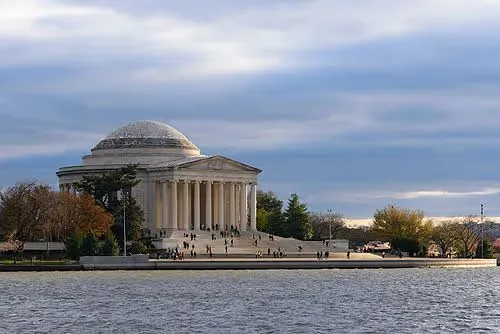
    A round, columned neoclassical temple on the shore of the Potomac River in West Potomac Park honors Thomas Jefferson, principal author of the Declaration of Independence and third president. Together with the White House, it forms one of the anchor points of the National Mall. The walls carry several of Jefferson's quotes, chosen to capture the ideas known as Jeffersonian democracy.

    The architect was John Russell Pope, the same New York architect who designed the West Building of the National Gallery of Art, and the builder was Philadelphia contractor John McShain. Pope drew on the Roman Pantheon and on Jefferson's own rotunda at the University of Virginia. Construction began in 1939 and finished in 1943, but the bronze statue of Jefferson was only added in 1947, four years after the dedication.

    The memorial is run by the National Park Service, listed on the National Register of Historic Places and ranked fourth on the American Institute of Architects' list of America's favorite architecture. Take time inside to read the quotes; they are the heart of the place.

    From here the route follows the water for 1200 m, about 16 minutes, to the Martin Luther King Jr. Memorial.

    Hours
    Open 24/7
    Price
    Free
    Website
    nps.gov ↗
  11. 12

    Martin Luther King Jr. Memorial

    Martin Luther King Jr. Memorial in Washington, D.C., stop 12 on the self-guided walking tour

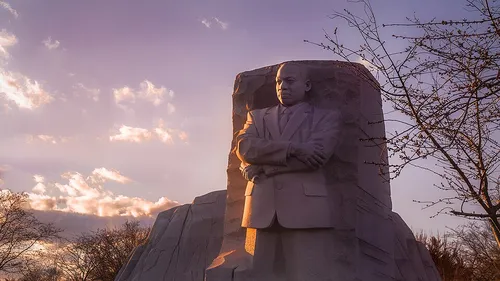
    The design grows out of one line from the “I Have a Dream” speech: “Out of the mountain of despair, a stone of hope.” At the center stands the Stone of Hope, a granite statue of Martin Luther King Jr. carved by sculptor Lei Yixin. The memorial covers four acres at the northwest corner of the Tidal Basin near the Franklin Delano Roosevelt Memorial, on a sightline linking the Lincoln Memorial and the Jefferson Memorial.

    Even the address tells a story: 1964 Independence Avenue S.W. commemorates the Civil Rights Act of 1964. The memorial opened on August 22, 2011, after more than two decades of planning, fundraising and building, as the 395th unit of the National Park Service. The dedication was set for August 28, 2011, the 48th anniversary of the speech, but Hurricane Irene pushed it to October 16, the anniversary of the 1995 Million Man March on the National Mall.

    King is the first African American honored with a memorial on or near the National Mall, and only the fourth person who was not a president. Then walk 420 m, about 6 minutes, to the Korean War Veterans Memorial.

    Hours
    Open 24/7
    Price
    Free
    Website
    nps.gov ↗
  12. 13

    Korean War Veterans Memorial

    Korean War Veterans Memorial in Washington, D.C., stop 13 on the self-guided walking tour

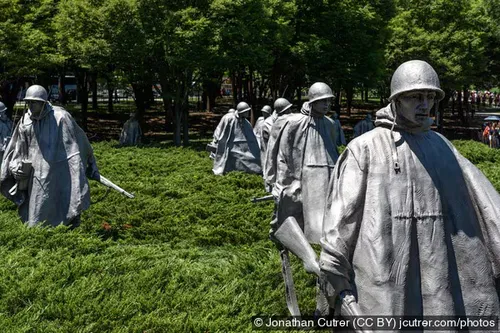
    Nineteen statues of American service members in action are the first thing you see here, south of the Reflecting Pool and southeast of the Lincoln Memorial. Since 2022 a granite wall adds the names of the U.S. military personnel who died in the war, along with South Koreans who served in U.S. units.

    Getting it built was a struggle. Congress authorized the memorial on April 20, 1986, and a team of four architects and landscape architects from Pennsylvania State University won the design competition that year. When it became clear their plan would have to change to satisfy the advisory board and reviewing bodies such as the Commission of Fine Arts, they withdrew, sued over the changes and lost. Cooper-Lecky Architects produced the final design, bringing several designers together.

    President George H. W. Bush broke ground on Flag Day, June 14, 1992. On July 27, 1995, the 42nd anniversary of the armistice, President Bill Clinton and South Korean President Kim Young Sam dedicated the memorial. Look for the list of builders on the memorial itself, from the Cold Spring Granite Company to the Tallix Art Foundry.

    Next is a 500 m walk, about 7 minutes, to the Vietnam Veterans Memorial.

    Hours
    Open 24/7
    Price
    Free
    Website
    nps.gov ↗
  13. 14

    Vietnam Veterans Memorial

    Vietnam Veterans Memorial in Washington, D.C., stop 14 on the self-guided walking tour

    Two walls of polished black granite cut into the ground of Constitution Gardens, just northeast of the Lincoln Memorial. They carry the names of the service members who died or remain missing from the war in Vietnam and Southeast Asia. Each wall is 246 feet 9 inches long, the same length as the pool at the World War II Memorial, and made of 72 panels, 70 of them inscribed.

    Walk it from one end to the other and the design works on you. The walls are only 8 inches high at their ends and 10.1 feet where they meet, and while their top edges stay level, their bottom edges sink below the ground. So you start at ground level, descend and come back up again, a shape meant as a wound that is closed and healing. The stone for all 144 panels came from Bangalore, India.

    American architect Maya Lin designed it, and the wall was completed in 1982. Its plain, minimalist look without heroic ornament was controversial at first, so the statue Three Soldiers was added in 1984 and the Vietnam Women's Memorial in 1993. Opinion turned: in 2007 the American Institute of Architects ranked it tenth on its list of America's favorite architecture, and around three million people come each year.

    The final leg is the shortest of the day: 260 m, about 4 minutes, to the Lincoln Memorial.

    Hours
    Open 24/7
    Price
    Free
    Website
    nps.gov ↗
  14. 15

    Lincoln Memorial

    Lincoln Memorial in Washington, D.C., stop 15 on the self-guided walking tour

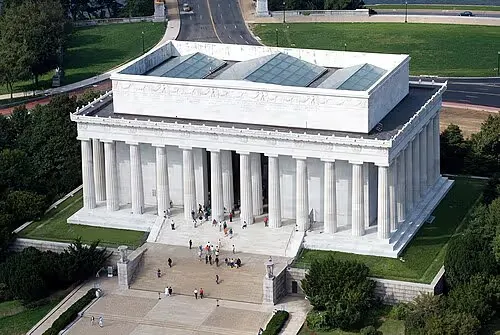
    The walk ends at the western end of the National Mall, in a classical temple lined with Doric columns, designed by Henry Bacon. Inside sits the large statue of Abraham Lincoln, designed by Daniel Chester French in 1920 and carved in marble by the Piccirilli brothers. Above it runs the epitaph by Royal Cortissoz, and Jules Guérin painted the murals.

    On the walls you can read two of Lincoln's best-known speeches, the Gettysburg Address and his second inaugural address. After Ford's Theatre earlier today, this is the other half of his story: the memorial was dedicated on May 30, 1922, and has drawn visitors ever since, more than seven million a year.

    It has also become a symbolic center for race relations and civil rights. Here, on August 28, 1963, at the end of the March on Washington for Jobs and Freedom, Martin Luther King Jr. gave his “I Have a Dream” speech. The memorial has been on the National Register of Historic Places since October 15, 1966, and ranked seventh on the American Institute of Architects' 2007 list of America's favorite architecture.

    Before you leave, turn around: the Reflecting Pool leads your eye back to the Washington Monument, and beyond it to where you started at the Capitol.

    Hours
    Open 24/7
    Price
    Free
    Website
    nps.gov ↗
Walking tour route map of Washington, D.C. Route loaded
United States CapitolNational Air and Space MuseumNational Gallery of ArtNational Archives Museum+11
All 15 stops are already on the map.
You just press start.
AI Tour Guide

You know the route now. Walk it with a guide in your ear.

Press start wherever you are, even hundreds of kilometres from Washington, D.C., and the guide begins telling its stories right away. In the city, pick any of the 15 stops to start from: it leads you there, then talks with you the whole route, asking, listening, remembering, and shaping the tour around your answers.

15stops 11.6km 2 h 41 minwalking 13languages
▶Start the tour free

Free to start · Runs in your browser · No app, no download

Shorter Ways to Walk Washington, D.C.

Fifteen stops in one day is a lot. If you have less time or a clear interest, these three sections of the route work well on their own.

The museum stretch

Stops: 1, 2, 3, 4, 5

For museum lovers and families: the Capitol and four free museums close together on the Mall. Only 34 minutes of walking, so nearly all your time goes into the collections. No entry fees anywhere.

Presidents and power

Stops: 6, 7, 8, 9

For history fans: the place where Lincoln was shot, the president's residence, the Star-Spangled Banner and the obelisk for George Washington. 54 minutes of walking. Everything is free; Ford's Theatre and the Washington Monument charge a small fee only if you reserve online.

The memorial walk

Stops: 9, 10, 11, 12, 13, 14, 15

For anyone who wants the open-air side of Washington: from the Washington Monument around to the Lincoln Memorial, past six memorials. 64 minutes of walking, no tickets needed at the memorials, and no museum schedule to work around.

How Long This Washington, D.C. Tour Takes, Museums Included

The whole walk covers 11.6 km with 2 h 41 min of pure walking. The longest legs are the 1860 m from the White House to the National Museum of American History and the 1700 m from the World War II Memorial to the Jefferson Memorial; between the museums on the Mall the legs shrink to a few hundred metres.

For a realistic total, count three museum visits of about an hour each and around 10 minutes at each of the other twelve stops: that comes to about 7 h 41 min, so plan a full day. Every museum you skip saves you roughly an hour.

The variants are much lighter. The museum stretch with two museum visits and short stops elsewhere takes about 3 hours, the presidents' route with an hour inside Ford's Theatre roughly two and a half hours, and the memorial walk a little over 2 hours.

Before You Set Off From the Capitol

  • Start: The United States Capitol, at the eastern end of the National Mall. You can join at any stop, but starting here follows the recommended order.
  • Finish: The Lincoln Memorial, at the western end of the Mall.
  • Best time: Start in the morning so the museum stretch falls within opening hours; the memorials in the second half are outdoors, so a later finish is no problem.
  • Entry: All fifteen stops are free. At Ford's Theatre and the Washington Monument walk-up entry is free, while a reservation online carries a small fee. For inside visits at the Capitol and the White House, check the current schedule before you go.
Walking tour route map of Washington, D.C.
AI Tour Guide

Your guide is ready when you reach the Capitol.

Press start and a voice AI Tour Guide takes it from here: leading the route through Washington, D.C., telling the stories, and turning your walk into a real back-and-forth conversation. No app or download is needed; it runs in your browser.

15stops 11.6km 2 h 41 minwalking 13languages
▶Start the tour free

Free to start · Runs in your browser · No app, no download

What the AI Tour Guide Adds on the Mall

On a route this full of names and dates, the AI Tour Guide walks it with you as a conversation: it greets you at the Capitol, tells each place's story as you arrive, asks whether flight, art or presidents grab you most and leans the talk that way. Cut in whenever you like, for example to hear what Jefferson's quotes inside his memorial actually argue or how the March on Washington came together. You start with 100 free credits; after that, choose this tour all-inclusive for €19.99 with no time limit, or credits at €5 per hour.

A Real Conversation A voice AI Tour Guide greets you, leads the whole route, and tells the stories and facts as you walk, asking what you want to see and keeping a real conversation going. Not a recording you press play on.
Map Navigation Follow the route on the map and walk at your own pace. You choose where to start and when to move to the next stop.
Ask Anything Curious about a building you pass? Ask your AI Tour Guide on the spot and the conversation carries on.
13 Languages Switch language anytime. No separate tour needed.
Start free in your browser

Common Questions About Walking Washington, D.C.

Can I see the Udvar-Hazy Center on the same day?

The Steven F. Udvar-Hazy Center is the National Air and Space Museum's annex at Dulles International Airport, including its restoration hangar. It is not within walking distance of this route, so plan it as a separate outing.

Which museum should I pick if I only have time for one?

Follow your interest: flight and space at the National Air and Space Museum, Western art at the National Gallery of Art, the American story and the Star-Spangled Banner at the National Museum of American History, fossils, minerals and meteorites at the National Museum of Natural History.

Can I split the tour across two days?

Yes. A natural break comes after the White House: day one runs from the United States Capitol to the White House with 63 minutes of walking, day two from the National Museum of American History to the Lincoln Memorial with 72 minutes. That leaves both days plenty of time for museums.

Which cities pair well with Washington on an East Coast trip?

Philadelphia, where Congress met before 1800, continues the founding story. Further north, New York and Boston have their own walking tours.

Is the tour really free?

Yes. The whole tour is free: the route, the interactive map and the navigation cost you nothing. Only the voice AI Tour Guide is optional and paid: you test it with 100 free credits, then you pay either €5 per hour or €19.99 for this whole tour, with no time limit.

Do I need to download an app?

No. Everything runs in your phone browser. Open the route and start walking, no download and no sign-up required.

Do I need to book the walking tour in advance?

No booking needed. This self-guided tour is available anytime. Open the route in your browser and start walking. The AI Tour Guide works instantly, no app, no reservation required.

What languages is the AI Tour Guide available in?

The AI Tour Guide speaks 13 languages, so you take the tour in your own language and can switch at any time.

Can I skip stops or change the route?

Yes. Skip any stop, spend extra time at places you like, or start the route from any point. It is your walk, you set the pace.
Image credits
▶ Start free in your browser Runs in your browser, no app, no download