Free Walking Tour Philadelphia: Liberty Bell to Art Museum

From the rooms where the Declaration was adopted to Rodin's Thinker and the art museum on Fairmount: 13 stops, 8.0 km, all on foot.

13 Stops 8.0 km ~1 h 56 min walking
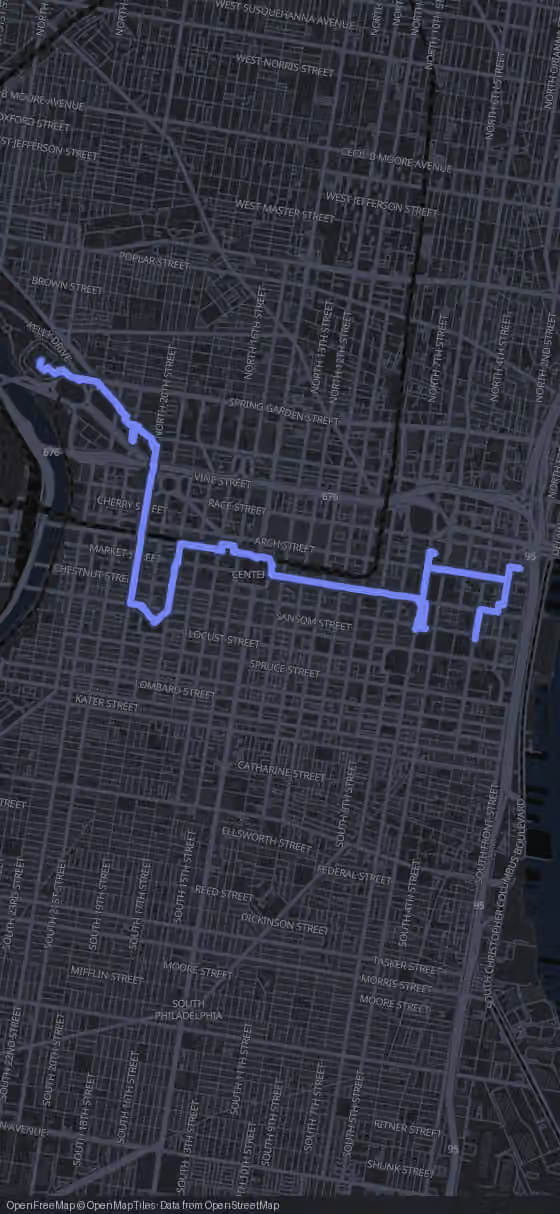
Route map for the Philadelphia walking tour
Stop 1 of 13
410 m·5 min
Museum of the American Revolution
Head north-east on Third Street toward Christ Church
Welcome to Philadelphia. I'm Alex, and the city's great symbol of freedom began with an embarrassing failure.
Try this tour with Alex

This Route at a Glance

Thirteen stops and 8.0 km, from the Museum of the American Revolution in Old City to the Philadelphia Museum of Art at the far end of the Benjamin Franklin Parkway. Pure walking time is 1 h 56 min; plan about 4 hours if you stay outside, a full day with museums.

Independence Hall, the Liberty Bell, Congress Hall, Elfreth's Alley, LOVE Park and Rittenhouse Square are free. Christ Church, the Betsy Ross House and the museums charge entry, the Rodin Museum on a pay-what-you-wish basis. The GPS route is free in your browser; the AI Tour Guide is optional.

Open free GPS & optional AI Tour Guide
This short shows highlights of the route. All 13 stops follow below.

The Route

Walking Map of Philadelphia, Old City to Fairmount

13 stops 8.0 km 1 h 56 min walking
Tap to load interactive map

The 13 stops along this route

  1. Museum of the American Revolution in Philadelphia, stop 1 on the self-guided walking tour
    1Museum of the American Revolution
  2. Christ Church in Philadelphia, stop 2 on the self-guided walking tour
    2Christ Church
  3. Elfreth's Alley in Philadelphia, stop 3 on the self-guided walking tour
    3Elfreth's Alley
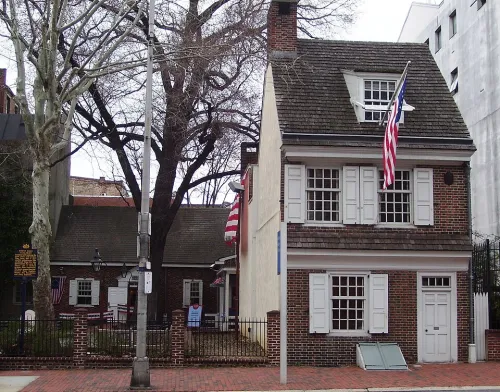
  4. Betsy Ross House in Philadelphia, stop 4 on the self-guided walking tour
    4Betsy Ross House
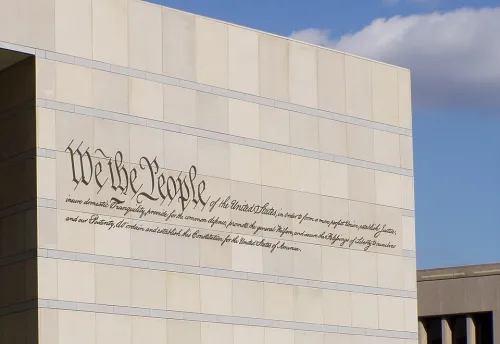
  5. National Constitution Center in Philadelphia, stop 5 on the self-guided walking tour
    5National Constitution Center
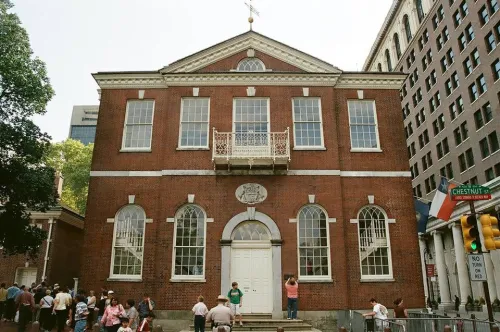
  6. Congress Hall in Philadelphia, stop 6 on the self-guided walking tour
    6Congress Hall
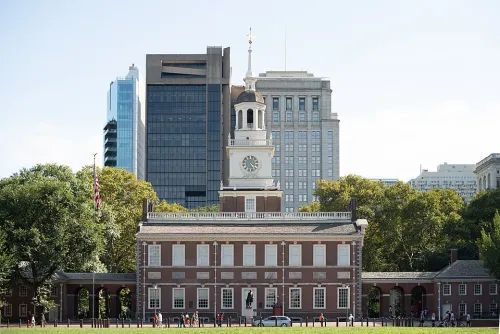
  7. Independence Hall in Philadelphia, stop 7 on the self-guided walking tour
    7Independence Hall
  8. Liberty Bell in Philadelphia, stop 8 on the self-guided walking tour
    8Liberty Bell
  9. LOVE Park in Philadelphia, stop 9 on the self-guided walking tour
    9LOVE Park
  10. Rittenhouse Square in Philadelphia, stop 10 on the self-guided walking tour
    10Rittenhouse Square
  11. Barnes Foundation in Philadelphia, stop 11 on the self-guided walking tour
    11Barnes Foundation
  12. Rodin Museum in Philadelphia, stop 12 on the self-guided walking tour
    12Rodin Museum
  13. Philadelphia Museum of Art, stop 13 on the self-guided walking tour
    13Philadelphia Museum of Art
  14. That's the full route.

    Walk it with an AI Tour Guide talking you through every one of these streets.

    Start free in your browser
    You made it

Your Philadelphia Walking Tour, Stop by Stop, from the Revolution to Rodin

  1. 1

    Museum of the American Revolution

    Museum of the American Revolution in Philadelphia, stop 1 on the self-guided walking tour

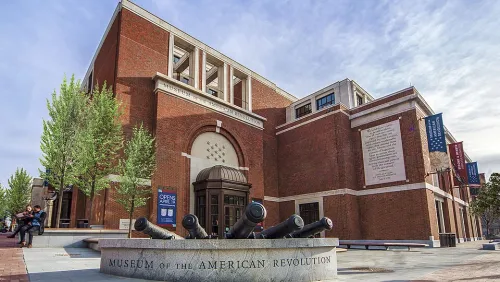
    You begin at 101 South Third Street, in the city that served as the revolutionary capital while the United States was being founded. The museum opened on April 19, 2017, exactly 242 years after the battles of Lexington and Concord, when the first shots of the Revolutionary War were fired. Across the street stands the First Bank of the United States, and Independence Hall and the Liberty Bell are only two blocks away, so you are right at the edge of the historic core.

    The building comes from Robert A. M. Stern Architects. It rises three stories above the street, and on the ground floor the Cross Keys Café opens straight onto the sidewalk. Inside, the first floor is organized around a skylit central court, with a cross-vaulted ticket lobby, a theater and a gallery for changing exhibitions.

    The collection runs to several thousand objects: paintings and sculpture, textiles and weapons, manuscripts and rare books. Theaters and large tableaux bring the people and events of the Revolution back to life, so the galleries tell the story through scenes and individuals, not only through glass cases. The project owes a great deal to Gerry Lenfest, a Philadelphia media entrepreneur and philanthropist who chaired the board from 2005 and was instrumental in getting the museum launched.

    Is it worth going in? If the Revolution is why you came to Philadelphia, yes: it gives you the background for everything you will see over the next few hours. Entry is paid and you will want a couple of hours. If you are mainly here for art, save your energy for the Parkway. From here it is 410 m, about 6 minutes, to Christ Church.
    Hours
    Daily 09:30–17:00 (Museum Shop open from 10:00; closed Thanksgiving Day, Christmas Day, New Year's Day)
    Price
    USD 27 adults walk-up / USD 25 online; USD 21 military, students & teachers, seniors 65+; USD 14 youth (6-17); free for children 5 and under, members, ACCESS Cardholders & SNAP recipients (walk-up only)
  2. 2

    Christ Church

    Christ Church in Philadelphia, stop 2 on the self-guided walking tour

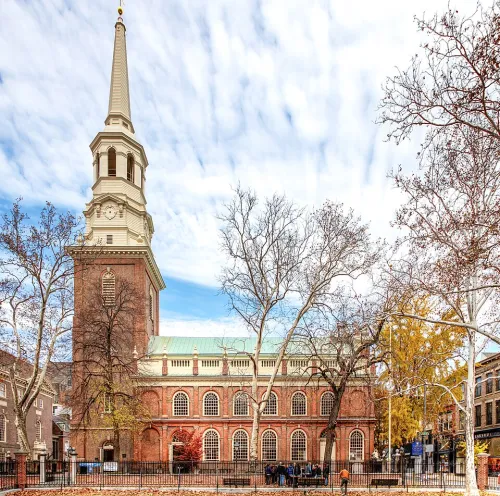
    Members of the Church of England founded this parish in 1695 and had a small wooden church standing by the following year. In 1700 Evan Evans came over from Wales as rector. Twenty years after the first building went up, the congregation had outgrown it and decided to build something far grander, meant to be the most sumptuous church in the Thirteen Colonies.

    What you see today was built between 1727 and 1744. The steeple followed in 1754 and, at 196 feet (60 m), made Christ Church the tallest building in what would become the United States. Look at the symmetrical, classical façade and the arched windows: the model was Christopher Wren's work in London, and the result is a fine example of Georgian architecture. Nobody knows the architect for certain. The physician John Kearsley supervised construction and was probably also behind the design.

    Inside, fluted columns and wooden pews keep things simple and elegant. The baptismal font in which William Penn was baptized came over in 1697 from All Hallows-by-the-Tower in London and is still in use. A second font and the communion table were made by the Philadelphia cabinetmaker Jonathan Gostelowe. Fifteen signers of the Declaration of Independence belonged to this congregation, and in 1785 its rector William White became the first Presiding Bishop of the Episcopal Church.

    Going in costs a fee, either with a guide or on your own, and is worth it if you want to stand by Penn's font and in the pews of the signers. If you are short on time, the façade and steeple tell much of the story from outside. Elfreth's Alley is 360 m away, about 5 minutes on foot.

    Hours
    Mon–Sat 11:00–17:00, Sun 09:45–11:00 and 11:30–17:00
    Price
    USD 10 adult guided tour; USD 5 youth (5-12) guided tour; USD 5 adult self-guided tour; USD 2 youth self-guided tour; USD 1 map; combo church & burial ground USD 8 adult / USD 3 youth self-guided
  3. 3

    Elfreth's Alley

    Elfreth's Alley in Philadelphia, stop 3 on the self-guided walking tour

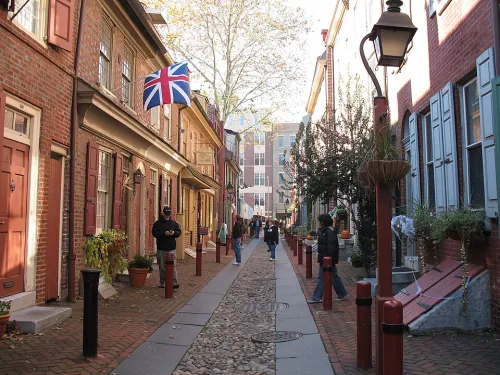
    This narrow cobblestone street dates back to 1703 and is a National Historic Landmark. Its 32 houses were built between 1703 and 1836, Georgian and Federal in style, typically small, and many of them are Trinity houses, a type found only in Philadelphia. The alley runs from North Front Street to North 2nd Street, and walking it from end to end gives you a sense of how ordinary people lived in the colonial city.

    It began as a deal between two neighbors on Front Street. Between 1702 and 1704 Arthur Wells gave 5 feet of his land on the south side and John Gilbert, who owned the land to the north, gave 10 feet. Wells died soon afterward, so it was first called Gilbert's Alley, then Preston's Alley after Paul Preston, who had married Gilbert's widowed daughter-in-law.

    The name you see today only stuck around 1750. Jeremiah Elfreth, a blacksmith living on Second Street, married five times. His first wife was the sister of Paul Preston's wife, his fifth the widow of a grandson of Arthur Wells, and through these two marriages he ended up owning land on both sides of the alley's Second Street end.

    The people who lived here were craftsmen and their families: shipwrights, silver and pewter smiths, glassblowers, furniture builders. In the 1770s a third of the households were headed by women. From 1868, when a stove factory took the place of houses in one row, industry closed in, and waves of immigrants came for the nearby jobs; by 1900 the neighborhood was overwhelmingly Irish. The street is free to walk, and the Elfreth's Alley Museum occupies numbers 124 and 126. The Betsy Ross House is 290 m away, about 4 minutes.

    Hours
    Always accessible
    Price
    Free
  4. 4

    Betsy Ross House

    Betsy Ross House in Philadelphia, stop 4 on the self-guided walking tour

    On Arch Street stands one of Philadelphia's most visited sights, and one of its most debated. Betsy Ross (1752 to 1836 are her dates), an upholsterer and flag maker, is said to have lived here when she sewed the first American flag. Whether she lived in this house, and whether she designed and sewed that flag at all, is a matter of controversy among historians.

    The story took off thanks to her relatives, above all her grandsons William and George Canby, and the celebrations of the Centennial in 1876. Family members pointed to this house, but the best archival evidence suggests she lived next door. That neighboring building was torn down to reduce the fire risk, which the 1937 Philadelphia Guide dryly called an irony on top of what may have been an error in research. If she did live here, it would have been from 1776, after the death of her first husband John Ross, until about 1779.

    The front part of the house dates from around 1740 and is built in the Pennsylvania colonial style; the rear section came a decade or two later. In 1937 the radio mogul A. Atwater Kent paid for a restoration by the architect Richardson Brognard Okie. Original elements were kept wherever possible, and materials from demolished period homes filled the gaps. Look at the front: the doorway was moved to the opposite corner, and a new window was put in.

    Entry is paid. Go in if you enjoy small colonial interiors and a good legend; if you are mostly curious about the controversy, the façade is enough. From here it is 610 m, about 9 minutes, to the National Constitution Center.

    Hours
    Mar–Nov: Daily 10:00–17:00 (Fri–Sat in Jun–Jul: 10:00–18:00; closed Thanksgiving); Dec–Feb: Wed–Mon 10:00–17:00, Tue closed (closed Dec 25, Jan 1)
  5. 5

    National Constitution Center

    National Constitution Center in Philadelphia, stop 5 on the self-guided walking tour

    Even the address carries a message. The center sits at 525 Arch Street because the Constitutional Convention began in Philadelphia on May 25, 5/25. Ground was broken on September 17, 2000, the 213th anniversary of the signing of the Constitution, and the doors opened on July 4, 2003.

    The idea goes back to the Constitution Heritage Act, signed by President Ronald Reagan in 1988, which asked for a center close to Independence National Historical Park that would explain the Constitution on a non-partisan basis. The building was designed by Pei Cobb Freed & Partners, and a New York Times critic praised it as quiet but assertive and respectful of its surroundings. Inside you find more than 75,000 square feet of exhibit space.

    This is an interactive museum and at the same time a kind of national town hall, where politicians, journalists, scholars and celebrities discuss the Constitution in public; it has even hosted presidential debates. One thing it does not have is the original document: that is kept at the National Archives in Washington, D.C..

    Entry is paid. If you can afford only one paid museum in Old City, choose between this one and the Museum of the American Revolution: here the subject is the ideas and the text, there the war and its people. Congress Hall is 580 m away, about 8 minutes.

    Hours
    Wed–Sun 10:00–17:00, Mon–Tue closed
  6. 6

    Congress Hall

    Congress Hall in Philadelphia, stop 6 on the self-guided walking tour

    This brick building at Chestnut and 6th Streets was the seat of the United States Congress from December 1790 until May 1800. In that decade Vermont, Kentucky and Tennessee joined the Union, the Bill of Rights was ratified, and two presidential inaugurations took place here: George Washington's second and John Adams's first.

    It was never meant for Congress. Samuel Lewis designed it as the Philadelphia County Courthouse; work began in 1787 and finished two years later. Philadelphia got the government back after a turbulent detour. In June 1783 a mob of angry mutineers confronted Congress next door, and when Pennsylvania failed to protect the delegates they withdrew to Princeton. The capital moved on to Annapolis, Trenton and finally New York. Only after the Residence Act of July 9, 1790 did Philadelphia serve as capital again, while a permanent federal district was being prepared.

    In the 20th century the hall was restored to its appearance of 1796, and the National Park Service now runs it as part of Independence National Historical Park. Entry is free and the guided tours are short, so this is an easy yes: you get to see where the early Congress actually sat.

    Congress Hall is joined to Independence Hall, which stands immediately to the east. You walk 100 m, about a minute.

    Hours
    Daily 09:00–17:00 (Open House 09:00–10:00, guided tours every 20 minutes from 10:00–16:40)
    Price
    Free
    Website
    nps.gov ↗
  7. 7

    Independence Hall

    Independence Hall in Philadelphia, stop 7 on the self-guided walking tour

    Here both the Declaration of Independence and the Constitution of the United States were debated and adopted. The building was completed in 1733 as the Pennsylvania State House, the capitol of the colonial province, and even then people called it the greatest ornament in the town. Take in the façade: American Georgian at its clearest, with symmetry, classical proportions and exposed brick set off by stone accents.

    During the Revolutionary War the Second Continental Congress met here between 1775 and 1781. On June 14, 1775 it founded the Continental Army inside these walls, and on July 4, 1776 it adopted the Declaration of Independence. Eleven years later the Constitutional Convention opened here on May 25, 1787 and ended on September 17 with the Constitution. The building's history did not stop with the founders: in 1915 former president William Howard Taft presided over a convention here that founded the League to Enforce Peace.

    Independence Hall became a World Heritage Site in 1979 and is the centerpiece of the national park, whose green space acts as a buffer against the modern city around it. Large visitor numbers and air pollution are the main pressures on the building, which is one reason for the security screening at the entrance.

    Entry is free, and going in is worth it for anyone: few rooms carry this much weight. Allow time for screening and a guided tour. The Liberty Bell waits across the street, 150 m and about 2 minutes away.

    Hours
    Daily 09:00–17:00 (Open house 09:00–09:50 no ticket required; guided tours every 20 min 10:00–16:00 and expanded tour 16:20 with ticket)
    Price
    Free
    Website
    nps.gov ↗
  8. 8

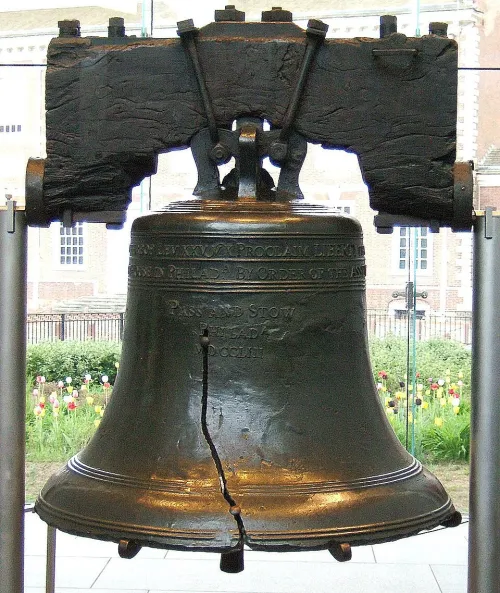
    Liberty Bell

    Liberty Bell in Philadelphia, stop 8 on the self-guided walking tour

    The bell once hung in the steeple of the State House you just left. The Pennsylvania Provincial Assembly ordered it in 1752 from Lester and Pack in London, later the Whitechapel Bell Foundry, with the inscription "Proclaim LIBERTY Throughout all the Land unto all the Inhabitants Thereof". Look for it on the bell, along with the names Pass and Stow.

    Those are the local workmen John Pass and John Stow. The bell cracked the first time it was rung after arriving in Philadelphia, and they recast it twice. In its early years it called lawmakers to their sessions and citizens to public announcements. It probably rang on July 8, 1776, when the Declaration was first read in public, though no account from the time records it.

    After independence it was largely forgotten until the 1830s, when abolitionist societies adopted it as a symbol and gave it the name Liberty Bell. The famous large crack appeared sometime in the first half of the 19th century; a popular story ties it to ringing after the death of Chief Justice John Marshall in 1835. Later the bell traveled to big expositions and suffered at the hands of souvenir hunters. The city still owns it, but the National Park Service has looked after it since World War II, and in the Cold War and the protests of the 1960s it became a symbol of freedom once more.

    Since 2003 it has hung in the Liberty Bell Center, after an interlude from 1976 in a glass pavilion nearby. Entry is free with security screening, and a short visit is enough. Now comes the longest leg: 1660 m, about 24 minutes, from Old City to LOVE Park in Center City.

    Hours
    Daily 09:00–17:00 (Security screening area closes at least 5 minutes prior to building closure)
    Price
    Free
  9. 9

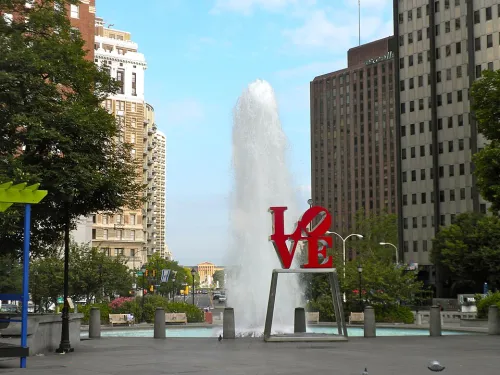
    LOVE Park

    LOVE Park in Philadelphia, stop 9 on the self-guided walking tour

    Officially this is John F. Kennedy Plaza, dedicated to the president in 1967. Everybody calls it LOVE Park because of Robert Indiana's LOVE sculpture from 1970, one of three in Philadelphia. The park faces City Hall and forms the visual end of the Benjamin Franklin Parkway, the axis that will lead you to the museums later.

    The sculpture came as a guest. It was first set up here in 1976 for the Bicentennial and taken away in 1978 when the celebrations were over. Fitz Eugene Dixon Jr., chairman of the Philadelphia Art Commission, then bought it and had it installed permanently that same year.

    The plaza itself goes back to Edmund Bacon, the city planner, who first sketched it in his architecture thesis at Cornell in 1932. Once he led the City Planning Commission, the architect Vincent G. Kling designed it, and it was built in 1965 on top of an underground parking garage, with the single-spout fountain added in 1969. In the 1990s and 2000s LOVE Park became one of the best-known skateboarding spots in the world, despite bans and redesigns meant to stop it.

    A reconstruction between 2016 and 2018 turned the hard plaza into a greener space with lawns, two gardens, planted stormwater basins, café seating and an open view of City Hall and the Parkway. It is free, so take your photo with the sculpture and walk on 1020 m, about 15 minutes, to Rittenhouse Square.

    Hours
    Always accessible
    Price
    Free
  10. 10

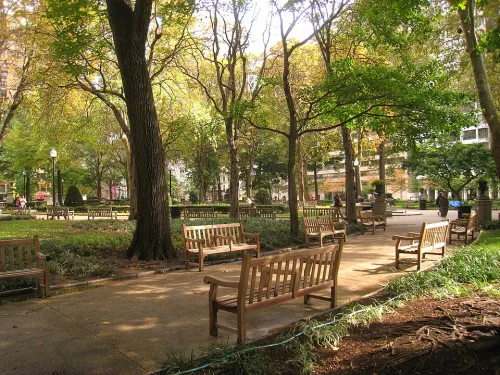
    Rittenhouse Square

    Rittenhouse Square in Philadelphia, stop 10 on the self-guided walking tour

    This is one of the five open squares that William Penn and his surveyor Thomas Holme planned for the city in the late 17th century. It started out as Southwest Square and in 1825 was renamed after David Rittenhouse: clockmaker, friend of the American Revolution and noted astronomer, with a crater on the Moon named after him. He descended from William Rittenhouse, a German immigrant and the first paper maker in Philadelphia.

    As the city spread from the Delaware River toward the Schuylkill in the early 19th century, an address on the square became highly desirable. The first to build here was James Harper, a merchant and brick manufacturer just retired from Congress. He bought most of the north side, put up a stately townhouse for himself at 1811 Walnut Street around 1840, and sold the rest as generous building lots, setting the patrician tone the square kept. After his death the house became the exclusive Rittenhouse Club, which added the present façade around 1901.

    The park measures roughly two short blocks on each side and is cared for by the non-profit Friends of Rittenhouse Square. It is free and open at all times, a good place to sit for a while between the founders' city and the art museums. From here it is 1450 m, about 21 minutes, back toward the Parkway and the Barnes Foundation.

    Hours
    Always accessible
    Price
    Free
  11. 11

    Barnes Foundation

    Barnes Foundation in Philadelphia, stop 11 on the self-guided walking tour

    Albert C. Barnes made his fortune with Argyrol, an antiseptic silver compound he co-developed to treat gonorrhea and inflammations of the eye, ear, nose and throat. He sold his company just months before the stock market crash of 1929, and his foundation, set up in 1922, was meant to teach people to look at art and plants.

    For decades the collection lived in Merion, outside the city. In the 1990s falling finances pushed its leaders into controversial moves, including a world tour of the paintings and the plan to bring the collection to Philadelphia. After many court battles the new building on the Benjamin Franklin Parkway opened on May 19, 2012. The arboretum stayed behind in Merion.

    What hangs here today is more than 4,000 objects, among them over 900 paintings, valued in the billions of dollars. The core is Impressionist, Post-Impressionist and Modernist masters, but the collection also takes in other European and American painters, African art, antiquities from China, Egypt and Greece, and Native American art.

    Entry is paid. If Impressionism and early modern painting are your thing, this is the art stop to give real time to; if you prefer a wider sweep, keep your energy for the Philadelphia Museum of Art at the end. The Rodin Museum is 460 m away, about 6 minutes.

    Hours
    Thu–Mon 11:00–17:00 (Members from 10:00; closed Tue–Wed; closed July 4, Thanksgiving, Christmas)
    Price
    USD 30 adults; USD 28 seniors; USD 5 college students (with valid ID) and youth 13-18; free for children 12 and under, members, ACCESS/EBT/Art-Reach cardholders; active-duty US military and family free Armed Forces Day to Labor Day (Blue Star Museums)
  12. 12

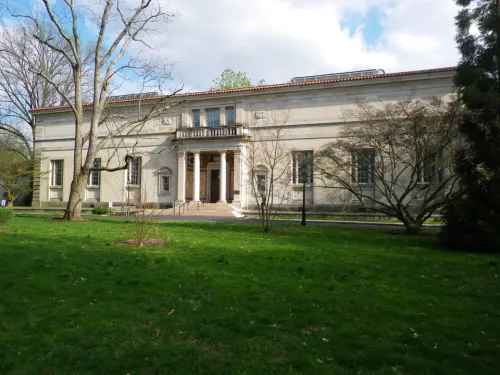
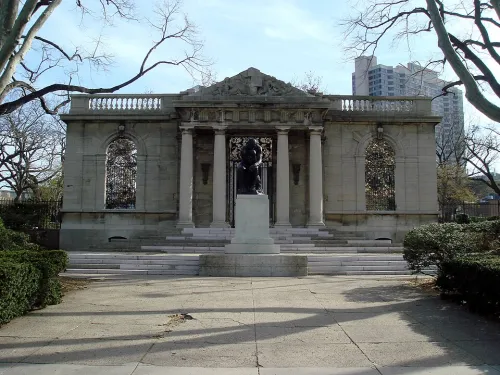
    Rodin Museum

    Rodin Museum in Philadelphia, stop 12 on the self-guided walking tour

    Before you even reach the door you meet The Thinker, sitting in the entry courtyard. Behind it rises a cast of The Gates of Hell, a bronze doorway 5.5 m high that once served as the museum's entrance and is no longer used. Rodin made more than 100 figures for these doors from 1880 until his death in 1917, for a museum of decorative arts in Paris that was never built. This cast is one of three originals, and The Thinker itself began as a study for the doors.

    The museum was a gift to the city from Jules Mastbaum, a movie-theatre magnate who began buying Rodin in 1923 with the plan of founding a museum. Within three years he had put together the largest Rodin collection outside Paris, with bronzes, plaster studies, drawings, prints, letters and books. In 1926 he commissioned the French architects Paul Cret and Jacques Gréber for the building and gardens, but he died that same year. His widow, Etta Wedell Mastbaum, saw the project through, and the museum opened on November 29, 1929.

    Inside, nearly 150 objects in bronze, marble and plaster fill several rooms, including The Kiss, Eternal Springtime, The Age of Bronze and The Burghers of Calais; the murals are by Franklin C. Watkins. The Philadelphia Museum of Art runs the museum, which reopened in 2012 after a three-year renovation that returned it to its original vision.

    The garden is free and you pay what you wish inside, so even a short visit is worth it. From here it is 920 m, about 14 minutes, to the Philadelphia Museum of Art.

    Hours
    Mon 10:00–17:00, Tue–Thu closed, Fri–Sun 10:00–17:00
    Price
    Pay what you wish (suggested admission); garden free year-round
  13. 13

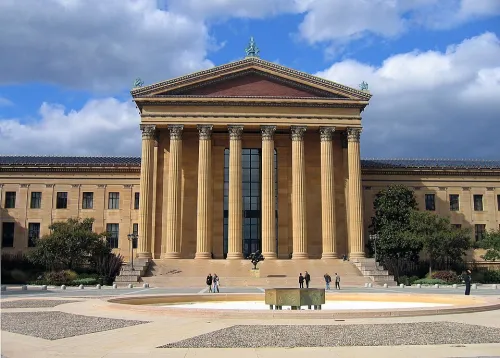
    Philadelphia Museum of Art

    Philadelphia Museum of Art, stop 13 on the self-guided walking tour

    You finish on Fairmount, the hill at the northwest end of the Benjamin Franklin Parkway at Eakins Oval. The museum was chartered in 1876 for the Centennial Exposition, the same celebration that made Betsy Ross famous, and its main building was completed here in 1928. Look back down the Parkway from the top: you have walked the whole axis that began at LOVE Park.

    The collections are vast, more than 240,000 objects of European, American and Asian origin: sculpture, paintings, prints, drawings, photographs, armor and decorative arts. Across the street to the north, the Perelman Building, opened in 2007, holds prints, drawings and photographs, costume and textile pieces and modern design, from furniture to glass. The museum also looks after the Rodin Museum you just saw and two colonial-era houses in Fairmount Park, Mount Pleasant and Cedar Grove. The buildings belong to the city and are run by a nonprofit corporation.

    Several special exhibitions come through every year, some of them touring shows arranged with museums at home and abroad. Entry is paid, with free admission for youths. If you want breadth across centuries and continents, this is the place to end the day indoors; if your feet are done, the view from the hill is a fitting finish on its own. This is the end of the route.

    Hours
    Thu 10:00–17:00, Fri 10:00–20:45, Sat–Mon 10:00–17:00, Tue–Wed closed
    Price
    USD 30 adults; USD 28 seniors (65+); USD 14 students with valid ID; free for youths and members; member guests USD 15
Walking tour route map of Philadelphia Route loaded
Museum of the American RevolutionChrist ChurchElfreth's AlleyBetsy Ross House+9
All 13 stops are already on the map.
You just press start.
AI Tour Guide

You know the route now. Walk it with a guide talking in your ear.

Press start wherever you are, even hundreds of kilometres from Philadelphia, and the guide begins telling its stories right away. In the city, pick any of the 13 stops to start from: it leads you there, then talks with you the whole route, asking, listening, remembering, and shaping the tour around your answers.

13stops 8.0km 1 h 56 minwalking 13languages
▶Start the tour free

Free to start · Runs in your browser · No app, no download

Shorter Ways to Walk Philadelphia

Thirteen stops in one day is a lot if you want to go inside. The route splits naturally where Old City ends and the long walk to Center City begins, so you can take one half, or just the core of Independence National Historical Park.

Old City and the founding years

Stops: 1, 2, 3, 4, 5, 6, 7, 8

For history lovers with half a day or more. About 2.5 km and 35 minutes of pure walking. Elfreth's Alley, Congress Hall, Independence Hall and the Liberty Bell are free; the Museum of the American Revolution, Christ Church, the Betsy Ross House and the National Constitution Center charge entry, so pick the one or two that interest you most.

Center City squares and the Parkway museums

Stops: 9, 10, 11, 12, 13

For art lovers, ideally on a separate day. About 3.9 km and 56 minutes of pure walking from LOVE Park to the Philadelphia Museum of Art. LOVE Park and Rittenhouse Square are free, the Rodin Museum asks what you wish to pay and its garden is free, while the Barnes Foundation and the Philadelphia Museum of Art charge entry. Choosing one of the two big collections keeps the day relaxed.

Independence core in an hour or two

Stops: 5, 6, 7, 8

For a short visit or a stopover. Only 830 m and 11 minutes of walking between the National Constitution Center, Congress Hall, Independence Hall and the Liberty Bell. Three of the four are free; skip the paid center if time is tight and spend it on the guided tour of Independence Hall instead.

How Long Does This Philadelphia Tour Take with Museums?

The whole route covers 8.0 km with 1 h 56 min of pure walking. Most legs are short: in Old City you rarely walk more than 10 minutes between stops. The one long stretch is the 1660 m from the Liberty Bell to LOVE Park, 24 minutes on foot, which carries you out of the colonial core into Center City.

If you look at everything from outside and spend about 10 minutes at each stop, you finish in roughly 4 hours. Add the free visits to Congress Hall, Independence Hall and the Liberty Bell and you reach about 5½ hours; one paid museum on top brings the day to about 7½ hours. Trying to see the inside of every museum in a single day does not work, so choose.

The Old City variant takes about 3 hours with the free interiors and one paid stop. The Parkway variant fits an afternoon of about 4 hours with one of the big art collections. The Independence core works in an hour or two.

Before You Set Off in Old City

  • Start: The Museum of the American Revolution on South Third Street is the recommended start, but you can join the route at any stop and follow it from there.
  • Finish: The route ends at the Philadelphia Museum of Art on Fairmount, at the top of the Benjamin Franklin Parkway, not back where you started.
  • Time of day: Start in the morning. The Old City half holds most of the indoor visits, and the museums at the far end deserve unhurried hours too. Several museums on the route close on certain weekdays, so check current hours before you fix the day.
  • Entry: Paid: Museum of the American Revolution, Christ Church, Betsy Ross House, National Constitution Center, Barnes Foundation and Philadelphia Museum of Art. Pay what you wish: Rodin Museum, with a free garden. Free: everything else.
  • Security: Independence Hall and the Liberty Bell Center both have security screening at the entrance, so keep bags light.
Walking tour route map of Philadelphia
AI Tour Guide

Your guide is ready whenever you reach the first stop.

Press start and a voice AI Tour Guide takes it from here: leading the route through Philadelphia, telling the stories, and turning your walk into a real back-and-forth conversation. No app or download is needed; it runs in your browser.

13stops 8.0km 1 h 56 minwalking 13languages
▶Start the tour free

Free to start · Runs in your browser · No app, no download

What the AI Tour Guide Adds Between Old City and the Parkway

On this route the AI Tour Guide turns the walk into a conversation. It greets you at the first stop, tells the stories of each place, asks what caught your attention and remembers it, so by the Parkway it knows whether you lean toward the founders or the painters. You can go beyond what you read here, for example what daily life looked like for a glassblower's family in Old City or how the founders argued their way through the summer of 1787, and interrupt it whenever you like. You start with 100 free credits; after that you choose this tour all-inclusive for €19.99 with no time limit, or credits at €5 per hour.

A Real Conversation A voice AI Tour Guide greets you, leads the whole route, and tells the stories and facts as you walk, asking what you want to see and keeping a real conversation going. Not a recording you press play on.
Map Navigation Follow the route on the map and walk at your own pace. You choose where to start and when to move to the next stop.
Ask Anything Curious about a building you pass? Ask your AI Tour Guide on the spot and the conversation carries on.
13 Languages Switch language anytime. No separate tour needed.
Start free in your browser

Common Questions Before You Walk Philadelphia

Do I need a ticket for Independence Hall?

Entry is free. A short open house at the start of the day needs no ticket; the guided tours later in the day do. Expect security screening at the door.

Which museum should I choose if I only have time for one?

For the war and its people, the Museum of the American Revolution. For the ideas behind the Constitution, the National Constitution Center. For Impressionist and Modernist painting, the Barnes Foundation; for breadth across centuries and continents, the Philadelphia Museum of Art.

Is Christ Church still a working church?

Yes, it is an active Episcopal parish. Visitors see it on a guided or self-guided tour, both with a fee, and a combined ticket also covers the church's burial ground.

Can I combine Philadelphia with New York or Washington?

Yes. New York is 134 km away and Washington, D.C. 200 km, and both have their own free routes: the New York walking tour and the Washington, D.C. walking tour. Boston continues the Revolution story further north.

Is the tour really free?

Yes. The whole tour is free: the route, the interactive map and the navigation cost you nothing. Only the voice AI Tour Guide is optional and paid: you test it with 100 free credits, then you pay either €5 per hour or €19.99 for this whole tour, with no time limit. Admission to 6 of the 13 stops is not included: Museum of the American Revolution, Christ Church, Betsy Ross House, National Constitution Center, Barnes Foundation and Philadelphia Museum of Art charge their own entry fees.

Do I need to download an app?

No. Everything runs in your phone browser. Open the route and start walking, no download and no sign-up required.

Do I need to book the walking tour in advance?

No booking needed. This self-guided tour is available anytime. Open the route in your browser and start walking. The AI Tour Guide works instantly, no app, no reservation required.

What languages is the AI Tour Guide available in?

The AI Tour Guide speaks 13 languages, so you take the tour in your own language and can switch at any time.

Can I skip stops or change the route?

Yes. Skip any stop, spend extra time at places you like, or start the route from any point. It is your walk, you set the pace.
Image credits
▶ Start free in your browser Runs in your browser, no app, no download