Free Walking Tour Cologne: Cathedral, Churches and Rhine

From the twin spires of the cathedral to Roman foundations, a Gestapo cellar and two Rhine bridges: 7.1 km through Roman, medieval and modern Cologne.

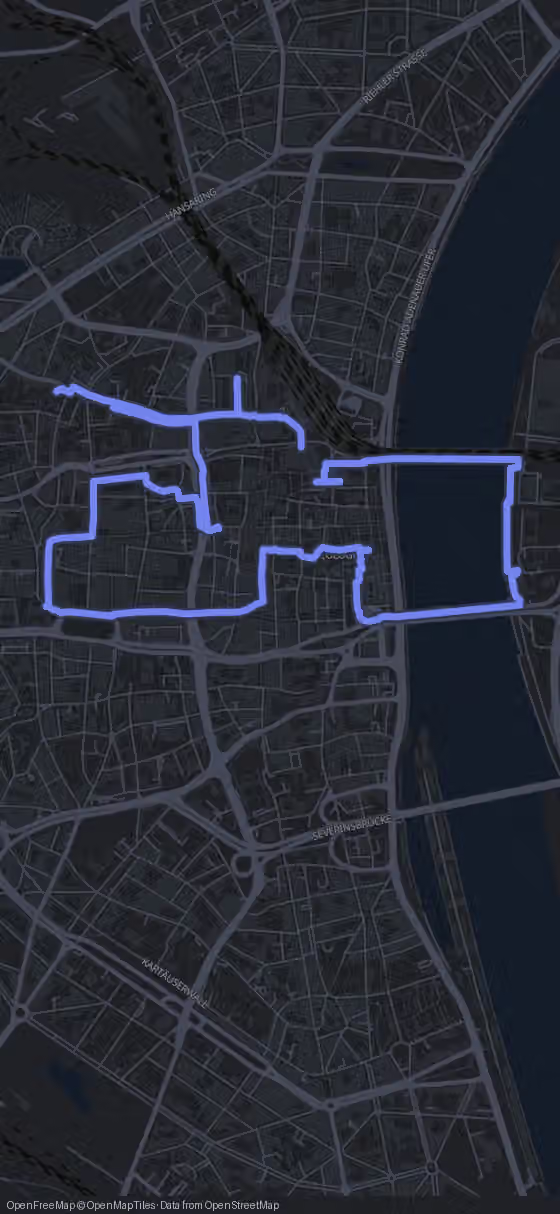
13 Stops 7.1 km ~1 h 39 min walking
Route map for the Cologne walking tour
Stop 1 of 13
420 m·5 min
Cologne Cathedral (Kölner Dom)
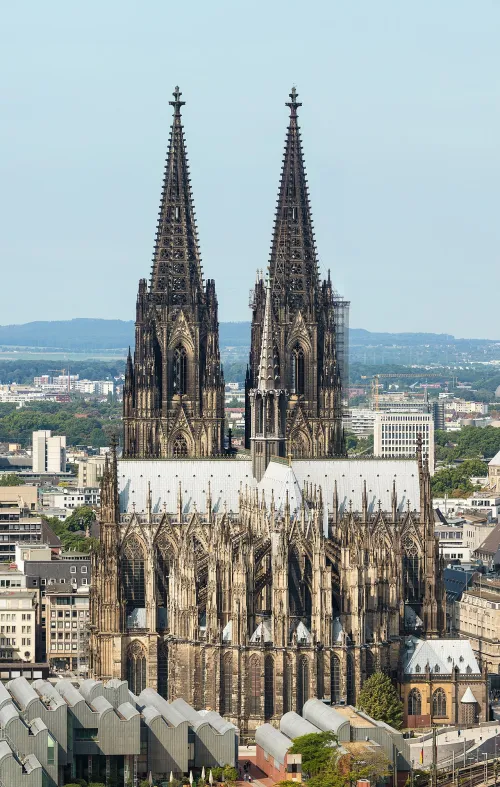
Head north-west down into the Altstadt
Guten Tag, welcome to Cologne. I'm Alex, and this city can make a single building project last for centuries.
Try this tour with Alex

The Cologne Route at a Glance

Thirteen stops on a 7.1 km line from Cologne Cathedral (Kölner Dom) to the Romano-Germanic Museum (Römisch-Germanisches Museum), which is currently closed for renovation. Pure walking time is 1 h 39 min; with short looks inside count on about three hours, with the museums a full day.

Streets, bridges and three Romanesque churches are free. The cathedral needs a ticket, as do Cologne City Museum (Kölnisches Stadtmuseum), EL-DE Haus (NS Documentation Centre) and Museum Ludwig. The GPS route in your browser costs nothing; the AI Tour Guide is optional.

Open free GPS & optional AI Tour Guide
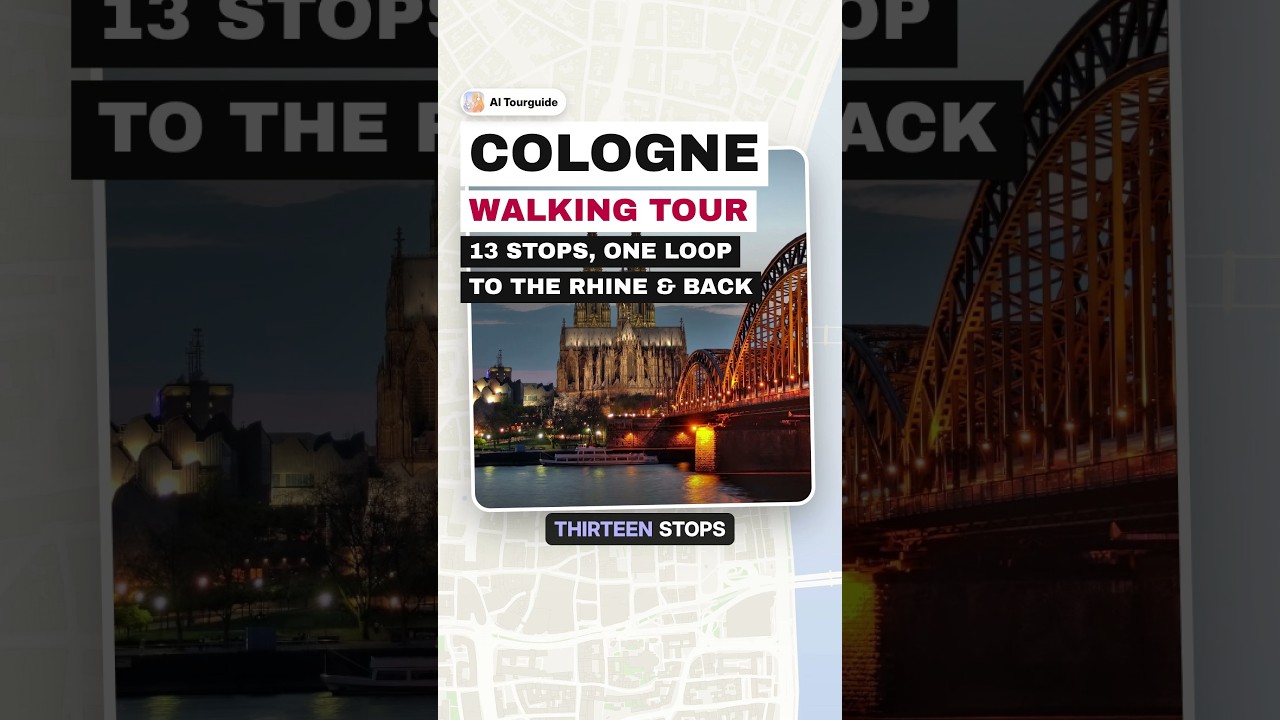
This short shows highlights of the route. All 13 stops follow below.

The Route

Walking Map of Cologne from the Dom to the Rhine

13 stops 7.1 km 1 h 39 min walking
Tap to load interactive map

The 13 stops along this route

  1. Cologne Cathedral (Kölner Dom), stop 1 on the self-guided walking tour
    1Cologne Cathedral (Kölner Dom)
  2. Old Town (Altstadt) in Cologne, stop 2 on the self-guided walking tour
    2Old Town (Altstadt)
  3. St. Gereon's Basilica in Cologne, stop 3 on the self-guided walking tour
    3St. Gereon's Basilica
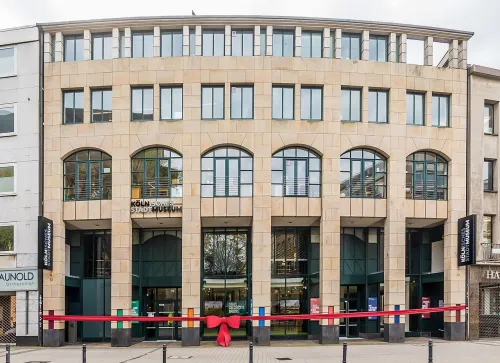
  4. Cologne City Museum (Kölnisches Stadtmuseum), stop 4 on the self-guided walking tour
    4Cologne City Museum (Kölnisches Stadtmuseum)
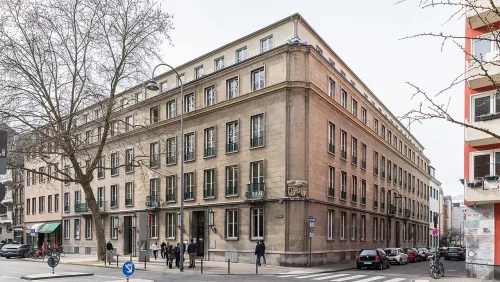
  5. EL-DE Haus (NS Documentation Centre) in Cologne, stop 5 on the self-guided walking tour
    5EL-DE Haus (NS Documentation Centre)
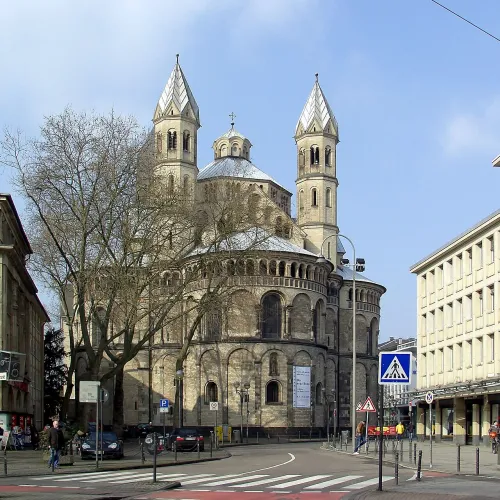
  6. St. Aposteln in Cologne, stop 6 on the self-guided walking tour
    6St. Aposteln
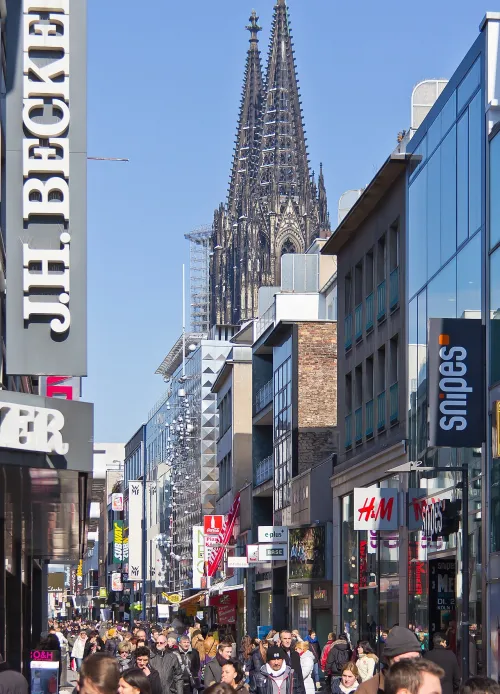
  7. Hohe Straße in Cologne, stop 7 on the self-guided walking tour
    7Hohe Straße
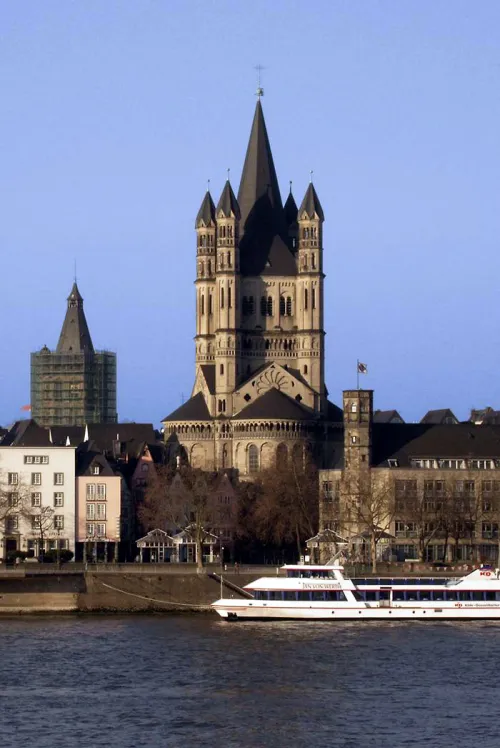
  8. Groß St. Martin in Cologne, stop 8 on the self-guided walking tour
    8Groß St. Martin
  9. Deutzer Bridge in Cologne, stop 9 on the self-guided walking tour
    9Deutzer Bridge
  10. Rhine Promenade in Cologne, stop 10 on the self-guided walking tour
    10Rhine Promenade
  11. Hohenzollern Bridge in Cologne, stop 11 on the self-guided walking tour
    11Hohenzollern Bridge
  12. Museum Ludwig in Cologne, stop 12 on the self-guided walking tour
    12Museum Ludwig
  13. Romano-Germanic Museum (Römisch-Germanisches Museum) in Cologne, stop 13 on the self-guided walking tour
    13Romano-Germanic Museum (Römisch-Germanisches Museum)
  14. That's the full route.

    Walk it with an AI Tour Guide talking you through every one of these streets.

    Start free in your browser
    You made it

Thirteen Places on Your Cologne Walking Tour, One by One

  1. 1

    Cologne Cathedral (Kölner Dom)

    Cologne Cathedral (Kölner Dom), stop 1 on the self-guided walking tour

    Stand back far enough to take in the whole west front. The two towers reach 157 metres, which makes this the tallest twin-spired church in the world and the tallest cathedral anywhere, and together they give it the largest façade of any church. In all of Cologne only the telecommunications tower rises higher. Around six million people come every year, more than to any other landmark in Germany, and since 1996 the cathedral has been a World Heritage Site.

    What looks like one confident Gothic plan took more than six centuries. Building began in 1248 with a clear purpose: a church grand enough to house the reliquary of the Three Kings and worthy of the Holy Roman Emperor at worship. Around 1560 work stopped, and for generations the city lived with an unfinished torso. Attempts to restart came around 1814, but real money only arrived in the 1840s. In 1880 the cathedral was finally completed, faithful to the medieval plan.

    The hill itself is far older. Cologne's first bishop, Maternus, is recorded around 313, when the small Christian community still met in a house thought to have stood beneath today's choir. After Roman rule collapsed, the Merovingian kings residing in Cologne built an episcopal church here in the sixth century, already a large building with an ambon for readings.

    Since 1 July 2026 you need a ticket to visit; buy it on site. If you only want a quiet moment, the north transept entrance for prayer is free and usually open outside services. For a first visit to Cologne the ticket is worth it; give it about 45 minutes.

    From here it is 440 metres, about six minutes, into the Old Town that grew up around the cathedral.
    Hours
    Sightseeing daily 10:00–17:45 (last entry 17:30), Sundays and church holidays 13:30–16:30 (last entry 16:15); north transept entrance for prayer usually 06:00–20:00 outside services, free
    Price
    Paid entry since 1 July 2026 (a ticket is required to visit the cathedral)
  2. 2

    Old Town (Altstadt)

    Old Town (Altstadt) in Cologne, stop 2 on the self-guided walking tour

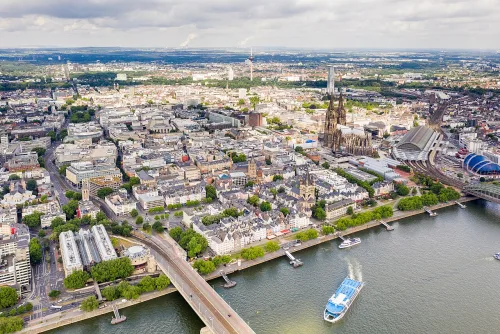
    Ask a local where the Altstadt is and many will point to the lanes around Groß St. Martin. The twist is that this was the Roman harbour, not the oldest part of town. The real seed of Cologne is Altstadt-Nord, the district you are standing in: a settlement existed here before the year 50, when the town was raised to the status of Colonia Claudia Ara Agrippinensium. Together with Altstadt-Süd it forms the heart of the city, framed by the Ring boulevards that trace the medieval walls in a half circle and by the Rhine on the other side.

    Within this district sit the cathedral, the City Hall, a cluster of museums, the Zeughaus, Romanesque churches and many old burgher houses. Look twice before you admire their age: a good number are reconstructions built after the Second World War, among them the parent house of 4711 at Glockengasse 4.

    The district also holds harder memories. In its north stood the Klingelpütz prison, completed in 1838. Under the Nazis it was the central execution site for the special courts of the Rhineland, and more than 1,000 people sentenced by the Reich Court and the People's Court are estimated to have died there under the guillotine. When the new prison in Ossendorf opened, the old building was blown up and the rubble pushed into a hill; today that ground is the Klingelpützpark. The Gestapo headquarters of the same era is still standing, and you will reach it later on this walk.

    The Old Town is free and always open. Head on 800 metres, about eleven minutes, to St. Gereon's Basilica.

    Hours
    Always open
    Price
    Free
    Website
    koeln.de ↗
  3. 3

    St. Gereon's Basilica

    St. Gereon's Basilica in Cologne, stop 3 on the self-guided walking tour

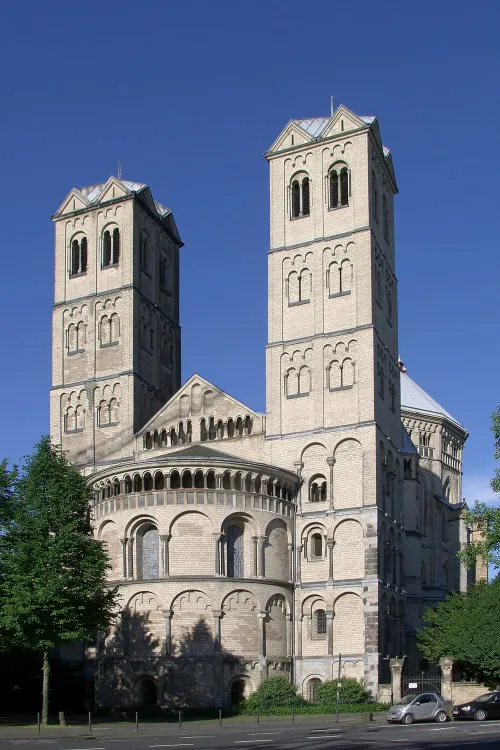
    The ten-sided core in front of you hides something rare. Its lower part is the remains of an oval central building with nine niches, built in the second half of the fourth century, probably between 350 and 365. It counts among the most important ancient prestige buildings north of the Alps and, together with the cathedral in Trier and Constantine's Aula Palatina, among the oldest sacred buildings still standing in Germany.

    It rose outside the Roman city wall on the city's oldest burial ground, above a rectangular grave building whose purpose is still debated. Nobody knows who commissioned the oval hall or what it was meant for. By the sixth century it had become a church, perhaps the one Gregory of Tours called the church of the Golden Saints, and a church of St. Gereon is first documented here in 612.

    Every age added a layer. Around 800 Archbishop Hildebold set a rectangular choir into the old atrium; from 1151 Archbishop Arnold II von Wied added the choir gallery, apse and transepts. Between 1219 and 1227 the ancient building was reinforced, clad, turned into the decagon and crowned with Gothic galleries and a central dome. St. Gereon is one of the twelve great Romanesque churches of Cologne and was made a minor basilica on 25 June 1920.

    Entry is free. Go in for the decagon, where Roman walls carry a medieval dome; even a ten-minute look rewards anyone. Then walk 950 metres, about 14 minutes, to the Cologne City Museum.

    Hours
    Daily: 10:00–18:00
    Price
    Free
  4. 4

    Cologne City Museum (Kölnisches Stadtmuseum)

    Cologne City Museum (Kölnisches Stadtmuseum), stop 4 on the self-guided walking tour

    The City Museum is camping, in a sense. Since March 2024 it has lived in the former Franz Sauer fashion house, between the Minoritenkirche, the Kolumba museum and the end of Breite Straße. Its long-time home, the historic Zeughaus used since 1958, had to be cleared in 2017 after water damage, leaving only the neighbouring Alte Wache for special exhibitions.

    The collection holds around 350,000 objects from the Middle Ages to the present: from a city seal of 1268 to paintings, prints, militaria, coins, textiles, furniture, everyday things and souvenirs of recent Cologne events. Only a small share is on show, and the current permanent exhibition arranges it around emotions rather than strict chronology, deliberately aiming to give the city a shared sense of identity.

    That fits the audience. Unlike in most cities, about half of the visitors are Cologne residents, which some read as proof of the famous local attachment to home. If you want to understand why people here talk about their city the way they do, this is the stop for it.

    The museum charges entry, and an hour is enough for a good impression. From here it is 440 metres, about six minutes, to the EL-DE Haus.

    Hours
    Tue–Sun 10:00–17:00, 1st Thursday of the month 10:00–22:00 (except on holidays); Mondays closed
    Price
    5.00 EUR
  5. 5

    EL-DE Haus (NS Documentation Centre)

    EL-DE Haus (NS Documentation Centre) in Cologne, stop 5 on the self-guided walking tour

    Look at the corner of the building before you go in. Next to the Cologne coat of arms is the emblem of the man who built it: two crossed clock hands with the letters L and D and the word EL-DE above them. Leopold Dahmen, a wholesaler of gold and watches, had the house built in 1934 and 1935 to plans by Hans Erberich as flats and shops on Appellhofplatz, at the corner of Elisenstraße.

    He never got to use it. After building stalled in the summer of 1935, the Cologne Gestapo seized the unfinished shell, as a tenant rather than an owner. Its position suited them: close to police headquarters, the courts and the Klingelpütz prison. On 1 December 1935 they moved in and had prisoners build ten cells in the basement, fitted with iron bunks, along with small guard rooms, niche washrooms and a gallows. Some cells measured barely 4.6 square metres. Until 1945 the house stood for Nazi terror in Cologne.

    Since 1988 it has housed the city's NS Documentation Centre, which charges entry. The cells are the heart of the visit, and they are hard to forget. Allow an hour, and know that it is a heavy hour.

    When you come back out, walk 730 metres, about ten minutes, to St. Aposteln, a very different kind of building.

    Hours
    Mon: Closed | Tue–Fri: 10:00–18:00 | Sat–Sun: 11:00–18:00
    Price
    4.50 EUR
  6. 6

    St. Aposteln

    St. Aposteln in Cologne, stop 6 on the self-guided walking tour

    St. Aposteln stands on Neumarkt, between Hahnenstraße and Mittelstraße, and its showpiece is the east end: a trefoil choir of three rounded apses with two flanking towers built into it, topped by a short octagonal crossing tower and its lantern. Opposite rises the west tower, about 67 metres high, the third tallest tower among Cologne's Romanesque churches.

    A college of canons was founded here in the tenth century, and its first church was probably simple. Early in the eleventh century a large new Salian church followed, under Archbishop Heribert or his successor Pilgrim; historians disagree, but the building is simply called the Pilgrim church. Pilgrim's tomb in the west choir speaks for him, since burial there was an honour for a founder.

    That church faced west, with its main altar where the main tower stands today. Most churches put the choir in the east, toward the sunrise. Like other Cologne churches of the time, the Apostles' church followed the model of St. Peter's in Rome, which faces west to this day. Pope Paul VI made it a minor basilica on 18 September 1965.

    The church is free. If architecture is your thing, a 60-minute guided tour is available for a fee. Afterwards it is 950 metres, about 13 minutes, to Hohe Straße.

    Hours
    Mon–Sat: 10:00–19:00 | Sun: 09:00–17:00
    Price
    0 EUR (church free), guided tour 11 EUR / reduced 9 EUR (60 min)
  7. 7

    Hohe Straße

    Hohe Straße in Cologne, stop 7 on the self-guided walking tour

    Today Hohe Straße is a pedestrian shopping street, one of the oldest and busiest in Cologne, running about 680 metres from the cathedral at its northern end to Schildergasse in the south. Underneath the shop windows lies the backbone of the Roman city.

    This was the Cardo Maximus, the main street running parallel to the Rhine. It was lined with stores, smithies, offices and vendors; at its centre lay the forum, temples and the Praetorium, and two legions kept barracks, hospitals, canteens and baths along its course. It crossed the whole Roman town, from the northern gate near today's cathedral to the southern gate near today's St. Maria im Kapitol, then the site of a temple to the Capitoline Triad.

    The street kept its central role while changing names. In the early Middle Ages it was the strata lapidea, the Stone Street, because it long remained a Roman road. Next to the Praetorium a Jewish quarter developed as early as late antiquity, and a document of 341 records imperial privileges for an early synagogue. The Praetorium site later served Frankish kings and, from the 1130s at the latest, the city council; the oldest parts of today's City Hall there date from the 1330s. North of it, the University of Cologne was founded in 1388.

    Hohe Straße is free and always open, so window shopping costs you only time. Walk 440 metres, about six minutes, to Groß St. Martin.

    Hours
    Always open
    Price
    0 EUR
    Website
    koeln.de ↗
  8. 8

    Groß St. Martin

    Groß St. Martin in Cologne, stop 8 on the self-guided walking tour

    The broad crossing tower of Groß St. Martin is the landmark of the Old Town by the river. Walk around to the east end and you will recognise the trefoil plan from St. Aposteln: three apses around the crossing, a layout it shares with St. Maria im Kapitol. In Kölsch the church is Jruhß Zint Määtes.

    Its foundations, from around 960, rest on the remains of a Roman chapel built on what was then an island in the Rhine. The church became a Benedictine abbey, and the buildings you see went up between 1150 and 1250. A seventeenth-century catalogue of local saints suggests an even earlier start: the missionaries Viro and Plechelmus, sponsored by Pepin of Herstal and his wife Plectrude, are said to have founded churches on the Rhine between 670 and 714, and one of them may have become Groß St. Martin.

    The Second World War left the church badly damaged, and restoration was only completed in 1985. Since 2009 the Monastic Fraternities of Jerusalem have used it, and it is open to visitors again.

    Entry is free, but the opening hours are tight, so plan to pass in the afternoon. The Roman Rhine bridge once began close by, and its successor is your next stop, 640 metres or nine minutes away.

    Hours
    Mon: Closed | Tue–Thu: 13:00–17:25 | Fri–Sat: 10:00–12:30, 13:00–17:25 | Sun: 13:00–18:00
    Price
    Free
  9. 9

    Deutzer Bridge

    Deutzer Bridge in Cologne, stop 9 on the self-guided walking tour

    The Deutzer Bridge links Heumarkt in the city centre with Deutz on the other bank, carrying light rail and cars with footpaths and cycle paths on both sides. Cologne has eight Rhine bridges; only the Südbrücke and the Hohenzollern Bridge are reserved for trains, bikes and pedestrians.

    The first crossing near here was Roman. Around 310, under Constantine, a wooden bridge was built on 19 stone piers, each standing on some 150 oak piles rammed deep into the riverbed, with pointed noses facing upstream and a deck about eleven metres wide. It started at today's Salzgasse near Groß St. Martin, above the Roman harbour, and ran across the former Rhine island to the west gate of the new fort in Deutz. After Constantine's death in 337 it disappears from the records and seems to have decayed quickly. Archbishop Bruno, who ruled from 953 to 965, is said to have had the remains removed, and wooden piles were still being pulled out of the river in 1898.

    Later centuries managed with less. From about 1674 a cable ferry, the flying bridge, connected the banks, and on 16 November 1822 a wooden pontoon bridge about 400 metres long, carried by some 40 boats, was opened.

    The bridge is free and always open. Walk out onto the footpath to feel the width of the river, then continue 590 metres, about eight minutes, to the Rhine Promenade.

    Hours
    Always open
    Price
    Free
    Website
    koeln.de ↗
  10. 10

    Rhine Promenade

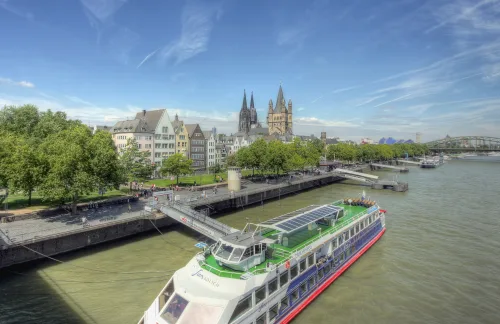
    Rhine Promenade in Cologne, stop 10 on the self-guided walking tour

    This is the river half of the walk, and the promenade works best as a corridor with benefits rather than a destination in itself: it links the Deutzer Bridge with the Hohenzollern Bridge and sets you up for the museum ending. It is free and open around the clock.

    The promenade is open and exposed. In July and August the pleasant windows are before 11:00 and after 16:00, so bring water and sun protection if you pass at midday. Summer thunderstorms here tend to be heavy but are usually over within the hour.

    From here it is 480 metres, about seven minutes, to the Hohenzollern Bridge.

    Hours
    Open 24/7
    Price
    Free
    Website
    koeln.de ↗
  11. 11

    Hohenzollern Bridge

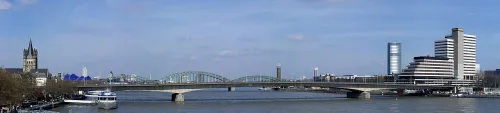
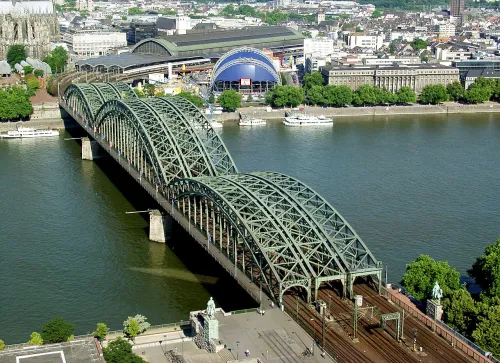
    Hohenzollern Bridge in Cologne, stop 11 on the self-guided walking tour

    More than 1,200 trains cross the Hohenzollern Bridge every day between Köln Hauptbahnhof and Köln Messe/Deutz, which makes it the busiest railway bridge in Germany. It crosses the Rhine at kilometre 688.5. Originally it carried road traffic too, but since its destruction in 1945 and the rebuilding afterwards it has been open only to trains and pedestrians.

    It replaced the old Cathedral Bridge, which could no longer cope with the traffic once the main station opened. Railway engineer Fritz Beermann led the project, with Friedrich Dirksen working out the designs, and construction ran from 1907 to 1911. Kaiser Wilhelm II opened it on 22 May 1911 and it was named after the House of Hohenzollern, the rulers of Prussia and German emperors; Cologne then belonged to the Prussian Rhine Province. Like its predecessor, it lines up with the central axis of the cathedral, a choice that was argued over even then.

    Look for the equestrian statues of Hohenzollern kings and emperors at the ramps. Two of them came from the old Cathedral Bridge: Friedrich Wilhelm IV by Gustav Blaeser and Kaiser Wilhelm I by Friedrich Drake, which now stand on the east bank.

    The bridge is free and always open. Back on the cathedral side, walk 560 metres, about seven minutes, to Museum Ludwig.

    Hours
    Always open
    Price
    Free
    Website
    koeln.de ↗
  12. 12

    Museum Ludwig

    Museum Ludwig in Cologne, stop 12 on the self-guided walking tour

    Museum Ludwig is Cologne's house for art after 1900: Pop Art, abstraction, Surrealism, many works by Andy Warhol and Roy Lichtenstein, and one of the largest Picasso collections in Europe. At its core is also the Haubrich collection, art from 1914 to 1939 that the lawyer Josef Haubrich gave to the city in May 1946.

    The museum exists because of a deal. In 1976 the chocolate magnate Peter Ludwig agreed to donate 350 modern works, then valued at 45 million dollars, and in return the city committed to build a museum carrying his name. The building by Peter Busmann and Godfrid Haberer opened in 1986, first shared with the Wallraf-Richartz Museum; in 1994 the city decided to give it to Museum Ludwig alone. It also contains the Kölner Philharmonie. The square on top, Heinrich-Böll-Platz by Dani Karavan, sits above the concert hall, and during concerts you are not allowed to walk across it because footsteps disturb the music.

    One story is still unfinished. In 2016 the museum co-organised an Anselm Kiefer retrospective that opened in Beijing; when a museum in Shenzhen opened late, the works went into storage and were lost track of. Found in a warehouse in January 2020, they were held back by Chinese authorities, among them the monumental Pasiphae.

    The museum charges entry. For modern art fans it is worth an hour and a half; if not, the square alone is a fine pause. The last stop is only 80 metres away, about one minute.

    Hours
    Tue–Sun 10:00–18:00 (incl. public holidays), 1st Thursday of the month 10:00–22:00; Mon closed
    Price
    13.50 EUR, reduced 9.50 EUR, under 18 free
  13. 13

    Romano-Germanic Museum (Römisch-Germanisches Museum)

    Romano-Germanic Museum (Römisch-Germanisches Museum) in Cologne, stop 13 on the self-guided walking tour

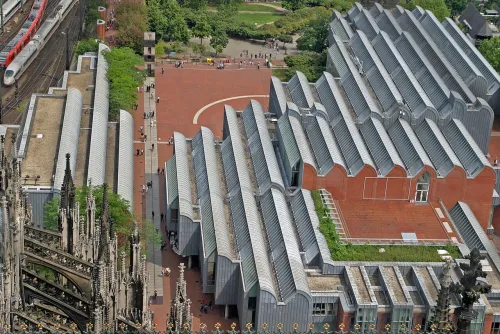
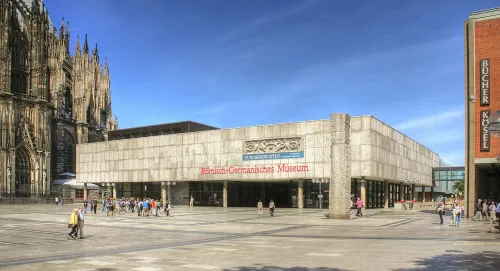
    The Romano-Germanic Museum is currently closed: the building has been shut for a general renovation since 2019, and its interim exhibition is in the Belgian House near Neumarkt. You see it from outside, which still tells you a lot.

    Opened on 4 March 1974, the award-winning building was conceived as a shop window into Roman times. Its surrounding colonnades echo the Roman peristyle house that lies beneath it, home of the famous Dionysus mosaic, which the architects placed so that it could be seen from Roncalliplatz in the museum's lower level. The museum is also the city's office for archaeological heritage, the archive of Cologne's prehistoric, Roman and Frankish past.

    Its collection connects the whole walk. It holds finds from the Roman Rhine harbour and wooden parts of Constantine's bridge, the one that once started near Groß St. Martin; the central arch of the northern city gate with the inscription CCAA, the gate that stood at the end of the Roman main street you followed as Hohe Straße; and a roadworthy reconstruction of a Roman travelling carriage.

    This is where the route ends. If you want to return to the start, the GPS navigation leads you back from here.

    Status
    Currently closed
Walking tour route map of Cologne Route loaded
Cologne Cathedral (Kölner Dom)Old Town (Altstadt)St. Gereon's BasilicaCologne City Museum (Kölnisches Stadtmuseum)+9
All 13 stops are already on the map.
You just press start.
AI Tour Guide

You know the route now. Walk it with a guide talking you through Cologne.

Press start wherever you are, even hundreds of kilometres from Cologne, and the guide begins telling its stories right away. In the city, pick any of the 13 stops to start from: it leads you there, then talks with you the whole route, asking, listening, remembering, and shaping the tour around your answers.

13stops 7.1km 1 h 39 minwalking 13languages
▶Start the tour free

Free to start · Runs in your browser · No app, no download

Shorter Ways to Walk Cologne

Not everyone has a whole day. Both halves of the route work on their own, and the GPS navigation lets you begin at any stop.

Roman roots and the twentieth century

Stops: 1, 2, 3, 4, 5, 6

For history lovers with a morning to spare: from the cathedral through the Old Town to St. Gereon's Basilica, the City Museum, the EL-DE Haus and St. Aposteln. About 3.4 km and 47 minutes of walking. Entry costs apply at the cathedral, the City Museum and the EL-DE Haus; both churches are free.

High street, river and modern art

Stops: 7, 8, 9, 10, 11, 12, 13

For an afternoon: Hohe Straße, Groß St. Martin, out to the Deutzer Bridge, along the Rhine Promenade, across the Hohenzollern Bridge and on to Museum Ludwig. About 2.8 km and 38 minutes of walking. Everything is free except Museum Ludwig; afternoons also suit the opening hours of Groß St. Martin.

How Long Does This Cologne Tour Take with Museums?

The walking itself adds up to 1 h 39 min over 7.1 km. If you stay outside the museums and only look into the cathedral and the free churches, about three hours is a comfortable pace.

Doing it properly means roughly 45 minutes in the cathedral, an hour each in the City Museum and the EL-DE Haus, and an hour and a half in Museum Ludwig. Start at 10:00 and you reach Museum Ludwig shortly after 16:00, with enough time left for the collection; the whole day comes to close to eight hours without a lunch break. The two shorter variants take 47 and 38 minutes of walking respectively, plus whatever time you spend inside.

Before You Set Off from the Cathedral

  • Start and finish: The recommended start is Cologne Cathedral and the route ends at the Romano-Germanic Museum. You can join at any stop, and the GPS navigation will lead you back to the start from the last one if you wish.
  • Best day and time: Pick a day when the museums are open and start in the morning, once the cathedral is open for visitors.
  • What it costs: The walk is free. Budget for the cathedral ticket, which you buy on site, plus entry at the City Museum, the EL-DE Haus and Museum Ludwig if you want all of them.
  • For the river stretch: In high summer bring water and sun protection for the open section along the Rhine.
Walking tour route map of Cologne
AI Tour Guide

Your guide is ready whenever you reach the cathedral.

Press start and a voice AI Tour Guide takes it from here: leading the route through Cologne, telling the stories, and turning your walk into a real back-and-forth conversation. No app or download is needed; it runs in your browser.

13stops 7.1km 1 h 39 minwalking 13languages
▶Start the tour free

Free to start · Runs in your browser · No app, no download

What the AI Tour Guide Adds Between Dom and Rhine

The walk takes you from a Roman mausoleum to a Gestapo cellar within an hour, and that is where a conversation helps. The AI Tour Guide greets you at the cathedral, tells the stories as you go, asks what caught your eye and remembers it: if the EL-DE Haus moved you, it will pick up that thread again at the Hohenzollern Bridge, a bridge rebuilt after 1945. Ask it what became of Leopold Dahmen after the Gestapo moved into his building, or what Kölsch names like Jruhß Zint Määtes say about the city, and interrupt whenever you like. You start with 100 free credits; after that it is €19.99 for this tour with no time limit, or €5 per hour.

A Real Conversation A voice AI Tour Guide greets you, leads the whole route, and tells the stories and facts as you walk, asking what you want to see and keeping a real conversation going. Not a recording you press play on.
Map Navigation Follow the route on the map and walk at your own pace. You choose where to start and when to move to the next stop.
Ask Anything Curious about a building you pass? Ask your AI Tour Guide on the spot and the conversation carries on.
13 Languages Switch language anytime. No separate tour needed.
Start free in your browser

Common Questions About Walking Cologne

What if I am in Cologne on a Monday?

Mondays are the weakest day for this route: the City Museum, the EL-DE Haus, Museum Ludwig and Groß St. Martin are all closed. The cathedral, St. Gereon's Basilica, St. Aposteln, the streets and both bridges still work, so a Monday suits the outdoor half and the churches.

Which stops work on a rainy day?

Plenty of the route is under a roof: the cathedral, three Romanesque churches that cost nothing to enter, and three museums. On a wet day you can lengthen your time inside St. Gereon's Basilica, the City Museum and the EL-DE Haus and keep the bridges and the promenade short.

Can I combine the walk with another city nearby?

Yes. Bonn is 26 km away and Düsseldorf 34 km, both with their own free walking routes, and Aachen makes a good Roman and medieval counterpart at 64 km.

Is the tour really free?

Yes. The whole tour is free: the route, the interactive map and the navigation cost you nothing. Only the voice AI Tour Guide is optional and paid: you test it with 100 free credits, then you pay either €5 per hour or €19.99 for this whole tour, with no time limit. Admission to 4 of the 13 stops is not included: Cologne Cathedral (Kölner Dom), Cologne City Museum (Kölnisches Stadtmuseum), EL-DE Haus (NS Documentation Centre) and Museum Ludwig charge their own entry fees.

Do I need to download an app?

No. Everything runs in your phone browser. Open the route and start walking, no download and no sign-up required.

Do I need to book the walking tour in advance?

No booking needed. This self-guided tour is available anytime. Open the route in your browser and start walking. The AI Tour Guide works instantly, no app, no reservation required.

What languages is the AI Tour Guide available in?

The AI Tour Guide speaks 13 languages, so you take the tour in your own language and can switch at any time.

Can I skip stops or change the route?

Yes. Skip any stop, spend extra time at places you like, or start the route from any point. It is your walk, you set the pace.
Image credits
▶ Start free in your browser Runs in your browser, no app, no download