Free Walking Tour Düsseldorf: Altstadt, Rhine, Königsallee

Old town lanes, art on the Rhine, a TV tower with a giant clock, then a market lunch and the Königsallee: Düsseldorf in one free walk of 7.3 km.

12 Stops 7.3 km ~1 h 40 min walking
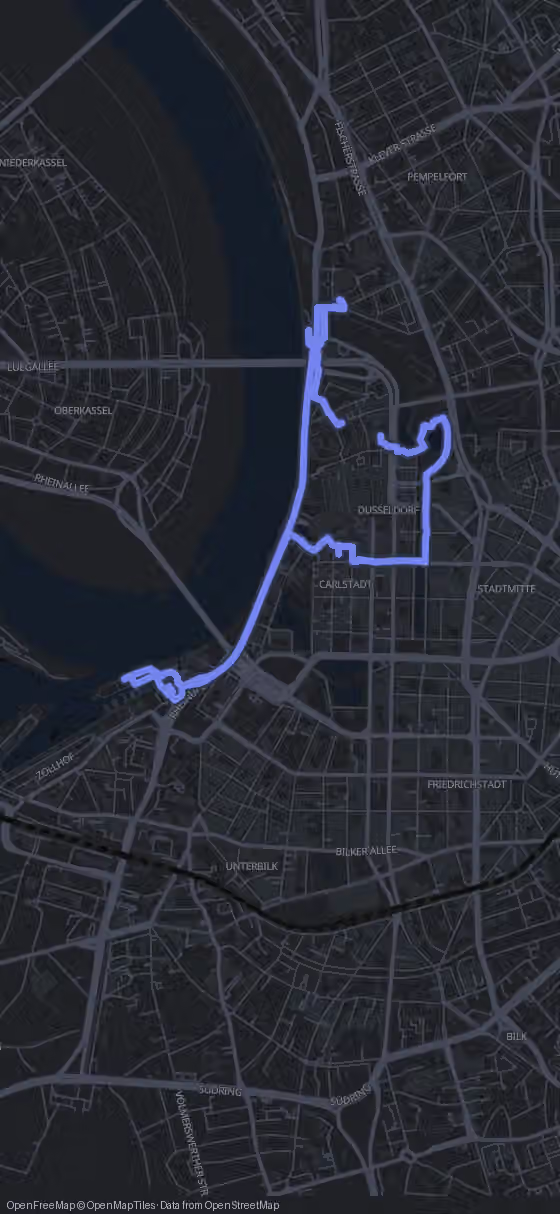
Route map for the Düsseldorf walking tour
Stop 1 of 12
610 m·8 min
Altstadt
Head north toward the Fischmarkt riverside square
Welcome to Düsseldorf. I'm Alex, and our first story begins with a riverbank reclaimed from traffic.
Try this tour with Alex

What this Düsseldorf walk covers

Twelve stops lead from the Altstadt along the Rhine past the Kunstpalast and the Rheinturm, then through the Markt am Carlsplatz and the Königsallee to the K20 (Grabbeplatz). The route is 7.3 km with 1 h 40 min of pure walking; with lunch and a couple of visits inside, plan about seven hours.

Seven stops are free; the Kunstpalast, NRW-Forum, Rheinturm, Filmmuseum / Hetjens and K20 (Grabbeplatz) charge entry. The route, map and GPS navigation in your browser cost nothing, and the AI Tour Guide is optional.

Open free GPS & optional AI Tour Guide
This short shows highlights of the route. All 12 stops follow below.

The Route

Walking Map of Düsseldorf: Altstadt, Rhine and Königsallee

12 stops 7.3 km 1 h 40 min walking
Tap to load interactive map

The 12 stops along this route

  1. Altstadt in Düsseldorf, stop 1 on the self-guided walking tour
    1Altstadt
  2. Fischmarkt in Düsseldorf, stop 2 on the self-guided walking tour
    2Fischmarkt
  3. Kunstpalast in Düsseldorf, stop 3 on the self-guided walking tour
    3Kunstpalast
  4. NRW-Forum in Düsseldorf, stop 4 on the self-guided walking tour
    4NRW-Forum
  5. Rheinuferpromenade in Düsseldorf, stop 5 on the self-guided walking tour
    5Rheinuferpromenade
  6. MedienHafen in Düsseldorf, stop 6 on the self-guided walking tour
    6MedienHafen
  7. Rheinturm in Düsseldorf, stop 7 on the self-guided walking tour
    7Rheinturm
  8. Filmmuseum / Hetjens in Düsseldorf, stop 8 on the self-guided walking tour
    8Filmmuseum / Hetjens
  9. Markt am Carlsplatz in Düsseldorf, stop 9 on the self-guided walking tour
    9Markt am Carlsplatz
  10. Königsallee in Düsseldorf, stop 10 on the self-guided walking tour
    10Königsallee
  11. Hofgarten in Düsseldorf, stop 11 on the self-guided walking tour
    11Hofgarten
  12. K20 (Grabbeplatz) in Düsseldorf, stop 12 on the self-guided walking tour
    12K20 (Grabbeplatz)
  13. That's the full route.

    Walk it with an AI Tour Guide talking you through every one of these streets.

    Start free in your browser
    You made it

Düsseldorf on Foot, Stop by Stop from the Altstadt to the K20

  1. 1

    Altstadt

    Altstadt in Düsseldorf, stop 1 on the self-guided walking tour

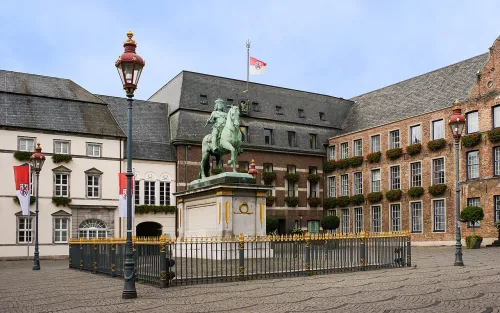
    Start where Düsseldorf started. The Altstadt covers just 0.47 km² on the bank of the Rhine, and only about 2,244 people actually live here, yet it is still the historic, political and cultural heart of the state capital. The Rathaus, the Kunstsammlung Nordrhein-Westfalen and the Kunstakademie all sit inside the district, and large parts of it are pedestrian zone, so you can wander the lanes without dodging traffic.

    What gives the quarter its reputation is the sheer number of places to drink. More than 300 pubs, clubs and restaurants crowd into half a square kilometre, which is why the Altbierlied, the song about the local Altbier, calls it the “longest bar in the world”. That side of the Altstadt belongs to the evening, so keep it in mind for after the walk.

    The town itself grew from very little. Before 1190 a knight named Arnold von Tyvern pledged his large estate on the right bank of the Rhine, including land at “Dusseldorp”, to Count Engelbert of Berg for 100 marks of silver. He never redeemed it, so the land passed to the Counts of Berg. By the middle of the 13th century the village mattered as a ferry and trading point between the two banks, and after the Battle of Worringen it received town rights on 14 August 1288. At that moment Düsseldorf consisted of only a handful of streets and lanes.

    The Altstadt faces the Rhine with its riverside promenade, and the Hofgarten closes it off to the northeast; you will meet both later on the walk. For now, head for the water: the Fischmarkt is 620 m away, about 9 minutes on foot.
    Hours
    Always open
    Price
    0 EUR
  2. 2

    Fischmarkt

    Fischmarkt in Düsseldorf, stop 2 on the self-guided walking tour

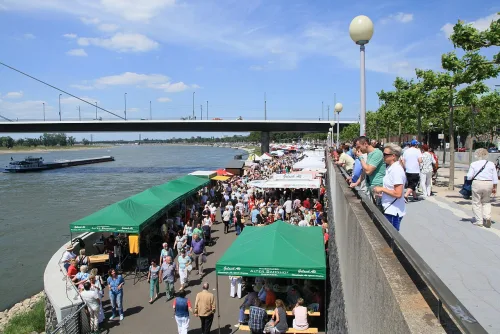
    The Fischmarkt sets up at the Tonhallenufer on the Rhine bank on eight set Sundays, and browsing is free. If your visit falls on one of them, give it a short wander; on any other day you simply stand on the bank where it takes place.

    Either way, this is the point where the walk becomes a river walk. The Tonhallenufer is one section of the long promenade that Düsseldorf reclaimed from a highway, and from here the Rhine leads and the next stops follow it.

    Keep the river at your side to the Kunstpalast, 500 m and about 7 minutes away.

    Hours
    On eight set Sundays between April and November, 11:00–18:00
    Price
    0 EUR
  3. 3

    Kunstpalast

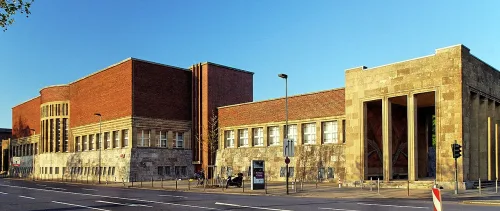
    Kunstpalast in Düsseldorf, stop 3 on the self-guided walking tour

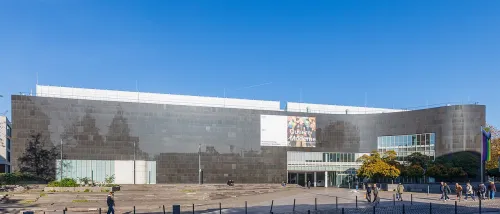
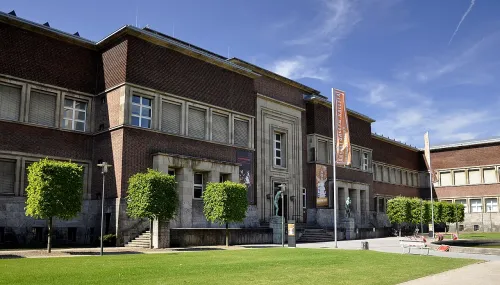
    The building in front of you is part of the Ehrenhof, an ensemble the architect Wilhelm Kreis designed in 1925 and 1926 for the GeSoLei exhibition. Kreis did not start from scratch: he worked the older Kunstpalast, used for exhibitions since 1902, into the new complex. Its listed façade survived a renovation by Oswald Mathias Ungers completed in 2000, and after a thorough overhaul the collection reopened in a new presentation in November 2023.

    Inside are more than 100,000 objects covering almost every genre: paintings and sculpture from the Middle Ages to the present, special collections of applied art and design, graphics and photography, and a major glass collection that grew out of the Glasmuseum Hentrich. The Robert-Schumann-Saal, a concert hall with 796 seats, is part of the building and runs its own programme.

    The museum is a public and private hybrid. The city of Düsseldorf and the energy company E.ON set up the foundation that runs it in 1998, and the municipal art museum it took over had been founded in 1913.

    Is it worth going in? If art is one of the reasons you came to Düsseldorf, yes: the sheer range rewards a long visit rather than a quick look.

    The NRW-Forum shares the Ehrenhof complex and is only 220 m away, about 3 minutes.

    Hours
    Mon: Closed | Tue–Wed: 11:00–18:00 | Thu: 11:00–21:00 | Fri–Sun: 11:00–18:00
    Price
    EUR 17 adult; EUR 13 reduced
  4. 4

    NRW-Forum

    NRW-Forum in Düsseldorf, stop 4 on the self-guided walking tour

    Same architect, same ensemble, very different museum. The NRW-Forum opened in the 1970s as the Museum für Industrie und Wirtschaft, a museum about the industry and economy of North Rhine-Westphalia. In the 1990s it changed both its name and its concept: where more than half of the displays used to be permanent, it now runs changing exhibitions.

    Today it specialises in photography and new media, and its shows tend to look at political, historical, social or economic phenomena from a particular angle. Past exhibitions show the range: the history of the VW Beetle, Helmut Newton in 2003, Vivienne Westwood in 2006, Andy Warhol in 2008. Since January 2020 it has belonged to the Kunstpalast.

    Whether to go in depends entirely on what is showing when you visit, so look at the current exhibition at the entrance before deciding. If photography is your thing and the Kunstpalast feels too big for your day, this is the smaller, more focused alternative.

    Now comes one of the longer legs: 1,150 m, about 16 minutes, to the Rheinuferpromenade.

    Hours
    Mon: Closed | Tue–Wed: 11:00–18:00 | Thu: 11:00–21:00 | Fri–Sun: 11:00–18:00
    Price
    11 EUR regular, 8 EUR reduced
  5. 5

    Rheinuferpromenade

    Rheinuferpromenade in Düsseldorf, stop 5 on the self-guided walking tour

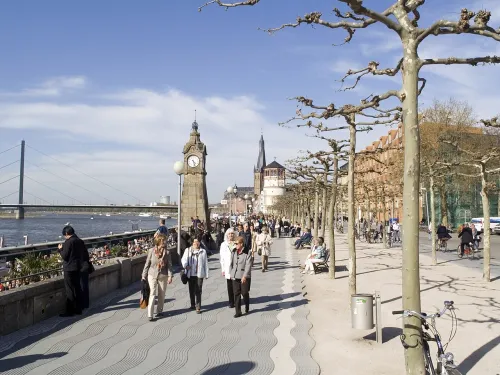
    The Rheinuferpromenade is the landscaped riverbank along the Altstadt, the Carlstadt and the Hafen district, made up of the Tonhallenufer, Schlossufer, Rathausufer and Mannesmannufer. It goes back to the moving of the riverbank between 1898 and 1902, when two levels were built: the lower one for handling ships and everything they needed, the upper one already as a promenade.

    After the Second World War the city gave much of it to the Bundesstraße 1. A multi-lane road ran beside, and in places instead of, the promenade and cut the city centre off from its own river. The fix came in the 1990s with the Rheinufertunnel, which moved the entire road underground. The architects Niklaus Fritschi, Benedikt Stahl and Günter Baum redesigned the bank, and in 1995, two years after the tunnel was finished, a million visitors celebrated the new promenade with a big festival. Among other prizes, the design won the Deutscher Städtebaupreis in 1998.

    So the ground you walk on is reclaimed space, free and open at all hours. Further along the bank, the Museum KIT has occupied a spot level with the former Mannesmann high-rise since 2007, the Apollo Varieté sits beneath the Rheinkniebrücke, and the promenade ends at the Landtag, the state parliament of North Rhine-Westphalia.

    Carry on 1,190 m, about 16 minutes, to the MedienHafen.

    Hours
    Open 24/7
    Price
    0 EUR
  6. 6

    MedienHafen

    MedienHafen in Düsseldorf, stop 6 on the self-guided walking tour

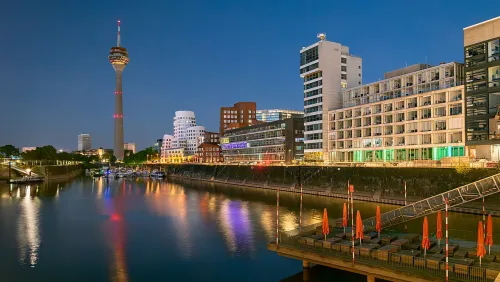
    Düsseldorf has been a port city since its founding, which is why an anchor appears in its coat of arms. For centuries ships simply moored at suitable stretches of the bank. In the 17th century a harbour basin was built in today's Carlstadt, and in the early 19th century the Grand Duchy of Berg and the city added a Sicherheitshafen, a safety harbour that protected ships from floods and ice.

    The commercial port here opened in 1896 and is the third-largest inland port in Germany. For a long time nobody saw it as part of the city at all: it was a large industrial zone, partly fenced off. That changed in the 1990s, when the sections bordering Unterbilk were converted into the “Medienhafen” and filled with new buildings, some of them architecturally ambitious.

    Today media and advertising firms work here alongside fashion and design companies with large showrooms, while a multiplex cinema, restaurants, a big club and several lounges make it a nightlife area too. Officially the Hafen district has just 377 residents, the fewest of any Düsseldorf district. Walking among the buildings is free at any hour; give yourself half an hour to see the architecture from different angles.

    The Rheinturm is close: 360 m, about 5 minutes.

    Hours
    Open around the clock
    Price
    0 EUR
  7. 7

    Rheinturm

    Rheinturm in Düsseldorf, stop 7 on the self-guided walking tour

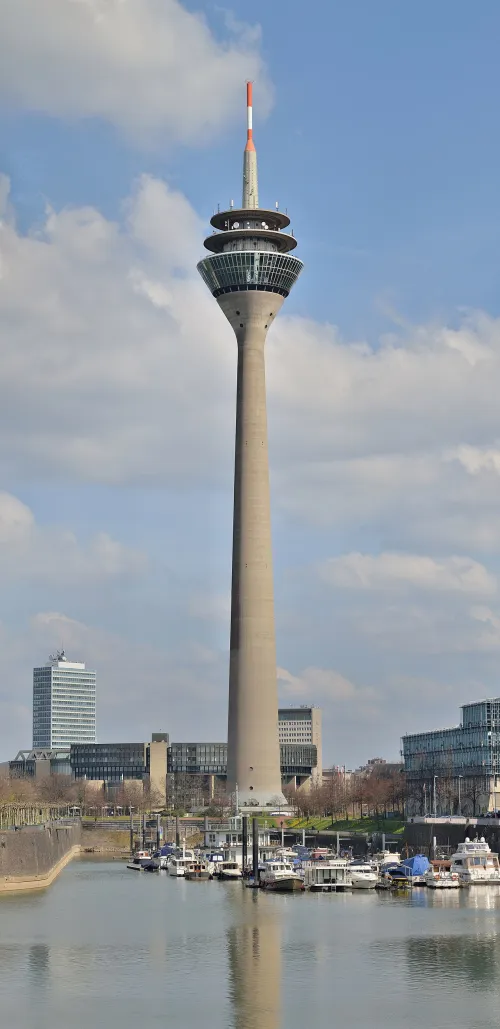
    At 240.50 metres the Rheinturm is the tallest structure in Düsseldorf and the tenth-tallest TV tower in Germany. Built between 1978 and 1982, it carries antennas for radio relay, DVB-T television and FM radio and doubles as an observation tower. Look at the side facing the Altstadt: the light sculpture running up the shaft is considered the largest digital clock in the world.

    The idea of a “Rheinturm” is much older than the tower. Before the First World War the German steel association proposed a steel lattice “wonder” that was to rise 500 metres, 200 more than the Eiffel Tower, resting on four piers, two of them on the arches of a Rhine bridge. It was never built. The city's first telecom tower went up in 1960 and 1961 on a hill east of Gerresheim, only 75 metres tall. It lost importance because it had little room for new antennas and stood too far from the central telephone exchange on Graf-Adolf-Straße, so the new tower had to stand near that exchange and close enough to the centre to shape the skyline.

    About 300,000 people go up every year, and the M168 viewing level charges admission. It is the only stop on the route where you see Düsseldorf from above, so if you pay for just one thing today, this is a strong candidate.

    From the tower it is 1,160 m, about 16 minutes, to the Filmmuseum.

    Hours
    Daily 10:00–00:00 (M168 viewing level; QOMO restaurant daily 18:00–00:00, Sundays also 12:00–16:00)
    Price
    Adults: 12.50 EUR
  8. 8

    Filmmuseum / Hetjens

    Filmmuseum / Hetjens in Düsseldorf, stop 8 on the self-guided walking tour

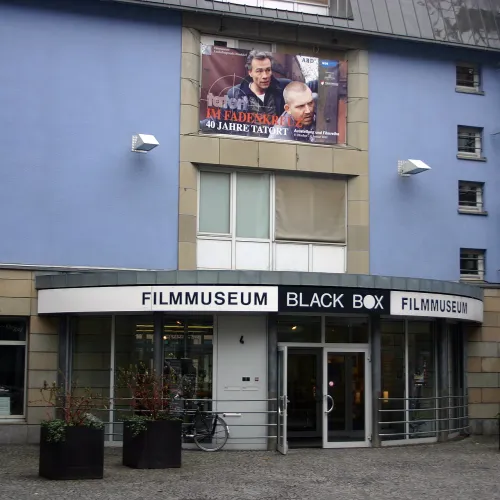
    The Filmmuseum Düsseldorf is one of the few film museums in Germany. Its exhibition rooms and part of its archive are at the Alter Hafen in the Altstadt, and the permanent exhibition spreads over 2,200 square metres on four floors, from the very beginnings of cinema to the present.

    Inside you find early cinematography equipment, models of film sets, decorations, props and costumes, a reconstructed film studio and a whole section on special effects; the point is to follow how films are produced, distributed and shown. Temporary exhibitions focus either on individual filmmakers or on film in relation to society and art. Recent ones covered Christoph Schlingensief, animal actors and visual effects, and in 2026 Andrzej Wajda.

    Entry is inexpensive, with a surcharge for special exhibitions, which makes this the cheapest museum visit on the route and an easy hour for anyone who loves cinema.

    The second half of this stop is the Hetjens, the German Ceramic Museum, which you pass on the way on. Its entry costs the same as the Filmmuseum. From here it is 300 m, about 4 minutes, to the Markt am Carlsplatz.

    Local name
    Filmmuseum Düsseldorf
    Hours
    Filmmuseum: Tuesday–Sunday 11:00–18:00, Monday closed; Hetjens: Wednesday 12:00–21:00, Thursday–Sunday 12:00–18:00, Monday and Tuesday closed
    Price
    Filmmuseum: 5 EUR regular, 2.50 EUR reduced (special exhibitions 7 EUR / 5 EUR); Hetjens - German Ceramic Museum: 5 EUR regular, 2.50 EUR reduced
  9. 9

    Markt am Carlsplatz

    Markt am Carlsplatz in Düsseldorf, stop 9 on the self-guided walking tour

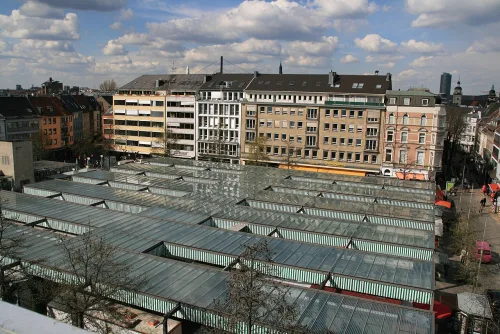
    The Markt am Carlsplatz is the route's kitchen: around sixty stalls with cheese, fish, butchers' counters, pastries and flowers. Walking in is free, and it is the natural place for lunch on this walk.

    Plan your day so you get here by lunchtime, because the next stretch has no comparable lunch stop.

    Eat here rather than in a hurry later: the next two stops, the Königsallee and the Hofgarten, are made for walking off a meal. The Königsallee is 540 m away, about 7 minutes.

    Hours
    Mon–Fri: 08:00–18:00 | Sat: 08:00–16:00 | Sun: Closed
    Price
    0 EUR
  10. 10

    Königsallee

    Königsallee in Düsseldorf, stop 10 on the self-guided walking tour

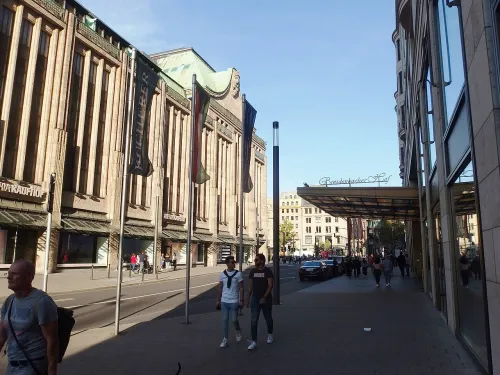
    The Königsallee, “King's Avenue”, which locals simply call the Kö, runs for about a kilometre through Stadtmitte, from the Hofgarten to Carl-Theodor-Straße and Luisenstraße. The whole boulevard is about 80 metres wide, and down its middle runs a canal 31 metres wide and up to 5 metres deep, fed by the Düssel, the small river that gave the city its name.

    It exists because of a peace treaty. Around 1800 Düsseldorf was a small Baroque town and capital of the Grand Duchy of Berg; after the Treaty of Lunéville the Duke had to remove the fortifications, which freed space for a more generous plan. Court architect Caspar Anton Huschberger, landscape architect Maximilian Friedrich Weyhe and hydraulic engineer Wilhelm Gottlieb Bauer designed a classicist esplanade, and canal and boulevard were completed between 1802 and 1804. The Hotel Breidenbacher Hof opened in 1812, and other buildings soon followed.

    Read the two sides differently. The eastern side is all commerce, with upmarket flagship stores and shopping arcades running deep into the blocks. The western side is quieter, mostly offices, bank branches and hotels, with cafés and restaurants on both. It counts among Germany's busiest upscale shopping streets, but the walk along the canal costs nothing.

    At its Hofgarten end the boulevard reaches out onto the Landskrone, a peninsula in the park's lake. The Hofgarten stop is 760 m away, about 10 minutes.

    Hours
    Always open
    Price
    0 EUR
  11. 11

    Hofgarten

    Hofgarten in Düsseldorf, stop 11 on the self-guided walking tour

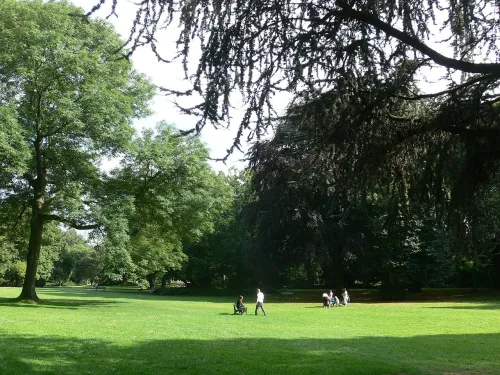
    The Hofgarten is Düsseldorf's central park: 27.73 hectares, 13 of them meadow, stretching from Schloss Jägerhof to Heinrich-Heine-Allee on the edge of the Altstadt, and from the Königsallee to the Ehrenhof by the Rhine, so the museums you saw in the morning sit at its far edge. Its oldest public part was laid out in 1769, which makes it Germany's first and oldest Volksgarten, a park built for the public.

    Its story goes back to Duke Wilhelm the Rich. In the 16th century a ducal garden lay outside the city walls, reached through the Ratinger Tor. It is first recorded in 1557, when Düsseldorf had become the main residence and the duke had the grounds extended. In 1585 part of the lavish celebrations for the wedding of hereditary prince Johann Wilhelm and Jakobe von Baden-Baden took place here.

    In the 18th century the garden became a public promenade, and early in the 19th century Maximilian Friedrich Weyhe, the same landscape architect who worked on the Königsallee, gave the new Hofgarten the shape it largely keeps today. The design marks the shift from Baroque gardens to the English landscape style. The last big changes came after the destruction of the Second World War.

    Look out for the many historic monuments and modern sculptures as you cross; the park is free and always open. The last leg is 480 m, about 7 minutes, to the K20 (Grabbeplatz).

    Hours
    Open 24/7
    Price
    0 EUR
  12. 12

    K20 (Grabbeplatz)

    K20 (Grabbeplatz) in Düsseldorf, stop 12 on the self-guided walking tour

    The walk ends at a ticket counter, on purpose. The K20 at Grabbeplatz is a regularly priced art museum: the standard ticket covers the collection and the special exhibition together, and there is a cheaper collection-only ticket.

    After a full day on foot, the collection-only ticket is often the honest choice; your attention is the scarcest thing on this route.

    With that you are done, back in the neighbourhood of the Königsallee and the Hofgarten, with the whole day's walk still around you.

    Hours
    Tuesday–Sunday 11:00–18:00 (every 1st Wednesday of the month until 22:00), Monday closed
    Price
    16 EUR regular (collection and special exhibition), 14 EUR reduced; collection only 9 EUR (reduced 7 EUR)
Walking tour route map of Düsseldorf Route loaded
AltstadtFischmarktKunstpalastNRW-Forum+8
All 12 stops are already on the map.
You just press start.
AI Tour Guide

You know the route now. Walk it with a guide in your ear.

Press start wherever you are, even hundreds of kilometres from Düsseldorf, and the guide begins telling its stories right away. In the city, pick any of the 12 stops to start from: it leads you there, then talks with you the whole route, asking, listening, remembering, and shaping the tour around your answers.

12stops 7.3km 1 h 40 minwalking 13languages
▶Start the tour free

Free to start · Runs in your browser · No app, no download

Shorter Ways to Walk Düsseldorf

The route splits neatly into a river half and a city half, and the full walk also works without a single ticket.

The river half: Altstadt to the Rheinturm

Stops: 1, 2, 3, 4, 5, 6, 7

For a morning by the water. About 4.2 km and 56 minutes of walking, ending at the tower. Entries are optional: Kunstpalast, NRW-Forum and Rheinturm. With the Kunstpalast and the view from the tower, it fills just under five hours.

The city half: Filmmuseum to the K20

Stops: 8, 9, 10, 11, 12

For an afternoon of market, boulevard and park. About 2.1 km and 28 minutes of walking. Entries: Filmmuseum, Hetjens and K20. With an hour of film, a market lunch and the K20 collection, count on about four hours.

All twelve stops, no tickets

Stops: 1, 2, 3, 4, 5, 6, 7, 8, 9, 10, 11, 12

For anyone who wants the whole city without paying entry: the full 7.3 km and 1 h 40 min of walking, every museum and the tower seen from outside. With a market lunch it takes about five hours.

How Long Does the Düsseldorf Walk Take with Museums and Lunch?

The 7.3 km take 1 h 40 min of pure walking. Most legs are short; the three longest, each about 16 minutes, run from the NRW-Forum to the Rheinuferpromenade, from there to the MedienHafen, and from the Rheinturm to the Filmmuseum.

A realistic full day: start in the Altstadt at 10:00, see the Kunstpalast and the NRW-Forum from outside, go up the Rheinturm (about 45 minutes), eat at the Markt am Carlsplatz (about 45 minutes) and see the K20 collection (about 75 minutes). You reach the tower around 12:35, the market around 13:45, the K20 at 15:35 and finish around 16:50.

Add the Kunstpalast to that day (about 90 minutes) and you arrive at the K20 only around 17:00, with little time left for it, so pick one of the two big art museums. Without going inside anywhere, but with a market lunch, the full route takes about five hours.

Before You Set Off in Düsseldorf

  • Start and finish: The Altstadt is the recommended start, but you can join at any stop; the order of the stops is the recommended one. The route ends at the K20 (Grabbeplatz), and the GPS navigation in your browser can lead you from there back to the start.
  • Best day: Pick your day with care: the museums and the market on this route are not open every day. On a day when the museums are shut, the free version of the walk still works well.
  • Costs: Walking the route is free. Going into every paid stop adds up quickly; the Rheinturm plus the K20 collection is a good pairing for one day.
Walking tour route map of Düsseldorf
AI Tour Guide

Your guide is ready when you are, at any of the twelve stops

Press start and a voice AI Tour Guide takes it from here: leading the route through Düsseldorf, telling the stories, and turning your walk into a real back-and-forth conversation. No app or download is needed; it runs in your browser.

12stops 7.3km 1 h 40 minwalking 13languages
▶Start the tour free

Free to start · Runs in your browser · No app, no download

How the AI Tour Guide leads you through Düsseldorf

The text gives you the facts; the AI Tour Guide turns the walk into a conversation. It greets you in the Altstadt, tells the stories of each place as you arrive, asks what you care about and remembers it: if you lingered over the glass in the Kunstpalast, it picks that thread up again later, and if you would rather hear about Altbier culture or about Robert Schumann, whose name the concert hall carries, it takes the conversation there. You can interrupt it at any time. You start with 100 free credits; after that you choose between this tour all-inclusive for €19.99 with no time limit, or €5 per hour.

A Real Conversation A voice AI Tour Guide greets you, leads the whole route, and tells the stories and facts as you walk, asking what you want to see and keeping a real conversation going. Not a recording you press play on.
Map Navigation Follow the route on the map and walk at your own pace. You choose where to start and when to move to the next stop.
Ask Anything Curious about a building you pass? Ask your AI Tour Guide on the spot and the conversation carries on.
13 Languages Switch language anytime. No separate tour needed.
Start free in your browser

Common Questions about Walking Düsseldorf

Should I go up the Rheinturm in the evening instead?

You can. The viewing level is also open in the evening, so walk the route by day and save the tower for later. The QOMO restaurant up there serves dinner too.

If I only have time for one museum, which should it be?

For breadth, the Kunstpalast. For film fans on a small budget, the Filmmuseum. If you prefer to end the day with art, the collection-only ticket at the K20. The NRW-Forum depends on its current exhibition.

Does the walk work on a Sunday?

Mostly. The museums and the Rheinturm are open, but the Markt am Carlsplatz is closed, so plan lunch in the Altstadt instead. On its market Sundays you get the Fischmarkt on the Rhine bank in exchange.

Can I combine Düsseldorf with Cologne or Bonn?

Yes, as separate days. Cologne is 34 km away and Bonn 60 km, and each has its own free walking route.

Is the tour really free?

Yes. The whole tour is free: the route, the interactive map and the navigation cost you nothing. Only the voice AI Tour Guide is optional and paid: you test it with 100 free credits, then you pay either €5 per hour or €19.99 for this whole tour, with no time limit. Admission to 5 of the 12 stops is not included: Kunstpalast, NRW-Forum, Rheinturm, Filmmuseum / Hetjens and K20 (Grabbeplatz) charge their own entry fees.

Do I need to download an app?

No. Everything runs in your phone browser. Open the route and start walking, no download and no sign-up required.

Do I need to book the walking tour in advance?

No booking needed. This self-guided tour is available anytime. Open the route in your browser and start walking. The AI Tour Guide works instantly, no app, no reservation required.

What languages is the AI Tour Guide available in?

The AI Tour Guide speaks 13 languages, so you take the tour in your own language and can switch at any time.

Can I skip stops or change the route?

Yes. Skip any stop, spend extra time at places you like, or start the route from any point. It is your walk, you set the pace.
Image credits
▶ Start free in your browser Runs in your browser, no app, no download