Free Walking Tour Monschau: Castle, Cliffs and Cloth

From a hill castle past working glassblowers and the rocks of the Perlenbach valley to the cloth barons' red mansion: 6.1 km of Monschau on foot.

8 Stops 6.1 km ~1 h 26 min walking
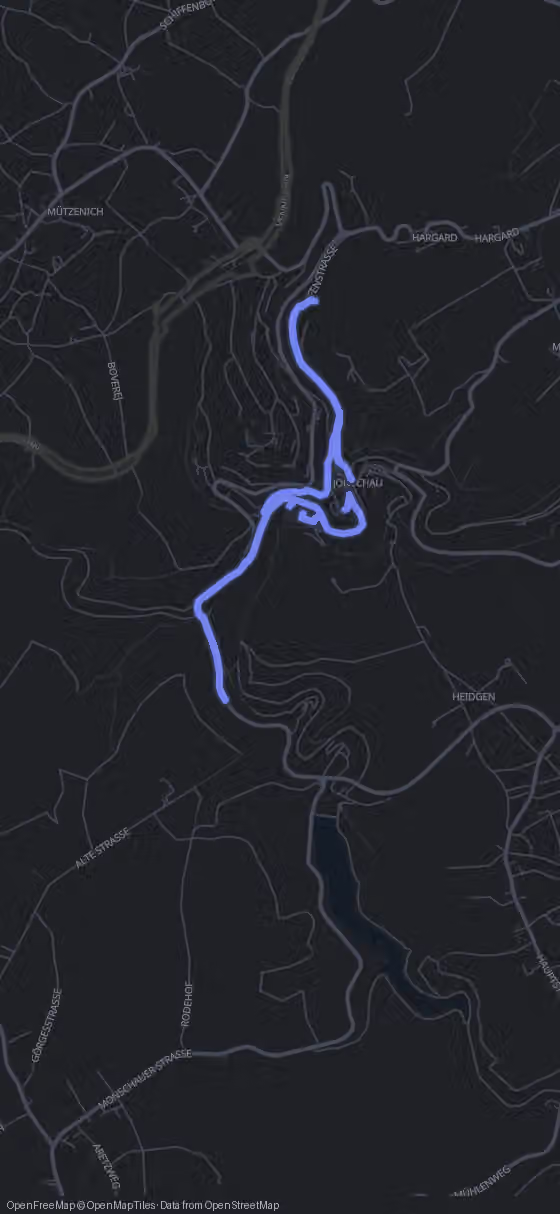
Route map for the Monschau walking tour
Stop 1 of 8
640 m·8 min
Burg Monschau
Head west down toward the river and the Glashütte Monschau.
Welcome to Monschau. I'm Alex, and in this old cloth town, one former textile mill found a much sharper second life.
Try this tour with Alex

This Monschau Route at a Glance

Eight stops lead from Burg Monschau to the Evangelische Stadtkirche next to the Rotes Haus. The route covers 6.1 km with 1 h 26 min of pure walking; with the paid visits and a mill tour, plan about six hours.

Glashütte Monschau, the Teufelsley, Haus Troistorff, the castle grounds and the church cost nothing. Tickets apply at the Erlebnismuseum / Felsenkeller, for the guided tour of the Senfmühle and at the Rotes Haus. The GPS route runs free in your browser; the AI Tour Guide is optional.

Open free GPS & optional AI Tour Guide
This short shows highlights of the route. All 8 stops follow below.

The Route

Walking Map of Monschau, from Castle to Church

8 stops 6.1 km 1 h 26 min walking
Tap to load interactive map

The 8 stops along this route

  1. Burg Monschau, stop 1 on the self-guided walking tour
    1Burg Monschau
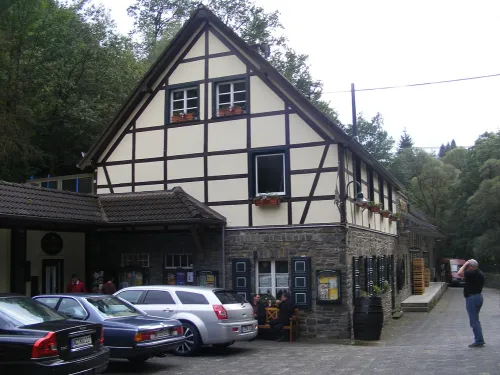
  2. Glashütte Monschau, stop 2 on the self-guided walking tour
    2Glashütte Monschau
  3. Erlebnismuseum / Felsenkeller in Monschau, stop 3 on the self-guided walking tour
    3Erlebnismuseum / Felsenkeller
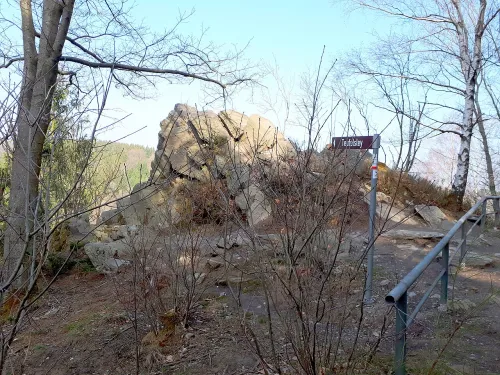
  4. Teufelsley in Monschau, stop 4 on the self-guided walking tour
    4Teufelsley
  5. Senfmühle in Monschau, stop 5 on the self-guided walking tour
    5Senfmühle
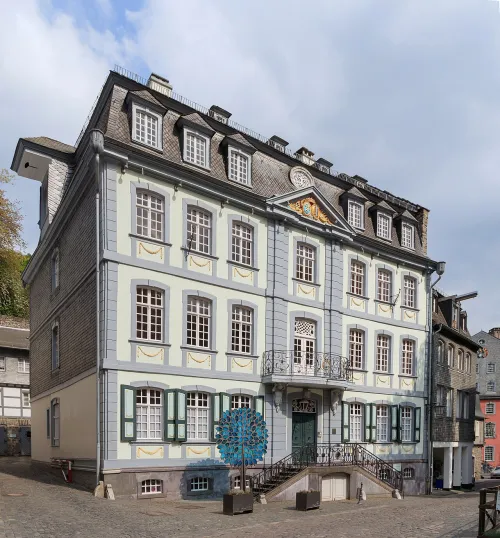
  6. Haus Troistorff in Monschau, stop 6 on the self-guided walking tour
    6Haus Troistorff
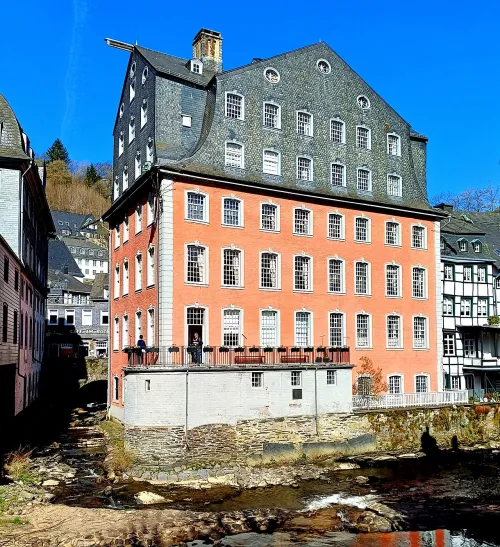
  7. Rotes Haus in Monschau, stop 7 on the self-guided walking tour
    7Rotes Haus
  8. Evangelische Stadtkirche in Monschau, stop 8 on the self-guided walking tour
    8Evangelische Stadtkirche
  9. That's the full route.

    Walk it with an AI Tour Guide talking you through every one of these streets.

    Start free in your browser
    You made it

Your Monschau Walking Tour, Stop by Stop Through Eight Places

  1. 1

    Burg Monschau

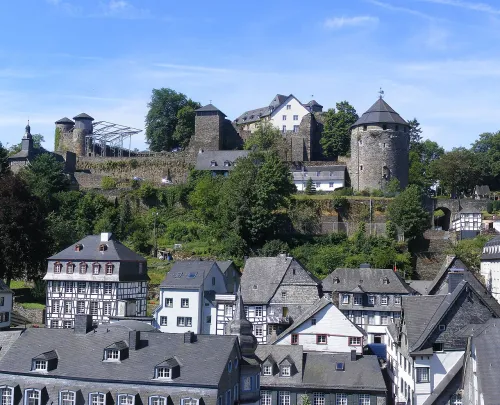
    Burg Monschau, stop 1 on the self-guided walking tour

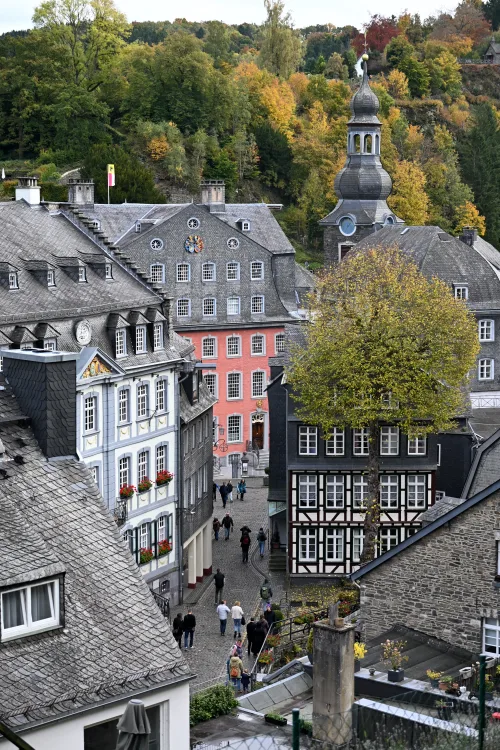
    Burg Monschau stands on its hill over the town, and the grounds are open around the clock at no charge, which makes it an easy place to begin before anything else unlocks. Read the complex in two parts: the upper castle with its outer bailey is the oldest core, while the lower castle with the Eselsturm and the drawbridge came later. The wall walks along the ring walls are reconstructions.

    The first building phase took place between 1190 and 1198 under Duke Walram IV of Limburg. The dukes needed a new stronghold: around 1140 they had handed their Burg Reichenstein to the Premonstratensian order because it was not defensible enough, and an older castle across the valley, the Haller, could not be expanded on its terrain. The castle first appears in writing in 1217 as "castrum in Munjoje", in a document of Archbishop Engelbert I of Cologne.

    In 1269 the lordship of Monschau was joined with Valkenburg, today in Dutch Limburg, and in 1354 it passed to the margraves, later dukes, of Jülich. They turned the castle into a fortress with massive ring walls. Their additions include the castle chapel, first recorded in 1369 as the "nuwe Capelle", which served for about 300 years as Monschau's first church. Keep that chapel in mind; it returns at the end of the walk. The Haus zum Turm, built in 1351 as the official home and guardhouse of the forester and watch commander, stayed with the castle lords until 1795.

    Today parts of the castle house a youth hostel and a retirement home, and in summer the courtyard becomes a venue for open-air concerts. Walk the courtyards and walls quietly and give yourself about half an hour. From here it is 680 m, around 10 minutes, to the glassworks.
    Hours
    Open 24/7
    Price
    Free
  2. 2

    Glashütte Monschau

    Glashütte Monschau, stop 2 on the self-guided walking tour

    After eight centuries of stone, the Glashütte Monschau shows a craft at work right now. Glassblowers shape their pieces in front of visitors in regular demonstrations, and entry is free.

    For travellers on a tight budget this is one of the strongest reasons to walk through town: you watch something being made without paying a cent. The one thing that costs money is the glass ball you blow yourself, a souvenir made with your own breath and hard to refuse if children are with you. The price you learn at the counter.

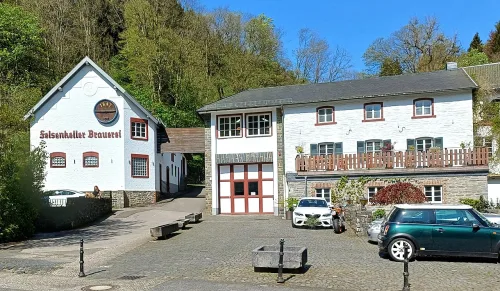
    Forty minutes are enough to catch a demonstration and look around. The next stop is only 360 m away, about 5 minutes, and on the way you pass the building of the old Felsenkeller brewery museum.

    Hours
    Mon–Sun 10:00–18:00
    Price
    Free
  3. 3

    Erlebnismuseum / Felsenkeller

    Erlebnismuseum / Felsenkeller in Monschau, stop 3 on the self-guided walking tour

    This stop carries two names because Monschau's museum landscape changed and many older guides did not. The Felsenkeller, the historic brewery museum, is permanently closed. What opens is the Erlebnismuseum Lernort Natur, a hands-on nature museum inside the Handwerkermarkt.

    Check the calendar before you plan around it, because the museum opens only on certain days. Tickets come in adult, reduced and family versions, and the pricing tells you who it is for: families with children get the most out of it.

    Adults travelling without kids are better off saving their time and money for the Rotes Haus later on the route: that house is the town's memory, this museum is the region's classroom. If you do go in, your ticket includes a one euro voucher for the Handwerkermarkt, so the market itself becomes your break.

    From here the route leaves the exhibits behind for the real landscape: 1,330 m, about 19 minutes, to the Teufelsley.

    Local name
    Erlebnismuseum Lernort Natur
    Hours
    Fri–Sun 11:00–17:00 (September weekends, additional holiday days in October)
    Price
    EUR 5.50 adult; EUR 2.50 child; EUR 14 family; EUR 2.50 reduced
  4. 4

    Teufelsley

    Teufelsley in Monschau, stop 4 on the self-guided walking tour

    The Teufelsley is one of several rock formations in the Lower Perlenbach Valley nature reserve, together with the Engelsley, the Bromelsley and the Pferdeley. The lower course of the Perlenbach runs through two wooded areas and rocky stretches, with the Perlenbach reservoir lying between them. Some of the larger cliffs have been made into viewpoints, and the stop is open at all hours and free.

    Look closely at the rock itself. Heath-like vegetation has taken hold on the stone in places, while in the shaded parts numerous ferns grow, among them the rare Killarney fern. The slopes carry mostly middle-aged spruce, and further down, toward the Perlenbach's mouth into the Rur, the stream is lined with natural floodplain forest.

    The reserve exists to protect habitats for plants, fungi and animals on the red list for North Rhine-Westphalia. It matters for the kingfisher, for several bats including the pond bat, the greater mouse-eared bat, Daubenton's bat, the whiskered bat and the brown long-eared bat, for wild daffodils, bog asphodel and marsh violet, and in the water for the bullhead and the brook lamprey. You will not see most of them on a short visit, but knowing they are here changes how you look at the place.

    Twenty minutes are enough to take in the rocks. If you are short on time or energy, this is the stop to leave out, because it adds the most walking. The next leg is the longest of the route: 2,630 m, about 39 minutes, to the Senfmühle.

    Hours
    Open 24/7
    Price
    Free
  5. 5

    Senfmühle

    Senfmühle in Monschau, stop 5 on the self-guided walking tour

    The Senfmühle is a listed group of buildings on the bank of the Laufenbach. It was built at the end of the 18th or start of the 19th century as the Laufentaler Mühle for textile work, and today it is the home of the Breuer family's mustard, sold in the mill shop. The guided tour is paid; ask in the shop when the next one starts.

    The buildings had a long textile life first. From 1816 they served as a spinning mill, from 1882 the firm of Hermann Josef Fettweis ran a shoddy wool factory here, and from 1896 Wilhelm Stein and Josef Klein used it as a spinning mill again. In 1918 it was sold to the Meyer company. Only in 1952 did Clemens August Breuer the Younger take over the works and move his mustard business here from the town centre.

    The family's mustard story starts much smaller. Clemens August Breuer the Elder began making mustard in 1882 on the Holzmarkt, without any mill. In 1908 he moved production into empty textile buildings on the Schmitzenhof near the Rotes Haus, creating Monschau's first mustard mill. A year later his son Emil Bruno Breuer took over, added soft drinks, seltzer, lemonade and vinegar, and swapped the old wooden waterwheel for an iron one, which is still visible outside the former wheel house on the old water channel. The mill ran first on water, later on an English steam engine, and finally on an electric motor driving a transmission so several machines could work at once.

    Take the tour if you want to see how the milling works; otherwise the shop alone is free to browse. From here it is 980 m, about 12 minutes, to Haus Troistorff, and near the Rotes Haus you can look for that iron waterwheel.

    Hours
    Mon–Sat 08:30–18:00, Sun and holidays 10:00–18:00 (mill shop)
    Price
    5.00 EUR weekdays, 6.00 EUR Sundays/holidays (guided tour)
  6. 6

    Haus Troistorff

    Haus Troistorff in Monschau, stop 6 on the self-guided walking tour

    Haus Troistorff is a view from the street, free at any hour. It was finished in 1783 by an unknown master builder for the cloth manufacturer Matthias Peter Wolfgang Troistorff, who gave it his name. Look up at the ornamental gable: the double coat of arms belongs to the couple who built it, Troistorff on the left and Böcking on the right.

    The house sits in a web of family ties. Matthias Peter's father, Bartholomäus Troistorff, settled in Monschau as a cloth maker and married Anna Katharina Offermann. Her sister Maria Agnes was married to Johann Heinrich Scheibler, the builder of the Rotes Haus, so the two great houses on this street belong to families joined by marriage. Matthias Peter took over his father's works and built them, alongside the Scheibler firms, into one of the most important manufactories in town. In 1769 several cloth makers, most of them related to each other several times over, formed the manufacturers' association known as the Feine Gewandschaft.

    His marriage to the wealthy Magdalena Katharina Böcking gave him the means for a grand residence and headquarters, meant to be the most imposing building of Monschau's cloth boom after the Rotes Haus. He enjoyed it only briefly: born in 1737, he died in 1784, a year after moving in, and his son Adolf Peter Troistorff took over both the factories and the house.

    Today Haus Troistorff belongs to the StädteRegion Aachen and is used for receptions, conferences, weddings and exhibitions organised by the Kunst- und Kulturverein Haus Troistorff, which has its seat here. Ten minutes for the facade is enough; the Rotes Haus is just 80 m, a minute's walk, away.

    Hours
    Open 24/7 (exterior view from public street)
    Price
    Free
  7. 7

    Rotes Haus

    Rotes Haus in Monschau, stop 7 on the self-guided walking tour

    The Rotes Haus was built, probably between 1752 and 1768, by the cloth manufacturer Johann Heinrich Scheibler, and takes its name from the colour of its facade. It stands where the Laufenbach flows into the Rur, with three main floors, two gable floors and an attic used for storage. Next to the much lower half-timbered houses around it, it looked unusually massive in its day and is sometimes called an early high-rise.

    Look at the two halves. The left part, Zum goldenen Helm, was the family home; the right part, Zum Pelikan, held the counting house and production. A helmet and a pelican over the entrance doors mark the difference. The brick facade is set in front of a timber frame, highly unusual in half-timbered Monschau but chosen on purpose for its precision. Base, window and door frames and corner pilasters are in Aachen bluestone; in the attic floors the frames are wood painted to match. Rocaille keystones crown the doors and windows, and the carved doors hint at the rich rooms inside. The architect is not known.

    Inside, the museum shows how a wealthy family lived around the turn from the 18th to the 19th century. If you pay for one interior on this route, make it this one, but keep in mind that it closes for lunch and opens only for part of the year. Plan about an hour.

    The last stop is only 20 m away, a minute's walk.

    Hours
    Tue–Sun 10:00–13:00, 14:00–17:00 (season 01 April – 30 November)
    Price
    5.00 EUR adults, 3.00 EUR reduced, free under 18
  8. 8

    Evangelische Stadtkirche

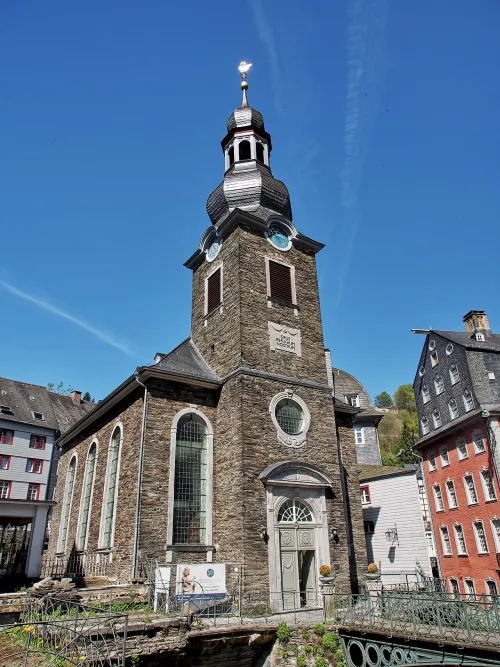
    Evangelische Stadtkirche in Monschau, stop 8 on the self-guided walking tour

    The Evangelische Stadtkirche ends the walk right beside the Rotes Haus, and it is free to visit. The church received its present name at the service celebrating its reopening on 23 August 2014, a name meant to stress its role as a church for the whole town.

    Protestant life in the Monschau area reaches back to the first half of the 16th century, with Anabaptists and early traces of the evangelical movement, and a Lutheran congregation may have existed before 1597. When the duchy of Jülich was jointly ruled by Palatinate-Neuburg and Brandenburg, Lutheran services were held from 1609, and Reformed services from 1614, in the castle chapel of Burg Monschau, the same chapel you saw at the start.

    That ended in 1622, when the Spanish captured the castle and town of Montjoie. Public Protestant worship became impossible and both Lutherans and Reformed were harshly suppressed. The Lutherans moved to a barn in the hamlet of Menzerath and met there in secret, while the Reformed attached themselves to the congregation in Gemünd. Even after the Peace of Westphalia in 1648, it took until the religious settlement of 26 April 1672 for the Lutherans to regain the right to worship in public. In 1683 they built their first church of their own in Menzerath, about 1.5 km northeast of Monschau.

    Sit for a few minutes and let the day come together: castle, cloth, mustard and faith, all within one valley. If you want to return to Burg Monschau, the GPS navigation in your browser leads you back.

    Hours
    Mon–Sun 11:00–17:00 (season Easter/01 April – 31 October)
    Price
    Free
Walking tour route map of Monschau Route loaded
Burg MonschauGlashütte MonschauErlebnismuseum / FelsenkellerTeufelsley+4
All 8 stops are already on the map.
You just press start.
AI Tour Guide

You know the way now. Walk it with a guide in your ear.

Press start wherever you are, even hundreds of kilometres from Monschau, and the guide begins telling its stories right away. In the city, pick any of the 8 stops to start from: it leads you there, then talks with you the whole route, asking, listening, remembering, and shaping the tour around your answers.

8stops 6.1km 1 h 26 minwalking 13languages
▶Start the tour free

Free to start · Runs in your browser · No app, no download

Shorter Ways to Walk Monschau

Not everyone wants the full day. These three sections of the route stand on their own and each has its own character.

Castle and glass

Stops: 1, 2, 3

For a short morning or a family with children. 1,040 m and 15 minutes of walking. The castle grounds and the glassworks are free; the Erlebnismuseum ticket mostly makes sense with kids.

The valley walk

Stops: 3, 4, 5

For walkers who want nature between the museums. 3,960 m and 58 minutes of walking from the Erlebnismuseum to the Teufelsley and on to the Senfmühle. The rocks are free; the only possible cost is the mill tour.

Mustard and merchant houses

Stops: 5, 6, 7, 8

For anyone mainly interested in Monschau's industrial and family history. Only 1,080 m and 14 minutes of walking. Tickets for the Senfmühle tour and the Rotes Haus; Haus Troistorff and the church are free.

How Long This Monschau Tour Takes, With and Without Museums

The 6.1 km are not spread evenly. The town section at the start and the cluster of Haus Troistorff, Rotes Haus and Stadtkirche at the end are short hops, while the walk out to the Teufelsley and on to the Senfmühle accounts for most of the 1 h 26 min of pure walking.

A full day with every interior works like this. Start at Burg Monschau at 10:00, give it half an hour, and you reach the Glashütte at 10:40. Forty minutes there, five minutes on, and you arrive at the Erlebnismuseum at 11:25. After an hour inside you reach the Teufelsley at 12:44; twenty minutes at the rocks and the long leg bring you to the Senfmühle at 13:43. Allow 45 minutes for tour and shop and you stand at Haus Troistorff at 14:40. Ten minutes for the facade, one minute on, and you reach the Rotes Haus at 14:51, after its lunch break. An hour inside, the church at 15:52, and you finish around 16:10.

Castle and glass takes about two and a half hours including the museum. The valley walk takes about two hours if you skip the museum and keep the mill tour. Mustard and merchant houses fills about two and a half hours with the mill tour and the Rotes Haus.

Before You Set Off From Burg Monschau

  • Start and finish: Start at Burg Monschau, the recommended order, but you can join at any stop. The route ends at the Evangelische Stadtkirche; the GPS navigation in your browser leads you back to the castle if you want.
  • Best day: Plan your day around the Erlebnismuseum and the Rotes Haus, since neither is open every day of the week. In the warmer months every stop on the route can be visited.
  • Time of day: Set off in the morning. That puts you at the glassworks once it has opened and at the Rotes Haus after its lunch break.
  • Costs: Route, map and GPS navigation are free. The Erlebnismuseum, the Senfmühle tour and the Rotes Haus are paid, and the mill tour costs a little more on Sundays. The AI Tour Guide starts with 100 free credits; after that you choose this tour all-inclusive for €19.99 with no time limit, or €5 per hour.
Walking tour route map of Monschau
AI Tour Guide

Your guide is ready when you reach the castle.

Press start and a voice AI Tour Guide takes it from here: leading the route through Monschau, telling the stories, and turning your walk into a real back-and-forth conversation. No app or download is needed; it runs in your browser.

8stops 6.1km 1 h 26 minwalking 13languages
▶Start the tour free

Free to start · Runs in your browser · No app, no download

What the AI Tour Guide Adds in Monschau

Monschau's stories run along family lines and old rights: the castle chapel at the start reaches forward to the church at the end, and two cloth dynasties built their houses side by side. The AI Tour Guide picks up these threads as a conversation, notices whether you lean toward the mills, the nature reserve or the merchant families, and goes deeper where you do. Ask it what a working day in the Pelikan half of the Rotes Haus looked like, or why the Spanish wanted Montjoie in 1622, and it talks it through with you while you walk.

A Real Conversation A voice AI Tour Guide greets you, leads the whole route, and tells the stories and facts as you walk, asking what you want to see and keeping a real conversation going. Not a recording you press play on.
Map Navigation Follow the route on the map and walk at your own pace. You choose where to start and when to move to the next stop.
Ask Anything Curious about a building you pass? Ask your AI Tour Guide on the spot and the conversation carries on.
13 Languages Switch language anytime. No separate tour needed.
Start free in your browser

Common Questions About Walking Monschau

Is the Felsenkeller brewery museum in Monschau still open?

No, it is permanently closed. The museum you can visit today is the Erlebnismuseum Lernort Natur inside the Handwerkermarkt.

Can I go inside Burg Monschau?

The grounds are open at any hour and free. Parts of the castle serve as a youth hostel and a retirement home, so treat it as a lived-in place rather than a museum. In summer the courtyard hosts open-air concerts.

What can I still see in Monschau in winter?

The castle grounds, the Teufelsley, the facade of Haus Troistorff, the glassworks and the Senfmühle shop. The Rotes Haus and the church close for the winter.

What is worth combining with Monschau on a longer trip?

Aachen lies 27 km away and belongs to the same region. Across the borders, Liège and Maastricht are both around 50 km from Monschau.

Is the tour really free?

Yes. The whole tour is free: the route, the interactive map and the navigation cost you nothing. Only the voice AI Tour Guide is optional and paid: you test it with 100 free credits, then you pay either €5 per hour or €19.99 for this whole tour, with no time limit. Admission to 2 of the 8 stops is not included: Erlebnismuseum / Felsenkeller and Rotes Haus charge their own entry fees.

Do I need to download an app?

No. Everything runs in your phone browser. Open the route and start walking, no download and no sign-up required.

Do I need to book the walking tour in advance?

No booking needed. This self-guided tour is available anytime. Open the route in your browser and start walking. The AI Tour Guide works instantly, no app, no reservation required.

What languages is the AI Tour Guide available in?

The AI Tour Guide speaks 13 languages, so you take the tour in your own language and can switch at any time.

Can I skip stops or change the route?

Yes. Skip any stop, spend extra time at places you like, or start the route from any point. It is your walk, you set the pace.
Image credits
▶ Start free in your browser Runs in your browser, no app, no download