

Limburger Dom
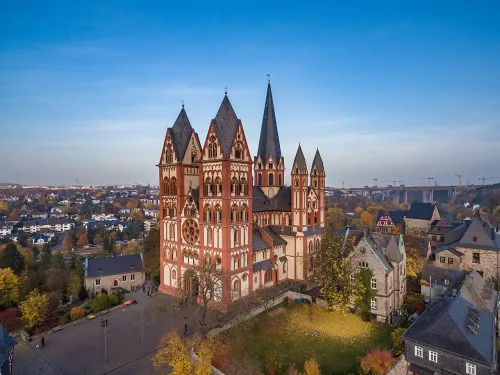
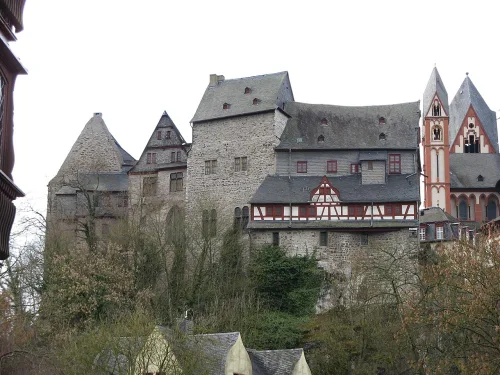
Start where Limburg itself began: on the limestone rock high above the Lahn, where the Limburger Dom stands so exposed that you can see it from far away. Take in the outside before you go in. The church is an Early Romanesque building modernised in Early Gothic style, so you are looking at a transitional mix of both in one body. It is the cathedral of the Catholic Diocese of Limburg and is also called Georgsdom after Saint George; in the Middle Ages Saint Nicholas shared the dedication.
Nobody knows exactly when the first church went up on this rock. A note in the necrology of St. Castor in Koblenz says Archbishop Hetti of Trier consecrated a church of Saint George in "Lympurgensis" in the first half of the 9th century. Because that note was only written down in the 16th century, scholars still argue about it. Chance finds from Carolingian times under today's church point to a building here in that century, but no walls survive.
Firmer ground comes on 10 February 910, when King Louis the Child issued the deed for a foundation of canons, pushed for by the local count Konrad Kurzbold. Emperor Otto I names Saint George as patron in 940. In the 11th century an Early Romanesque basilica replaced the first church; a lead reliquary shaped like a small church, found in the main altar in 1776, names a Count Heinrich as builder of the new "templum". Around 1180 the great remodelling began that gave the cathedral its present shape.
Going in is free, and worth it for anyone curious how Romanesque and Gothic meet inside one space. A paid guided tour, free for children, is a good choice if you want the building explained in detail. From the door, the Bischofsschloss is just 130 metres away, a two minute walk.