Free Walking Tour Münster: From Gables to the Palace

Walk from the gabled arcades of the Prinzipalmarkt to the prince-bishops' palace and back, past Picasso, a 13th-century cathedral and three iron cages on a church tower.

9 Stops 3.7 km ~51 min walking
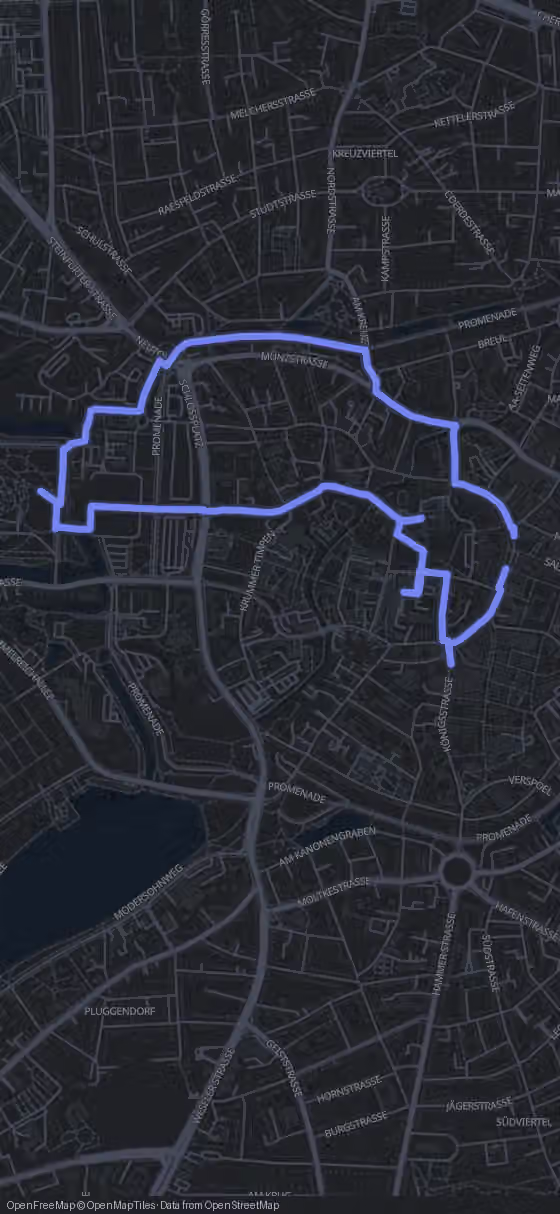
Route map for the Münster walking tour
Stop 1 of 9
70 m·1 min
Prinzipalmarkt
Head south toward the Historisches Rathaus
Moin, welcome to Münster. I'm Alex, and one wood-paneled room here helped bring two long European wars to an end.
Try this tour with Alex

Münster's old town on foot: what this route covers

Nine stops, 3.7 km and 51 minutes of pure walking, from the Prinzipalmarkt past the Domplatz and the St.-Paulus-Dom out to Schloss Münster and back to the Lambertikirche. Without museum visits, plan about 2 hours 45 minutes; with both art museums, a little over five hours.

Streets, churches, park and palace grounds are free. You pay admission at the Historisches Rathaus, the Kunstmuseum Pablo Picasso and the LWL-Museum für Kunst und Kultur. The GPS route runs free in your browser; the AI Tour Guide is optional.

Open free GPS & optional AI Tour Guide
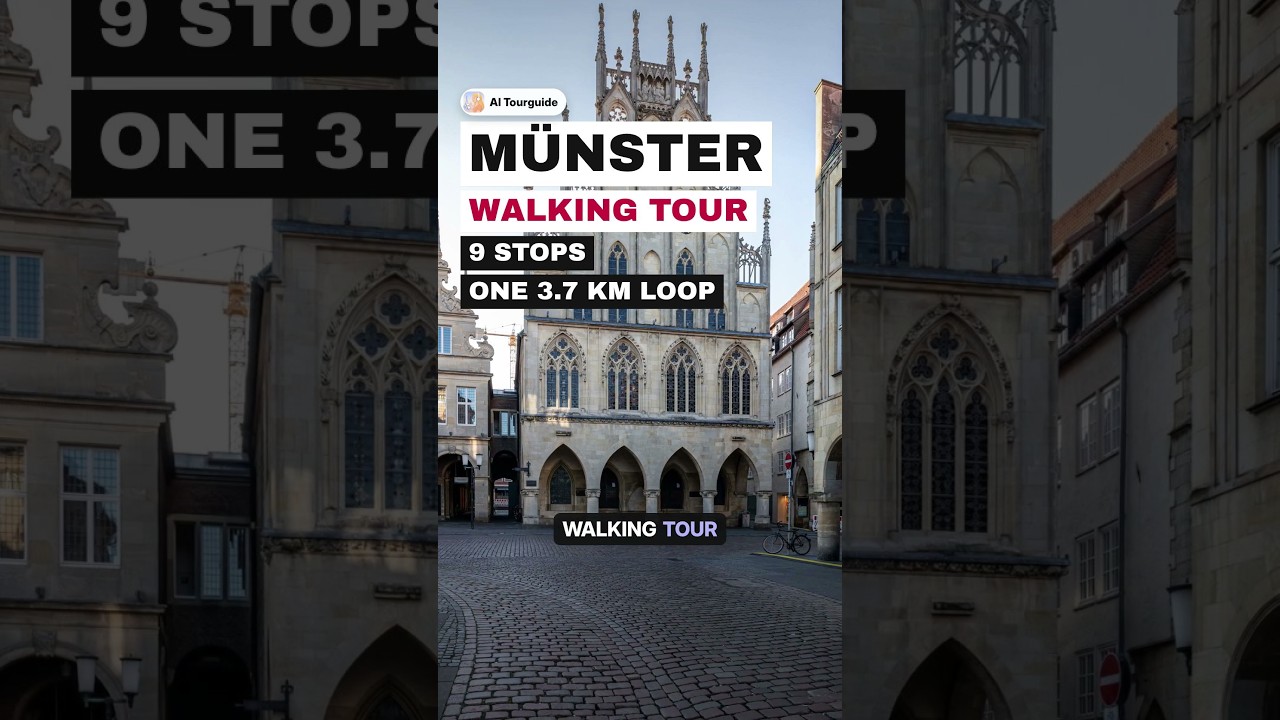
This short shows highlights of the route. All 9 stops follow below.

The Route

Walking Map of Münster: Prinzipalmarkt to the Schloss and Back

9 stops 3.7 km 51 min walking
Tap to load interactive map

The 9 stops along this route

  1. Prinzipalmarkt in Münster, stop 1 on the self-guided walking tour
    1Prinzipalmarkt
  2. Historisches Rathaus in Münster, stop 2 on the self-guided walking tour
    2Historisches Rathaus
  3. Kunstmuseum Pablo Picasso in Münster, stop 3 on the self-guided walking tour
    3Kunstmuseum Pablo Picasso
  4. LWL-Museum für Kunst und Kultur in Münster, stop 4 on the self-guided walking tour
    4LWL-Museum für Kunst und Kultur
  5. St.-Paulus-Dom in Münster, stop 5 on the self-guided walking tour
    5St.-Paulus-Dom
  6. Schlossgarten in Münster, stop 6 on the self-guided walking tour
    6Schlossgarten
  7. Schloss Münster, stop 7 on the self-guided walking tour
    7Schloss Münster
  8. Promenade in Münster, stop 8 on the self-guided walking tour
    8Promenade
  9. Lambertikirche in Münster, stop 9 on the self-guided walking tour
    9Lambertikirche
  10. That's the full route.

    Walk it with an AI Tour Guide talking you through every one of these streets.

    Start free in your browser
    You made it

Your Münster Walking Tour, Stop by Stop, from the Arcades to Lamberti

  1. 1

    Prinzipalmarkt

    Prinzipalmarkt in Münster, stop 1 on the self-guided walking tour

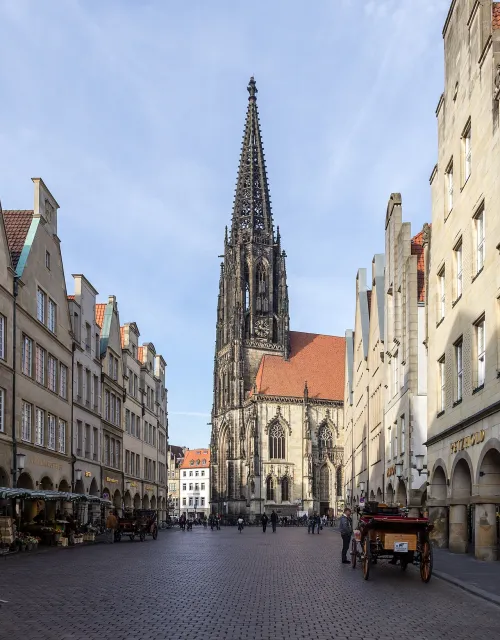
    Stand in the middle of the street and look along both sides: a continuous row of gabled houses, each with its own front, and no two gables alike. Some architects clearly borrowed ideas from their neighbours, yet every house went its own way, and that is what gives the street its rhythm. At ground level the arcades run along the east and west sides, and the facades are clad in Baumberger sandstone, the pale stone you will meet again and again in Münster. At the north end the tower of the Lambertikirche closes the view, at the south end the Stadthaus tower. The only break in the row is the Michaelisplatz, the opening through to the Domplatz.

    The name simply means main market, as opposed to the Roggenmarkt and Fischmarkt that continue the same line of street. It grew as the merchants' street on the edge of the cathedral precinct from the 12th century, was built up in a closed row by around 1280, and gained its arcades at the turn of the 14th century. The name Prinzipalmarkt itself only appeared in the early 17th century. Remarkably, the division of plots and the number of houses have stayed largely the same since about 1500.

    In the Second World War most of these buildings were completely destroyed, some down to their cellars and ground-floor arcades. What you see rose again on the old plots, and today the whole street is protected as an ensemble. Locals call it Münster's 'gute Stube', the city's front parlour, and in 2006 a ZDF television poll ranked it fourth among the Germans' favourite places.

    Walk slowly under the arcades before moving on. The most famous house on the street is only 70 m away, about a minute: the Historisches Rathaus, flanked by the Stadtweinhaus.
    Hours
    24/7
    Price
    Free
  2. 2

    Historisches Rathaus

    Historisches Rathaus in Münster, stop 2 on the self-guided walking tour

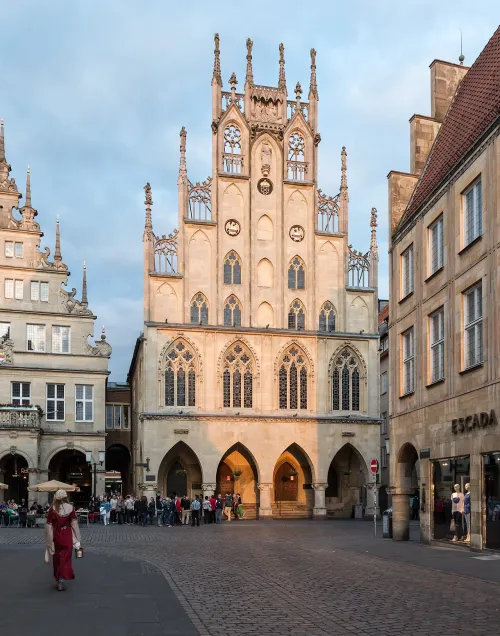
    The Gothic gable at Prinzipalmarkt 10 is one of the two symbols of Münster, alongside the cathedral, and in 2012 alone it counted more than 120,000 visitors. Its fame comes from the negotiations for the Peace of Westphalia in 1648, which ended the Thirty Years' War in Western Europe and the Eighty Years' War between Spain and the Dutch Republic. In 2015 the European Commission awarded the European Heritage Seal jointly to the two town halls where that peace was negotiated, as 'Sites of the Peace of Westphalia'.

    Inside, the council chamber in the lower part of the building is the room people come for: it became known as the Hall of Peace. Entry costs little, and if the Peace of Westphalia means anything to you, this short visit is the best value on the route.

    The building's early history is surprisingly murky. During the rule of the Anabaptists in 1534 and 1535, every document about the city's past held in its archive was destroyed, so what is known before about 1530 comes from records kept elsewhere. Münster became a city around 1170, and a simple timber-framed building for council meetings and court sessions stood near the cathedral precinct by the middle of the 12th century; the first recorded court assembly here dates from 1250.

    The war left the Rathaus heavily damaged, and it was rebuilt true to the original between 1950 and 1958. The mayor and the administration had already moved out in 1907, so today the council meets here only occasionally. From here it is 220 m, about 3 minutes, to the Kunstmuseum Pablo Picasso.

    Local name
    Rathaus Münster
    Hours
    Tue–Fri 10:00–17:00, Sat–Sun 10:00–16:00, Mon closed
    Price
    3 EUR full, 2 EUR reduced
  3. 3

    Kunstmuseum Pablo Picasso

    Kunstmuseum Pablo Picasso in Münster, stop 3 on the self-guided walking tour

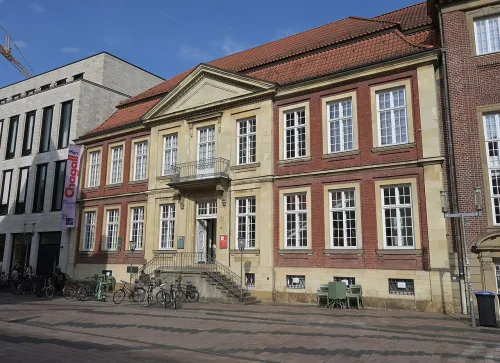
    This museum opened in 2000, and until September 2010 it was called the Graphikmuseum Pablo Picasso, which tells you where its heart lies: in prints. The collection holds more than 800 works by Picasso, above all lithographs, but also other techniques from different periods of his life. Around 600 square metres of exhibition space show changing selections, so the Picasso you meet depends on when you come.

    The special exhibitions reach well beyond Picasso himself, to his friends and contemporaries. Over the years Braque, Miró, Chagall, Matisse, Klee, Léger, Giacometti and Le Corbusier have all had shows here, as well as a show on Klimt, Schiele and Kokoschka. For its tenth birthday in 2010 the museum celebrated with exhibitions on Miró, Picasso and Klee.

    Is it worth going in? Admission is charged, and you should allow about an hour. If you love drawing, printmaking or the circle of artists around Picasso, yes. If you only have energy for one museum and are more curious about the region, save yourself for the LWL museum. Ask at the desk what is currently on display before you decide.

    From here it is 360 m, about 5 minutes, to the LWL-Museum für Kunst und Kultur. On the way you cross the Domplatz, where Münster holds its weekly market, the Wochenmarkt.

    Hours
    Tue–Sun 10:00–18:00, Mon closed
    Price
    12 EUR full, 10 EUR reduced
  4. 4

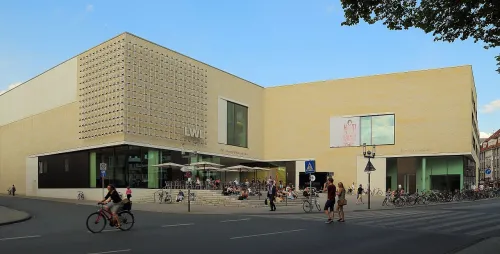
    LWL-Museum für Kunst und Kultur

    LWL-Museum für Kunst und Kultur in Münster, stop 4 on the self-guided walking tour

    Before you go in, look up above the Renaissance-style entrance portal: the allegorical figure of Art is by the sculptor Wilhelm Bolte. The building by architect Hermann Schaedtler was inaugurated on 17 March 1908, and the museum has stood on the Domplatz ever since. Until 2013 it was called the Westfälisches Landesmuseum für Kunst und Kulturgeschichte; it is run by the regional association Landschaftsverband Westfalen-Lippe.

    The museum grew out of the collections of Westphalia's historical society and the Westfälischer Kunstverein, which is still part of the house. Its second director, Max Geisberg, led it from 1910 until he was dismissed in 1934, after which the museum was renamed.

    The darkest chapter came in 1937, when the Nazi campaign against 'degenerate art' took works out of this collection by August Macke, Wassily Kandinsky, Paula Modersohn-Becker, Erich Heckel, Karl Schmidt-Rottluff, Christian Rohlfs, Otto Mueller and many others. Exhibitions of those years, such as 'Das deutsche Danzig' in 1937 or a show of captured weapons in 1942, served the regime's ideology. After a bomb hit in 1941 the collection was moved to various places, so the losses stayed comparatively small, and the museum was rebuilt after 1945.

    Tickets are available for the collection alone or with the special exhibition; give it an hour and a half. It is the better choice if you want a broad look at Westphalian art and cultural history rather than one artist. Then cross over to the cathedral, 290 m and about 4 minutes away.

    Hours
    Tue–Sun 10:00–18:00, Mon closed
    Price
    10 EUR full (Collection) / 13 EUR full (with Special exhibition), 5 EUR / 6.50 EUR reduced
  5. 5

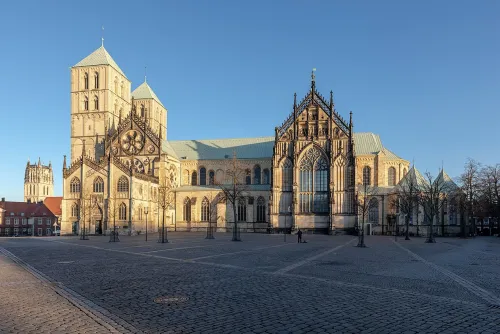
    St.-Paulus-Dom

    St.-Paulus-Dom in Münster, stop 5 on the self-guided walking tour

    Start at the west front: the two nearly identical towers and the westwork were built around 1192 for the previous cathedral and simply kept when the present one went up. That is why the building mixes styles so openly, with a Romanesque westwork, old choir and west towers joined to a Gothic nave, transepts, high choir and ring of chapels. Together with the Rathaus it is the symbol of the city, the cathedral church of the Catholic diocese, dedicated to Saint Paul.

    You are standing on the Horsteberg, a small hill ringed by the Roggenmarkt, the Prinzipalmarkt, the Rothenburg and the river Aa. This was the old Domburg, the fortified cathedral precinct, and the Domplatz still belongs to it. West of the cathedral lie the bishop's palace and part of the old canons' quarter.

    This is the third cathedral on the hill. The first, the Ludgerus Dom, stood to the north and lasted from 805 to 1377; it also served a monastery founded by Liudger. The second, from the 10th or 11th century, was pulled down while the present building rose between 1225 and 1264. Originally the cathedral was the parish church for all of Münster, but new parishes shrank its district, and once the church of St Jacobi was built on the Domplatz in the 13th century it lost that role entirely.

    Entry is free, so there is no reason not to step in for twenty minutes. Afterwards comes the longest leg of the tour, 1060 m and about 15 minutes, out to the Schlossgarten.

    Hours
    Mon–Sun 06:30–19:00
    Price
    Free
  6. 6

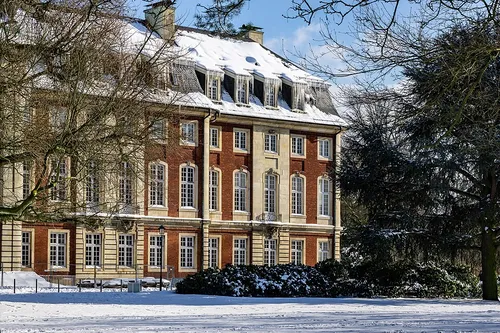
    Schlossgarten

    Schlossgarten in Münster, stop 6 on the self-guided walking tour

    Behind the baroque palace lies the Schlossgarten, a public park that is free and open at any time. At its centre sits the university's Botanical Garden, which keeps its own hours. So the park is always open while its green heart sometimes is not.

    The ground here has a military past. The Botanical Garden occupies what remains of the Paulsburg, an early baroque citadel built from 1661 until about 1700 on what was probably a medieval predecessor. From the air its bastions are still easy to make out. After the Seven Years' War left Münster badly damaged, the minister Franz von Fürstenberg ordered the fortifications torn down in 1764, and that cleared the way for the palace.

    After the long walk from the cathedral, treat this as the tour's breather: sit down, look at the plants, and only then turn to the palace, just 70 m and a minute away.

    Hours
    always open (Schlossgarten Park) / Botanischer Garden: daily 08:00–19:00 (summer, 15 Mar – 14 Oct), 09:00–16:00 (Winter, 15 Oct – 14 Mar)
    Price
    Free
  7. 7

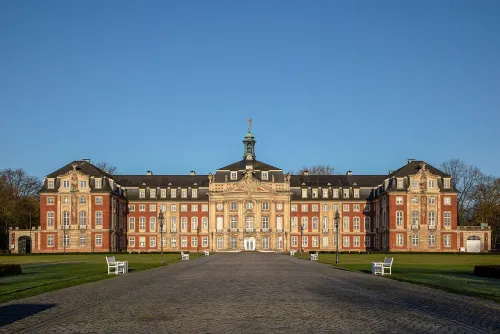
    Schloss Münster

    Schloss Münster, stop 7 on the self-guided walking tour

    Step back far enough to take in all three wings. Johann Conrad Schlaun designed this residence for Prince-Bishop Maximilian Friedrich von Königsegg, the foundation stone was laid on 26 August 1767, and building went on until 1787. Look at the materials: pale Baumberger sandstone for cornices, pilasters and decoration, red brick for the flat surfaces, a combination typical of Schlaun. The floors tell the old hierarchy: service rooms on the ground floor, the grand main floor above, then a lower residential floor and the attic rooms.

    The prince-bishops took a long time to get here. In the Middle Ages they lived at the Fürstenhof on the Domplatz, and from 1661 in the Fraterhaus in town. Plans for a proper palace came and went; Schlaun drew his first designs for this site as early as 1732, and a monastery church was even begun but never finished. Only after the Seven Years' War, and largely at the wish of Münster's nobility, did the prince-bishop commission the palace on the site of the former citadel.

    Since 1954 the palace has been the seat of the University of Münster, and the grounds in front are open and free at any time. Then comes the second long leg: 990 m, about 13 minutes, to the Promenade.

    Local name
    Fürstbischöfliches Schloss Münster
    Hours
    Always open
    Price
    Free
  8. 8

    Promenade

    Promenade in Münster, stop 8 on the self-guided walking tour

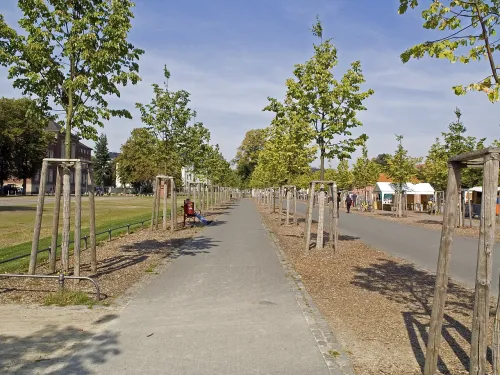
    The Promenade is a car-free ring of about 4,500 m around the old town, lined with lime trees. It has three lanes: the wide middle one belongs to cyclists, the two narrower sides to people on foot. Legally the middle is not a cycle path but a road closed to every vehicle except bicycles, and Münster's cyclists use it accordingly, so stay on the side paths.

    You are walking on the old city defences. The fortifications date from the early 13th century and were adapted to new weapons over time. After the Seven Years' War, during which Münster was captured several times, the city began dismantling them: from 1764 the inner ring was removed and the inner moat filled in, and the freed land went back to the residents from 1765. From 1770, following plans by Johann Conrad Schlaun, the outer ring became a four-row lime avenue. Ten streets leading out of the centre still cross the Promenade where the city gates once stood.

    The trees near the palace are younger than the rest. In January 2007 the storm Kyrill uprooted or badly damaged so many around the Schlossplatz that all the remaining ones there had to be felled. Under the 'Bürgerbäume' project, 210 winter limes paid for by donations from Münster's residents were planted in their place.

    From the Promenade it is 670 m, about 9 minutes, back into the centre to the Lambertikirche.

    Hours
    24/7
    Price
    Free
  9. 9

    Lambertikirche

    Lambertikirche in Münster, stop 9 on the self-guided walking tour

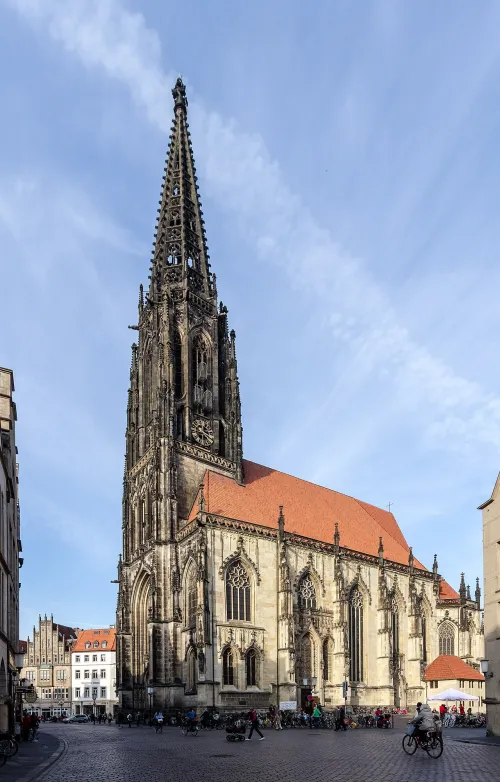
    Look up at the tower before anything else. Three iron cages hang there. In 1536 they held the bodies of Jan van Leiden, Bernhard Krechting and Bernhard Knipperdolling, the leaders of the Anabaptist rebellion, after they had been publicly tortured and executed on the Prinzipalmarkt. It is the same Anabaptist rule that wiped out the city archive in the Rathaus.

    The church itself counts as the most significant example of Westphalian late Gothic. Münster's merchants paid for it as their market church and city church, and the foundation stone was laid in 1375. It had several predecessors: a wooden church around 1000, a stone one just before 1100, a Romanesque church from 1150 and a Gothic hall church from 1270. The facade of that 1270 extension contains a Jewish gravestone from 1302, looted during the pogroms of 1350, a quiet reminder worth looking for.

    St Lamberti stands on the north side of the Prinzipalmarkt, with the Lambertikirchplatz and its fountain, the Lambertibrunnen, towards the Salzstraße. In 2007 the crime series Wilsberg filmed an episode here called 'Die Wiedertäufer', The Anabaptists. Entry is free.

    Go in, then step back out onto the Prinzipalmarkt: you are at the north end of the street where the walk began, and the gables you saw at the start now carry the whole story of the city behind them.

    Hours
    Mon–Sat 08:00–18:45, Sun 09:30–19:00
    Price
    Free
Walking tour route map of Münster Route loaded
PrinzipalmarktHistorisches RathausKunstmuseum Pablo PicassoLWL-Museum für Kunst und Kultur+5
All 9 stops are already on the map.
You just press start.
AI Tour Guide

You've read the Münster route. Now walk it with a guide in your ear.

Press start wherever you are, even hundreds of kilometres from Münster, and the guide begins telling its stories right away. In the city, pick any of the 9 stops to start from: it leads you there, then talks with you the whole route, asking, listening, remembering, and shaping the tour around your answers.

9stops 3.7km 51 minwalking 13languages
▶Start the tour free

Free to start · Runs in your browser · No app, no download

Three ways to split the Münster route

The full loop works in one go, but it also splits neatly at the St.-Paulus-Dom into an art and history half and a green half.

Art and history half

Stops: 1, 2, 3, 4, 5

For museum lovers and rainy days. From the Prinzipalmarkt to the St.-Paulus-Dom you walk just 940 m, about 13 minutes. Admission at the Historisches Rathaus, the Kunstmuseum Pablo Picasso and the LWL-Museum für Kunst und Kultur; the cathedral is free.

Green half

Stops: 5, 6, 7, 8, 9

For a free afternoon outdoors. From the St.-Paulus-Dom through the Schlossgarten, past the palace and along the Promenade to the Lambertikirche: 2.8 km and 38 minutes of walking. Everything on this half is free.

Full loop, outsides only

Stops: 1, 2, 3, 4, 5, 6, 7, 8, 9

For a first look at the whole city in one go. All nine stops, 3.7 km and 51 minutes of walking, but you skip the two art museums and only step into the Hall of Peace and the two churches. The only ticket is for the Rathaus.

How Long Does This Münster Tour Take, With and Without the Museums?

The walking itself takes 51 minutes. The first five stops sit close together around the Prinzipalmarkt and the Domplatz; the two long legs come afterwards, out to the Schlossgarten and back along the Promenade.

Counting a short look inside the Rathaus, the cathedral and the Lambertikirche plus a break in the garden, the full loop takes about 2 hours 45 minutes. Add an hour for the Picasso museum and an hour and a half for the LWL museum and you are at a little over five hours. The art and history half with both museums fills about 3 hours 40 minutes; the green half takes around two hours.

Before you set off in Münster

  • Start and finish: The recommended start is the Prinzipalmarkt, but you can join at any stop. You finish at the Lambertikirche on the north side of the same street, so you end almost where you began.
  • Best day and time: Pick your day with care: the Rathaus and both art museums are not open every day. Start in the morning, once they have opened, to get the full loop with museums done by mid-afternoon, and do the green half before the Botanical Garden in the Schlossgarten closes.
  • Costs: The route, the cathedral, the Lambertikirche, the park, the palace grounds and the Promenade cost nothing. You pay admission only at the Rathaus, the Picasso museum and the LWL museum, where the special exhibition costs extra.
Walking tour route map of Münster
AI Tour Guide

Your Münster guide is ready when you are

Press start and a voice AI Tour Guide takes it from here: leading the route through Münster, telling the stories, and turning your walk into a real back-and-forth conversation. No app or download is needed; it runs in your browser.

9stops 3.7km 51 minwalking 13languages
▶Start the tour free

Free to start · Runs in your browser · No app, no download

What the AI Tour Guide adds in Münster

This route is full of threads that run from one stop to the next: the Anabaptists who cost the Rathaus its archive end up in the cages on the Lamberti tower, and Schlaun designed both the palace and the lime avenue of the Promenade. The AI Tour Guide walks with you as a conversation, picks up these links, asks whether art or history pulls you more and shifts its stories to match. Ask it what the envoys actually argued about in 1648, or how the Anabaptists came to rule the city in the first place; you can interrupt it at any moment. You start with 100 free credits; after that, this tour costs 19.99 € all-inclusive with no time limit, or 5 € per hour.

A Real Conversation A voice AI Tour Guide greets you, leads the whole route, and tells the stories and facts as you walk, asking what you want to see and keeping a real conversation going. Not a recording you press play on.
Map Navigation Follow the route on the map and walk at your own pace. You choose where to start and when to move to the next stop.
Ask Anything Curious about a building you pass? Ask your AI Tour Guide on the spot and the conversation carries on.
13 Languages Switch language anytime. No separate tour needed.
Start free in your browser

Common Questions About Walking Münster

If I only have time for one museum in Münster, which should it be?

Pick the Kunstmuseum Pablo Picasso if you love drawing and printmaking and want one artist in depth. Pick the LWL-Museum für Kunst und Kultur if you are more curious about Westphalian art and cultural history and the story of what the museum lost in 1937.

Can I go inside Schloss Münster?

The palace has been the seat of the university since 1954, so the walk treats it as an outside stop. The grounds in front and the garden behind are open and free at any time.

Can I start early in the morning?

Yes. The Prinzipalmarkt, the Promenade and the palace grounds never close, and both churches open early. Only the Rathaus and the two museums wait until mid-morning, so an early start works best with the green half.

Can I combine Münster with another city?

Soest is the closest city with its own walking route, 55 km away. Across the border, Arnhem and Nijmegen also have routes.

Is the tour really free?

Yes. The whole tour is free: the route, the interactive map and the navigation cost you nothing. Only the voice AI Tour Guide is optional and paid: you test it with 100 free credits, then you pay either €5 per hour or €19.99 for this whole tour, with no time limit. Admission to 3 of the 9 stops is not included: Historisches Rathaus, Kunstmuseum Pablo Picasso and LWL-Museum für Kunst und Kultur charge their own entry fees.

Do I need to download an app?

No. Everything runs in your phone browser. Open the route and start walking, no download and no sign-up required.

Do I need to book the walking tour in advance?

No booking needed. This self-guided tour is available anytime. Open the route in your browser and start walking. The AI Tour Guide works instantly, no app, no reservation required.

What languages is the AI Tour Guide available in?

The AI Tour Guide speaks 13 languages, so you take the tour in your own language and can switch at any time.

Can I skip stops or change the route?

Yes. Skip any stop, spend extra time at places you like, or start the route from any point. It is your walk, you set the pace.
Image credits
▶ Start free in your browser Runs in your browser, no app, no download