Free Walking Tour Groningen: Squares, Spires and Gardens

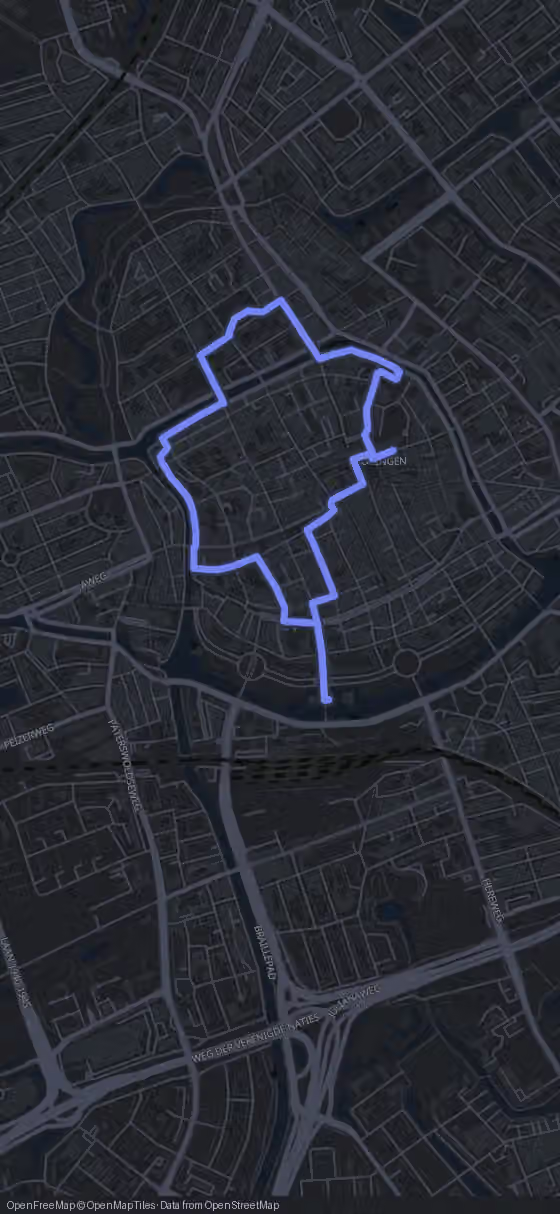
From the Grote Markt to a walled Renaissance garden and back to the Old Grey tower: a 4.0 km loop past churches, a synagogue and a museum built in a canal.

11 Stops 4.0 km ~55 min walking
Route map for the Groningen walking tour
Stop 1 of 11
290 m·4 min
Grote Markt
Head south-west off the Grote Markt toward the Vismarkt.
Welcome to Groningen. I'm Alex, and one small stone bird gives a hidden church its local name.
Try this tour with Alex

What This Groningen Loop Covers

Eleven stops on a 4.0 km loop that starts and ends at the Grote Markt, with 55 min of pure walking. With the Synagogue of Groningen, a couple of churches and the climb up the Martini Tower, plan about four hours; the Groninger Museum adds about two more.

The squares, the Prinsenhof Gardens and the Nieuwe Kerk are free; the synagogue, the museum, Der Aa-kerk, the Martini Church and the tower charge admission. Route, map and GPS navigation run free in your browser, and the AI Tour Guide is optional.

Open free GPS & optional AI Tour Guide
This short shows highlights of the route. All 11 stops follow below.

The Route

Walking Map of Groningen: Eleven Stops on One Loop

11 stops 4.0 km 55 min walking
Tap to load interactive map

The 11 stops along this route

  1. Grote Markt in Groningen, stop 1 on the self-guided walking tour
    1Grote Markt
  2. Vismarkt in Groningen, stop 2 on the self-guided walking tour
    2Vismarkt
  3. Lutheran Church Groningen, stop 3 on the self-guided walking tour
    3Lutheran Church Groningen
  4. Synagogue of Groningen, stop 4 on the self-guided walking tour
    4Synagogue of Groningen
  5. Groninger Museum in Groningen, stop 5 on the self-guided walking tour
    5Groninger Museum
  6. Der Aa-kerk in Groningen, stop 6 on the self-guided walking tour
    6Der Aa-kerk
  7. Museum aan de A in Groningen, stop 7 on the self-guided walking tour
    7Museum aan de A
  8. Nieuwe Kerk in Groningen, stop 8 on the self-guided walking tour
    8Nieuwe Kerk
  9. Prinsenhof Gardens in Groningen, stop 9 on the self-guided walking tour
    9Prinsenhof Gardens
  10. Martini Church in Groningen, stop 10 on the self-guided walking tour
    10Martini Church
  11. Martini Tower in Groningen, stop 11 on the self-guided walking tour
    11Martini Tower
  12. That's the full loop.

    Walk it with an AI Tour Guide talking you through every one of these streets.

    Start free in your browser
    You made it

Your Groningen Walking Tour, Stop by Stop, from Market Square to Old Grey

  1. 1

    Grote Markt

    Grote Markt in Groningen, stop 1 on the self-guided walking tour

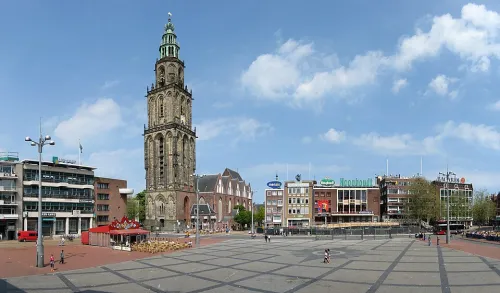
    You start where Groningen has always come together. The Grote Markt is the city's main square and its centre, dominated by the Martini Tower and the Stadhuis, the city hall. Look out for the Goudkantoor too, and on the east side for Forum Groningen, which rises up behind the row of buildings. Until around 1820 people mostly called this place the Breede Merckt, the broad market.

    The square still serves as a marketplace, but it's best known for its cafés and bars. The big name is Drie Gezusters, simply 'de drie' to locals, with room for 3,700 people and, by its own account, the largest pub in Europe. Hotel De Doelen belongs to it, and it's the oldest hospitality business in Groningen still in operation.

    For centuries every celebration and solemn occasion in the city has played out here, including the festivities on 28 August that remember Groningens Ontzet, the relief of the city. If you want to see the square as it looked before the war, Otto Eerelman's 1920 painting De Paardenkeuring, the horse inspection, hangs in the hall of the city hall and shows the old market in all its glory.

    That old square did not survive 1945. The destruction during the liberation of Groningen changed its face, and in the rebuilding years the north and east sides went up in a modernist style, with the eastern building line moved back 17 metres. A large redevelopment in the early 21st century has been giving those sides a new look and has restored the old line on the east; what happens to the north side is still undecided. The square itself was redesigned in 2024.

    From here it's 290 m, about 4 minutes, to the city's second market square, the Vismarkt.
    Hours
    24/7
    Price
    Free
  2. 2

    Vismarkt

    Vismarkt in Groningen, stop 2 on the self-guided walking tour

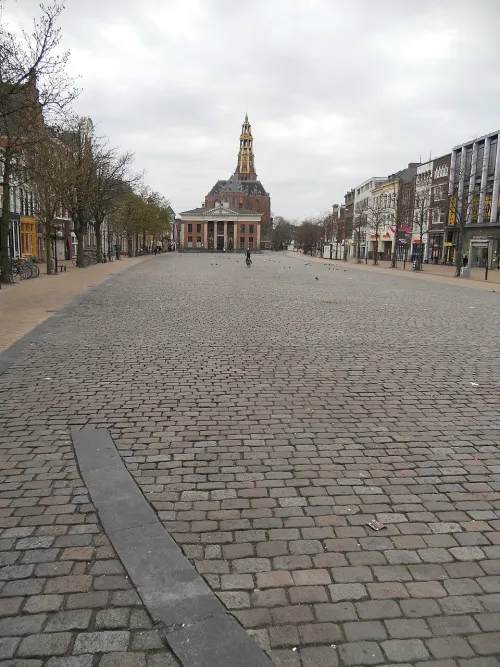
    The Vismarkt is one of the three open spaces in Groningen's inner city, a long, rectangular square. At its western end stands the Korenbeurs, the old corn exchange, and behind it the Aa-kerk, which you'll reach later on the loop.

    The name Vismarkt, fish market, first turns up in the early fifteenth century; before that the place was known as Langestraat. It refers to the kind of market that was held here regularly, and still is.

    Each side has its own character. The north side goes by the local name Glènne Riepe and is considered the least handsome; here Groningen's first department store, the Grand Bazar Français, was built in 1904. The south side keeps a row of historic buildings, among them Huize Maas, with the café Huis de Beurs on the corner of the Folkingestraat. The Pelsterstraat and the Haddingestraat also open onto this side.

    On the east side stands a monumental building from the 1930s. To its right a narrow passage, the Tingtangstraatje, leads through to the Herestraat; it owes its name to the large copper bell that once hung at this end of the market. On the other side of the building the street Tussen Beide Markten, between both markets, runs back to the Grote Markt. Every year the square is also the finish of the 4 Mijl van Groningen race.

    Turn into the Haddingestraat for the Lutheran Church, just 150 m and 2 minutes away.

    Hours
    24/7
    Price
    Free
  3. 3

    Lutheran Church Groningen

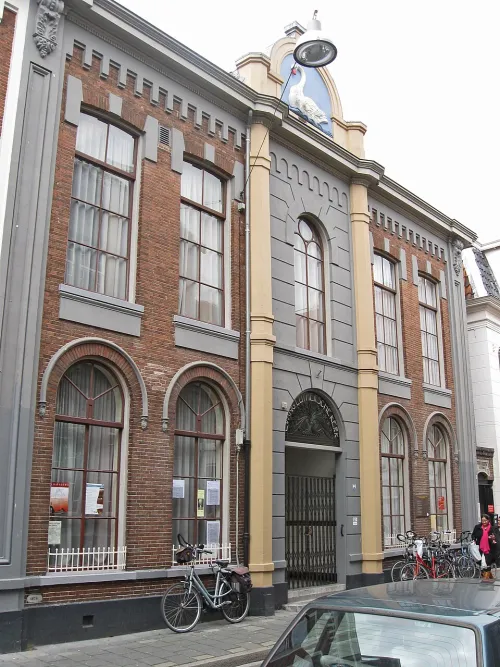
    Lutheran Church Groningen, stop 3 on the self-guided walking tour

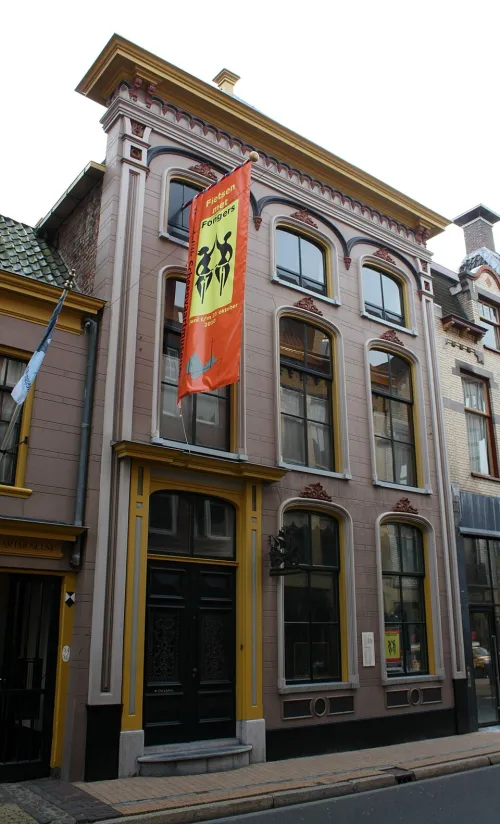
    In the Haddingestraat stands the Lutherse Kerk, in use since 1696. Look up at the top of the front gable: a gable stone in the shape of a swan has given it its nickname, the zwaantjeskerk, the little swan church.

    Inside are two organs worth knowing about. One was built by the Van Oeckelen firm in 1896; the other is a reconstruction of Arp Schnitger's organ of 1717, made by Bernhardt Edskes in 2017. The church also holds the grave of the organ builder Albertus Antoni Hinsz, and it's home to the Luthers Bach Ensemble. Keep the name Schnitger in mind: it comes back at the Aa-kerk.

    A portal connects the church with the Lutherzaal, whose main entrance is in the neighbouring Juffer Margarethagasthuis.

    The church isn't open for regular sightseeing. If you'd like to see the interior and hear the organs, come to the Sunday service or one of the occasional music services, which are free. Otherwise the swan gable and the quiet street are reason enough to pause.

    From here the synagogue is 190 m and 2 minutes away.

    Local name
    Lutherse Kerk
    Hours
    Sun 10:00 (church services and occasional music services/events; closed for regular tourist sightseeing)
    Price
    Free
  4. 4

    Synagogue of Groningen

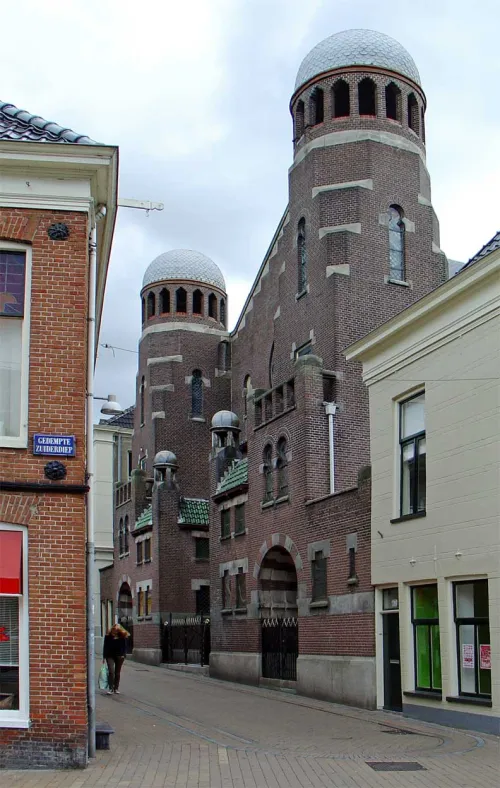
    Synagogue of Groningen, stop 4 on the self-guided walking tour

    Groningen's synagogue was designed by the Dutch architect Tjeerd Kuipers and consecrated in 1906. Look at its forms: it's built in a neo-Byzantine style with neo-Moorish elements. Kuipers was known mainly for churches, and it shows in the cross-shaped floor plan, unusual for a synagogue.

    A Jewish community had existed in the city since 1744. The new building went up in 1905 on the plot of a prayer house that had stood here since 1756 and was pulled down because the growing community had outgrown it. Over time the surrounding streets had become a Jewish quarter, with a Jewish school and a yeshiva among other things. Before the Second World War the synagogue seated more than 600 people.

    On 26 August 1943 the German occupiers closed the synagogue and turned it into a depot for radios, copper and tin. The Torah scrolls were saved and hidden in the vault of a branch of the Rotterdamsche Bank. The occupiers deported and murdered almost all Jews in the province. Of the 2,724 Jews registered in the city in February 1941, only a few survived the Shoah; around 120 were in the city just after the war, and in 1948 the community counted 239 members, a number that fell every year as many emigrated to Israel.

    After Rabbi Aäron Prins also left for Israel in 1952, the community decided to sell the building, which had come through the war undamaged. The Apostolic community used it for its services, and later it became a laundry, which lasted until 1973.

    Going in is worth it for anyone interested in this history. There's an admission charge, guided tours are available, children go free and young people pay a reduced rate. The Groninger Museum is 300 m, about 4 minutes, further on.

    Local name
    Synagoge Groningen
    Hours
    Tue–Fri and Sun 13:00–17:00 (Jul–Sep also Thu–Fri 10:30–17:00; Jan–Feb Wed, Fri, Sun 13:00–17:00; Mon and Sat closed)
    Price
    6 EUR standard admission, 8 EUR admission including guided tour, children up to 12 free, youth up to 16 1 EUR
  5. 5

    Groninger Museum

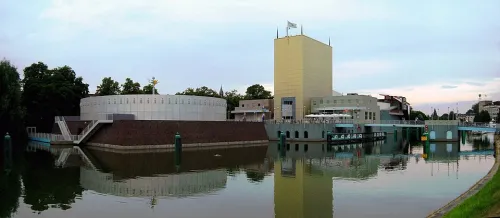
    Groninger Museum in Groningen, stop 5 on the self-guided walking tour

    You can't miss it: the Groninger Museum stands in a canal opposite the railway station, a cluster of postmodern pavilions completed in 1994. Pick them out one by one: a silver cylindrical building by Philippe Starck, a yellow tower by Alessandro Mendini and a pale blue deconstructivist space by Coop Himmelb(l)au. A bridge links the museum to the station and forms part of a cycling and walking path into the centre.

    The colourful, futuristic style echoes the Italian postmodern designs of the Memphis Group, of which Mendini had been a member. In 1990 museum director Frans Haks asked him to design the new building. Haks wanted something extravagant and insisted on non-architects for the concept studies. The American artist Frank Stella was first approached for one pavilion, but his plan proved too expensive: he wanted it built entirely of Teflon, so Coop Himmelb(l)au got the commission instead.

    Most of the money came from Gasunie, the Dutch natural gas company, which wanted to give the city a present for its 25th anniversary. The museum itself is much older: founded in 1874, it opened its first own building in 1894 on the Praediniussingel, and in 1921 the heirs of the last residents of the Menkemaborg, a historic mansion, donated it to the museum.

    Inside you'll find modern and contemporary art by local, national and international artists; in 2024 just under 166,000 people came. Tickets aren't cheap, though students pay less. If you love art and design, it's worth a visit of its own; otherwise the buildings from outside are already a highlight.

    From here it's 590 m, about 8 minutes, back into the old town to the Aa-kerk.

    Hours
    Tue–Sun 10:00–17:00, Mon closed (closed 18 Sep, 25 Dec, 1 Jan)
    Price
    EUR 19.50 adult; EUR 10 student
  6. 6

    Der Aa-kerk

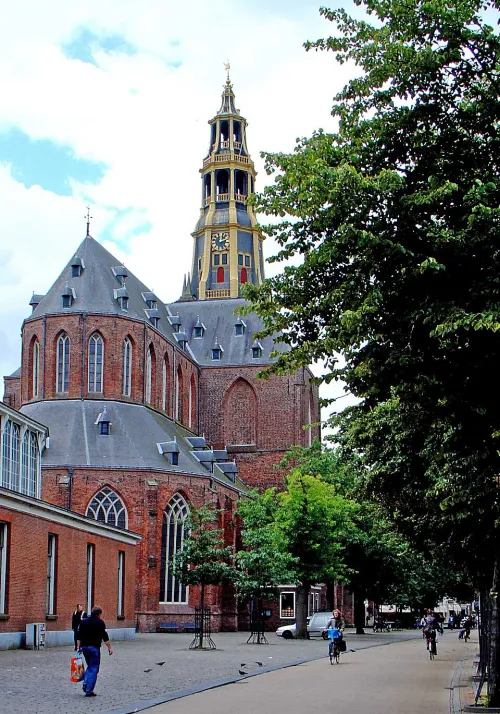
    Der Aa-kerk in Groningen, stop 6 on the self-guided walking tour

    Together with the Martini Tower, the Aa-kerk shapes Groningen's skyline. Before this church, a chapel to Mary and Saint Nicholas, patron saint of fishermen, stood here close to the river Aa, where bargemen cast off in the western harbour. In 1247 it became a parish church, the Church of Our Lady at the Aa. Groningen then had two centres, each around a church, and this was the one of the fishermen and tradesmen.

    The chapel grew into a brick Gothic church in the fifteenth century, finished in 1495. Iconoclasm during the Reformation, war damage in the siege of 1672 and lightning have changed it again and again. Images from that siege show the tower without its top; a wooden top followed, but on 23 April 1710 the tower suddenly collapsed, killing two people. The present tower dates from 1711, and its three bells, cast by Crans of Enckhuysen in 1714 and tuned to F sharp, D sharp and B, are still rung by hand with ropes.

    The organs have a story of their own. A Van Hagerbeer organ of 1667 burned in 1671; Arp Schnitger's first organ here, from 1697, was destroyed when the tower fell. The Schnitger organ you see today was built in 1702 for the Broerkerk and moved here in 1815. There's also the Bolsward organ, built by Raphael Rodensteen in 1550 for the Martinikerk in Bolsward.

    No services are held anymore; the church hosts concerts, theatre, exhibitions and events. A visit costs a small fee and young visitors go free, cheap enough to step in for the organs and the space. The Museum aan de A is just 240 m, 3 minutes, away.

    Hours
    Tue–Sat 10:00–16:00, Sun 12:00–16:00, Mon closed
    Price
    2 EUR standard church visit, children 0-17 free
    Website
    akerk.nl ↗
  7. 7

    Museum aan de A

    Museum aan de A in Groningen, stop 7 on the self-guided walking tour

    The Museum aan de A tells the history of the city and province of Groningen, in two fourteenth-century buildings in the A-kwartier. It's currently closed, so you see it from outside.

    Until recently this was the Noordelijk Scheepvaartmuseum, the northern maritime museum. When the city set out in 2014 to create a house of Groningen history here, the museum wanted to play the lead role; in 2020 it agreed to work together with the Noorderpoort College, the Groninger Archieven and the Groninger Museum, and since 2022 it has carried its new name.

    Renovation of the historic buildings and the courtyard between the Brugstraat and the Schuitemakersstraat is planned for 2026, with the new presentation expected to open in 2027 and a new building for temporary exhibitions after that.

    Now comes the longest leg of the loop: 1,000 m, about 14 minutes, north to the Nieuwe Kerk.

    Status
    Currently closed
  8. 8

    Nieuwe Kerk

    Nieuwe Kerk in Groningen, stop 8 on the self-guided walking tour

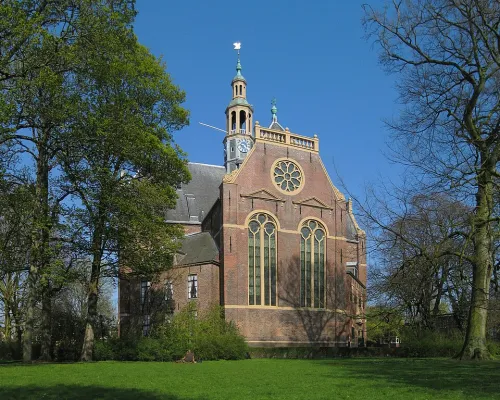
    The Nieuwe Kerk stands on the Nieuwe Kerkhof in the Hortusbuurt, on the northernmost hill of the Hondsrug, known as the Noordes or Tie. In the eighteenth century it was also called the Noorderkerk. 'New' refers to the old Sint-Walburgkerk, and the churchyard was originally the new Sint-Walburg cemetery.

    After the siege of 1594 the city planned a large expansion, and the new fortifications were finished in 1624. A year earlier city architect Garwer Peters had designated this site as a cemetery and designed four entrance gates, since demolished; one survives in a drawing by Cornelis Pronk. Plague victims were buried here when the spot still lay outside the city. Today the cemetery has made way for a lawn with old maples and beeches.

    In 1634 Johan Isenbrants set aside part of the ground for a church modelled on the Noorderkerk in Amsterdam, but money ran short for decades. Building finally began in 1660 to a design by master Conraet Roeleffs: Renaissance style, a Greek cross plan crowned by a small crossing tower, and triangular houses in the corners, one of them still home to the sexton. It was finished in 1664 and was the first church in Groningen built for Protestant worship.

    The organ dates from 1831, built by Johannes Wilhelmus Timpe from a design by Petrus van Oeckelen, remarkable because Van Oeckelen probably learned his trade from Timpe. Entry is free: the Stilteportaal is the easiest way in, while the church itself opens for visitors only on certain days.

    The Prinsenhof Gardens are 680 m, about 9 minutes, away.

    Hours
    Stilteportaal: daily 10:00–18:00; Tourist church visits: Thu 10:00–16:00 (year-round) and Sat 12:00–16:00 (summer season Apr/May to Sep)
    Price
    Free
  9. 9

    Prinsenhof Gardens

    Prinsenhof Gardens in Groningen, stop 9 on the self-guided walking tour

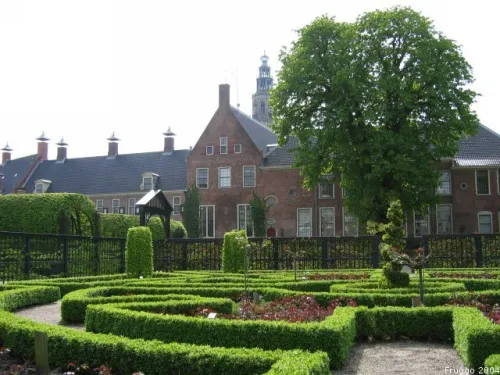
    Behind the Prinsenhof, a fifteenth-century building, lies the Prinsentuin, a walled inner garden. The Prinsenhof was the local residence of the princes of Nassau from 1594, and in 1626 Ernst Casimir of Nassau-Dietz and his wife Sophia Hedwig of Brunswick-Wolfenbüttel had the garden laid out.

    Walk through the rose garden, the herb garden and the section with berceaus, covered arbour walks. In one of the five beds, look for box hedges clipped into crowned letters W and A, the initials of Willem Frederik and Albertine Agnes.

    Toward the Turfsingel a high wall closes the garden off. On one side you can still see a piece of the little blue wall that once stood on top of it, added in the French period when the Prinsenhof was a military hospital, to stop people throwing drink over the wall.

    From the nineteenth century the garden fell into decay and slowly turned into a square, later with a mortuary and stables for the Royal Marechaussee. E.A. Canneman of the national monuments service reconstructed the original layout from Egbert Haubois's city map of 1634. One of the six original beds, once planted with fruit trees, couldn't be restored because the cantonal court had been built there in 1911, and some plants and features aren't seventeenth century, so strictly speaking it isn't a Renaissance garden. After work from 1935 the garden reopened in 1939.

    Entry is free, so it's an easy place for a quiet break. The Martini Church is 410 m, about 6 minutes, away.

    Local name
    Prinsentuin
    Hours
    Daily 10:00–16:30
    Price
    Free
  10. 10

    Martini Church

    Martini Church in Groningen, stop 10 on the self-guided walking tour

    The Martinikerk is the oldest church in Groningen, and archaeology has traced several predecessors: a wooden church around 800, probably replaced by a tuff stone building in the early tenth century, and in the thirteenth century a Romano-Gothic brick cross basilica, which appears on the city seal of 1245.

    In the fifteenth century the whole building was rebuilt in high Gothic style. In the 1450s the choir gained an ambulatory, and from that work come the 13 closely set round pillars between choir and ambulatory. The nave became a hall church: the old pillars stayed, but all vaults were raised. Look above the springing line and you can see it, where the old round arches are cut off and continued by stilted arches.

    Outside, the hall nave carries transverse roofs, as at three churches in Bremen, and their gables show pointed blind arches with white plastered backgrounds, more typical of the Baltic region.

    After Maurits of Orange took the city on 22 July 1594, the bishopric, seated here since 1559, was dissolved. Two days later altars and images were removed, and three days after that the first Reformed service was held. A plaque in the right side aisle recalls those days in July 1594.

    The church isn't open every day, so try the door. There's an admission fee, with young children free, and it's worth it for the choir alone. The tower is 100 m, a minute, away.

    Hours
    Tourist opening hours: open on available days 11:00–17:00
    Price
    3 EUR per person, children up to 12 free
  11. 11

    Martini Tower

    Martini Tower in Groningen, stop 11 on the self-guided walking tour

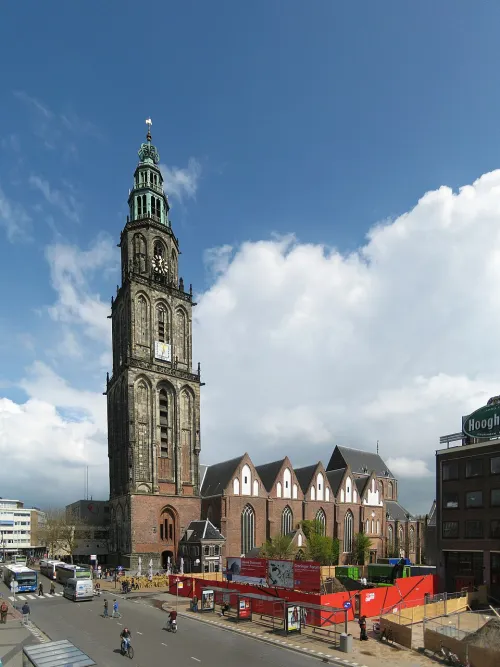
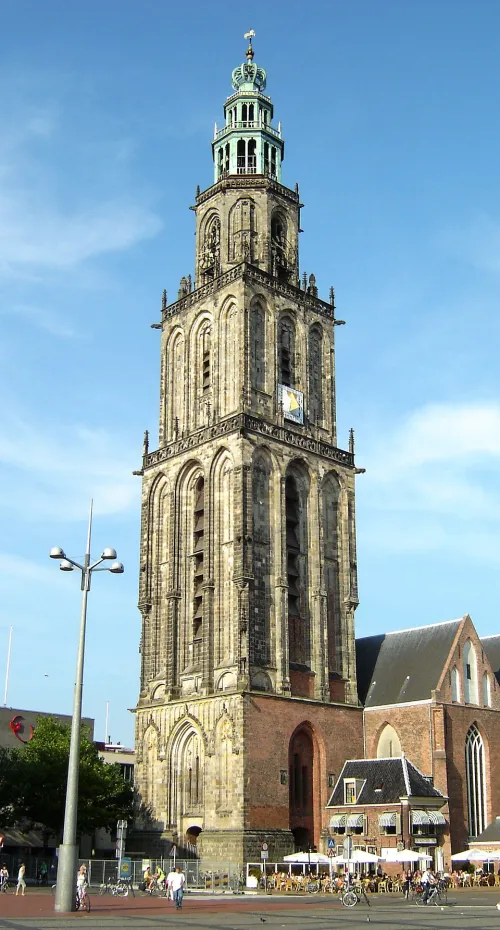
    At 96.8 metres the Martinitoren is the highest tower in Groningen, and locals call it d' Olle Grieze, Gronings for the old grey one. It belongs to the Martini Church and still holds twelve bells rung by hand.

    It's the third tower here. The first, from the thirteenth century, was about 30 metres high and appears on the city seal; lightning destroyed it in 1408. A second, about 45 metres and partly of wood, was begun in 1452. On the Tuesday after Easter 1465 a great fire broke out in it after 'groet donder ende blyxem', great thunder and lightning, as the chronicler Sicke Benninghe wrote, and in 1468 it collapsed, taking everything built around it down too.

    This time the tower went up at the west side of the church, from blocks of Bentheim sandstone with a wooden upper part and spire, reportedly on a foundation three metres deep. Building began in 1469, and it was meant to display the city's growing power over the Ommelanden. Some have suggested it copies the Domtoren in Utrecht; in any case it can be seen as a reflection of it. How long the building took is unknown.

    You can climb it: there's a fee, with reduced tickets for students and children, and the youngest go free with an adult ticket. If you only pay for one thing on this walk, make it this climb up the city's landmark.

    From the foot of the tower it's 100 m, a minute, back to the Grote Markt, and the loop is closed.

    Hours
    Mon–Sat 11:00–17:00, Sun 12:00–17:00 (last admission 1 hour before closing)
    Price
    7 EUR adults, 6 EUR students, 5 EUR children 4-12, children 0-3 free with adult ticket
Walking tour route map of Groningen Route loaded
Grote MarktVismarktLutheran Church GroningenSynagogue of Groningen+7
All 11 stops are already on the map.
You just press start.
AI Tour Guide

You know the route now. Walk it with a guide in your ear.

Press start wherever you are, even hundreds of kilometres from Groningen, and the guide begins telling its stories right away. In the city, pick any of the 11 stops to start from: it leads you there, then talks with you the whole route, asking, listening, remembering, and shaping the tour around your answers.

11stops 4.0km 55 minwalking 13languages
▶Start the tour free

Free to start · Runs in your browser · No app, no download

Shorter Ways to Walk Groningen

The loop splits neatly in two at the Aa-kerk, so you can spread it over two half days or pick the half that suits you.

Southern half: art and Jewish history

Stops: 1, 2, 3, 4, 5, 6

For anyone who wants the synagogue and the Groninger Museum without rushing. From the Grote Markt via the Vismarkt and the Lutheran Church to the synagogue, the museum and the Aa-kerk: 1,520 m and 20 minutes of walking. All three charge admission, and the synagogue also offers guided tours. Close to four hours if you give the museum two of them.

Northern half: churches, garden and tower

Stops: 6, 7, 8, 9, 10, 11

For lovers of old churches, quiet gardens and a tower climb. From the Aa-kerk past the Museum aan de A to the Nieuwe Kerk, the Prinsenhof Gardens, the Martini Church and the Martini Tower: 33 minutes of walking, plus 1 minute back to the Grote Markt. The Nieuwe Kerk and the garden are free; the Aa-kerk, the Martini Church and the tower charge admission. Allow a little under three hours.

How Long This Groningen Tour Takes with Museum and Tower

The whole loop is 4.0 km with 55 min of pure walking, and most legs are short: the longest is the 1,000 m, 14 minute walk from the Museum aan de A to the Nieuwe Kerk. Everything else around the centre is a matter of a few minutes.

Realistically, with the synagogue, the Aa-kerk, a stroll through the Prinsenhof Gardens, the Martini Church and the tower climb, you'll need about four hours. The Groninger Museum deserves about two hours of its own, and fitting it into the same day makes the afternoon tight, since neither the garden nor the tower stays open late. If the museum is a priority, give it a separate visit or walk one half of the loop per day.

Before You Start Walking Groningen

  • Start and finish: The recommended start is the Grote Markt, and the loop brings you back there. You can join at any stop and follow the order from there.
  • Best day: Check that the synagogue, the Groninger Museum and the Aa-kerk are open on your day, since all three have closing days. Ideally pick a day when the Nieuwe Kerk also opens for visitors.
  • Time of day: Start with the Martini Tower, right by the Grote Markt, so you're not racing its last entry later on. Then linger on the two market squares and walk to the synagogue once it has opened.
  • Costs: Walking the loop costs nothing. The synagogue, the Aa-kerk, the Martini Church and the tower charge admission, and the Groninger Museum is the priciest ticket on the route.
  • Route and guide: Map, route and GPS navigation from stop to stop are free in your browser. The AI Tour Guide starts with 100 free credits; after that you choose this tour all-inclusive for €19.99 with no time limit, or credits at €5 per hour.
Walking tour route map of Groningen
AI Tour Guide

Your guide for Groningen is ready when you are.

Press start and a voice AI Tour Guide takes it from here: leading the route through Groningen, telling the stories, and turning your walk into a real back-and-forth conversation. No app or download is needed; it runs in your browser.

11stops 4.0km 55 minwalking 13languages
▶Start the tour free

Free to start · Runs in your browser · No app, no download

What the AI Tour Guide Adds on This Loop

This loop runs on threads that cross from stop to stop: Schnitger organs, collapsing towers, the siege of 1594, the princes of Nassau. The AI Tour Guide walks you through them as a conversation, greets you at the Grote Markt, tells the stories as you go and notices what grabs you, whether that's organ builders or the war years. You can interrupt it at any point, for instance to ask what Groningens Ontzet actually was, who Willem Frederik and Albertine Agnes were, or what the Ommelanden meant to the city, and it shapes the rest of the walk around your interests. The route stays the same; the conversation is yours.

A Real Conversation A voice AI Tour Guide greets you, leads the whole route, and tells the stories and facts as you walk, asking what you want to see and keeping a real conversation going. Not a recording you press play on.
Map Navigation Follow the route on the map and walk at your own pace. You choose where to start and when to move to the next stop.
Ask Anything Curious about a building you pass? Ask your AI Tour Guide on the spot and the conversation carries on.
13 Languages Switch language anytime. No separate tour needed.
Start free in your browser

Common Questions About Walking Groningen

Which sights can I count on being open?

The Martini Tower, the Prinsenhof Gardens and the Stilteportaal of the Nieuwe Kerk are the most reliably open, and the squares are always accessible, so a walk always works. The synagogue, the museum and the Aa-kerk have closing days, so check them before you plan around them.

I'm arriving by train. Where should I join the loop?

Join at the Groninger Museum, which stands opposite the railway station and is linked to it by a bridge. Follow the loop on via the Aa-kerk and the north of the centre to the Grote Markt, then continue past the Vismarkt and the synagogue back to the museum.

Where can I hear the historic organs?

The Lutheran Church opens for its Sunday service and for occasional music services, and it's home to the Luthers Bach Ensemble. The Aa-kerk is used for concerts. Check what's on locally when you're in town.

Where can I walk next after Groningen?

Across the German border, Oldenburg is 110 km away and Bremen 150 km. Within the Netherlands, Amsterdam is 147 km away and Utrecht 159 km.

Is the tour really free?

Yes. The whole tour is free: the route, the interactive map and the navigation cost you nothing. Only the voice AI Tour Guide is optional and paid: you test it with 100 free credits, then you pay either €5 per hour or €19.99 for this whole tour, with no time limit. Admission to 5 of the 11 stops is not included: Synagogue of Groningen, Groninger Museum, Der Aa-kerk, Martini Church and Martini Tower charge their own entry fees.

Do I need to download an app?

No. Everything runs in your phone browser. Open the route and start walking, no download and no sign-up required.

Do I need to book the walking tour in advance?

No booking needed. This self-guided tour is available anytime. Open the route in your browser and start walking. The AI Tour Guide works instantly, no app, no reservation required.

What languages is the AI Tour Guide available in?

The AI Tour Guide speaks 13 languages, so you take the tour in your own language and can switch at any time.

Can I skip stops or change the route?

Yes. Skip any stop, spend extra time at places you like, or start the route from any point. It is your walk, you set the pace.
Image credits
▶ Start free in your browser Runs in your browser, no app, no download