

National Palace of Sintra
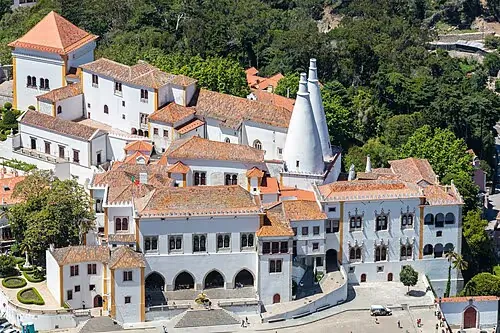
You begin in the heart of town, at the palace locals also call the Palácio da Vila, the Town Palace. It counts as the best-preserved medieval royal residence in Portugal, lived in more or less continuously from at least the early 15th century until the late 19th. Today it is a historic house museum and part of the Cultural Landscape of Sintra, listed by UNESCO.
The site is older than the building you see. In the Moorish era Sintra had two castles: this one, downhill, was the residence of the rulers of the Taifa of Lisbon, and the other is the hilltop ruin you will reach later, Castelo dos Mouros. The Arab geographer Al-Bakri gives the earliest written mention. In the 12th century King Afonso Henriques conquered the village and took the palace for himself, yet nothing from the Moorish years or the first Portuguese kings survives.
What stands is mostly the work of the 15th and early 16th centuries, a blend of Gothic, Manueline, Moorish and Mudéjar styles. Much of it goes back to João I, who started a major building campaign around 1415. The oldest surviving part is the Royal Chapel, possibly from the reign of Dinis I in the early 14th century. Look for the tiles in the apse laid out like a carpet, walls painted in squares that imitate tiles with the Holy Ghost descending as a dove, and a wooden ceiling of geometric Moorish latticework.
Is it worth going in? Yes, especially if you want the medieval and Moorish layer of Sintra before the Romantic fantasies higher up; the standard ticket includes the gardens. From here it is 830 m, about 12 minutes on foot, to Quinta da Regaleira.