Free Walking Tour Montreal: Mount Royal and Old Town

From a governor's house of 1705 over Mount Royal to the Old Port: a long, varied day on foot through Montreal, from New France to the Plateau.

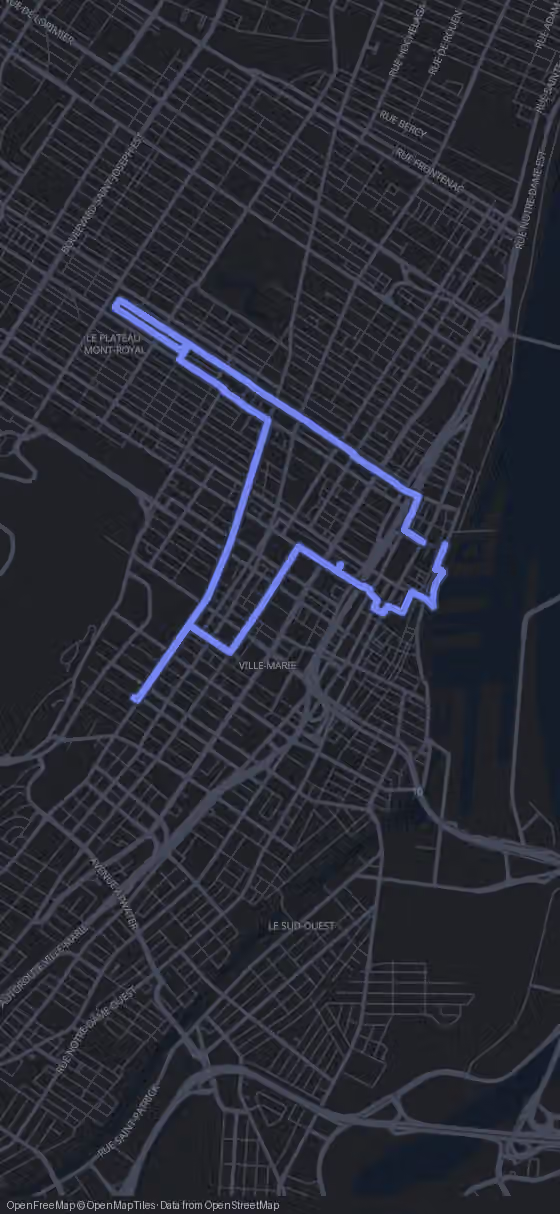
10 Stops 10.8 km ~2 h 31 min walking
Route map for the Montreal walking tour
Stop 1 of 10
3 km·38 min
Château Ramezay
Head north-west from Chateau Ramezay toward Mount Royal
Bonjour, welcome to Montreal. I'm Alex, and one stone house here witnessed Benjamin Franklin's failed revolutionary mission.
Try this tour with Alex

Montreal on Foot at a Glance

Ten stops over 10.8 km: you start at Château Ramezay in the old town, walk up to Mount Royal and The Plateau, come back down past the Montreal Museum of Fine Arts and Chinatown, and finish at Marché Bonsecours by the Old Port of Montreal. Pure walking time is 2 h 31 min; with breaks and two interiors, count on about seven and a half hours.

Seven stops are free. Château Ramezay, Notre-Dame Basilica and the museum charge entry. The route with map and GPS navigation runs free in your browser; the AI Tour Guide is optional.

Open free GPS & optional AI Tour Guide
This short shows highlights of the route. All 10 stops follow below.

The Route

Walking Map of Montreal: Old Town, Mountain and Port

10 stops 10.8 km 2 h 31 min walking
Tap to load interactive map

The 10 stops along this route

  1. Château Ramezay in Montreal, stop 1 on the self-guided walking tour
    1Château Ramezay
  2. Mount Royal in Montreal, stop 2 on the self-guided walking tour
    2Mount Royal
  3. The Plateau in Montreal, stop 3 on the self-guided walking tour
    3The Plateau
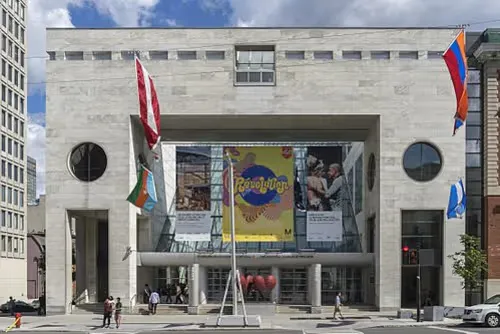
  4. Montreal Museum of Fine Arts, stop 4 on the self-guided walking tour
    4Montreal Museum of Fine Arts
  5. Chinatown in Montreal, stop 5 on the self-guided walking tour
    5Chinatown
  6. Place d'Armes in Montreal, stop 6 on the self-guided walking tour
    6Place d'Armes
  7. Notre-Dame Basilica in Montreal, stop 7 on the self-guided walking tour
    7Notre-Dame Basilica
  8. Old Montreal, stop 8 on the self-guided walking tour
    8Old Montreal
  9. Old Port of Montreal, stop 9 on the self-guided walking tour
    9Old Port of Montreal
  10. Marché Bonsecours in Montreal, stop 10 on the self-guided walking tour
    10Marché Bonsecours
  11. That's the full route.

    Walk it with an AI Tour Guide talking you through every one of these streets.

    Start free in your browser
    You made it

Stop by Stop: Your Montreal Walking Tour from Ramezay to Bonsecours

  1. 1

    Château Ramezay

    Château Ramezay in Montreal, stop 1 on the self-guided walking tour

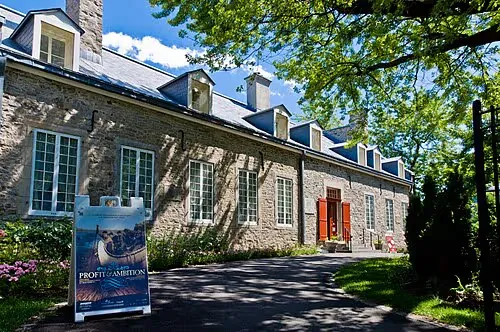
    You start in front of a solid stone house on Rue Notre-Dame, directly opposite Montreal's Hôtel de Ville. Château Ramezay is a typical town house of the New France era and one of the oldest surviving buildings in the city. Look at it as a home first: Claude de Ramezay, then governor of Montreal, had it built in 1705 as his private residence.

    Its later life reads like a summary of Montreal's history. Ramezay's descendants sold the house in 1745 to the French West India Company. A fire in 1754 did heavy damage, and by 1757 it had been rebuilt and enlarged on the original foundations. After the British conquest the company was forced to sell in 1764, and the merchant William Grant bought it. From 1773 he rented it to the government, and the governor general lived here whenever he was in town.

    One interruption stands out: during the invasion of Canada by the Continental Army in 1775 and 1776, American commanders lodged in these rooms. The last governor moved out in 1844. The building then became a courthouse, from 1856 a primary school, for a while offices of the education ministry, and from 1880 the home of Université Laval's medical faculty in Montreal, joined by its law faculty in 1883. The university left in 1889, a court returned for four years, and in 1895 the city took ownership.

    Since then the Société d'archéologie et de numismatique de Montréal has run a museum inside, with ethnological collections and a portrait gallery; the house has been a National Historic Site since 1949. If colonial history is your thing, 45 minutes inside are a fine start to the day; if you mainly came for the walk, the facade and its story are enough.

    Now comes the first long stretch: 3010 m and about 44 minutes on foot, out of the old town and up to the mountain that gave the city its name.
    Hours
    Museum daily 10:00–17:00; governor's garden 9:00–16:30
    Price
    14.99 CAD adults (13.04 + taxes)
  2. 2

    Mount Royal

    Mount Royal in Montreal, stop 2 on the self-guided walking tour

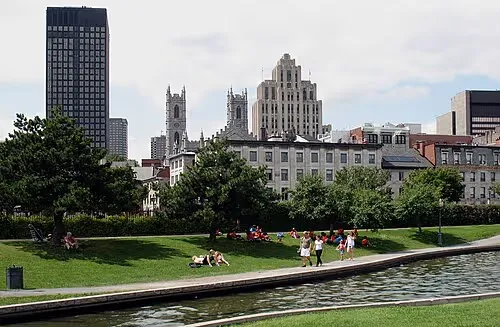
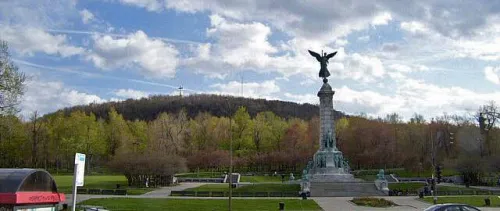
    Mount Royal, Mont Royal in French, is the reason Montreal is called Montreal: the city's name comes from the mountain. It rises immediately west of Downtown, and walking it costs nothing.

    Geologically it belongs to the Monteregian Hills, a chain standing between the Laurentians and the Appalachian Mountains, and it even lent its Latin name, Mons Regius, to the whole chain. What looks like one green hill from the city actually has three peaks: Colline de la Croix, the true Mont Royal, at 233 m; Colline d'Outremont, also called Mount Murray, at 211 m in the borough of Outremont; and Westmount Summit at 201 m.

    After the stone streets of the old town, this is the turning point of the route. From here you head back down through lived-in neighbourhoods toward the river, and the city's layers change with every leg.

    Your next stop, The Plateau, lies on the mountain's eastern slope, only 650 m away, about 9 minutes on foot.

    Local name
    Mont Royal
    Price
    Free
  3. 3

    The Plateau

    The Plateau in Montreal, stop 3 on the self-guided walking tour

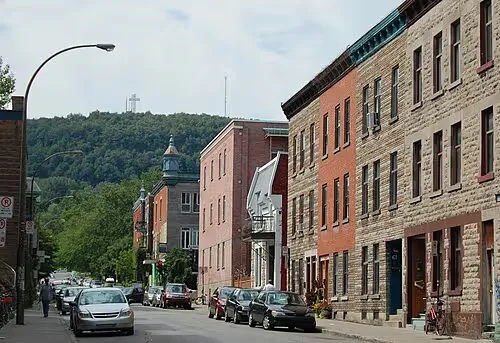
    The Plateau, officially Le Plateau-Mont-Royal, is a central borough on the eastern slope of Mount Royal, set on a plateau that overlooks downtown and bounded by Sherbrooke Street. About 104,000 people lived on its 8.1 km² in 2016, which tells you what to expect: a dense neighbourhood where people actually live, not a sight to tick off. Walk it slowly.

    Its story begins when Montreal grew beyond the old Faubourg Saint-Laurent in the 19th century. New villages appeared on this high ground: Coteau-Saint-Louis in 1846, Saint-Jean-Baptiste in 1861 and Saint-Louis-du-Mile-End in 1878. Together they became the borough you are walking through.

    Today the Plateau is one of Canada's major creative hubs, with a concentration of artists, musicians and creative organisations unmatched anywhere else in the country. The Conservatoire de musique de Montréal is here, along with theatres such as the Rideau Vert, the Théâtre de Quat'Sous, La Licorne and the Théâtre d'Aujourd'hui. Ubisoft Montréal develops video games in the borough, and the Institut de tourisme et d'hôtellerie du Québec trains the province's hospitality staff.

    Green space is never far: Parc Jeanne-Mance leads straight to the Parc du Mont-Royal, and Parc La Fontaine, Parc Sir-Wilfrid-Laurier, Square Saint-Louis and Place Gérald-Godin all belong to the Plateau. Since the 2000s so many French expatriates have settled here that locals call it the Petit-Paris or the Quartier français, and sometimes, with a wink, the Nouvelle-France.

    Ahead lies the longest leg of the whole route: 3190 m, about 45 minutes, down to Sherbrooke Street West and the Montreal Museum of Fine Arts.

    Local name
    Le Plateau-Mont-Royal
    Price
    Free
  4. 4

    Montreal Museum of Fine Arts

    Montreal Museum of Fine Arts, stop 4 on the self-guided walking tour

    The Montreal Museum of Fine Arts stands on the Golden Square Mile stretch of Sherbrooke Street West. What you see from the street is only part of it: the museum spreads across five pavilions with 53,095 m² of floor space, 13,000 m² of it for exhibitions. By gallery space it is the largest art museum in Canada, and with a founding date of 1860 also the oldest. In 2013 the permanent collection held around 44,000 works.

    It started without a home. In April 1860 the Anglican bishop Francis Fulford founded the Art Association of Montreal to encourage the appreciation of fine arts among the people of the city. With nowhere to keep acquisitions, the association could neither buy works nor borrow from collectors, and for twenty years its shows moved from one Montreal venue to the next.

    The turning point came in 1877 from the businessman Benaiah Gibb. He gave 72 canvases and 4 bronzes from his collection, a building site on the north-east corner of Phillips Square and $8,000, on one condition: a museum had to be built there within three years. The association's original reading room grew into today's library, the oldest art library in Canada. The museum belongs to the Bizot Group, the forum where the heads of the world's largest museums exchange works and exhibitions, and in 2016 it opened the Michal and Renata Hornstein Pavilion for Peace.

    Should you go in? A collection this size needs hours, and on the full route a proper visit would leave you no time for Notre-Dame Basilica. Better to come back on another day and give it the time it deserves. Today, a look at the building is enough.

    From here it is 2330 m, about 31 minutes, to Chinatown.

    Local name
    Musée des beaux-arts de Montréal
    Hours
    Mon: Closed | Tue: 10:00–17:00 | Wed: 10:00–21:00 | Thu–Sun: 10:00–17:00
    Price
    30-32 CAD adults (30 CAD online, 32 CAD on site)
  5. 5

    Chinatown

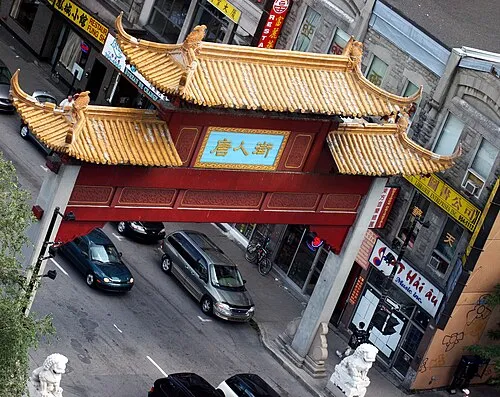
    Chinatown in Montreal, stop 5 on the self-guided walking tour

    Chinatown, the Quartier chinois, centres on De la Gauchetière Street. Look around and you will see Asian restaurants, food markets and convenience stores, but also institutions of Montreal's East Asian community such as the Montreal Chinese Hospital and the Montreal Chinese Community and Cultural Centre.

    Before it was Chinatown, this area belonged to Montreal's Jewish quarter around Saint Laurent Boulevard: thousands of Yiddish-speaking immigrants settled here between 1890 and 1920. The first Chinese immigrants reached Montreal in March 1877, and in the 1890s a Chinatown emerged, shared by the Chan, Hom (Tam), Lee and Wong clans. Many came from Taishan and worked for the railways, which made this spot convenient. Most spoke Toisanese, a sister language of Cantonese, and had moved from British Columbia and southern China.

    Laundries shaped the early years. Running their own business let Chinese Montrealers escape the pay discrimination they had faced in British Columbia, and since a laundry has to be close to its customers, they spread across the city. Among the first residents was Jos Song Long, who opened a laundry on Craig Street, today Saint Antoine Street.

    In 1902 the name became official for several blocks of De La Gauchetière Street between Chenneville and Clark Streets. Modest lots, affordable rents and the nearness of Saint-Laurent Boulevard drew restaurants and specialty grocers and brought in non-Chinese customers too. Later, people from Hong Kong and ethnic Chinese refugees from Vietnam opened their own shops and restaurants.

    From here the walk gets short: 570 m, about 8 minutes, to Place d'Armes.

    Local name
    Quartier chinois de Montréal
    Price
    Free
  6. 6

    Place d'Armes

    Place d'Armes in Montreal, stop 6 on the self-guided walking tour

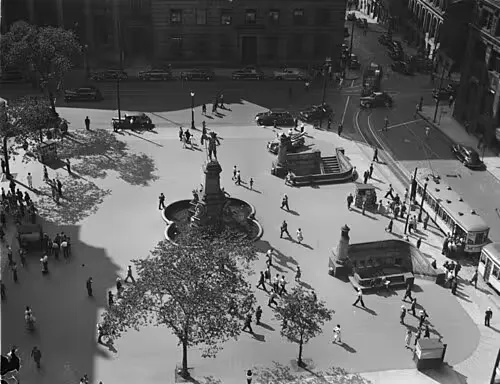
    Place d'Armes is the square where Old Montreal shows its full range at once. In the middle stands the Maisonneuve Monument, honouring Paul de Chomedey, founder of Montreal. Turn slowly around: Notre-Dame Basilica, the Saint-Sulpice Seminary, the New York Life Building, the Aldred Building, the Bank of Montreal head office and 500 Place d'Armes all frame the square, from religious buildings to banking towers.

    It is the second oldest public site in Montreal. In 1693 it was laid out at the Sulpicians' request as Place de la Fabrique, and in 1721 it was renamed Place d'Armes when it became the stage for military events. From 1781 it served for three decades as a hay and wood market, and after the city bought it in 1836 it became a Victorian garden. Its present size only came after the old Notre-Dame Church was demolished in 1830 and its bell tower in 1843; the layout you see goes back to a plan begun in 1845 and finished in 1850 with the completion of Notre-Dame Street.

    The square hides a curious story underground. During the Great Depression, Mayor Camillien Houde launched public works including more than 20 public restrooms that locals nicknamed Camilliennes. One was finished under Place d'Armes in 1934: an Art Deco design by Jean-Omer Marchand, 270 m² in size, costing $51,255, with two granite entrances letting in daylight and glass block windows, rare in 1930s Montreal. By the 1940s it had become run-down, and in 1980 it closed for moral and cleanliness reasons.

    The square was renovated in the 1960s and again from 2009; the work finished in 2011 at a cost of $15.5 million. The basilica faces you across the square, 150 m and about 2 minutes away.

    Price
    Free
  7. 7

    Notre-Dame Basilica

    Notre-Dame Basilica in Montreal, stop 7 on the self-guided walking tour

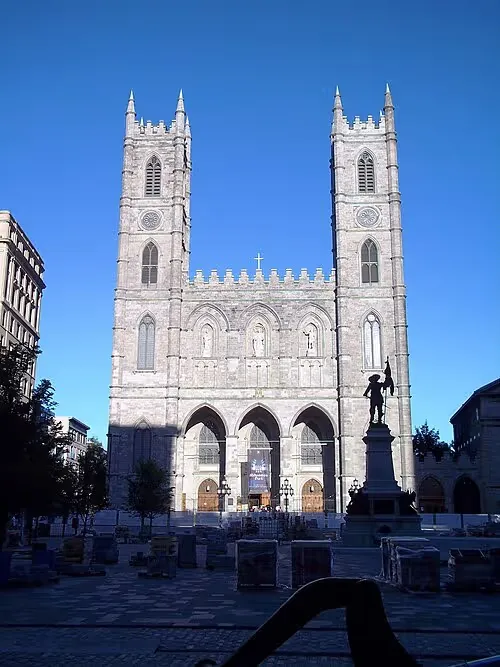
    Notre-Dame Basilica stands at 110 Notre-Dame Street West, on the corner of Saint Sulpice Street, next to the Saint-Sulpice Seminary and facing Place d'Armes. Pope John Paul II raised it to the rank of minor basilica on 15 February 1982. Around 11 million people visit every year, which puts it among the most visited monuments in North America.

    This is the stop where going inside is the whole point. The interior is regarded as a masterpiece of Gothic Revival architecture: the vaults are deep blue and scattered with golden stars, and the sanctuary glows in blues, azures, reds, purples, silver and gold. Hundreds of intricate wooden carvings and several religious statues fill the space.

    Look closely at the stained glass along the walls. Unusually for a church, the windows do not show biblical scenes but episodes from the religious history of Montreal. Then look for the Casavant Frères organ from 1891, with four keyboards, 99 stops, 7000 pipes and a pedal board.

    The church goes back to the Sulpicians, who arrived in Ville-Marie in 1657 and six years later became lords of the island, ruling until 1840. Their parish, dedicated to the Holy Name of Mary, built its first church of Notre-Dame on this site in 1672.

    The basilica is the stop to plan your day around, so make sure you reach it in good time. Afterwards it is only 120 m, about 2 minutes, into the lanes of Old Montreal.

    Hours
    Mon–Sat 09:00–16:00, Sun 12:30–16:00
    Price
    16 CAD adults (+ taxes), day visit
  8. 8

    Old Montreal

    Old Montreal, stop 8 on the self-guided walking tour

    Old Montreal, Vieux-Montréal, is the historic core you have been circling since the morning. Its traditional limits are rue McGill to the west, Ruelle des Fortifications to the north, rue Saint-André to the east and the Saint Lawrence River to the south; recent changes stretched it to Rue des Soeurs Grises, Saint Antoine Street and Saint Hubert Street. Many buildings here date back to New France, and in 1964 much of the district was declared a historic district by Quebec's ministry of cultural affairs.

    Before the city, there was a trading post. Samuel de Champlain set up a fur-trading post at Place Royale, where the Saint Lawrence met the Petite Rivière St-Pierre, a river that no longer exists, near today's Place D'Youville and the Pointe-à-Callière Museum. Iroquois incursions later forced the settlers to give it up.

    The settlement that followed was called Ville-Marie, a name the surrounding borough still carries. Paul Chomedey de Maisonneuve, whose monument you just saw at Place d'Armes, built a fort in 1643 as headquarters of the Société Notre-Dame de Montréal. Its mission was to convert members of the First Nations and to found a Christian settlement in New France; the company had been set up by the Sulpician Jean-Jacques Olier and Jérôme Le Royer, Sieur de La Dauversière. When the Société dissolved on 9 March 1663, the Sulpicians became the seigneurs of Montreal, while King Louis XIV took personal control of the colony.

    Take your time in these streets; they are free and the stories sit in the stone. Then walk 290 m, about 4 minutes, toward the water; you pass the Montreal Science Centre on the way to the Old Port.

    Local name
    Vieux-Montréal
    Price
    Free
  9. 9

    Old Port of Montreal

    Old Port of Montreal, stop 9 on the self-guided walking tour

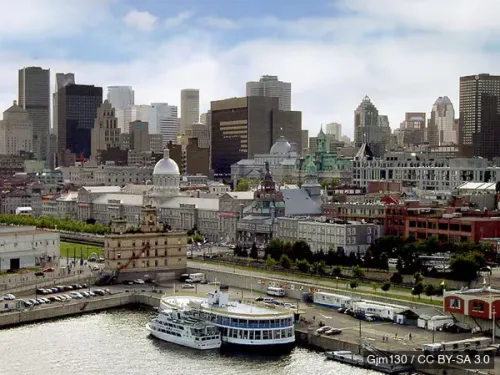
    The Old Port of Montreal runs for two kilometres along the Saint Lawrence River, right next to the old town. What you walk along are former piers, linked by a waterfront promenade. The working port, the largest inland port in North America, now lies further downstream.

    This shore is where the city began. At Pointe-à-Callière, roughly in the middle of the area, Champlain had his temporary fur-trading post, and on 17 May 1642 French colonists founded Fort Ville-Marie on the same spot. For the next three centuries the port drove Montreal's growth. The biggest expansion came in the 1890s, when the Canadian government built piers, warehouses, basins and grain silos.

    Then the ships went elsewhere. The opening of the Saint Lawrence Seaway in 1959 started the decline, the closure of the Lachine Canal in 1970 sped it up, and in 1976 port operations in the city centre ended. Planning for a new use began in 1977; in 1981 a waterfront park was created and six of the eight harbour railway tracks were removed. From 1989 the Société du Vieux-Port de Montréal carried out a full development plan, and in 1992, for the city's 350th anniversary, the Old Port opened to visitors. Ten years later the Lachine Canal reopened.

    Today about six million people come here every year. The street running parallel to the promenade is lined with listed buildings from the 18th and 19th centuries, worth a glance as you walk. The last leg is 520 m, about 7 minutes, to Marché Bonsecours.

    Local name
    Vieux-Port de Montréal
    Hours
    Daily 06:00–24:00
    Price
    Free
  10. 10

    Marché Bonsecours

    Marché Bonsecours in Montreal, stop 10 on the self-guided walking tour

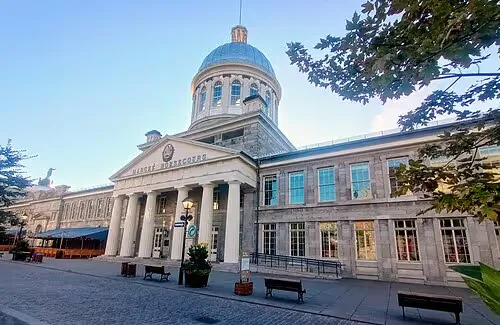
    Marché Bonsecours is the long neoclassical building between Rue Saint-Paul and the Old Port. It was built as a market hall and named after the neighbouring pilgrimage chapel of Notre-Dame-de-Bon-Secours. Today it is a cultural centre, and it has been a National Historic Site since 1984.

    Construction began in 1844 under the British architect William Footner. The building was in use by January 1847 even though work was still going on, but Footner had overrun the budget threefold, and in May 1847 George Browne took over; the following year it was finished. The butchers' stalls were at the back in the base, and a police post sat at the south-east end.

    Then politics arrived. On 25 April 1849 an angry crowd set fire to the Marché Sainte-Anne, the provisional parliament of the Province of Canada, and the members sat here until 7 May. There had been thoughts of making this hall the permanent parliament, but given the unrest the government chose Toronto as the new capital instead. In 1850 Browne converted the southern part into a city hall, with a concert hall added at the other end; the city administration moved in in 1852 and left for the most part in 1878 for the new Hôtel de Ville.

    Fires in 1891, 1948 and 1954 meant repairs to the roof, and the market itself moved out in 1963 to a new building north of the centre. After restorations in the 1960s, the dome burned in 1976 and was rebuilt by 1978; the city kept some offices here until 1990.

    Entry is free, and on the timing suggested you still have time to walk through. This is where the route ends; if you want to get back to Château Ramezay, the GPS navigation will take you there.

    Hours
    Mon–Wed: 10:00–18:00 | Thu–Sat: 10:00–19:00 | Sun: 10:00–18:00
    Price
    Free (entry)
Walking tour route map of Montreal Route loaded
Château RamezayMount RoyalThe PlateauMontreal Museum of Fine Arts+6
All 10 stops are already on the map.
You just press start.
AI Tour Guide

From Reading to Walking: Take Montreal with a Guide in Your Ear

Press start wherever you are, even hundreds of kilometres from Montreal, and the guide begins telling its stories right away. In the city, pick any of the 10 stops to start from: it leads you there, then talks with you the whole route, asking, listening, remembering, and shaping the tour around your answers.

10stops 10.8km 2 h 31 minwalking 13languages
▶Start the tour free

Free to start · Runs in your browser · No app, no download

Shorter Ways to Walk Montreal

The full route is a long day. If you have less time or want to split it, two parts of it work well on their own.

Old Montreal and the port in an afternoon

Stops: 5, 6, 7, 8, 9, 10

For a first afternoon in the city: from Chinatown through Place d'Armes and Notre-Dame Basilica into the old streets, out to the waterfront and on to Marché Bonsecours. That is 1650 m and about 23 minutes of walking. The only entry fee is the basilica, so arrive early enough to give yourself time inside.

Mountain, Plateau and art

Stops: 2, 3, 4

For a slower half day with green space and a big collection: Mount Royal, The Plateau and the Montreal Museum of Fine Arts. The walking adds up to 3840 m and about 54 minutes; the museum is the only paid stop.

How Long Does This Montreal Tour Take, With and Without Museums?

The 10.8 km break down very unevenly. Three long legs carry most of the 2 h 31 min of pure walking: 44 minutes from Château Ramezay up to Mount Royal, 45 minutes from The Plateau to the Montreal Museum of Fine Arts and 31 minutes on to Chinatown. After that, the last six stops follow each other within 23 minutes of walking.

What really matters is reaching Notre-Dame Basilica while it is still open. A workable day: start at Château Ramezay at 10:00 and spend 45 minutes inside, reach Mount Royal at 11:29, The Plateau at 12:08, look at the museum from outside at 13:33, arrive in Chinatown at 14:14 and at Place d'Armes at 14:52. You are in the basilica at 15:09 with time to look around, in Old Montreal at 15:51, at the Old Port of Montreal at 16:25 and at Marché Bonsecours at 17:02. With half an hour there you finish around 17:30, so about seven and a half hours in total.

If you also want a real visit to the Montreal Museum of Fine Arts, the basilica no longer fits into the same day; save the museum for a Wednesday evening. The Old Montreal variant takes about two and a half hours including the basilica, the mountain variant about half a day with a museum visit.

Before You Set Off in Montreal

  • Start: Château Ramezay on Rue Notre-Dame is the recommended start, and its museum is a fine start to the day. You can join the route at any stop, the order shown is simply the one that works best.
  • Finish: Marché Bonsecours, beside the Old Port. If you want to get back to the start, the GPS navigation leads you from the last stop to the first.
  • Best day: Any day works for the walk itself. If you want to go inside the Montreal Museum of Fine Arts, pick a day when it is open, and start by 10:00 to reach the basilica in time.
  • Costs: Walking the route is free. Château Ramezay, Notre-Dame Basilica and the Montreal Museum of Fine Arts charge admission, and the museum is cheaper if you buy your ticket online. The AI Tour Guide starts with 100 free credits; after that you choose between €19.99 for this tour with no time limit or €5 per hour.
Walking tour route map of Montreal
AI Tour Guide

Your Montreal Guide Is Ready When You Are

Press start and a voice AI Tour Guide takes it from here: leading the route through Montreal, telling the stories, and turning your walk into a real back-and-forth conversation. No app or download is needed; it runs in your browser.

10stops 10.8km 2 h 31 minwalking 13languages
▶Start the tour free

Free to start · Runs in your browser · No app, no download

What the AI Tour Guide Adds on This Route

Montreal's route has long walking legs between the mountain, the museum and Chinatown, and that is where the AI Tour Guide makes a difference. It greets you at the start, tells the stories of each place as you go, asks what you care about more, the governors of New France or the parliament that fled a burning building, and shapes the rest of the conversation around your answers. You can interrupt it at any time to ask about things the route only touches, such as what goes on in the Saint-Sulpice Seminary next to the basilica or who Mayor Camillien Houde was beyond his famous restrooms.

A Real Conversation A voice AI Tour Guide greets you, leads the whole route, and tells the stories and facts as you walk, asking what you want to see and keeping a real conversation going. Not a recording you press play on.
Map Navigation Follow the route on the map and walk at your own pace. You choose where to start and when to move to the next stop.
Ask Anything Curious about a building you pass? Ask your AI Tour Guide on the spot and the conversation carries on.
13 Languages Switch language anytime. No separate tour needed.
Start free in your browser

Common Questions About Walking Montreal

Do I have to pay anything to go up Mount Royal?

No. The mountain is free, and so are The Plateau, Chinatown, Place d'Armes, the old town streets and the Old Port.

When should I plan my visit to Notre-Dame Basilica?

Plan it for the earlier part of your day so you have enough time inside before it closes.

Is the Old Port of Montreal open in the evening?

Yes, so you can finish the route there at your own pace.

Which other city pairs well with a trip to Montreal?

Quebec City is 232 km away and has its own walking route. If you are heading south, Boston is 403 km away and New York 529 km.

Is the tour really free?

Yes. The whole tour is free: the route, the interactive map and the navigation cost you nothing. Only the voice AI Tour Guide is optional and paid: you test it with 100 free credits, then you pay either €5 per hour or €19.99 for this whole tour, with no time limit. Admission to 3 of the 10 stops is not included: Château Ramezay, Montreal Museum of Fine Arts and Notre-Dame Basilica charge their own entry fees.

Do I need to download an app?

No. Everything runs in your phone browser. Open the route and start walking, no download and no sign-up required.

Do I need to book the walking tour in advance?

No booking needed. This self-guided tour is available anytime. Open the route in your browser and start walking. The AI Tour Guide works instantly, no app, no reservation required.

What languages is the AI Tour Guide available in?

The AI Tour Guide speaks 13 languages, so you take the tour in your own language and can switch at any time.

Can I skip stops or change the route?

Yes. Skip any stop, spend extra time at places you like, or start the route from any point. It is your walk, you set the pace.
Image credits
▶ Start free in your browser Runs in your browser, no app, no download