Free Walking Tour Quebec City: From River to Ramparts

Start where Champlain landed in 1608, climb to the Citadelle and the battlefield of 1759, then drift back down to the lanes of Petit Champlain.

10 Stops 7.3 km ~1 h 47 min walking
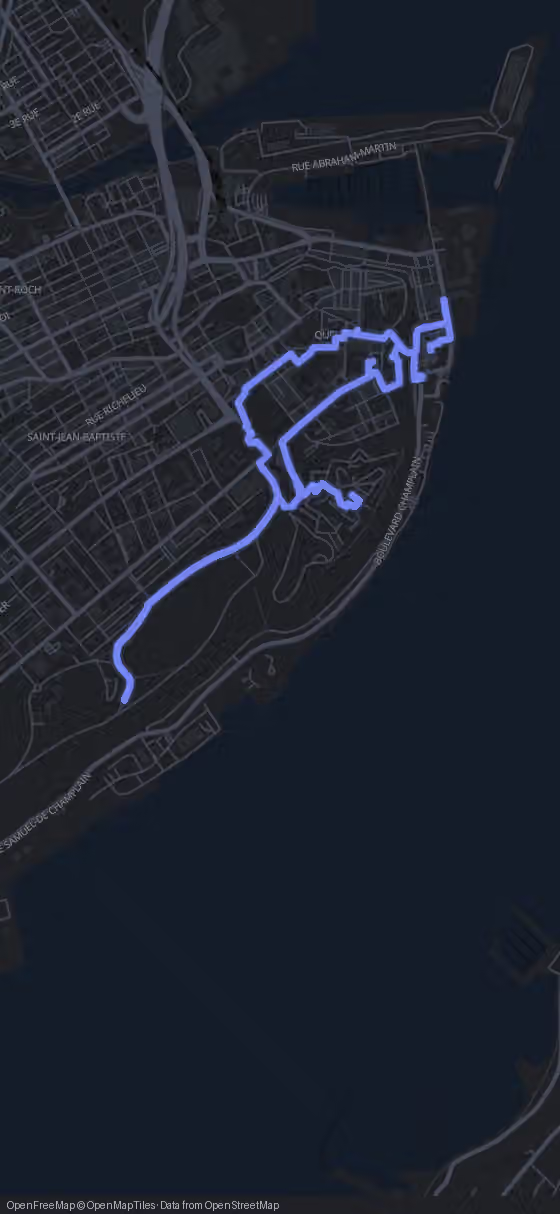
Route map for the Quebec City walking tour
Stop 1 of 10
470 m·6 min
Place Royale
Head west toward the Château Frontenac
Bonjour, welcome to Quebec City. I'm Alex, and one small cobbled square marks the beginning of a much larger French story.
Try this tour with Alex

This Quebec City walk at a glance

Ten stops lead from Place Royale, where Champlain founded the city, up to the Citadelle of Quebec and the Plains of Abraham, then back down to Petit Champlain. The route covers 7.3 km with 1 h 47 min of pure walking; plan about three and a half hours, or most of a day with museum visits.

The squares, Notre-Dame de Québec Cathedral and Fontaine de Tourny are free; the Citadelle, Morrin Centre, Musée de la Civilisation and a visit inside the Château Frontenac cost admission. Route, map and GPS navigation are free in your browser; the AI Tour Guide is optional.

Open free GPS & optional AI Tour Guide
View of Quebec City

The Route

Walking Map of Quebec City: Ten Stops Between River and Ramparts

10 stops 7.3 km 1 h 47 min walking
Tap to load interactive map

The 10 stops along this route

  1. Place Royale in Quebec City, stop 1 on the self-guided walking tour
    1Place Royale
  2. Château Frontenac in Quebec City, stop 2 on the self-guided walking tour
    2Château Frontenac
  3. Place d'Armes in Quebec City, stop 3 on the self-guided walking tour
    3Place d'Armes
  4. Citadelle of Quebec in Quebec City, stop 4 on the self-guided walking tour
    4Citadelle of Quebec
  5. Plains of Abraham in Quebec City, stop 5 on the self-guided walking tour
    5Plains of Abraham
  6. Fontaine de Tourny in Quebec City, stop 6 on the self-guided walking tour
    6Fontaine de Tourny
  7. Morrin Centre in Quebec City, stop 7 on the self-guided walking tour
    7Morrin Centre
  8. Notre-Dame de Québec Cathedral in Quebec City, stop 8 on the self-guided walking tour
    8Notre-Dame de Québec Cathedral
  9. Musée de la Civilisation in Quebec City, stop 9 on the self-guided walking tour
    9Musée de la Civilisation
  10. Petit Champlain in Quebec City, stop 10 on the self-guided walking tour
    10Petit Champlain
  11. That's the full route.

    Walk it with an AI Tour Guide talking you through every one of these streets.

    Start free in your browser
    You made it

Your Quebec City Walking Tour, from Champlain's Landing to Petit Champlain

  1. 1

    Place Royale

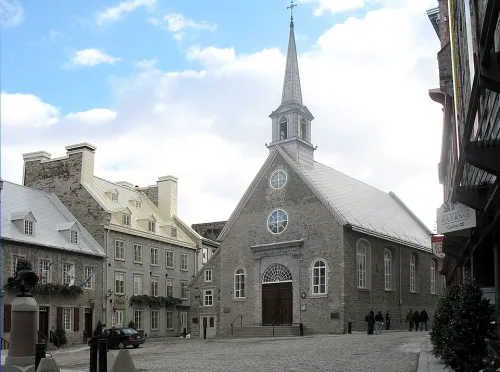
    Place Royale in Quebec City, stop 1 on the self-guided walking tour

    You are standing at the spot where French settlement in today's Quebec began, which is why the square is called the cradle of French civilisation in America. On 3 July 1608 the French navigator Samuel de Champlain arrived here and had a fortified trading post built, the Habitation de Québec. It was made of wood, ringed by a ditch and a palisade, and existed mainly for the fur trade with the Indigenous peoples. From 1624 Champlain replaced it on the same spot with a building of stone, and archaeologists found its foundation walls in the 1970s.

    The trading post grew quickly into the Lower Town. After the great fire of 1682 the houses were rebuilt with firewalls between them, so look for those raised stone walls dividing the roofs. From 1686 a statue of Louis XIV, the Sun King, stood on the square, and that gave Place Royale its name. On its south side the church of Notre-Dame-des-Victoires went up between 1687 and 1723; it is described as the oldest stone church in North America.

    In 1759 the British army under General James Wolfe besieged Quebec for three months, and the bombardment wrecked much of the city, this square included. In the 19th century the quarter lost its trade and slowly fell into decay. In 1967 the provincial government decided to restore it, and excavations, above all between 1975 and 1977, gave the basis for rebuilding the stone houses in their 18th century style. Much of what you see is therefore a careful reconstruction, and the project was controversial for how strongly it reshaped the old quarter.

    From here it is 460 m, about 10 minutes, up to the Upper Town and the Château Frontenac.
    Hours
    Freely accessible, no fixed opening hours
    Price
    Free
  2. 2

    Château Frontenac

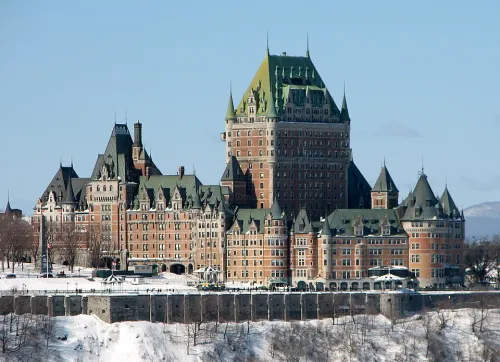
    Château Frontenac in Quebec City, stop 2 on the self-guided walking tour

    The green roofs and turrets in front of you belong to a hotel, not a castle. The Canadian Pacific Railway built it, the New York architect Bruce Price designed it in the Château style, and it opened in 1893 as one of Canada's first grand railway hotels. It is considered the most photographed hotel in the world, and once you see it rising from the edge of the promontory you understand why.

    The building has 18 floors and is 79.9 m tall, and it stands on ground that already lies 54 m high, on the promontory of Quebec that pushes out into the Saint Lawrence River. The hotel was expanded three times, the last major expansion coming in 1993, and in 1981 it was designated a National Historic Site of Canada. Terrasse Dufferin wraps around it from the northeast to the southeast, looking out over the river. A curious detail: two public roads, rue du Trésor and rue des Carrières, run right through the hotel.

    The name honours Louis de Buade, Count of Frontenac, governor of New France, who will turn up again at the Citadelle. Going inside on a visit costs admission; it is worth it if grand hotel interiors are your thing, otherwise the outside and the terrace give you the essence.

    Place d'Armes lies directly on the hotel's north side, 230 m and about 4 minutes away.

  3. 3

    Place d'Armes

    Place d'Armes in Quebec City, stop 3 on the self-guided walking tour

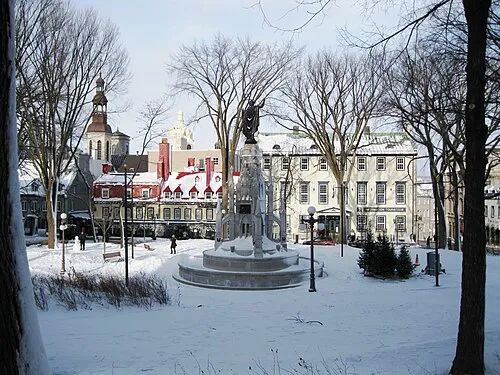
    This trapezoid of about 5000 m² was the military heart of the French town. Charles Jacques Huault de Montmagny, governor of New France, laid it out between 1640 and 1648 near Fort Saint-Louis, and soldiers stationed in the city drilled and paraded here. After the conquest of 1759 the British troops used it the same way, though they often moved to roomier grounds. Once the Citadelle took over in the 19th century, the square lost its military role, and in 1865 it became a public park.

    In the middle stands the Monument de la Foi, a 12 m granite monument by the abbé Adolphe Garneau. It was unveiled in 1916 for the 300th anniversary of the arrival of the Franciscan Récollets, and the young woman at its centre symbolises the Christian faith.

    Turn around slowly: the Château Frontenac closes the square to the south, and to the west you see the former courthouse, now the Ministry of Finance, and the Anglican Holy Trinity Cathedral. The square has had many names: Grande Place in the 17th century, Place du Fort in 1683, Place du Château in 1692 and Grande Parade in 1815, while the British simply called it the Ring.

    The walk to the Citadelle of Quebec is 1230 m, about 19 minutes, through the streets of Old Quebec City.

    Hours
    Freely accessible, no fixed opening hours
    Price
    Free
  4. 4

    Citadelle of Quebec

    Citadelle of Quebec in Quebec City, stop 4 on the self-guided walking tour

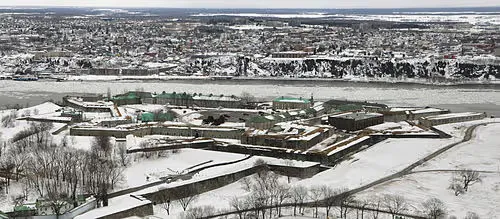
    The star-shaped fortress on Cap Diamant is still an active military installation. It is also the secondary official residence of the governor general of Canada and the residence of the monarch of Canada when in Quebec. The walls it belongs to make Quebec one of only two cities in North America still surrounded by fortifications; the other is Campeche in Mexico.

    Champlain recognised the value of Cap Diamant in 1608 and founded the town at the foot of the escarpment. The cliff was practically impossible to climb, so only the west side, the one without natural protection, was ever heavily fortified. The first wall there, Major Provost's palisade, was ordered by Governor Frontenac and finished just in time for the Battle of Quebec in 1690. The French and then the British built several defences on the site after the conquest of New France.

    The citadel you see was built from 1820 to 1850 to protect the city against a possible American attack. The British used it until 1871, when they handed it over to the Canadian government. Today it is a National Historic Site, inside the Historic District of Old Quebec, a World Heritage Site since 1985, and it receives some 200,000 visitors a year.

    Because it is a working base, you go in with a ticket, which includes a 60-minute guided outdoor tour and the Royal 22e Régiment Museum. If military history or fortifications interest you, it is the most rewarding paid visit on this route; otherwise the walls from outside tell much of the story.

    Next comes the longest leg: 1900 m, about 26 minutes, to the Plains of Abraham, which adjoin the Citadelle.

    Price
    22 CAD adults (incl. 60-minute guided outdoor tour and the Royal 22e Régiment Museum), seniors 65+ and students 20 CAD, ages 11–17 8 CAD, 10 and under free
  5. 5

    Plains of Abraham

    Plains of Abraham in Quebec City, stop 5 on the self-guided walking tour

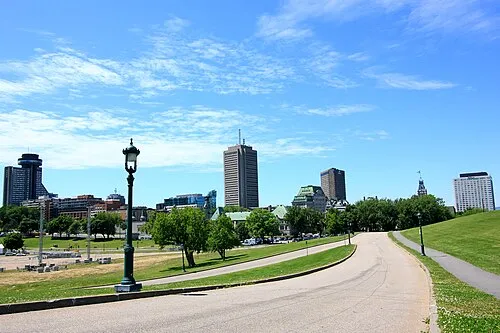
    This open parkland, the Plaines d'Abraham, is where the fate of New France was decided on 13 September 1759 in the Battle of the Plains of Abraham. Afterwards, hundreds of acres were used for grazing, housing and small industrial buildings. Only in 1908 was the land ceded to Quebec City, and the park was established on 17 March 1908 under the federally run National Battlefields Commission.

    The name most likely goes back to Abraham Martin, called the Scot, a fisherman and river pilot who lived from 1589 to 1664. He came to Quebec in 1635 with his wife Marguerite Langlois and received 32 acres of land between the Lower Town and the promontory. Deeds of the 17th and 18th centuries speak of the coast of Abraham, a plan from 1734 even marks an Abraham Street, and the journals of the Chevalier de Lévis and the Marquis de Montcalm refer to the Heights of Abraham. British soldiers in their diaries also used the name Plains of Abraham.

    Today the park stretches about 2.4 km long and 0.8 km wide, 98 hectares on a plateau above the Saint Lawrence, reaching westward from the Citadelle and the city walls. Some 4 million visitors a year come for sports, concerts and walks. If you want the battle in detail, the Plains of Abraham Museum serves as the park's reception centre.

    From the plains it is 1550 m, about 22 minutes, to Fontaine de Tourny.

    Local name
    Plaines d'Abraham
    Hours
    Open 24/7
    Price
    Free
  6. 6

    Fontaine de Tourny

    Fontaine de Tourny in Quebec City, stop 6 on the self-guided walking tour

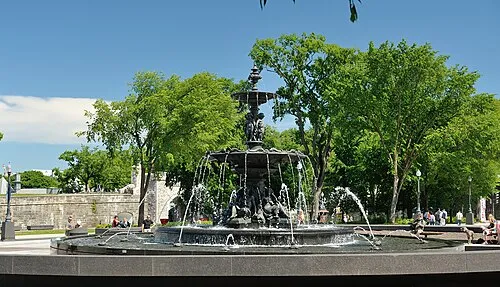
    This fountain stands in the roundabout on Avenue Honoré-Mercier in front of the Parliament building, yet it spent most of its life in Bordeaux. It was one of two identical fountains commissioned by the mayor of Bordeaux to celebrate the opening of the city's water supply, placed at either end of the Allées de Tourny, named after Louis-Urbain-Aubert de Tourny.

    Look at the details: several round basins rise toward a central column, and the jets at the base spurt from the mouths of stone frogs toward the next level, while more water falls from the upper basins into those below. Mathurin Moreau created the model and sculptures, Michel Joseph Napoléon Liénard carried out the figures and ornaments. The fountains were cast in 1854 at the Val d'Osne foundry and won a gold medal at the 1855 World Exhibition in Paris; around 15 examples of the model exist worldwide.

    Bordeaux set them up in 1857 and took them down in 1960 because upkeep had become too expensive. In 2003 the Quebec fashion retailer La Maison Simons bought one, had it restored at a cost of millions of dollars and gave it to the city for its 400th anniversary. It was inaugurated on 3 July 2007, the same date Champlain had arrived 399 years earlier. Its twin stands in Soulac-sur-Mer in France, in poor condition.

    The Morrin Centre is 530 m away, about 7 minutes, and you pass the Parliament of Quebec as you set off.

    Hours
    Freely accessible, no fixed opening hours
    Price
    Free
  7. 7

    Morrin Centre

    Morrin Centre in Quebec City, stop 7 on the self-guided walking tour

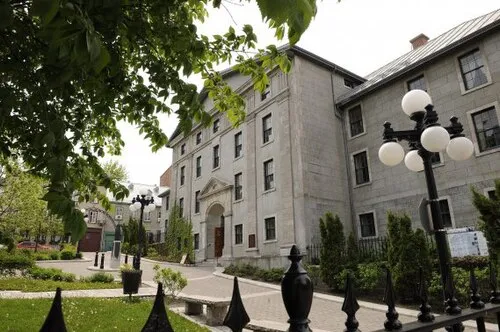
    This sober Palladian building looks like a college, and it was one, but it began as a jail. Under French rule the royal redoubt stood here from 1712, attached to the city walls and used mainly as barracks and also for prisoners of war. After 1759 the British made it the city jail, from 1787 a military storehouse, and in 1808 it was pulled down.

    Between 1808 and 1813 the present T-shaped building went up to plans by the architect François Baillairgé. For five decades it served as a prison, the first on Canadian soil to apply the ideas of the British reformer John Howard. Harsh laws sent people to jail even for minor offences, so it was soon badly overcrowded, and in 1867 it closed.

    In 1862 Morrin College was founded from the legacy of the former mayor Joseph Morrin, the first English-language institution of higher learning in Quebec. It moved into the old jail in 1868 and, working with McGill University in Montreal, could award bachelor's degrees and train Presbyterian ministers. Today the building is an English-language cultural centre and home of the Literary and Historical Society of Quebec, the oldest learned society in Canada, and a National Historic Site since 1981.

    You can only go inside on a paid guided tour. It is well worth it if the jump from prison cells to a library intrigues you.

    Notre-Dame de Québec Cathedral is 410 m away, about 6 minutes, past the Musée de l'Amérique Francophone.

    Hours
    Daily 09:00–17:00, last tour 17:00 (as of June schedule; library area has its own narrower opening hours)
    Price
    Guided tour only: 18.50 CAD, seniors 65+, children 9–17 and students 16.50 CAD, 8 and under free (taxes included)
  8. 8

    Notre-Dame de Québec Cathedral

    Notre-Dame de Québec Cathedral in Quebec City, stop 8 on the self-guided walking tour

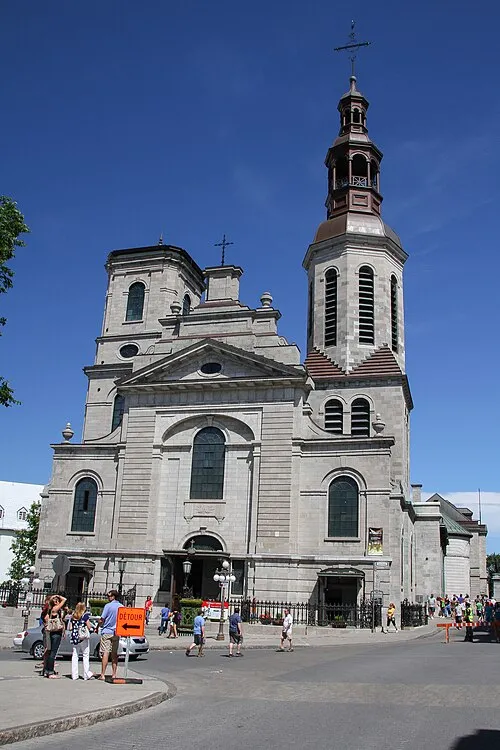
    This cathedral basilica is the seat of the Archdiocese of Quebec, and in 1874 Pope Pius IX made it the first church in Canada raised to the rank of minor basilica. It stands where Champlain built the chapel of Notre-Dame de la Recouvrance in 1633; work on the first cathedral began in 1647 under the name Notre-Dame de la Paix.

    Fire destroyed it twice. The first time was during the siege of 1759, after which it was rebuilt from plans drawn by Gaspard-Joseph Chaussegros de Léry in 1743, with a bell tower designed by Jean Baillairgé. Jean and his son François, the architect of the Morrin Centre, shaped the interior from 1786 to 1822, and in 1843 François' son Thomas proposed the neoclassical façade modelled on Sainte-Geneviève in Paris. In 1922 the church burned again. The Ku Klux Klan was suspected at first, but in 1927 the American career criminal Ray Marsden confessed in prison to a series of church fires set to cover his burglaries. The architects Maxime Roisin and Raoul Chenevert restored it.

    Entry is free, so go in. Look for the baldachin, the episcopal throne, the stained glass, the paintings and the chancel lamp given by Louis XIV. In the crypt lie four governors of New France and the bishops of Quebec, starting with the first, François de Laval. For the 350th anniversary in 2014 the cathedral received a holy door, only the eighth in the world and the second outside Europe.

    Then you head down to the Lower Town: 680 m, about 9 minutes, to the Musée de la Civilisation.

    Hours
    Mon 07:30–16:00 | Tue 07:30–16:00 | Wed–Fri 07:30–16:00 | Sat 07:30–17:30 | Sun 08:30–17:00
    Price
    Free
  9. 9

    Musée de la Civilisation

    Musée de la Civilisation in Quebec City, stop 9 on the self-guided walking tour

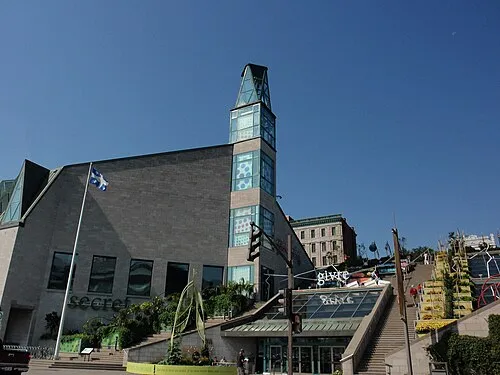
    The museum on Rue Dalhousie sits in the Lower Town between Place Royale and the old port. Its main building, opened on 19 December 1988, was designed by the architect Moshe Safdie in concrete, glass and steel, and its roof shapes and tower deliberately echo the old houses around it.

    Two historic buildings on the parallel Rue Saint-Pierre are part of the complex. One was built in 1752 for Guillaume Estèbe, a wealthy merchant in the French colonial administration, when the lot still lay on the bank of the Saint Lawrence; land was later gained by filling. The house came through the siege of 1759 unharmed and served trading firms for two centuries. During its restoration in the 1980s workers found a shallop, a small boat from the mid 18th century, now on display in the museum. The other is the former Banque de Québec of 1812, a neo-Renaissance building.

    Inside, Le Temps des Québécois tells the history of the city, Nous, les Premières Nations is devoted to the First Nations, and Territoires covers the whole province, alongside changing exhibitions. Admission costs extra; if you only go into one museum on this walk, this is the one that ties together everything you have seen since Place Royale.

    The last leg is only 300 m, about 4 minutes, to Petit Champlain.

    Hours
    Summer (23 June-7 Sept): daily 10:00–17:00 | regular (8 Sept-23 June): Mon closed, Tue–Sun 10:00–17:00
    Price
    18-34 years: 22 CAD | 35-64 years: 27 CAD | 65+: 26 CAD
    Website
    mcq.org ↗
  10. 10

    Petit Champlain

    Petit Champlain in Quebec City, stop 10 on the self-guided walking tour

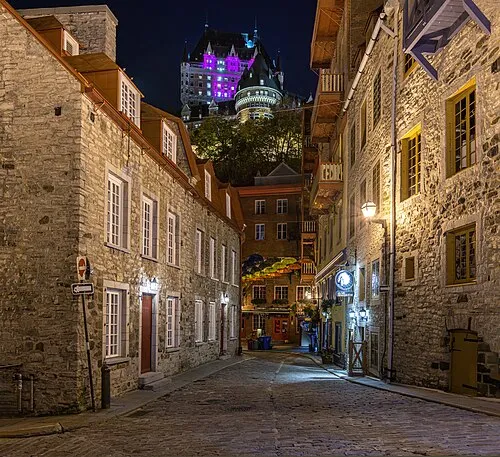
    The walk ends in a few lanes at the foot of the Cap Diamant cliff, close to where it began at Place Royale. The so-called Quartier Petit Champlain is not an official district at all, just about a hundred metres of pedestrian streets: Cul-de-Sac, Sous-le-Fort and above all rue du Petit-Champlain, lined with dozens of shops and restaurants in typical Old Quebec buildings.

    In the early 1700s the street was called rue des Meulles, after the intendant Jacques de Meulles. In the 19th century English-speaking residents nicknamed it Little Champlain Street to tell it apart from the newer rue Champlain nearby, today's boulevard Champlain, and the name stuck.

    By the middle of the 19th century the area was run down, even unhealthy, and exposed to rockfalls from the promontory above. The revival came only in the 1970s and 1980s, led by the entrepreneur Gérard Paris and the architect Jacques de Blois. They bought eight buildings in 1977 and nine more with the SODEC in 1982. Back then the area had some thirty homes, about fifty shops and workshops, six cafés and restaurants, a theatre and a park, much as it does today. In 1985 the artisans and shopkeepers formed a cooperative, bought the restored buildings and still decide what kinds of shops and products belong here.

    Strolling is free, so take your time. When you are done, the GPS navigation can lead you back to Place Royale.

    Hours
    Freely accessible, no fixed opening hours
    Price
    Free (entry)
Walking tour route map of Quebec City Route loaded
Place RoyaleChâteau FrontenacPlace d'ArmesCitadelle of Quebec+6
All 10 stops are already on the map.
You just press start.
AI Tour Guide

You know the route now. Walk it with a guide in your ear.

Press start wherever you are, even hundreds of kilometres from Quebec City, and the guide begins telling its stories right away. In the city, pick any of the 10 stops to start from: it leads you there, then talks with you the whole route, asking, listening, remembering, and shaping the tour around your answers.

10stops 7.3km 1 h 47 minwalking 13languages
▶Start the tour free

Free to start · Runs in your browser · No app, no download

Shorter Ways to Walk Quebec City

The full loop is a long day if you go inside everywhere. These three versions keep the story intact while cutting time or tickets.

Champlain to the battlefield

Stops: 1, 2, 3, 4, 5

For history fans who care most about how the city was founded, fortified and fought over. You walk from Place Royale past the Château Frontenac and Place d'Armes to the Citadelle and end on the Plains of Abraham: 59 minutes of walking. Only the Citadelle and a look inside the Château Frontenac cost admission.

Parliament Hill down to the river

Stops: 6, 7, 8, 9, 10

A compact afternoon for when your legs are tired or time is short. From Fontaine de Tourny past the Parliament of Quebec to the Morrin Centre, the cathedral, the Musée de la Civilisation and Petit Champlain: 26 minutes of walking. The Morrin Centre tour and the museum cost admission, the cathedral is free.

The whole route without tickets

Stops: 1, 2, 3, 4, 5, 6, 7, 8, 9, 10

For travellers on a budget who want every place without paying anywhere. You see the Citadelle, the Morrin Centre, the museum and the Château Frontenac from outside and go into the cathedral for free: 1 h 47 min of walking, about three and a half hours in total.

How Long the Quebec City Tour Takes, With and Without Museums

The pure walking time is 1 h 47 min over 7.3 km. Most legs are short; the long ones sit in the middle, where 1900 m (26 min) take you from the Citadelle of Quebec to the Plains of Abraham and another 1550 m (22 min) bring you on to Fontaine de Tourny.

Seen from outside, with time to look around and step into the cathedral, the tour takes about three and a half hours. The Citadelle visit, which includes a 60-minute guided outdoor tour and the regiment museum, adds roughly one and a half hours; the Musée de la Civilisation deserves another one and a half, and the Morrin Centre tour about an hour. With all three you are looking at most of a day.

The first half, from Place Royale to the Plains of Abraham, needs about two hours on the outside or three and a half with the Citadelle. The second half, from Fontaine de Tourny to Petit Champlain, takes about an hour and a half outside or around four hours with the Morrin Centre and the museum.

Before You Set Off in Quebec City

  • Start: Place Royale in the Lower Town is the recommended start, because the story begins there in 1608. You can join the route at any stop.
  • Finish: Petit Champlain, a short distance from Place Royale. The GPS navigation can lead you back to the start if you want.
  • Time of day: Start in the morning if you plan to do the Citadelle tour and a museum on the same day; the outside-only walk fits easily into an afternoon.
  • Admission: The Citadelle of Quebec, the Morrin Centre (guided tour only), the Musée de la Civilisation and a visit inside the Château Frontenac cost admission. Everything else on the route is free.
Walking tour route map of Quebec City
AI Tour Guide

Your guide is waiting at Place Royale whenever you are

Press start and a voice AI Tour Guide takes it from here: leading the route through Quebec City, telling the stories, and turning your walk into a real back-and-forth conversation. No app or download is needed; it runs in your browser.

10stops 7.3km 1 h 47 minwalking 13languages
▶Start the tour free

Free to start · Runs in your browser · No app, no download

What the AI Tour Guide Adds Between the Ramparts

On this route the AI Tour Guide walks the gaps with you: on the long stretch across the Plains of Abraham it can take you through how the battle of 1759 actually unfolded, or at Place Royale talk through the arguments about which houses should have been rebuilt at all. It remembers what you enjoyed and leans the conversation that way. You start with 100 free credits; after that you choose this tour all-inclusive for €19.99 with no time limit, or credits at €5 per hour.

A Real Conversation A voice AI Tour Guide greets you, leads the whole route, and tells the stories and facts as you walk, asking what you want to see and keeping a real conversation going. Not a recording you press play on.
Map Navigation Follow the route on the map and walk at your own pace. You choose where to start and when to move to the next stop.
Ask Anything Curious about a building you pass? Ask your AI Tour Guide on the spot and the conversation carries on.
13 Languages Switch language anytime. No separate tour needed.
Start free in your browser

Common Questions About Walking Old Quebec

Can I go into the Château Frontenac if I'm not staying there?

It is a working Fairmont hotel, and a visit inside costs admission; ask at the hotel how it works on the day. From outside you get the full picture, and two public streets, rue du Trésor and rue des Carrières, even run through the hotel property.

Is the Plains of Abraham Museum part of the walk?

It is an optional add-on. The museum at 835 Wilfrid-Laurier Avenue is the park's information and reception centre, with a multimedia exhibition on the siege of Quebec and the battles of 1759 and 1760 plus archaeological finds from the park. Ask at the desk about admission.

Where did the prisoners from the old jail go?

When the jail in today's Morrin Centre closed in 1867, the inmates moved to a new prison on the Plains of Abraham. That building is now part of the Musée national des beaux-arts du Québec.

Is there a similar walk in another city nearby?

Yes. Montreal is the natural next stop in Quebec province, and across the border you can walk the history of Boston the same way.

Is the tour really free?

Yes. The whole tour is free: the route, the interactive map and the navigation cost you nothing. Only the voice AI Tour Guide is optional and paid: you test it with 100 free credits, then you pay either €5 per hour or €19.99 for this whole tour, with no time limit. Admission to 4 of the 10 stops is not included: Château Frontenac, Citadelle of Quebec, Morrin Centre and Musée de la Civilisation charge their own entry fees.

Do I need to download an app?

No. Everything runs in your phone browser. Open the route and start walking, no download and no sign-up required.

Do I need to book the walking tour in advance?

No booking needed. This self-guided tour is available anytime. Open the route in your browser and start walking. The AI Tour Guide works instantly, no app, no reservation required.

What languages is the AI Tour Guide available in?

The AI Tour Guide speaks 13 languages, so you take the tour in your own language and can switch at any time.

Can I skip stops or change the route?

Yes. Skip any stop, spend extra time at places you like, or start the route from any point. It is your walk, you set the pace.
Image credits
▶ Start free in your browser Runs in your browser, no app, no download