Free Walking Tour Lille: Belfry to Vieille Bourse

Go up a 104 m belfry, stand where Louis XIV entered Lille, and finish among the booksellers of the Vieille Bourse on one 5.9 km walk.

9 Stops 5.9 km ~1 h 23 min walking
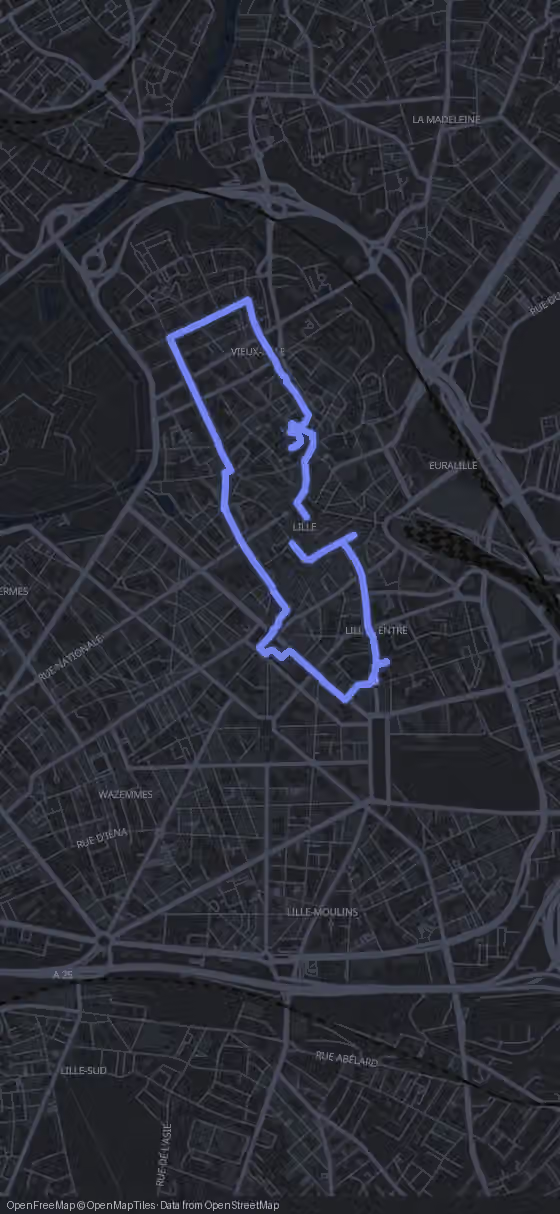
Route map for the Lille walking tour
Stop 1 of 9
370 m·5 min
Place Rihour
Head east toward Saint-Maurice Church
Welcome to Lille. I'm Alex, and our first story begins with a stock exchange disguised as a ring of houses.
Try this tour with Alex

This Lille Route at a Glance

Nine stops lead from Place Rihour via Saint-Maurice Church, the Belfry of Lille City Hall, Porte de Paris and the Palais des Beaux-Arts to the Maison natale de Charles de Gaulle, Cathédrale Notre-Dame-de-la-Treille, Hospice Comtesse and the Vieille Bourse: 5.9 km, 1 h 23 min of pure walking, about six and a half hours with the main visits.

Squares, the city gate, both churches and the Vieille Bourse are free; the belfry, the Palais des Beaux-Arts and the de Gaulle house charge entry. The GPS route is free in your browser, the AI Tour Guide is optional.

Open free GPS & optional AI Tour Guide
View of Lille

The Route

Walking Map of Lille: Nine Stops from Rihour to the Old Exchange

9 stops 5.9 km 1 h 23 min walking
Tap to load interactive map

The 9 stops along this route

  1. Place Rihour in Lille, stop 1 on the self-guided walking tour
    1Place Rihour
  2. Saint-Maurice Church in Lille, stop 2 on the self-guided walking tour
    2Saint-Maurice Church
  3. Belfry of Lille City Hall, stop 3 on the self-guided walking tour
    3Belfry of Lille City Hall
  4. Porte de Paris in Lille, stop 4 on the self-guided walking tour
    4Porte de Paris
  5. Palais des Beaux-Arts in Lille, stop 5 on the self-guided walking tour
    5Palais des Beaux-Arts
  6. Maison natale de Charles de Gaulle in Lille, stop 6 on the self-guided walking tour
    6Maison natale de Charles de Gaulle
  7. Cathédrale Notre-Dame-de-la-Treille in Lille, stop 7 on the self-guided walking tour
    7Cathédrale Notre-Dame-de-la-Treille
  8. Hospice Comtesse in Lille, stop 8 on the self-guided walking tour
    8Hospice Comtesse
  9. Vieille Bourse in Lille, stop 9 on the self-guided walking tour
    9Vieille Bourse
  10. That's the full route.

    Walk it with an AI Tour Guide talking you through every one of these streets.

    Start free in your browser
    You made it

Your Lille Walking Tour, Stop by Stop: Belfries, Gates and Old Lille

  1. 1

    Place Rihour

    Place Rihour in Lille, stop 1 on the self-guided walking tour

    Start on Place Rihour, a square in the heart of Lille that opens straight onto the Place du Général-de-Gaulle. Hard to imagine now, but you're standing on what was once soggy ground: until the Palais Rihour was built in the 15th century, this was a patch of meadows and trees, listed in the city accounts of 1398 as a 'riez', a marsh.

    The name goes back to a landowner. In 1248 a certain Bérard Rihout handed a plot planted with alders and willows, complete with a fishery, to the Hospice Comtesse, the charitable house you'll reach near the end of this walk. Nobody knows for sure whether the place took his name or he took the name of the place. Water hemmed the area in on several sides, among them the Canal des Poissonceaux, which separated it from the Grand Place.

    In 1664 the city magistrates moved into the Palais Rihour, and justice became very visible here: on 12 July 1664 a man named Charles de Renaucourt, convicted of horse theft and other crimes, was hanged on a gallows on the square.

    The square you see today is bigger than it used to be. The town hall stood on the site of the Palais Rihour until a fire destroyed it in 1916; before that, only two narrow passages, the 'contour de l'Hôtel-de-Ville' and the 'cour du Frêne', linked the square to the rue du Palais Rihour. That lost town hall is the reason Lille later built the tower you'll see at the Belfry of Lille City Hall. First, though, it's 370 m, about 5 minutes, to Saint-Maurice Church.
    Hours
    Freely accessible, no opening hours
    Price
    Free
  2. 2

    Saint-Maurice Church

    Saint-Maurice Church in Lille, stop 2 on the self-guided walking tour

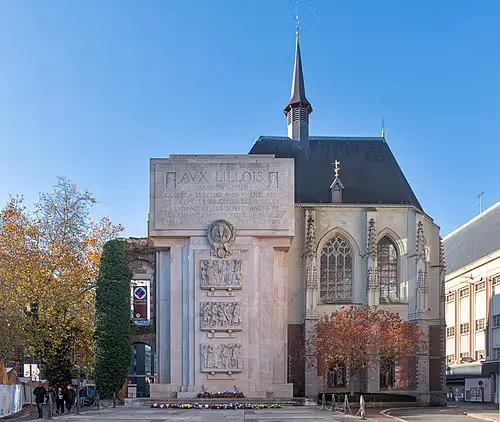
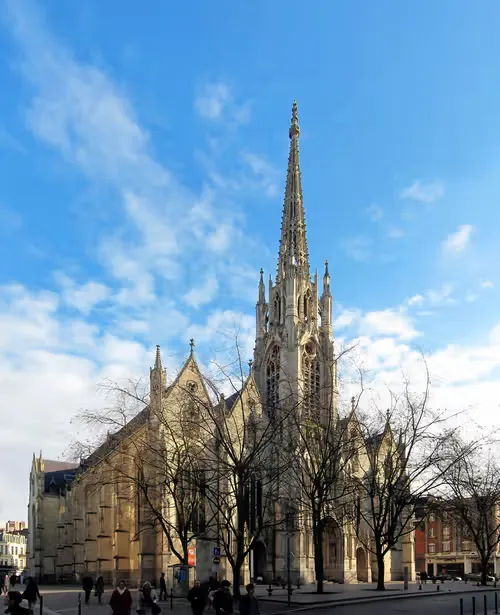
    Saint-Maurice Church stands close to Lille-Flandres station on Rue Pierre Mauroy. From outside, take in the flamboyant Gothic front and look up at the tympanum: Saint Maurice on horseback, carved in 1874 by Henri Biebuyck. Several of the other figure groups on the exterior are his work or that of Jules Victor Heyde.

    The church took two centuries to build: work started in 1420 and only ended in 1623. In the 19th century the architect Philippe Canissié completed the western part of the nave and added the bell tower, both in the original flamboyant style, so old and new are hard to tell apart. It has been a listed historic monument since 1840.

    Go inside, because the interior is the real surprise. This is a hall church: five naves with transept and choir, twelve bays long, all vaulted at the same height and carried by 48 columns. Look for the statue of Saint Peter by Théophile Bra, a 17th-century Flemish Madonna and Child, and the oldest painting, Saint Maurice on horseback from the 16th century. Four Passion scenes are by Louis Joseph Watteau, the same painter whose initiative founded the Palais des Beaux-Arts in 1792.

    In the left transept chapel stands the monument to the Duc de Berry, murdered in 1820; part of his remains lie in this church. The monument was taken down in 1831 and not put back until 1980. Facing it is a suffering Christ from 1663 beneath a 1931 Passion window by Pierre Turpin, while the choir windows were designed by Victor Mottez and made by Charles Gaudelet.

    Entry is free. From here it's 770 m, 11 minutes, to the Belfry of Lille City Hall.

    Hours
    Mon–Fri: 11:00–18:00 | Sat: 11:00–19:00 | Sun: 15:00–20:00
    Price
    Free
  3. 3

    Belfry of Lille City Hall

    Belfry of Lille City Hall, stop 3 on the self-guided walking tour

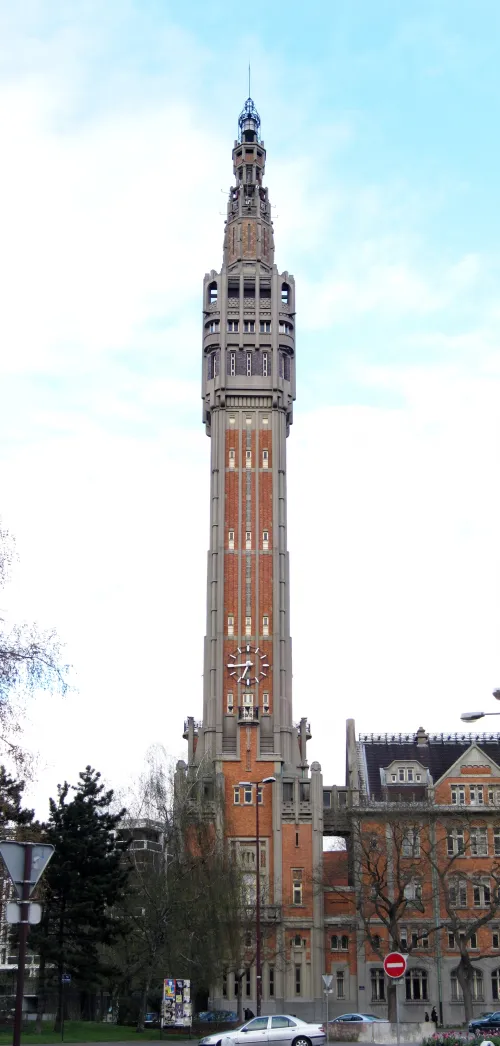
    The Belfry of Lille City Hall rises 104 m, the highest civic belfry in Europe and the tallest municipal building in France. It was inaugurated in 1932, after the old town hall had been destroyed during the First World War, and it was meant to show that Lille's political and commercial power had survived. Architect Émile Dubuisson designed tower and town hall as one ensemble: a massive block for the offices, a slender shaft for the belfry.

    Look at the materials: red brick and concrete made to look like carved stone, mixing Art Deco with neo-Flemish forms. The red brick was meant to answer the green of the plane trees around the building. Dubuisson also borrowed the 'travée lilloise', the bay pattern of the 17th-century houses in the old town, which you'll meet again in Vieux-Lille. Behind the brick, the building was cutting-edge: the first reinforced concrete construction of this size in France. Curiously, this belfry has no bells and no carillon.

    Why here, in the old Saint-Sauveur quarter, slightly off the centre of the time? Land was available, and the choice was political. Lille had earlier belfries: one on the aldermen's hall, demolished in 1601, and one at the town hall in the Palais Rihour, built in 1826 and pulled down in 1856. Today the site is a listed monument and inscribed on the UNESCO World Heritage List.

    Going up costs a ticket and is worth it if you want to see the city you're walking through from 104 m. Guided visits need a reservation, but at set times you can also go up without one. The Porte de Paris is only 160 m away, a 2-minute walk.

    Local name
    Beffroi de l’Hôtel de Ville de Lille
    Hours
    Guided visits: daily 10:00 by reservation; free visit without reservation daily 11:00–13:00 and 14:00–17:30, last ascent 45 min before closing
    Price
    9.00 EUR
  4. 4

    Porte de Paris

    Porte de Paris in Lille, stop 4 on the self-guided walking tour

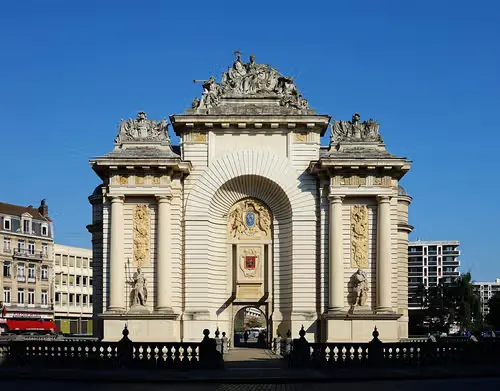
    The Porte de Paris, also called the Porte des Malades, is a triumphal arch that doubled as a city gate. It celebrates the victories of Louis XIV and was built between 1686 and 1694 by the architect Simon Vollant, then completed at the end of the 19th century. It has been a listed monument since 1875.

    Its older name tells an earlier story. A gate stood here on the city wall of the 13th-century expansion that brought the parishes of Saint-Sauveur and Saint-Maurice inside Lille. It was the southern way out, at the end of the rue des Malades, named after the leper house it led to: founded around 1233 for Lille's citizens outside the walls and removed around 1670 when Fort Saint-Sauveur was built. After the French conquest the street became rue de Paris; today it's Rue Pierre Mauroy, the same street as Saint-Maurice Church.

    On 28 August 1667, after a siege of ten days, Louis XIV entered Lille through this gate and received the keys of the city from the magistrates. A year later the Treaty of Aix-la-Chapelle made Lille French. The king took an interest in his new Flemish town and ordered this arch to mark its joining France.

    Picture it in two pieces: until the fortifications were dismantled in the 1860s, the arch faced the countryside, while about ten metres behind it, on the town side, stood a one-storey guardhouse on the site of the old gate, linked to the arch by a short passage. It's free to see at any hour. From here walk 730 m, about 10 minutes, to the Palais des Beaux-Arts.

    Hours
    Open 24/7
    Price
    Free
    Website
    lille.fr ↗
  5. 5

    Palais des Beaux-Arts

    Palais des Beaux-Arts in Lille, stop 5 on the self-guided walking tour

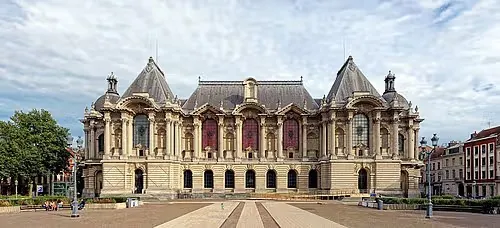
    The Palais des Beaux-Arts on Place de la République is one of the largest museums in France and, by number of works on show, the largest fine arts museum in the country outside the capital. From a collection of more than 70,000 pieces it displays about 2,000.

    Its story starts with the Revolution. In 1792 the painter Louis Joseph Watteau pushed for a museum built from works confiscated from émigrés and the city's religious houses, among them paintings by Rubens, Van Dyck and Jordaens. In 1803 the state added more under the Chaptal decree, which gave rise to many regional museums, and in 1809 the doors opened to the public. From the 1850s it was above all bequests and donations that shaped the collection.

    By 1881 there were so many paintings that mayor Géry Legrand decided to build a palace for them. It opened in 1892 and finally brought together paintings, sculptures, drawings, antiquities and decorative arts that had been scattered. Before the First World War the city kept buying, including major works by David, Goya, Delacroix, Courbet, Corot and Puvis de Chavannes, alongside many artists from the region.

    Go in if you care about painting: Flemish and Dutch works of the 15th, 16th and 17th centuries and French art of the 19th century are the heart of the house. Plan at least 90 minutes; the museum charges admission.

    Next comes the longest leg of the walk, 2,150 m and about 30 minutes, into Vieux-Lille to the Maison natale de Charles de Gaulle.

    Hours
    Mon: 14:00–18:00 | Tue: Closed | Wed–Sun: 10:00–18:00
    Price
    7 EUR
  6. 6

    Maison natale de Charles de Gaulle

    Maison natale de Charles de Gaulle in Lille, stop 6 on the self-guided walking tour

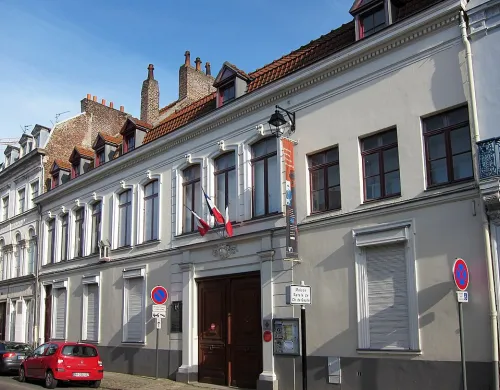
    At 9 rue Princesse in Vieux-Lille, Charles de Gaulle was born on 22 November 1890. This was the home of his maternal grandparents, Jules-Émile and Julia Maillot, textile industrialists, and custom at the time had the baby born in the grandparents' house. He was baptised the same day at the church of Saint-André on rue Royale.

    De Gaulle came back here at times as a child and teenager, and he's said to have liked it so much that he considered buying it in 1947. Instead, an association of his friends bought the house in 1961 and later left it to the Charles de Gaulle Institute and Foundation. It's a handsome town house of a middle-class family from the north and has changed relatively little since the end of the 19th century.

    The museum opened in 1983. The house was listed in 1989 and classified on 22 November 1990, exactly a hundred years after his birth, and it received the Maisons des Illustres label in 2011. Inside you follow his military and political path from the start: his origins, his birth and childhood here, his education and his ties to the region, from his military service to his marriage to Yvonne Vendroux. Temporary exhibitions add to the visit.

    It's worth going in if 20th-century French history interests you, or if you'd like to see a bourgeois home much as it looked around his birth. There's an admission charge, with reduced tickets available. Then it's 1,020 m, about 14 minutes, to the Cathédrale Notre-Dame-de-la-Treille.

    Hours
    Mon: 10:00–18:00 | Tue: Closed | Wed–Sun: 10:00–18:00
    Price
    EUR 8 adult; EUR 6 reduced
  7. 7

    Cathédrale Notre-Dame-de-la-Treille

    Cathédrale Notre-Dame-de-la-Treille in Lille, stop 7 on the self-guided walking tour

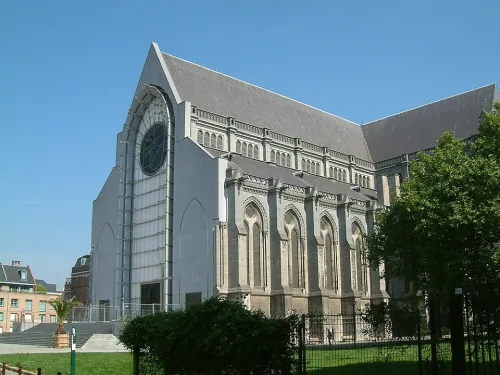
    The Cathédrale Notre-Dame-de-la-Treille is a Gothic Revival church, a basilica and the cathedral of the Archdiocese of Lille. It takes its name from a 12th-century statue of the Virgin to which miraculous powers were attributed. For more than six hundred years that statue stood in the Collegiate Church of St Peter, which was destroyed during the French Revolution.

    The project had two aims: to give the city centre a large church again, and to win Lille its own bishop, since the city then belonged to a neighbouring archdiocese. With the population growing fast during the Industrial Revolution, a commission of clergy and wealthy laymen such as Charles Kolb-Bernard planned the building as a future cathedral from day one.

    The foundation stone was laid in 1854, and an international competition asked for a design in 'the Gothic style of the first half of the 13th century'. Of 41 entries, the first two prizes went to English projects, but handing a church for the Virgin to foreign Anglican architects drew objections, so the Lille architect Charles Leroy took over. Money was a constant struggle: building began in 1856 and, under several generations of architects, was only finished in 1975. Keep that long timeline in mind as you look at how the parts fit together.

    Entry is free. Go in for a quiet moment, then walk just 180 m, about 3 minutes, along Rue de la Monnaie to the Hospice Comtesse.

    Hours
    Mon: 14:00–18:30 | Tue–Sun: 10:30–18:30
    Price
    Free
  8. 8

    Hospice Comtesse

    Hospice Comtesse in Lille, stop 8 on the self-guided walking tour

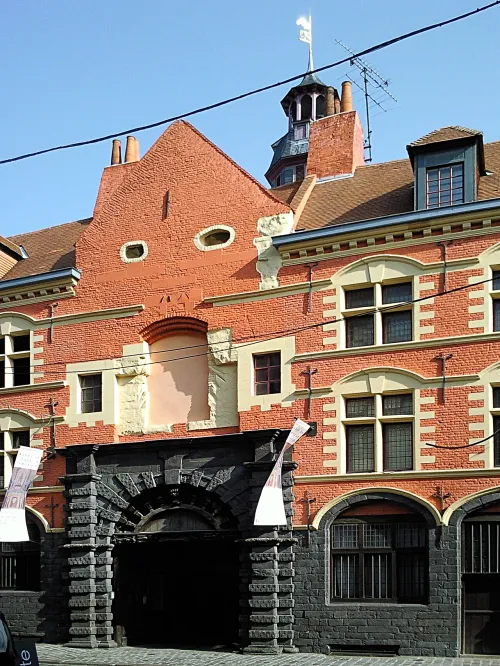
    Behind the frontages of Rue de la Monnaie lies the Hospice Comtesse, an old hospital whose buildings mostly date from the 17th century and which now houses a museum. It was founded in 1237 by Jeanne de Constantinople, Countess of Flanders, inside the grounds of her own palace, and richly endowed. In 1243 she gave it the mills of Lille and Wazemmes and the milling rights over the surrounding area, the 'Mannée de Lille', a privilege that lasted until its abolition in 1789. This is also the house that received Bérard Rihout's marshy plot on Place Rihour in 1248.

    From 1245 the brothers and sisters followed the Rule of Saint Augustine and cared for the sick poor, pilgrims and travellers. Nothing of that first hospital survives: a fire on the night of 11 April 1468 burned it to the ground. The sick ward was rebuilt by 1472, and the ground floor of the Augustinian sisters' building followed between 1477 and 1482.

    Another fire on 17 March 1649 took the chapel and parts of the convent. The sisters got a new dormitory storey, and in 1650 Julien Destrée put up the wing along Rue de la Monnaie, renting its frontage to craftsmen and shopkeepers. Between 1652 and 1657 a new, higher chapel followed, separated from the sick ward by a rood screen as the Council of Trent recommended. In the sick ward, look up at the wooden ceiling, decorated with tapestries from 1704. The building closing the main courtyard on the west was finished in 1724, and this remained Lille's main hospital until the end of the 18th century.

    Go in if you want to see how care, faith and daily life fitted together under one roof; you'll find the ticket price at the desk. The last leg is 560 m, about 8 minutes, through Vieux-Lille to the Vieille Bourse.

    Hours
    Mon 14:00–18:00 (afternoons only), Tue closed all day, Wed–Sun 10:00–18:00, additionally closed on some holidays
  9. 9

    Vieille Bourse

    Vieille Bourse in Lille, stop 9 on the self-guided walking tour

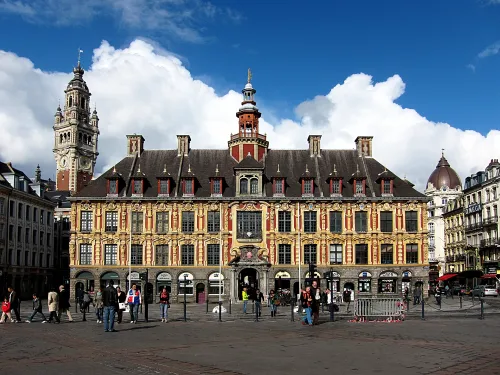
    The Vieille Bourse stands between the Grand'Place and the Place du Théâtre and is one of Lille's most prestigious monuments. Built in 1653, while Lille was under Spanish rule, it bears witness to the booming trade of the 17th century, when the city competed with its Flemish sisters such as Ghent and Bruges. It has been called the 'old' exchange since the new Chamber of Commerce, the 'Nouvelle Bourse', went up in the 1910s.

    In 1651, at the guilds' suggestion, the city magistrates obtained permission from Philip IV of Spain to build 'a bourse for the use of merchants, surrounded and enclosed by 24 houses'. The city sold the plots to 24 merchants and paid for the galleries, the courtyard paving and the four entrances itself. On 19 April 1652 it commissioned Julien Destrée, the architect behind the Rue de la Monnaie wing of the Hospice Comtesse, to draw up the plan.

    Walk around the outside first: the four-sided building is made up of 28 identical houses enclosing an inner courtyard. Above the upper windows, look at the cartouches: regional companies had their coats of arms placed there to mark their part in the restoration that began in 1989 and ended in 1998, after an earlier one in the 19th century. It has been a listed monument since 1921 and 1923.

    Then go into the courtyard, which is free to enter. This is where booksellers, florists, chess players, strollers and visitors meet, an easy place to browse and let the walk wind down. Rihour metro station is close by when you're ready to move on.

    Hours
    Mon: Closed | Tue–Sun: 13:00–19:00
    Price
    Free
Walking tour route map of Lille Route loaded
Place RihourSaint-Maurice ChurchBelfry of Lille City HallPorte de Paris+5
All 9 stops are already on the map.
You just press start.
AI Tour Guide

You've read the Lille route. Now walk it with a guide in your ear.

Press start wherever you are, even hundreds of kilometres from Lille, and the guide begins telling its stories right away. In the city, pick any of the 9 stops to start from: it leads you there, then talks with you the whole route, asking, listening, remembering, and shaping the tour around your answers.

9stops 5.9km 1 h 23 minwalking 13languages
▶Start the tour free

Free to start · Runs in your browser · No app, no download

Shorter Ways to Walk Lille

The longest leg, 30 minutes between the Palais des Beaux-Arts and the de Gaulle house, splits the route neatly into two halves. You can also walk the whole thing and only go inside where it's free.

Centre and belfry half

Stops: 1, 2, 3, 4, 5

For a morning with a big view and a big museum. From Place Rihour to the Palais des Beaux-Arts it's 2,030 m and 28 minutes on foot. Entry costs come from the belfry and the Palais des Beaux-Arts; everything else is free.

Vieux-Lille half

Stops: 6, 7, 8, 9

For an afternoon in the old town, from de Gaulle's birthplace to the Vieille Bourse: 1,760 m and 25 minutes on foot. You pay at the Maison natale de Charles de Gaulle and the Hospice Comtesse; the cathedral and the Vieille Bourse courtyard are free.

Free-only full walk

Stops: 1, 2, 3, 4, 5, 6, 7, 8, 9

For anyone on a tight budget: the full 5.9 km and 1 h 23 min of walking, going inside only at Saint-Maurice Church, the cathedral and the Vieille Bourse courtyard, and taking in the belfry, the museums and the de Gaulle house from outside. It costs nothing.

How Long Does This Lille Tour Take with the Belfry and Museums?

Pure walking time is 1 h 23 min for 5.9 km. Most legs are short hops of a few minutes; the one real stretch is the 2,150 m, 30-minute walk from the Palais des Beaux-Arts into Vieux-Lille.

A realistic day: leave Place Rihour at 10:45 and you reach Saint-Maurice Church at 11:00. After 20 minutes inside you're at the belfry at about 11:30. Allow 45 minutes up there, glance at the Porte de Paris and arrive at the Palais des Beaux-Arts around 12:40. With 90 minutes in the museum you reach the de Gaulle house around 14:40, then the cathedral, the Hospice Comtesse at 16:00 and the Vieille Bourse at about 16:50, finishing around 17:15. That's roughly six and a half hours; add your lunch break on top. Even with an hour for lunch you're at the Hospice Comtesse by 17:00.

The centre and belfry half takes about three hours twenty minutes with both paid visits, the Vieux-Lille half about two and a half hours, and the free-only full walk about three and a half hours.

Before You Set Off in Lille

  • Start and finish: Place Rihour is the recommended start, but you can join at any stop. The route ends at the Vieille Bourse, and the GPS navigation in your browser can lead you back to the start if you wish.
  • Best days: Wednesday to Saturday suits the route best, as you can then go inside everywhere along the way.
  • Time of day: Start around 10:45 so you're at Saint-Maurice Church and the belfry in the late morning and reach the Vieille Bourse courtyard late in the day, a fitting place to finish.
  • Costs: The walk is free. You pay for going up the belfry and for visiting the Palais des Beaux-Arts, the de Gaulle house and the Hospice Comtesse.
  • Getting there: Rihour metro station on line 1 lies directly beneath Place Rihour.
Walking tour route map of Lille
AI Tour Guide

Your guide is ready whenever you start in Lille.

Press start and a voice AI Tour Guide takes it from here: leading the route through Lille, telling the stories, and turning your walk into a real back-and-forth conversation. No app or download is needed; it runs in your browser.

9stops 5.9km 1 h 23 minwalking 13languages
▶Start the tour free

Free to start · Runs in your browser · No app, no download

What the AI Tour Guide Adds in Lille

The AI Tour Guide greets you wherever you start, tells the stories of these places as you walk, asks what draws you in and builds on it. If you linger at the Duc de Berry monument and wonder how part of a murdered prince ended up in Saint-Maurice Church, or want to know which Rubens to look for first in the Palais des Beaux-Arts, it picks up the thread, and you can interrupt at any time. You start with 100 free credits; after that it's this tour all-inclusive for €19.99 with no time limit, or €5 per hour.

A Real Conversation A voice AI Tour Guide greets you, leads the whole route, and tells the stories and facts as you walk, asking what you want to see and keeping a real conversation going. Not a recording you press play on.
Map Navigation Follow the route on the map and walk at your own pace. You choose where to start and when to move to the next stop.
Ask Anything Curious about a building you pass? Ask your AI Tour Guide on the spot and the conversation carries on.
13 Languages Switch language anytime. No separate tour needed.
Start free in your browser

Common Questions About Walking Lille

Can I start the Lille walk after lunch?

Yes, but you'll have to choose, because not every interior fits into an afternoon. The Vieux-Lille half works best, ending at the Vieille Bourse courtyard late in the day.

Does the route work on a Sunday?

Mostly, but Saint-Maurice Church isn't open on Sunday mornings. On a morning start, see it from outside and come back later if you want the interior; it's 370 m from Place Rihour.

Is Lille a good base for day trips?

Yes, Flanders is close. Bruges is 64 km away, Ghent 66 km and Brussels 94 km, and each has its own walking route.

Is the tour really free?

Yes. The whole tour is free: the route, the interactive map and the navigation cost you nothing. Only the voice AI Tour Guide is optional and paid: you test it with 100 free credits, then you pay either €5 per hour or €19.99 for this whole tour, with no time limit.

Do I need to download an app?

No. Everything runs in your phone browser. Open the route and start walking, no download and no sign-up required.

Do I need to book the walking tour in advance?

No booking needed. This self-guided tour is available anytime. Open the route in your browser and start walking. The AI Tour Guide works instantly, no app, no reservation required.

What languages is the AI Tour Guide available in?

The AI Tour Guide speaks 13 languages, so you take the tour in your own language and can switch at any time.

Can I skip stops or change the route?

Yes. Skip any stop, spend extra time at places you like, or start the route from any point. It is your walk, you set the pace.
Image credits
▶ Start free in your browser Runs in your browser, no app, no download