Free Walking Tour Trier: From Porta Nigra to Hauptmarkt

Roman and medieval Trier in one day: a blackened city gate, an emperor's throne hall, an arena with its cellars and a bridge still standing on Roman piers.

10 Stops 5.8 km ~1 h 20 min walking
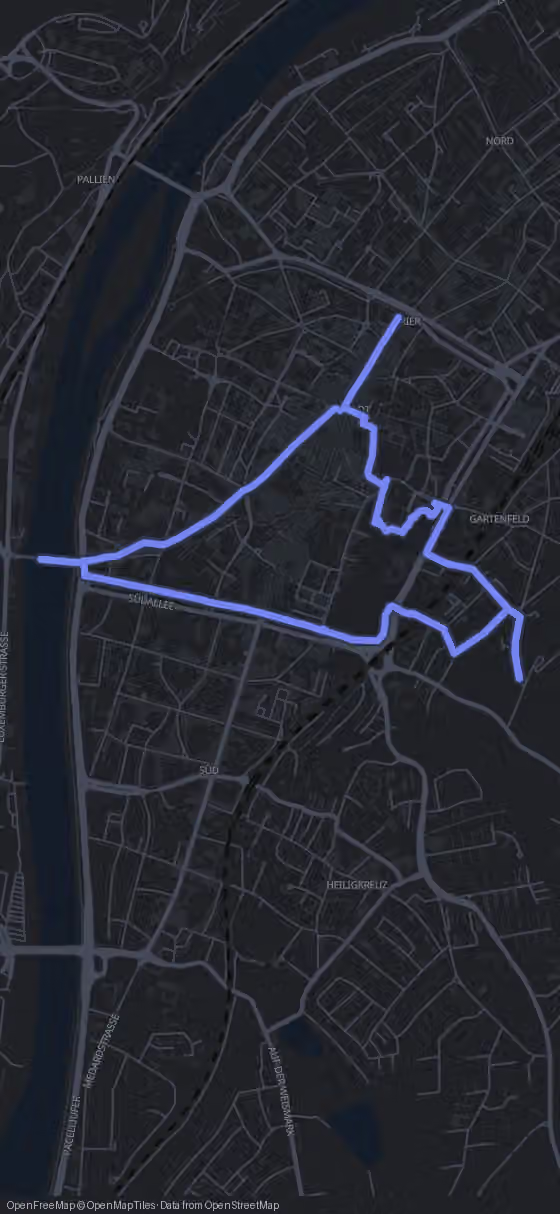
Route map for the Trier walking tour
Stop 1 of 10
530 m·7 min
Porta Nigra
Head south down Simeonstraße toward the Trierer Dom
Welcome to Trier. I'm Alex, and in Germany's oldest city, Roman engineering still carries ordinary traffic.
Try this tour with Alex

Trier on Foot: The Route at a Glance

Ten stops lead from the Porta Nigra to the Hauptmarkt over 5.8 km, with 1 h 20 min of pure walking; with the interiors worth seeing, plan about five hours. Trier Cathedral, the Liebfrauenkirche, the Constantine Basilica, the Roman Bridge and the Electoral Palace, seen from outside, are free.

Entry is charged at the Porta Nigra, the Amphitheater, the Imperial Baths and the Karl Marx House. The GPS route in your browser is free; the AI Tour Guide is optional and tells the stories as you walk.

Open free GPS & optional AI Tour Guide
View of Trier

The Route

Walking Map of Trier: Porta Nigra to Hauptmarkt

10 stops 5.8 km 1 h 20 min walking
Tap to load interactive map

The 10 stops along this route

  1. Porta Nigra in Trier, stop 1 on the self-guided walking tour
    1Porta Nigra
  2. Trier Cathedral, stop 2 on the self-guided walking tour
    2Trier Cathedral
  3. Liebfrauenkirche in Trier, stop 3 on the self-guided walking tour
    3Liebfrauenkirche
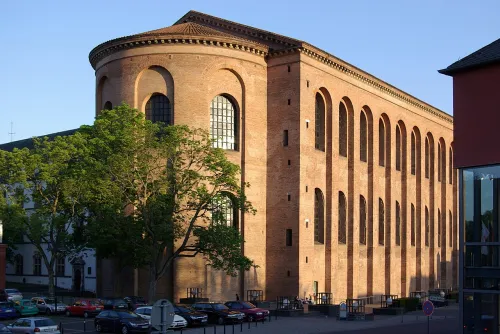
  4. Constantine Basilica in Trier, stop 4 on the self-guided walking tour
    4Constantine Basilica
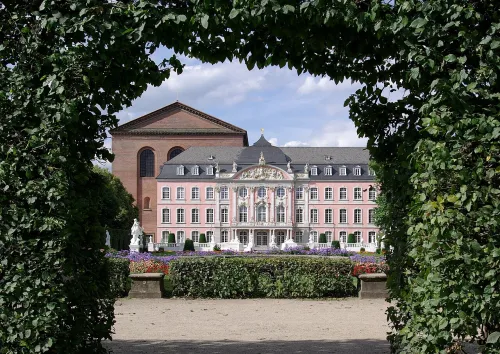
  5. Electoral Palace in Trier, stop 5 on the self-guided walking tour
    5Electoral Palace
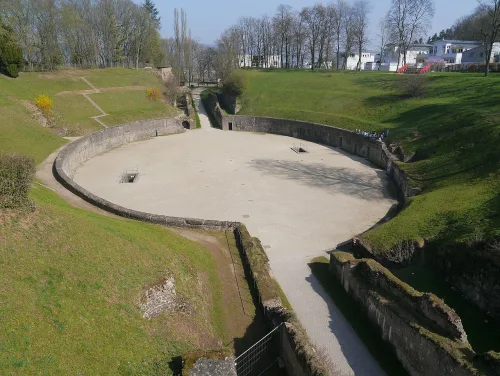
  6. Amphitheater in Trier, stop 6 on the self-guided walking tour
    6Amphitheater
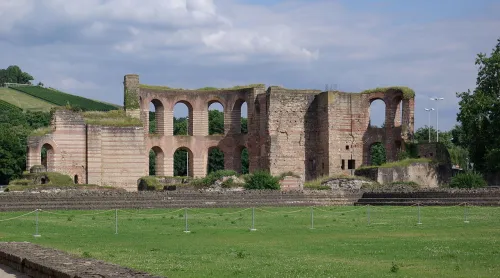
  7. Imperial Baths in Trier, stop 7 on the self-guided walking tour
    7Imperial Baths
  8. Roman Bridge in Trier, stop 8 on the self-guided walking tour
    8Roman Bridge
  9. Karl Marx House in Trier, stop 9 on the self-guided walking tour
    9Karl Marx House
  10. Hauptmarkt in Trier, stop 10 on the self-guided walking tour
    10Hauptmarkt
  11. That's the full route.

    Walk it with an AI Tour Guide talking you through every one of these streets.

    Start free in your browser
    You made it

Your Trier Walking Tour, From Gate to Market

  1. 1

    Porta Nigra

    Porta Nigra in Trier, stop 1 on the self-guided walking tour

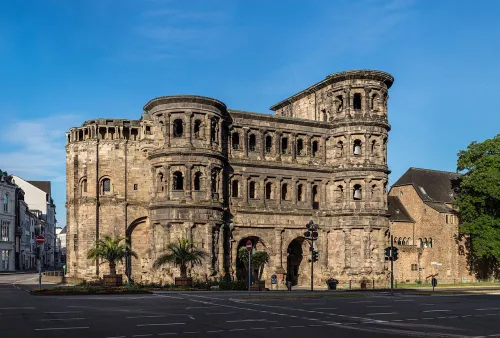
    Start at the Porta Nigra, the Roman city gate that locals simply call the Porta. Stand back first and take in the whole thing: two towers that bulge outwards in near semicircles, with the twin gate openings between them, once separated by a narrow courtyard. The Romans built it in grey sandstone some time after 170 AD. The name, Latin for black gate, only came in the Middle Ages, when the stone had darkened. What the Romans called it, nobody knows.

    Look closely at the outer, northern face and you see a building that was never finished. The blocks there were never smoothed, and the protruding stones would have made it impossible to hang movable gates. Why work stopped is unknown, yet the gate served as the northern entrance to Roman Trier for centuries. It was one of four: the Porta Alba stood in the east, the Porta Media in the south and the Porta Inclyta in the west, next to the bridge over the Moselle, each at the end of one of the two main Roman streets. The Porta Nigra is the only one left.

    The Middle Ages were hard on the Roman gates. Once they lost their purpose, people carried off their stones for new buildings and broke the iron and lead braces out of the walls to reuse the metal. On the north side of the Porta Nigra the scars are still plain to see. After 1028 a Greek monk named Simeon moved into the ruin and lived there as a hermit.

    Going inside costs entry. It's worth it if you want to stand within a Roman structure rather than only look at it; if time or budget is tight, the outside tells most of the story. From here it's 530 m, about 7 minutes, to Trier Cathedral. On the way you pass the Weinstand am Hauptmarkt, a small wine stand that's easy to miss.
    Hours
    Apr–Sep: daily 09:00–18:00; Oct: daily 09:00–17:00; Nov–Feb: daily 09:00–16:00; Mar: daily 09:00–17:00
    Price
    6 EUR regular, 5 EUR reduced
  2. 2

    Trier Cathedral

    Trier Cathedral, stop 2 on the self-guided walking tour

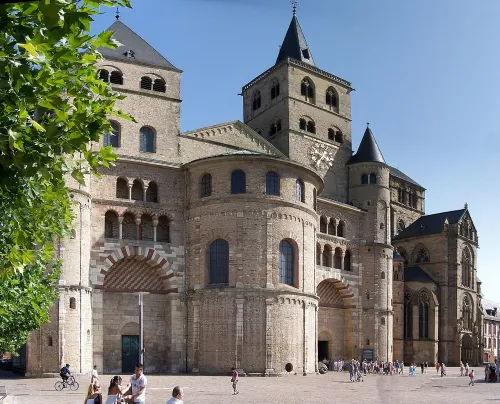
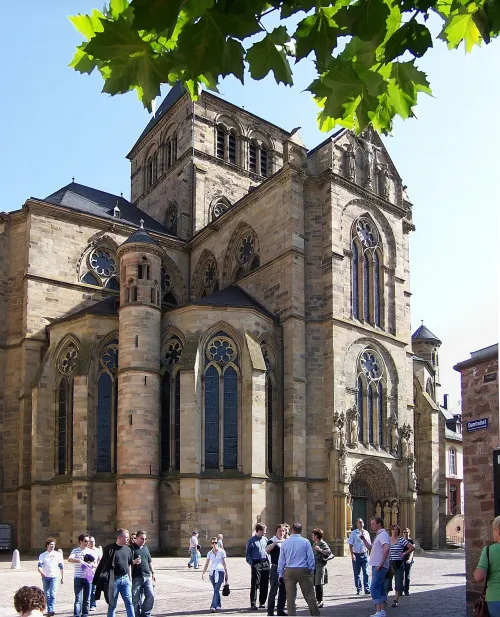
    Trier Cathedral, the High Cathedral of Saint Peter, is the oldest cathedral in Germany and the largest church building in Trier. Begin with the west front: a Romanesque westwork with four towers and an additional apse, a design that builders elsewhere copied again and again. It dates from the rebuilding completed under Archbishop Poppo of Babenberg in the first half of the 11th century, although the apse was only finished in 1196.

    The core is far older. The central part of the nave was built of Roman brick in the early fourth century, and the four piers of the crossing and parts of the brick outer walls still survive from that time. Tradition says Emperor Constantine commissioned the church on top of a palace of his mother, Saint Helena. After Constantine's conversion, Bishop Maximin is said to have overseen a complex on a ground plan four times the size of today's cathedral: four basilicas, a baptistry and outbuildings, at the time the grandest group of church buildings in the West outside Rome.

    Excavations show that the cathedral, its cloisters and the neighbouring Liebfrauenkirche all rest on the foundations of Roman Augusta Treverorum. What stands on them is a record of destruction and repair. The Franks left the fourth-century church in ruins with only the outer walls standing; it was rebuilt, then destroyed again by the Vikings in 882. Archbishop Egbert, who died in 993, began the rebuilding that gave the cathedral the shape you see.

    Entry is free, so go in even if you only have a few minutes and look for the Roman brickwork. If Christian art is your interest, the cathedral treasury holds an important collection. The next stop shares a wall with the cathedral: the Liebfrauenkirche is just 30 m, about a minute, away.

    Local name
    Trierer Dom
    Hours
    Apr–Oct: daily 06:30–18:00; Nov–Mar: daily 06:30–17:30
    Price
    Free
  3. 3

    Liebfrauenkirche

    Liebfrauenkirche in Trier, stop 3 on the self-guided walking tour

    The Liebfrauenkirche, the Church of Our Lady, is according to UNESCO the earliest church built in French High Gothic style outside France. It shares a wall and a cloister with the cathedral, so you can compare two eras side by side: the heavy Romanesque cathedral and, right next to it, a Gothic church designed by builders from France.

    A Roman double church originally stood on this site. The parish traces the first church here to a large endowment by Emperor Constantine in 326 AD. By around 1200 the southern part had fallen into disrepair, and Archbishop Theoderich von Wied brought in builders from Champagne, who replaced it completely with the Early Gothic church.

    Inside, look for a painted inscription on a column. It claims that construction started in 1227 and ended in 1243. Today the start is thought to have been 1230, and the building was probably finished around 1260, so the column is a little too proud of its builders' speed.

    The roof has its own story. In 1492 a tall spire went up on the central tower, admired for its craftsmanship, until a storm on Visitation Day, 2 July 1631, destroyed it. A hipped roof replaced it and was destroyed in the Second World War; a new roof followed in 1945 and a steeper one in 2003. On 13 July 1951 Pope Pius XII made the church a minor basilica.

    Entry is free, and the Gothic interior is worth a few quiet minutes after the cathedral. From here it's 350 m, about 5 minutes, to the Constantine Basilica.

    Hours
    Apr–Oct: daily 10:00–18:00; Nov–Mar: daily 10:00–16:00 (no visits during services)
    Price
    Free
  4. 4

    Constantine Basilica

    Constantine Basilica in Trier, stop 4 on the self-guided walking tour

    The Constantine Basilica began as a Roman palace hall, the audience hall of the emperors who lived in Trier in the fourth century. Its name honours Constantine the Great. The word basilica is a 19th-century label: the local historian Johannes Steiner took it from a late antique speech in praise of Constantine. Strictly speaking it doesn't fit. Architecturally the building is a single hall, not a basilica, and it was never a Catholic church either.

    What you see is part Roman, part reconstruction. The apse at the north end and the west wall are Roman, and remains of walls from earlier buildings lie beneath today's floor. On the west and north façades, look for traces of Roman paintwork on the outside walls.

    In the early Middle Ages the burnt-out ruin passed to the bishops of Trier, who turned it into a castle-like residence. In 1614 the south and east walls were torn down and what remained was built into the new Electoral Palace. In the 1840s and 1850s the hall was restored as a church, consecrated on 28 September 1856 and handed over 'for all time' to the Protestant congregation, which has used it ever since. That makes it the oldest building in Germany in use as a church.

    On 14 August 1944 an American air raid set it on fire and it burned out completely. When it was rebuilt in the 1950s, the interior was reduced to bare stone walls and a wooden coffered ceiling. Entry is free, and that plain interior lets the Roman hall speak for itself; it's a working church, so be considerate. The Electoral Palace is built right onto it, just 140 m, about 2 minutes, away.

    Local name
    Konstantinbasilika
    Hours
    Apr–Oct: Mon–Sat 10:00–18:00, Sun 14:00–18:00; Nov & Jan–Mar: Tue–Sat 10:00–12:00 and 14:00–16:00, Sun 14:00–16:00, Mon closed; Dec: Mon–Sat 10:00–12:00 and 14:00–16:00, Sun 14:00–16:00
    Price
    Free
  5. 5

    Electoral Palace

    Electoral Palace in Trier, stop 5 on the self-guided walking tour

    The Electoral Palace was the residence of the archbishops and electors of Trier from the 16th century until the late 18th century. The ground it stands on was already part of the Roman imperial palace Constantine used in the early fourth century, and the Constantine Basilica next door served the electors as their throne room. From the 11th century, when only its outer walls still stood, the archbishops used the old hall as a stronghold, fortifying the apse as a keep and adding battlements to the walls.

    In the late 16th century Archbishop Johann von Schönenberg planned a residence in the German Renaissance style and demolished parts of the medieval fortress and many houses to make room. Some Roman walls proved too tough to remove, so they were simply built in. His successors Lothar von Metternich and Philipp Christoph von Sötern completed the lower palace around 1650. It was called Saint Peter's Castle, St. Petersburg, after the town's patron saint. Work on the upper palace wings stopped because of the Thirty Years' War, and the bishops preferred their residence at Ehrenbreitstein in Koblenz, which was considered safer.

    From 1756 Archbishop-Elector Johann IX Philipp von Walderdorff had Johannes Seiz rebuild the south wing in Rococo style, and around the same time the Baroque gardens were fitted out with statues by Ferdinand Tietz. Then history turned: in 1794 French revolutionary armies took Trier, confiscated the palace and used it as barracks, and the Prussians kept doing so after 1814.

    Today the palace houses federal government offices and often hosts classical concerts. The interior opens only for events or special open days, so you see it from outside, free of charge. Next comes the longest walk so far: 1150 m, about 17 minutes, to the Amphitheater.

    Local name
    Kurfürstliches Palais
    Hours
    Exterior viewable 24/7 (interior accessible only during events or special open days)
    Price
    Free
  6. 6

    Amphitheater

    Amphitheater in Trier, stop 6 on the self-guided walking tour

    The Amphitheater of Roman Augusta Treverorum was built in the second half of the 2nd century and held up to 18,000 spectators. It lies at the foot of the Petrisberg, and that was no coincidence: the hillside meant the builders had to pile up earth for the seating on one half only. The arena faces north and has a north and a south exit.

    Beneath the arena lies a kind of cellar that has survived. Lifts down there brought performers on stage, and a hidden lift in the middle of the arena could bring animals or actors in quickly. Because of these rooms, the arena could never be flooded for water shows.

    For the people of Roman Trier this place soon became part of everyday life. Local dignitaries, imperial officials and, in late antiquity, emperors in person offered bread and circuses here: animal hunts and gladiator fights decided over life and death, executions took place and important announcements were read out. Unusually, the Amphitheater was also part of the city wall and served as Trier's eastern city gate.

    The arena stayed in use until the end of the Western Roman Empire in the 5th century. In the Middle Ages it became a quarry like so many buildings in Trier. Until the 19th century locals called it the Kaskeller, and it even appeared under that name on city maps, probably because the underground rooms were used as storage cellars. The name only disappeared when scholars began to study and restore the site.

    Entry is charged; as part of the World Heritage site the Amphitheater has been developed into a museum, and the cellars are the reason to go in. From here it's 1030 m, about 14 minutes, to the Imperial Baths.

    Hours
    Apr–Sep: daily 09:00–18:00; Oct: daily 09:00–17:00; Nov–Feb: daily 09:00–16:00; Mar: daily 09:00–17:00
    Price
    6 EUR regular, 5 EUR reduced
  7. 7

    Imperial Baths

    Imperial Baths in Trier, stop 7 on the self-guided walking tour

    The Imperial Baths are the monumental remains of a vast late Roman bath complex, with walls still standing up to 19 m high. They rank among the largest Roman baths north of the Alps, yet they were never finished. Even complete, they would not have been Trier's biggest: the much older Barbara Baths were larger, and the city had further baths at the Viehmarkt. Today the site is an archaeological park.

    Already in antiquity the unfinished baths were converted into cavalry barracks. Since the end of Roman rule the ruins have stood visible from far away, helped by the fact that the land around them stayed mostly unbuilt for a long time. The inner part may have served as a castle as early as the 6th century.

    When Archbishop Bruno of Lauffen built the medieval city wall in the early 12th century, the ruin became its south-eastern corner bastion, complete with a city gate. From the late 13th century the castle appears in records as vetus castellum or Alteburg, the old castle. That reuse is why the core survives; everything else disappeared in medieval stone robbing.

    The site kept changing. Around 1100 the parish church of St. Gervasius rose in the middle of the former exercise yard, the palaestra, and in 1295 the convent church of St. Agneten opened at its northern corner, with workshops and houses around it. In the early 19th century the bastion was no longer needed; its end began in 1806 with the demolition of a watchtower in the caldarium, the hot bath.

    Entry is charged, and it pays off if you want to walk among the high walls rather than see them from the street. Then comes the longest leg of the route: 1250 m, about 17 minutes, down to the Roman Bridge.

    Local name
    Kaiserthermen
    Hours
    Apr–Sep: daily 09:00–18:00; Oct: daily 09:00–17:00; Nov–Feb: daily 09:00–16:00; Mar: daily 09:00–17:00
    Price
    6 EUR regular, 5 EUR reduced
  8. 8

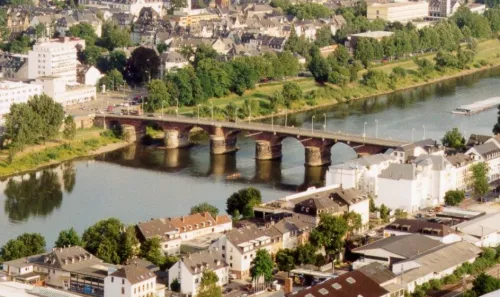
    Roman Bridge

    Roman Bridge in Trier, stop 8 on the self-guided walking tour

    The Roman Bridge, also called the Old Moselle Bridge, is the oldest bridge in Germany. It's free and open at all times, so take your time. Stand where you can see the piers: they are pointed on the upstream side to resist floods and ice, and all nine of them have survived. An older belief that two were renewed in 1717 and 1718 has turned out to be wrong.

    This is the third bridge on this stretch since Trier was founded. A wooden pile bridge stood from 18/17 BC; tree-ring dating of its piles in 1963 fixed the date. The first stone bridge followed in 71 AD, a little downstream of today's site. The piers you see were built between 142 and 150 AD. Roman engineers used watertight cofferdams to set them on the riverbed with blocks of basalt and bluestone, partly quarried around the former volcano Hohe Buche in the eastern Eifel.

    In Roman times a timber truss carried a roadway ten metres wide across the piers. At normal water level the road ran about 14 m over the Moselle, so ships sailing downstream no longer had to lower their masts. Going upstream against the strong current, they had to be towed. The stone arches came much later, between 1190 and 1490, possibly under Elector Balduin.

    Remember the Porta Inclyta from the Porta Nigra? The bridge gate, probably similar to the black gate, was torn down in the Middle Ages, and scholars still argue about which bank of the Moselle it stood on. From the bridge it's 750 m, about 10 minutes, to the Karl Marx House.

    Local name
    Römerbrücke
    Hours
    24/7 (freely accessible public bridge)
    Price
    Free
  9. 9

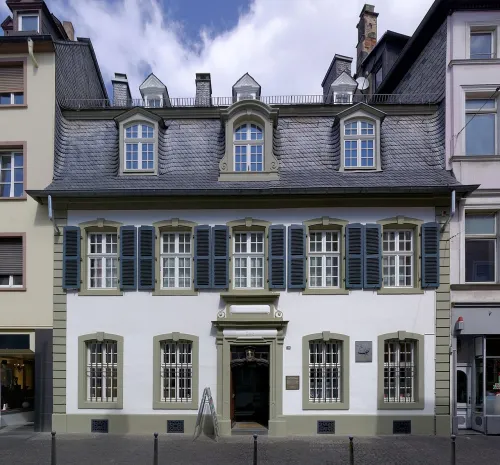
    Karl Marx House

    Karl Marx House in Trier, stop 9 on the self-guided walking tour

    Karl Marx was born in this house on 5 May 1818. It was built in 1727 as a two-storey Baroque house, and the Marx family did not stay long: in October 1819 they moved to a smaller building near the Porta Nigra. For almost a century nobody paid the birthplace any attention.

    That changed in 1904, when the Social Democratic Party tried to buy the house; it succeeded in 1928. After the Nazis came to power in 1933, they confiscated the building and turned it into a printing works. On 5 May 1947 it opened as a museum of Marx's life and work, and in 1968 it became part of the Friedrich Ebert Foundation, which is close to the SPD. On 10 September 1987 the East German head of state Erich Honecker came here during his visit to West Germany and laid down 50 roses.

    For Marx's 200th birthday in 2018 the exhibition was completely redone under the title 'From Trier to the World'. It covers his life from his Trier origins to exile, his work as philosopher, journalist, sociologist and economist, and his global impact to this day, plus a section on the house itself. Among the exhibits are Marx's reading chair, a first edition of Das Kapital and a bust made by his great-grandson.

    Entry is charged. Go in if you're curious about Marx or about how one man's ideas shaped the 20th century; if neither draws you, the house front is enough. From here it's 520 m, about 7 minutes, to the Hauptmarkt, past the Trier Christmas market.

    Local name
    Museum Karl-Marx-Haus
    Hours
    Daily 10:00–18:00 (no entry 13:00–13:30)
    Price
    7 EUR regular, 5 EUR reduced
  10. 10

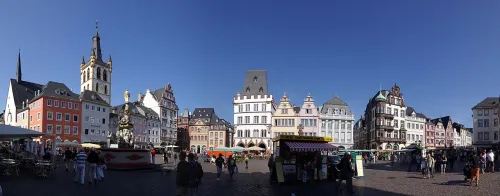
    Hauptmarkt

    Hauptmarkt in Trier, stop 10 on the self-guided walking tour

    The Hauptmarkt is Trier's central square and one of its largest, right in front of the cathedral district, where the main shopping streets meet. In the medieval town this was where goods were sold and traded. About two thirds of the surrounding houses survive, from Renaissance and Baroque to Neoclassical and late historicist buildings, among them the Hauptwache and the former Domhotel in German Neo-Renaissance style.

    Find the market cross. Archbishop Henry I set it up in 958 as a symbol of his authority. At three metres up, a Latin inscription reads 'Henricus archiepiscopus Treverensis me erexit', Archbishop Henry of Trier erected me. The front shows the Lamb of God with a cross staff and victory banner; on the sides are Saint Peter and a sundial, and on the back 'Renovatum 1724' is carved. The cross stands on an old Roman column that from 1200 also served as a pillory, the symbol of the market court.

    Look for the Steipe, a townhouse built around 1430, completely destroyed in the Second World War and rebuilt in the 20th century; today the city council uses it for official occasions. Next to it, the Red House carries a saying about Trier's legendary founding by Trebeta.

    Two quieter corners lead off the square. The church of St. Gangolf is hemmed in by buildings and can only be reached from the market through a Baroque gate. Through the Judenpforte you walk into the Judengasse and the city's former Jewish quarter. The square is free and always open, a good place to end the walk and let Trier's centuries settle.

    Hours
    24/7 (public town square)
    Price
    Free
Walking tour route map of Trier Route loaded
Porta NigraTrier CathedralLiebfrauenkircheConstantine Basilica+6
All 10 stops are already on the map.
You just press start.
AI Tour Guide

You've read the route. Now walk Trier with a guide in your ear.

Press start wherever you are, even hundreds of kilometres from Trier, and the guide begins telling its stories right away. In the city, pick any of the 10 stops to start from: it leads you there, then talks with you the whole route, asking, listening, remembering, and shaping the tour around your answers.

10stops 5.8km 1 h 20 minwalking 13languages
▶Start the tour free

Free to start · Runs in your browser · No app, no download

Shorter Ways to Walk Trier

Not everyone has a full day in Trier. These two cuts keep the order of the route and simply stop earlier.

The cathedral quarter in about two hours

Stops: 1, 2, 3, 4, 5

For an arrival afternoon or a half day. From the Porta Nigra to the Electoral Palace you cover 1050 m in about 15 minutes of walking. Only the Porta Nigra charges entry; the cathedral, the Liebfrauenkirche and the Constantine Basilica are free, and the palace is seen from outside. With visits inside, allow about two hours.

Roman Trier in about four hours

Stops: 1, 2, 3, 4, 5, 6, 7, 8

For Roman history fans who can leave Marx and the market for another time. From the Porta Nigra to the Roman Bridge you walk 63 minutes and see the Roman gate, the palace hall, the arena, the baths and the bridge. Entry is charged at the Porta Nigra, the Amphitheater and the Imperial Baths. With those interiors, plan about four hours.

How Long Does This Trier Tour Take With and Without Interiors?

The 5.8 km take 1 h 20 min of pure walking, but the effort is uneven. The first five stops sit close together: from the Porta Nigra to the Electoral Palace you walk only 15 minutes in total. After that the gaps grow, with 17 minutes out to the Amphitheater, 14 to the Imperial Baths and another 17 to the Roman Bridge, before two short legs bring you back into the centre.

Add the interiors that reward a visit (inside the Porta Nigra, Trier Cathedral, the Constantine Basilica, the Amphitheater with its cellars, the Imperial Baths and the Karl Marx House) and the full route fills about five hours. The cathedral quarter variant fits into about two hours, the Roman variant into about four.

Before You Set Off in Trier

  • Start and finish: The recommended start is the Porta Nigra and the walk ends at the Hauptmarkt. You can join at any stop; the order here is simply the one that flows best.
  • Best time to go: Start in the morning. With the paid interiors the full route takes most of a day, and the museums and Roman sites keep daytime opening hours.
  • Entry fees: Keep some budget for the four paid sites: the Porta Nigra, the Amphitheater, the Imperial Baths and the Karl Marx House. You find the current ticket price at each entrance.
Walking tour route map of Trier
AI Tour Guide

Your guide for Trier is ready when you are.

Press start and a voice AI Tour Guide takes it from here: leading the route through Trier, telling the stories, and turning your walk into a real back-and-forth conversation. No app or download is needed; it runs in your browser.

10stops 5.8km 1 h 20 minwalking 13languages
▶Start the tour free

Free to start · Runs in your browser · No app, no download

What the AI Tour Guide Adds in Trier

Much of Trier's story is hidden: a cellar under an arena, a throne hall built into a palace, piers that have stood in the Moselle since Roman times. The AI Tour Guide walks this route with you as a conversation. It greets you at the Porta Nigra, tells each place's story, asks what you'd like more of and remembers it at the next stop. Wondering what a day at the games felt like for a Roman spectator, or what the Trebeta legend on the Red House actually tells? Ask, interrupt, go deeper. You start with 100 free credits; after that you choose between this tour all-inclusive for €19.99 with no time limit or €5 per hour.

A Real Conversation A voice AI Tour Guide greets you, leads the whole route, and tells the stories and facts as you walk, asking what you want to see and keeping a real conversation going. Not a recording you press play on.
Map Navigation Follow the route on the map and walk at your own pace. You choose where to start and when to move to the next stop.
Ask Anything Curious about a building you pass? Ask your AI Tour Guide on the spot and the conversation carries on.
13 Languages Switch language anytime. No separate tour needed.
Start free in your browser

Common Questions About Walking Trier

Can I visit the Liebfrauenkirche during a service?

No, visits pause while services are held. If you arrive during one, look around Trier Cathedral first and come back; the two churches share a wall, so you lose no time.

How do I get back to the Porta Nigra after the Hauptmarkt?

The route ends at the Hauptmarkt, not where it started. If you want to return, the GPS navigation in your browser guides you from the last stop back to the Porta Nigra.

If I only pay for one interior, which should it be?

For the most unusual detail, pick the Amphitheater: the cellar under the arena, where lifts once brought animals and performers up, has survived. If you'd rather stand inside a Roman building that still rises high over the street, choose the Porta Nigra.

Which other walking tours are close to Trier?

Echternach is 17 km away and Luxembourg City 40 km. On the German side, Saarbrücken and Koblenz each have their own free route.

Is the tour really free?

Yes. The whole tour is free: the route, the interactive map and the navigation cost you nothing. Only the voice AI Tour Guide is optional and paid: you test it with 100 free credits, then you pay either €5 per hour or €19.99 for this whole tour, with no time limit. Admission to 4 of the 10 stops is not included: Porta Nigra, Amphitheater, Imperial Baths and Karl Marx House charge their own entry fees.

Do I need to download an app?

No. Everything runs in your phone browser. Open the route and start walking, no download and no sign-up required.

Do I need to book the walking tour in advance?

No booking needed. This self-guided tour is available anytime. Open the route in your browser and start walking. The AI Tour Guide works instantly, no app, no reservation required.

What languages is the AI Tour Guide available in?

The AI Tour Guide speaks 13 languages, so you take the tour in your own language and can switch at any time.

Can I skip stops or change the route?

Yes. Skip any stop, spend extra time at places you like, or start the route from any point. It is your walk, you set the pace.
Image credits
▶ Start free in your browser Runs in your browser, no app, no download