Free Walking Tour Santiago de Compostela: 7 Pilgrim Stops

Start among the octopus and barnacles of the market, cross the square of the living and the dead, and finish near the old gate where pilgrims walked into the city.

7 Stops 1.6 km ~23 min walking
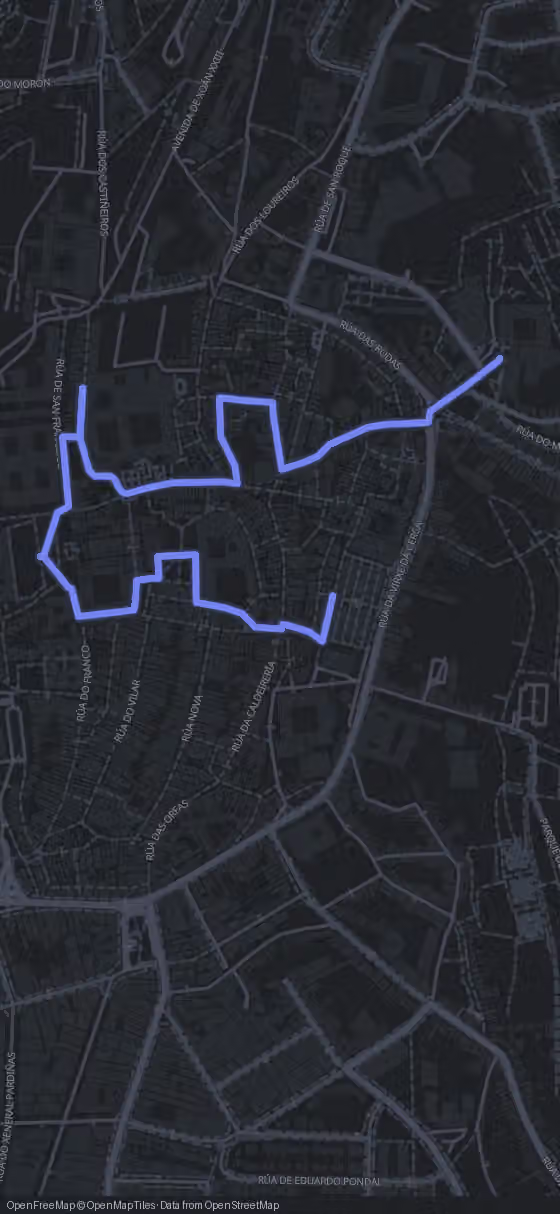
Route map for the Santiago de Compostela walking tour
Stop 1 of 7
280 m·4 min
Mercado de Abastos
Head west toward Praza da Quintana
Welcome to Santiago de Compostela. I'm Alex, and our first story begins with a cathedral censer built for a very human problem.
Try this tour with Alex

Your Santiago Route at a Glance

Seven stops lead from the Mercado de Abastos via Praza da Quintana, the Cathedral of Santiago de Compostela, Plaza del Obradoiro, the Monastery of San Martiño Pinario and the Museum of Pilgrimage and Santiago to the Convent of San Domingos de Bonaval: 1.6 km, 23 minutes of pure walking, around four hours with visits inside.

Everything is free to enter except San Martiño Pinario, which charges admission. Route, map and GPS navigation run free in your browser; the AI Tour Guide is optional and tells the stories as you walk.

Open free GPS & optional AI Tour Guide
View of Santiago de Compostela

The Route

Walking Map of Santiago de Compostela: Market to Bonaval

7 stops 1.6 km 23 min walking
Tap to load interactive map

The 7 stops along this route

  1. Mercado de Abastos in Santiago de Compostela, stop 1 on the self-guided walking tour
    1Mercado de Abastos
  2. Praza da Quintana in Santiago de Compostela, stop 2 on the self-guided walking tour
    2Praza da Quintana
  3. Cathedral of Santiago de Compostela, stop 3 on the self-guided walking tour
    3Cathedral of Santiago de Compostela
  4. Plaza del Obradoiro in Santiago de Compostela, stop 4 on the self-guided walking tour
    4Plaza del Obradoiro
  5. Monastery of San Martiño Pinario in Santiago de Compostela, stop 5 on the self-guided walking tour
    5Monastery of San Martiño Pinario
  6. Museum of Pilgrimage and Santiago in Santiago de Compostela, stop 6 on the self-guided walking tour
    6Museum of Pilgrimage and Santiago
  7. Convent of San Domingos de Bonaval in Santiago de Compostela, stop 7 on the self-guided walking tour
    7Convent of San Domingos de Bonaval
  8. That's the full route.

    Walk it with an AI Tour Guide talking you through every one of these streets.

    Start free in your browser
    You made it

The Santiago de Compostela Walking Tour Stops, From Market to Convent

  1. 1

    Mercado de Abastos

    Mercado de Abastos in Santiago de Compostela, stop 1 on the self-guided walking tour

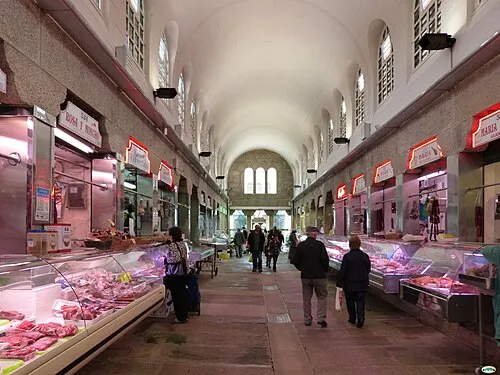
    Begin where Santiago shops for dinner. The Mercado de Abastos is a working covered market, free to walk into, and it is the one stop on this route that is not a monument to the pilgrimage. Everything after it tells the story of the people who came to the tomb of Saint James; this is the city that the pilgrimage feeds.

    Give the seafood counters your first ten minutes. Look for percebes, the goose barnacles, nécoras, the velvet crabs, and pulpo, octopus, all from the Atlantic and all laid out on ice. Even if you buy nothing, watching the trade is the point: locals choosing, stallholders weighing, the morning's catch leaving the counters bag by bag. This is a morning market, which is why the route begins here and not at the cathedral.

    The only decision here is a small one: buy something for later or buy nothing at all. Either way, don't hurry it. When you are ready, it is 280 m and about 4 minutes to Praza da Quintana. On the way you pass the Church of San Fiz de Solovio, and then you reach the square that wraps around the south facade of the cathedral.
    Hours
    Mon–Sat 08:00–14:00
    Price
    Free
  2. 2

    Praza da Quintana

    Praza da Quintana in Santiago de Compostela, stop 2 on the self-guided walking tour

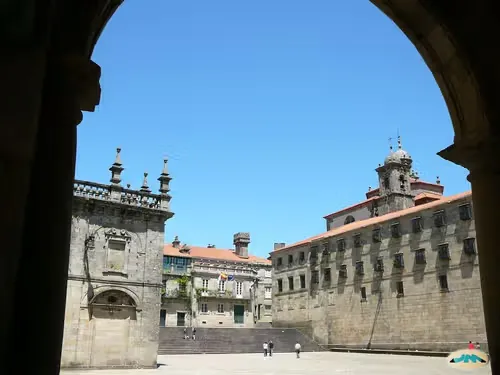
    Praza da Quintana is framed by four buildings: the south facade of the cathedral, the Casa da Parra, the Monastery of Saint Pelagius of Antealtares and the Casa da Conga. Look at how the square sits on two levels. The upper part is called the Quintana de Vivos, the Quintana of the living; the lower part is the Quintana de Mortos, the Quintana of the dead.

    That second name is no metaphor. This was a medieval cemetery, and around 1611 the mayor of Compostela decided to turn it into a public square. The remains were moved first to the Convent of San Domingos de Bonaval, where this walk ends, and later to the Boisaca cemetery. The word quintana itself is older still: in a Roman camp it was the street between the fifth and sixth maniples, the one that held the marketplace.

    The canon José Vega y Verdugo commissioned the masters Francisco Fernández de Araújo and José de la Peña de Toro, and their work also closed off the eastern side of the cathedral with a long running wall that hides the main chapel and the apse chapels like a screen. In a Holy Year, pilgrims cross this square to enter the cathedral through the Holy Door.

    Today the Quintana is where Santiago gathers: for Galician Literature Day, the National Day of Galicia, demonstrations and commemorations such as those of Plataforma Nunca Máis, and concerts by artists like Susana Seivane. Up on the canzorros at the top of the Casa da Parra sits a webcam of Galician public television that refreshes its picture every two seconds, so someone at home can watch you cross. The cathedral is right here: 40 m, about a minute away.

    Local name
    Plaza de la Quintana
    Hours
    Open 24/7
    Price
    Free
  3. 3

    Cathedral of Santiago de Compostela

    Cathedral of Santiago de Compostela, stop 3 on the self-guided walking tour

    You are standing at the reason the city exists. The Cathedral of Santiago de Compostela is the reputed burial place of Saint James the Great, one of the apostles of Jesus, and one of only a handful of churches in the world built over an apostle's tomb, alongside St Peter's in Vatican City, St Thomas in Chennai and St John's in İzmir. Since the early Middle Ages it has been the traditional end of the Way of St James. Entry is free, and whatever your reason for coming, go inside.

    The legend begins in 814, when Pelagius the Hermit saw strange lights in the night sky above the Libredon forest. Bishop Theodomirus of Iria declared it a miracle and told King Alfonso II of Asturias and Galicia, who ordered a chapel on the spot and is said to have been the first pilgrim himself. A first church followed in 829, and in 899 King Alfonso III of León built a larger pre-Romanesque church as the pilgrimage grew.

    Then came the fire. In 997 Al-Mansur, commander of the caliph of Córdoba's army, burned the church to ashes but left the tomb and relics untouched. He had the gates and bells carried to Córdoba by Christian captives and fitted into the great mosque there. When Ferdinand III of Castile took Córdoba in 1236, the same gates and bells were hauled away by Muslim captives to the Cathedral of Toledo.

    The building you see was begun in 1075 under Alfonso VI of Castile, with Bishop Diego Peláez as patron. Its core is Romanesque, with Gothic and Baroque additions layered on over the centuries, so expect to read several eras at once. From here it is 240 m and about 3 minutes round to the main square, past Praza das Praterías and the Miradoiro da Catedral.

    Hours
    Daily: 07:00–21:00
    Price
    Free
  4. 4

    Plaza del Obradoiro

    Plaza del Obradoiro in Santiago de Compostela, stop 4 on the self-guided walking tour

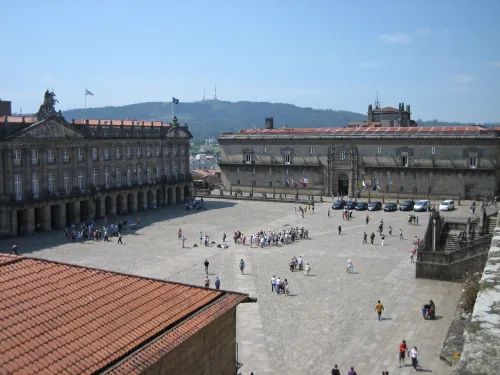
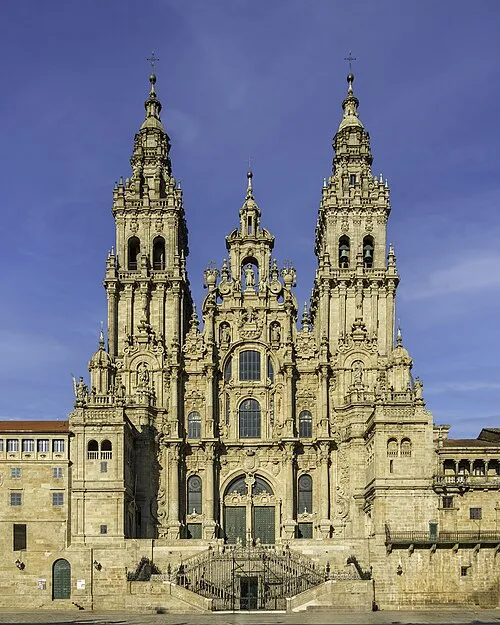
    Plaza del Obradoiro takes its name from the workshop: obradoiro is the Galician word for the place where craftsmen worked. It is the main square of the old town, though not at its actual centre, and it faces the main facade of the cathedral. Turn your back to the Pazo de Raxoi and look east: that facade is the most photographed image of the city, and behind it lies the Pórtico da Gloria, the entrance you pass through when you enter the cathedral from this side.

    The four buildings around you are said to stand for the four powers of the city. The cathedral to the east is the Church. The Hostal dos Reis Católicos to the north stands for the doctors and the bourgeoisie. The Pazo de Raxoi to the west is the government: after Spain's transition to democracy it was the seat of the President of the Xunta of Galicia, and today it houses the city council. The Colexio de San Xerome to the south is the university, now the seat of its rectorate.

    Between them, Baroque, Gothic, Renaissance and Neoclassical styles sit side by side, more than 700 years of building in one view. Now look down. Eight rays run out across the paving from the centre, where a plaque commemorates the Way of St James as a World Heritage Site; the pilgrims' final goal lies right around here. Cars once crossed the square; today it is pedestrian apart from taxis and delivery lorries.

    Take a few minutes to watch who arrives. Then it is 230 m and about 3 minutes to San Martiño Pinario, passing the Hostal dos Reis Católicos on the way.

    Hours
    Open 24/7
    Price
    Free
  5. 5

    Monastery of San Martiño Pinario

    Monastery of San Martiño Pinario in Santiago de Compostela, stop 5 on the self-guided walking tour

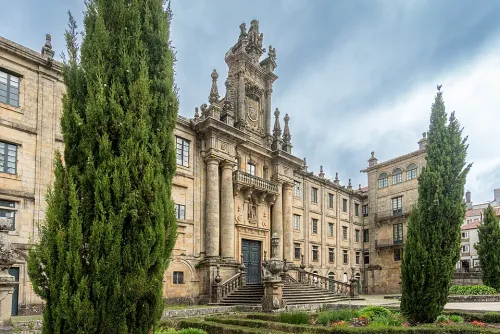
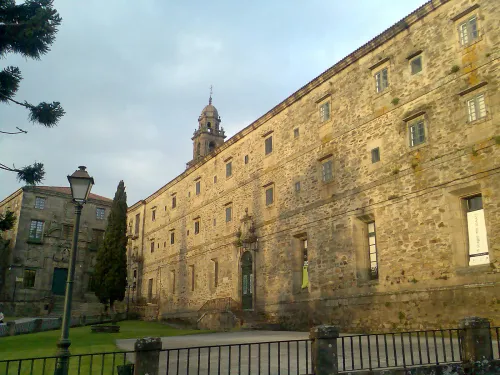
    The size is the first thing to take in. San Martiño Pinario was a Benedictine monastery and the second largest in Spain after San Lorenzo de El Escorial. Stand in the square of San Martín and look at the west facade of the church: it is built like a huge stone altarpiece, divided into three levels and three vertical sections by fluted columns, and dedicated to the Virgin Mary and the Benedictine order. At the top you will find Saint Martin, the patron of the house, on horseback, sharing his cloak with a poor man.

    The monks' story is tied to the cathedral from the start. They began in a chapel dedicated to Santa Maria, the Corticela. When Alfonso III and Bishop Sisnando started the new cathedral in the late ninth century, the old complex was demolished except for that chapel, which is still part of the cathedral today, and around 899 the monks moved to a new monastery here. Its successor church was consecrated in 1102 by Bishop Diego Gelmírez, though little of that era survives.

    Through the Middle Ages the house kept growing, and by the end of the fifteenth century it was the richest and most powerful monastery in Galicia, controlling most of the region's other monasteries. That wealth paid for an almost complete rebuilding from the sixteenth century. The present church was begun soon after Juan de Sanclemente Torquemada became Archbishop of Santiago in 1587, designed by Mateo López, the city's leading monastic architect; after his death in 1606 Benito González de Araujo took over.

    In the nineteenth century the monastery was closed in the Ecclesiastical Confiscations of Mendizábal, and the buildings now house a seminary. The facade costs nothing to admire; going inside costs admission, and it is worth it if the rise of this monastic power has caught your interest. Next comes the longest leg of the route: 420 m, about 7 minutes, to the Museum of Pilgrimage and Santiago.

    Local name
    Monasterio de San Martín Pinario
    Hours
    Tue–Sat 10:00–14:00 & 16:00–19:00 (guided tours 12:30 & 16:30); Sun and Mon closed
    Price
    5 EUR (single rate)
  6. 6

    Museum of Pilgrimage and Santiago

    Museum of Pilgrimage and Santiago in Santiago de Compostela, stop 6 on the self-guided walking tour

    After the cathedral and the monastery, this is where the pieces come together. The Museum of Pilgrimage and Santiago is devoted to pilgrimage as a cultural phenomenon: the Camino, the cathedral and the cult that grew around the tomb of Saint James the Great. Entry is free, which makes it an easy yes for anyone who wants to understand why so many people walked so far.

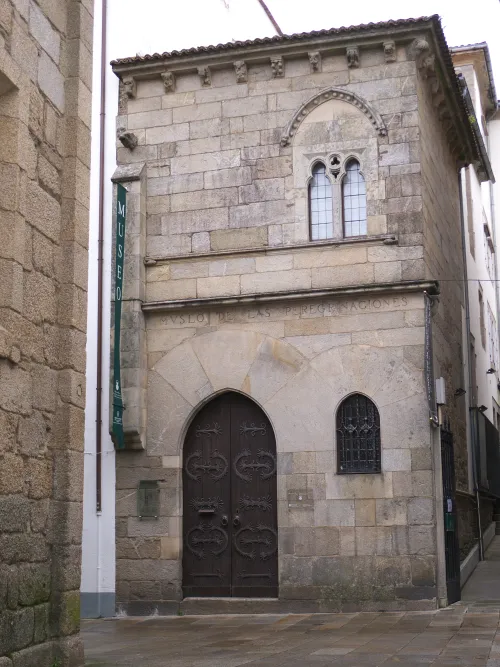
    The museum was founded at the end of 1951 on the initiative of Manuel Chamoso Lamas to hold archaeological remains and other objects connected with Santiago and the pilgrimage. It moved into the Casa Gótica at number 4 Rúa de San Miguel dos Agros, also known as the Casa do Rei Don Pedro, a fourteenth-century house named for its Gothic style, which is rare among the city's civic buildings.

    Its own history is a stop-start pilgrimage. The museum first opened to the public for the Holy Year of 1965, closed again until the Holy Year of 1976, passed to the Galician government in 1995 and finally opened for good in February 1996. In 2012 it expanded into the former Bank of Spain building on Praza das Praterías and the Casa do Cabildo; the Praterías site, remodelled by the architect Manuel Gallego Jorreto, opened in November 2015.

    Give it an hour if the story has hooked you, less if you just want the overview. From here it is 410 m and about 6 minutes to the last stop, past the Museum of the Galician People and the CGAC, the Galician Centre of Contemporary Art.

    Local name
    Museo das Peregrinacións e de Santiago
    Hours
    Mon: Closed | Tue–Fri: 09:30–20:30 | Sat: 11:00–19:30 | Sun: 10:15–14:45
    Price
    Free
  7. 7

    Convent of San Domingos de Bonaval

    Convent of San Domingos de Bonaval in Santiago de Compostela, stop 7 on the self-guided walking tour

    You finish outside the old walled city, on the slopes of Mount Almáciga, near the spot called Porta do Camiño, one of the gates through which pilgrims entered Santiago. The Convent of San Domingos de Bonaval is a former Dominican monastery, declared a national monument in 1912, and entry is free.

    Its founder was a pilgrim himself: Saint Dominic de Guzmán came to Santiago in 1219 and founded the convent in the early thirteenth century. The oldest document to mention it, from 1228, calls it Santa Maria; from the fifteenth century it appears as Santo Domingo, under the patronage of the house of Altamira. In 1695 the run-down buildings were rebuilt by the Galician Baroque architect Domingo de Andrade for Archbishop Antonio de Monroy, who held office between 1685 and 1715, and much of what you see today is his work.

    Inside the church, Gothic and Renaissance, the Dominican idea of a nave shows clearly: light and airy, fully vaulted, with the focus moved from the apse towards a pulpit at the crossing. Pope Innocent IV allowed the Dominicans to bury lay people, and the noble Moscoso and Castro families lie here. The altarpiece was built from 1687 by Andrade for the parish church of Santiago de Carril and lost its original structure when it was mounted here.

    Closed in the Mendizábal confiscations like San Martiño Pinario, the church no longer holds services. It houses the Pantheon of Illustrious Galicians and serves as a concert venue. Remember the Quintana de Mortos: the bones moved out of that cemetery came here first. If you want to head back to the market, the GPS navigation can lead you there.

    Hours
    Open 24/7
    Price
    Free
Walking tour route map of Santiago de Compostela Route loaded
Mercado de AbastosPraza da QuintanaCathedral of Santiago de CompostelaPlaza del Obradoiro+3
All 7 stops are already on the map.
You just press start.
AI Tour Guide

You've read the route. Now walk it with a guide in your ear.

Press start wherever you are, even hundreds of kilometres from Santiago de Compostela, and the guide begins telling its stories right away. In the city, pick any of the 7 stops to start from: it leads you there, then talks with you the whole route, asking, listening, remembering, and shaping the tour around your answers.

7stops 1.6km 23 minwalking 13languages
▶Start the tour free

Free to start · Runs in your browser · No app, no download

Shorter Ways Through Santiago's Old Town

Not every day has four hours in it. These cuts keep the route in its recommended order and simply drop the ends you can live without.

Market, squares and cathedral

Stops: 1, 2, 3, 4

For a first morning in Santiago or a short stay. From the Mercado de Abastos to Plaza del Obradoiro is 560 m and about 8 minutes of walking. All four stops are free, so the only cost is what you buy at the market. Plan a little under two hours with time inside the cathedral.

Cathedral and monastery

Stops: 2, 3, 4, 5

For anyone who cares most about the buildings. From Praza da Quintana to San Martiño Pinario is 510 m and about 7 minutes on foot. Only the monastery charges admission. With visits inside the cathedral and San Martiño, count on around two hours.

The pilgrimage half

Stops: 4, 5, 6, 7

For pilgrims who have already spent time at the cathedral, or anyone who wants the story behind the Camino. From Plaza del Obradoiro to San Domingos de Bonaval is 1,060 m and about 16 minutes of walking. San Martiño Pinario charges admission; the museum and Bonaval are free. Allow close to three hours.

How Long This Santiago de Compostela Tour Takes

The walking itself is short: 1.6 km and 23 minutes of pure walking, with no leg longer than 7 minutes. What fills the day is going inside. Allow about half an hour at the market, three quarters of an hour each in the cathedral and San Martiño Pinario, an hour in the museum and half an hour at Bonaval, and the full route comes to around four hours.

If you mostly stay outside and only look into the cathedral, an hour and a half is enough. The market and squares variant takes a little under two hours, the cathedral and monastery cut around two, and the pilgrimage half close to three.

Before You Set Off in Santiago

  • Start: The recommended start is the Mercado de Abastos, but you can join the route at any stop.
  • Finish: The route ends at the Convent of San Domingos de Bonaval. If you want to return to the market, the GPS navigation in your browser can lead you back.
  • Time of day: Go in the morning: the market is a morning affair, and the rest of the route fits comfortably after it.
  • Admission: Only the Monastery of San Martiño Pinario charges admission. The market, both squares, the cathedral, the museum and Bonaval are free.
  • Check the days: San Martiño Pinario and the Museum of Pilgrimage and Santiago are not open every day, so check their days and times before you plan which stops to visit inside.
Walking tour route map of Santiago de Compostela
AI Tour Guide

Your guide is ready whenever you start.

Press start and a voice AI Tour Guide takes it from here: leading the route through Santiago de Compostela, telling the stories, and turning your walk into a real back-and-forth conversation. No app or download is needed; it runs in your browser.

7stops 1.6km 23 minwalking 13languages
▶Start the tour free

Free to start · Runs in your browser · No app, no download

What the AI Tour Guide Adds in Santiago

On a route where every stone points back to one tomb, the AI Tour Guide turns the walk into a conversation: it greets you at the market, tells the stories of each place as you arrive, asks what you came to Santiago for and remembers it, so a pilgrim hears a different tour than an architecture fan. Ask it what the figures of the Pórtico da Gloria mean or why the scallop shell became the pilgrims' sign, and interrupt whenever you like. You start with 100 free credits; after that you choose this tour all-inclusive for €19.99 with no time limit, or credits at €5 per hour.

A Real Conversation A voice AI Tour Guide greets you, leads the whole route, and tells the stories and facts as you walk, asking what you want to see and keeping a real conversation going. Not a recording you press play on.
Map Navigation Follow the route on the map and walk at your own pace. You choose where to start and when to move to the next stop.
Ask Anything Curious about a building you pass? Ask your AI Tour Guide on the spot and the conversation carries on.
13 Languages Switch language anytime. No separate tour needed.
Start free in your browser

Common Questions About Walking Santiago

Which morning is best for the Mercado de Abastos?

Thursday and Saturday mornings, when the stalls are fullest and the catch is most complete.

What is a Holy Year, and does it change the walk?

A Jacobean Holy Year is any year in which Saint James' Day, 25 July, falls on a Sunday. Pilgrims then cross Praza da Quintana to enter the cathedral through the Holy Door, a custom tied to a plenary indulgence granted by Pope Alexander III in his bull Regis aeterni of 1179. The route itself stays the same.

I am arriving on the Camino. Where should I join?

Plaza del Obradoiro is the natural place: the plaque at the centre of its paving marks the end of the Way of St James. From there, continue with San Martiño Pinario, the museum and Bonaval, and pick up the market, Quintana and the cathedral another morning.

Where can I walk next after Santiago?

If you are travelling on through northwest Iberia, there are free walking routes in Porto and Braga in Portugal, and in Oviedo and León in Spain.

Is the tour really free?

Yes. The whole tour is free: the route, the interactive map and the navigation cost you nothing. Only the voice AI Tour Guide is optional and paid: you test it with 100 free credits, then you pay either €5 per hour or €19.99 for this whole tour, with no time limit. Admission to one of the 7 stops is not included: Monastery of San Martiño Pinario charges its own entry fee.

Do I need to download an app?

No. Everything runs in your phone browser. Open the route and start walking, no download and no sign-up required.

Do I need to book the walking tour in advance?

No booking needed. This self-guided tour is available anytime. Open the route in your browser and start walking. The AI Tour Guide works instantly, no app, no reservation required.

What languages is the AI Tour Guide available in?

The AI Tour Guide speaks 13 languages, so you take the tour in your own language and can switch at any time.

Can I skip stops or change the route?

Yes. Skip any stop, spend extra time at places you like, or start the route from any point. It is your walk, you set the pace.
Image credits
▶ Start free in your browser Runs in your browser, no app, no download