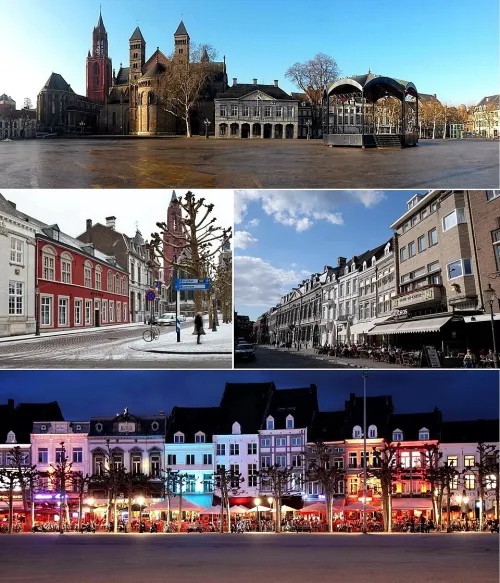
Free Walking Tour Maastricht: Basilicas, Bridges, Fort

Walk from Roman road layers under Vrijthof across the medieval bridge on the Maas to the fort that Tsar Peter the Great once toured.

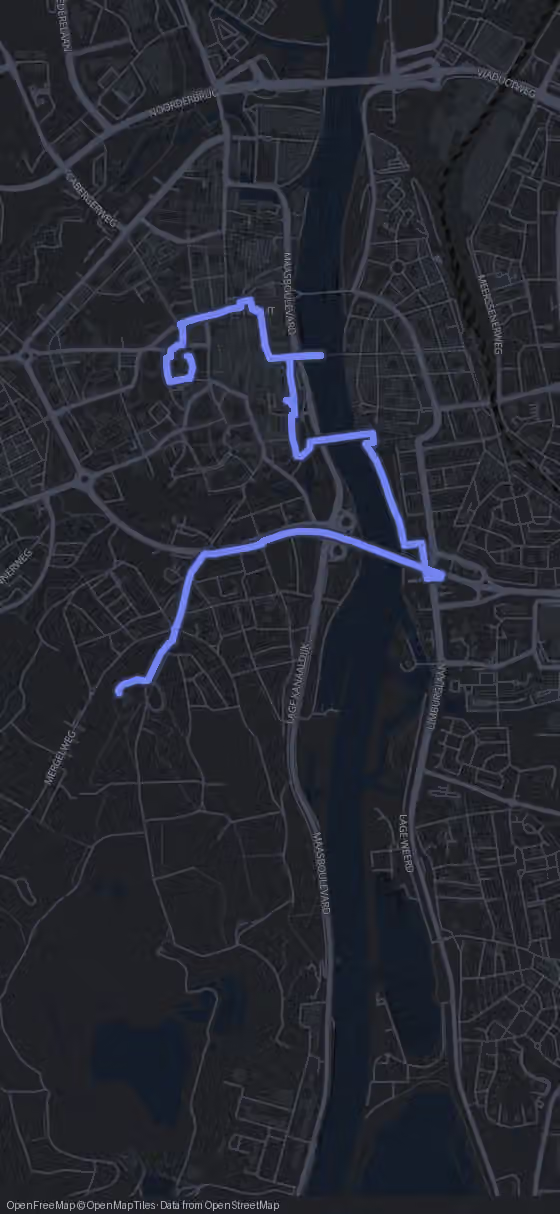
10 Stops 5.1 km ~1 h 13 min walking
Route map for the Maastricht walking tour
Stop 1 of 10
140 m·2 min
Vrijthof
Head south toward Saint John's Church, the tall red tower beside you
Welcome to Maastricht. I'm Alex, and this city once put a religious divide shoulder to shoulder in stone.
Try this tour with Alex

What This Walk Through Maastricht Covers

10 stops on 5.1 km, from Vrijthof to Fort Sint Pieter. Pure walking time is 1 h 13 min; with the interiors worth seeing, plan about five hours.

Free: Saint John's Church, Market Square, Sint Servaas Bridge, Basilica of Our Lady, Hoge Brug and the fort grounds. Paid: Basilica of Saint Servatius, the museum in the Helpoort and the Bonnefanten Museum. The GPS route is free; the AI Tour Guide is optional.

Open free GPS & optional AI Tour Guide
View of Maastricht

The Route

Walking Map of Maastricht: Vrijthof to Fort Sint Pieter

10 stops 5.1 km 1 h 13 min walking
Tap to load interactive map

The 10 stops along this route

  1. Vrijthof in Maastricht, stop 1 on the self-guided walking tour
    1Vrijthof
  2. Saint John's Church in Maastricht, stop 2 on the self-guided walking tour
    2Saint John's Church
  3. Basilica of Saint Servatius in Maastricht, stop 3 on the self-guided walking tour
    3Basilica of Saint Servatius
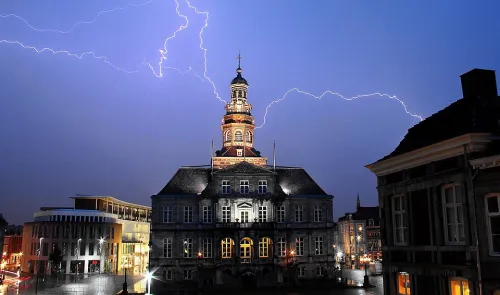
  4. Market Square in Maastricht, stop 4 on the self-guided walking tour
    4Market Square
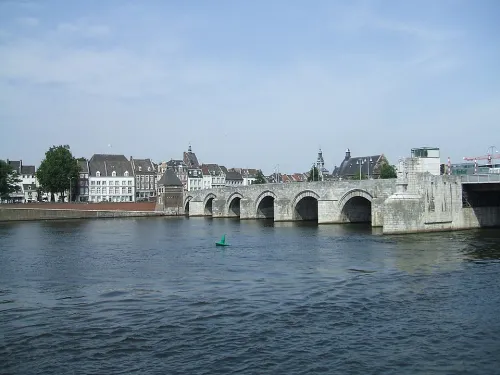
  5. Sint Servaas Bridge in Maastricht, stop 5 on the self-guided walking tour
    5Sint Servaas Bridge
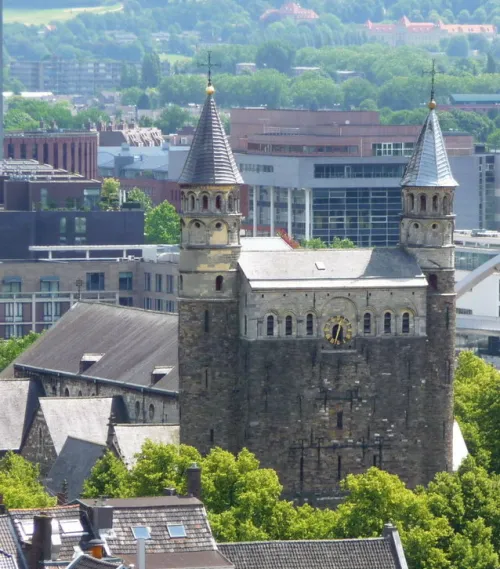
  6. Basilica of Our Lady in Maastricht, stop 6 on the self-guided walking tour
    6Basilica of Our Lady
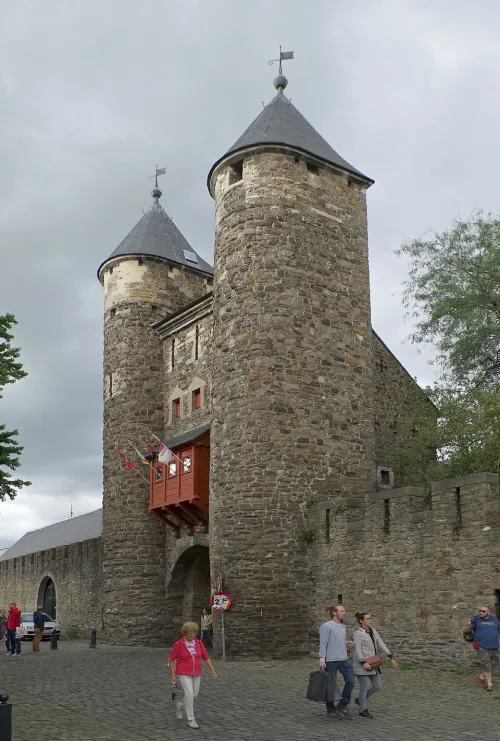
  7. Helpoort in Maastricht, stop 7 on the self-guided walking tour
    7Helpoort
  8. Hoge Brug in Maastricht, stop 8 on the self-guided walking tour
    8Hoge Brug
  9. Bonnefanten Museum in Maastricht, stop 9 on the self-guided walking tour
    9Bonnefanten Museum
  10. Fort Sint Pieter in Maastricht, stop 10 on the self-guided walking tour
    10Fort Sint Pieter
  11. That's the full route.

    Walk it with an AI Tour Guide talking you through every one of these streets.

    Start free in your browser
    You made it

Your Maastricht Walking Tour from Square to Fortress, Stop by Stop

  1. 1

    Vrijthof

    Vrijthof in Maastricht, stop 1 on the self-guided walking tour

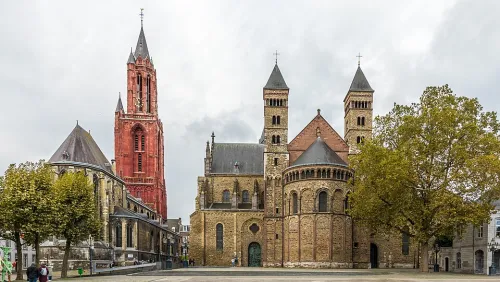
    Start on Vrijthof, the large square that has been Maastricht's main square since the 19th century. Look around its edges: heritage buildings, museums, a theatre, hotels, restaurants and bars frame the open space, and two great churches rise on one side. The square is regularly used for public events, so you may find a stage or stalls set up.

    What you stand on is far older than the cafés. Excavations show the area was used for burials from the late Roman period, and in 1969 and 1970, before an underground car park was built, archaeologists uncovered several large early medieval cemeteries. Publishing the thousands of finds has only recently begun. In 2003, digging on the north side revealed thirteen layers of Roman road: the Via Belgica, which linked Boulogne-sur-Mer on the English Channel with Cologne on the Rhine.

    The name Vrijthof first appears in 1223, when Emperor Frederick II handed the area to the chapter of Saint Servatius. The square was then walled, with iron gates near the corners. Only during the two weeks of the Septennial Pilgrimage were the walls taken down, because the crowds were too big: pilgrims gathered around the apse of Saint Servatius, where relics were shown from the dwarf gallery. A fountain of Saint Servatius stood in the middle, fed from a spring in the Jeker valley that pilgrims also visited. In the 15th century the Gothic King's Chapel was added to the northeast portal, with the Cemetery of the Poor beside it.

    The northeast corner was the lively one: in the 14th and 15th centuries famous inns stood there, and in 1292 the original perron went up at that spot, the symbol of the prince-bishop of Liège's jurisdiction. From here, Saint John's Church is just 130 m away, two minutes on foot.
    Hours
    24/7
    Price
    Free
  2. 2

    Saint John's Church

    Saint John's Church in Maastricht, stop 2 on the self-guided walking tour

    Saint John's Church (Sint-Janskerk) is Gothic and Protestant, and it stands right beside the Catholic Basilica of Saint Servatius. That closeness is the point. The chapter of Saint Servatius founded it around 1200 as a baptismal and parish church, so the basilica could serve only canons and pilgrims. On the eves of Easter and Pentecost the canons processed here to consecrate the baptismal water, while the choir sang to them from the first tower transept.

    First mentioned in 1218, the present church dates from the 14th and early 15th centuries, and the Gothic baptistery was added in 1414. The original tower collapsed in a violent storm on 8 June 1366. Its successor took a long time: it was only completed in the second half of the 15th century, when the roof lantern was put on top.

    After Frederik Hendrik conquered Maastricht in 1632, the church passed to the Protestants and has belonged to the Dutch Reformed Church since 1633. The Catholic wall paintings were covered in whitewash and only uncovered again during restoration in the early 20th century, so look for them inside. The neighbours did not always get on: in the 17th century the church council complained about 'wolf dancing', the wild ringing of the Saint Servatius bells to disrupt the sermon. In 1659 the council fell out with the ivory carver Johannes Boissier over the marble tomb he had made for Margarita Elisabet Cabeliaeu-de Gryse.

    Entry is free and a short look is worth it for the uncovered paintings. Climbing the tower costs extra and is the choice if you want the old town from above. The basilica entrance is 200 m on, three minutes.

    Local name
    Sint-Janskerk
    Hours
    Mon–Sat 11:00–16:00 (seasonal tourist opening from 31 March to 8 November); Sun regular church service at 10:00
    Price
    Church free; tower climbing 4.00 EUR adults, 2.00 EUR children (up to 15 years)
  3. 3

    Basilica of Saint Servatius

    Basilica of Saint Servatius in Maastricht, stop 3 on the self-guided walking tour

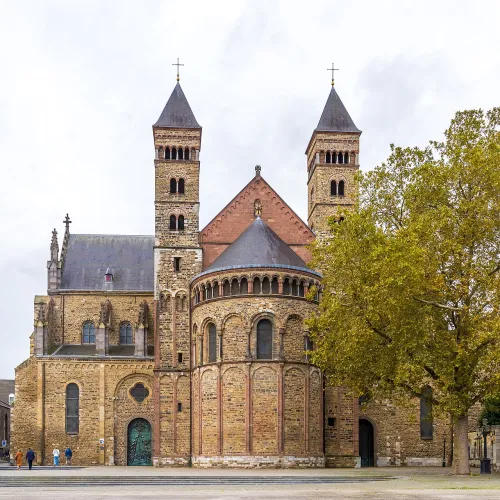
    The Basilica of Saint Servatius is a mix of styles, mainly Romanesque, and backs onto Vrijthof. It is probably the fourth church on the grave of Saint Servatius, an Armenian missionary and bishop of Tongeren who allegedly died in Maastricht in 384. A small memorial chapel came first. Bishop Monulph replaced it with a large stone church around 570, a bigger pilgrim church followed in the late 7th century, and the present building grew over more than 100 years: the nave in the first half of the 11th century, the transept in the second half, the choir and westwork in the 12th.

    This was built as an imperial church. The chapter kept close ties with the Holy Roman Emperors, and Emperor Henry III attended the dedication in 1039 together with twelve bishops. Most medieval provosts were sons of the highest German noble families; several served as chancellor of the Empire, and at least eight went on to become archbishops.

    Walk round to the south side for the Bergportaal, a sculpted portal begun around 1180 that stands between late Romanesque and early Gothic. The chapels along the side aisles and the vaults of nave and transept are Gothic, from the 14th and 15th centuries. Then look up at the westwork: a late Gothic spire was set between its two towers in 1556, and in 1770 the Liège architect Etienne Fayen crowned the whole front with Baroque helmet spires. Not everything survived the centuries; in the 17th century the Gothic rood screen carved with scenes from Servatius's life was demolished.

    The basilica charges admission. If medieval history is your thing, give it about an hour. Market Square is 490 m away, six minutes.

    Local name
    Sint-Servaasbasiliek
    Hours
    Mon–Sat 10:00–17:00; Sun 11:30–17:00; 1 Jul–31 Aug until 18:00; last entry 30 min before closing
    Price
    7.50 EUR adults, 4.00 EUR students, free for children up to 17 years (accompanied)
  4. 4

    Market Square

    Market Square in Maastricht, stop 4 on the self-guided walking tour

    Market Square, Merret in the local dialect, takes its name from the goods markets held here for centuries. The Town Hall (Stadhuis) dominates it, and cafés and restaurants fill the rest. It looks planned as one piece, yet for most of its history it was smaller and split in two.

    The square began at the northern edge of town, up against the first medieval city wall. Two adjoining streets, Kleine Gracht and Grote Gracht, still recall the moat that ran along it. In the late 13th century a cloth hall with a belfry was built against the inside of the wall, where the cloth of the weavers from the Boschstraatkwartier, north of the market, was traded. City gates flanked it: the Hochterpoort, the main gate, and the smaller Leugenpoort. When a second ring of walls was built in the 14th century, both gates lost their purpose and became prisons, and the Hochterpoort was known from then on as the Gevangenpoort.

    The old wall ran straight across the square until the mid-17th century. South of it lay the Saturday market, mainly for food, with set places for shoemakers, clog makers, furriers, rope makers and coopers. Outside the wall was the Houtmarkt, the timber market. In 1659 the cloth hall, the prison gate and the crumbling wall were torn down to make room for a new Town Hall designed by the Dutch master builder Pieter Post. The first stone was laid that year, and by 1664 the building stood complete except for its tower.

    So when you stand back and take in Post's Town Hall, you are looking at the reason this square is square. From here it is 550 m, eight minutes, to the river and the Sint Servaas Bridge.

    Hours
    24/7
    Price
    Free
  5. 5

    Sint Servaas Bridge

    Sint Servaas Bridge in Maastricht, stop 5 on the self-guided walking tour

    The Sint Servaas Bridge carries walkers and cyclists across the Maas, from the Binnenstad, the most central district, to Wyck on the east bank. It is built of limestone, 160 m long and 9 m wide, with seven arches of about 12 m each resting on seven piers. At its east end a separate steel drawbridge spans 54.5 m. Although largely rebuilt after the Second World War, it has been called the oldest bridge in the Netherlands.

    Walk out a little and think about the city's name. The Romans built a wooden bridge here around AD 50, and the Latin for 'crossing of the Maas', mosae trajectum, became Maastricht. For many years it was the only crossing of the lower Maas. In 1275 that bridge collapsed under the weight of a large procession, killing 400 people.

    Its replacement, slightly north of the old crossing, was built between 1280 and 1298, and the Church encouraged the work by granting indulgences to those who helped. Around that time it was named after Saint Servatius, the first bishop of Maastricht. It was renovated in 1680, a wooden section on the east side gave way to a stone arch in 1825, and in 1850 a channel was cut on the west side for the canal to Liège.

    Only when the Wilhelmina Bridge opened 300 m downstream in the early 1930s did it stop being the city's only river crossing. A major renovation followed: the arches were rebuilt in concrete and clad with the original stones. From the bridge, the Basilica of Our Lady is 390 m away, about five minutes.

    Hours
    24/7
    Price
    Free
  6. 6

    Basilica of Our Lady

    Basilica of Our Lady in Maastricht, stop 6 on the self-guided walking tour

    The Basilica of Our Lady, Slevrouwe to locals, is a Romanesque church dedicated to Our Lady of the Assumption and often called the Star of the Sea after its main devotion. Start with the imposing westwork, the massive front begun shortly after the year 1000. Most of the rest dates from the 11th and 12th centuries, and in the 13th century the nave received Gothic vaults.

    The site is probably older than the church. It lies inside the Roman castrum, next to a shrine to Jupiter, which suggests a Roman temple once stood here. The town's first church may well have been built on this spot and become the cathedral of the diocese of Tongeren-Maastricht in the 4th or 5th century. Nobody can say for certain, because no archaeological research has ever been done inside the building.

    Some time before 1100 it became a collegiate church. Its roughly 20 canons were appointed by the prince-bishop of Liège, its provosts came from Saint Lambert's Cathedral in Liège, and its parishioners appear in old documents as the Familia Sancti Lamberti. Saint Servatius, with its imperial ties, was the more powerful house, but the two churches stayed rivals throughout the Middle Ages. Around 1200 the canons gave up living together and built their own houses around the church.

    The church and chapel are free, so go in even if you are short on time. The treasury charges admission and suits those who want more than the building itself. The Helpoort is 280 m on, four minutes.

    Local name
    Onze-Lieve-Vrouwebasiliek
    Hours
    Treasury: Mon–Sat 11:00–17:00, Sun 12:30–17:00 (winter hours 1 Jan – 18 Feb: daily 12:00–14:30); Church & Chapel daily open for worship and visitors from 08:30 to 17:00
    Price
    Basilica and chapel free; Treasury 5.00 EUR adults, 3.00 EUR students, free for children under 12
  7. 7

    Helpoort

    Helpoort in Maastricht, stop 7 on the self-guided walking tour

    The Helpoort stands in the Jekerkwartier at the south end of Sint Bernardusstraat, opposite the Pesthuys. It dates from the second quarter of the 13th century, which makes it the oldest surviving city gate in the Netherlands. It has carried many names over time, among them Jekerpoort, Hoogbruggepoort and De Twee Torens; Helpoort itself only dates from the 18th century.

    Its story starts with a siege. Maastricht had two lords, and an earlier earth rampart with palisades was destroyed by the bishop of Liège, one of them, during the siege of 1204. In 1229 the Duke of Brabant allowed a stone wall to be built, and work on stone gates and towers probably began then, linked by earth ramparts that were turned to stone during the 13th century. On this bank of the Maas the wall ran about 2.4 km, stood 6 to 8 m high and had thirteen city gates and two water gates. The Helpoort was probably built around 1230.

    It is first named in 1358, as Hoogbruggepoort or 'porta de alto ponte', after a bridge over a branch of the Jeker that flowed past the outside of the gate. It guarded a secondary road leading south towards Sint Pieter and Liège.

    You can walk through the gate passage at any time. Inside, the Vestingmuseum charges admission, and guided tours including the museum are available too. It is worth it if fortifications interest you, since Fort Sint Pieter continues the story at the end of the walk. The Hoge Brug is 250 m away, four minutes.

    Hours
    Wed–Sun 11:00–16:00 (seasonal opening 15 March to 30 December; Mon–Tue closed); exterior and gate passage always accessible
    Price
    Vestingmuseum inside Helpoort: 6.00 EUR adults (12+), free for children under 12; guided tour incl. museum 12.00 EUR adults, 8.00 EUR youth
  8. 8

    Hoge Brug

    Hoge Brug in Maastricht, stop 8 on the self-guided walking tour

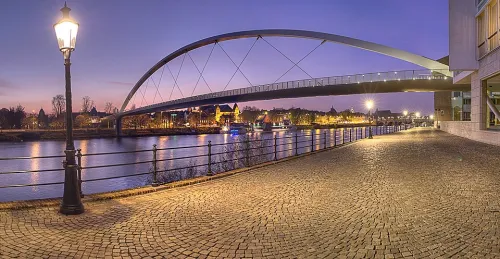
    After two medieval gates and a 13th-century bridge, the Hoge Brug jumps to 2003. This cycle and pedestrian bridge links the city centre with old Wyck and the new Céramique district on the east bank, and the Stadspark with the Charles Eyckpark. It was designed by the office of René Greisch from Liège and won the 2004 Steel Prize of the Bouwen met Staal foundation.

    Its shape follows a rule. Rijkswaterstaat decided that no piers could stand in the Maas, to avoid hindering shipping any further. The answer was a steel arch bridge whose deck hangs from diagonally tensioned cables, with supports only on the two banks. It is 261 m long and 7.20 m wide, the deck runs 16 m above the water and the top of the arch reaches 26 m.

    From the middle you have the river's bridges lined up: the John F. Kennedy Bridge lies to the south, the Sint Servaas Bridge to the north. Across the river lies Céramique, where the Bonnefanten Museum is 640 m on, nine minutes.

    Hours
    24/7
    Price
    Free
  9. 9

    Bonnefanten Museum

    Bonnefanten Museum in Maastricht, stop 9 on the self-guided walking tour

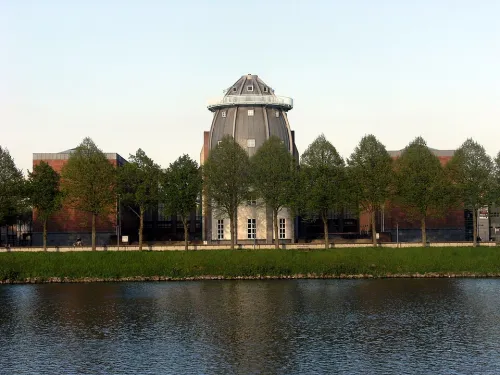
    You will spot the Bonnefanten Museum by its rocket-shaped cupola overlooking the Maas. Italian architect Aldo Rossi designed the building, one of Maastricht's most prominent modern ones, and the museum moved here in 1995, onto Céramique, a former industrial site.

    The museum is older than its building. It was founded in 1884 as the historical and archaeological museum of the province of Limburg, which still largely funds it. Its name comes from the French 'bons enfants', 'good children', the popular name of a former convent that housed it from 1951 until 1978. Since 1999 it has been purely an art museum, and the historical and archaeological collections moved elsewhere, partly to the Limburg Museum in Venlo.

    What makes it distinctive is old and new art under one roof. On the first floor you find early Italian, Flemish and Dutch painting together with a large collection of medieval sculpture, including wooden figures from the 13th to the 16th century by Jan van Steffeswert. The second floor usually shows the contemporary collection, with American Minimalism, Italian Arte Povera and Concept Art, and the second and third floors host temporary exhibitions.

    Tickets are not cheap, though Museumkaart holders go free. Go in if art is a main reason for your trip and you have about two hours; otherwise admire Rossi's building from outside. Then comes the longest leg: 2230 m, 33 minutes, to Fort Sint Pieter.

    Hours
    Tue–Sun 11:00–17:00, Mon closed (open on select public holidays)
    Price
    22.00 EUR adults, 11.00 EUR students/CJP, free for youth up to 18 years and Museumkaart holders
  10. 10

    Fort Sint Pieter

    Fort Sint Pieter in Maastricht, stop 10 on the self-guided walking tour

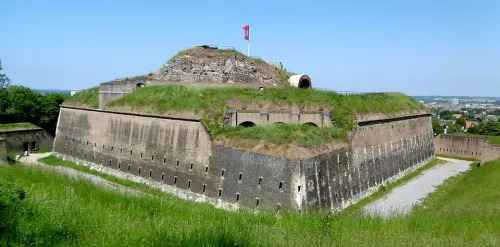
    Fort Sint Pieter was built in 1701 and 1702 on the north flank of the Sint-Pietersberg, and it is now a national monument. Its five-sided shape was laid out on the orders of Maastricht's military commander, Daniël Wolff baron van Dopff, to protect the city's southern walls. The reason lay in 1673, when the French had seized the Sint-Pietersberg and fired their cannons from up here to blast breaches in those walls. From this fort, any attack from the south could now be held off.

    In 1717 Tsar Peter the Great came to see it and was shown round in style by the governor. In 1794 the French attacked it from behind during the siege led by Kléber. The fort was thoroughly modernised in the early 19th century, but lost its military role when Maastricht ceased to be a fortress town in 1867.

    In the 20th century a café, restaurant and party venue stood on the north side, and many hikers on the Pieterpad raised a glass on its terrace at the end of their walk. That addition was demolished in 2011 for the restoration of the fort, completed in 2014. The hill around it is riddled with old workings: the Great Entrance of the Northern tunnel system once lay to the southwest, the Predikherengat to the southeast and the Ancienne Brasserie quarry to the northwest.

    The fort grounds, the dry moat and the plateau viewpoints are free to explore, a fitting end after the Helpoort. The interior can only be seen on paid guided tours at scheduled times. Book one if you want to stand inside the walls the tsar inspected.

    Hours
    Fort exterior hill, dry moat and plateau viewpoints open daily accessible daylight hours; guided interior tours run daily at scheduled times; ticket shop open daily 10:00–16:30
    Price
    Fort grounds, viewpoints and dry moat free; Guided interior tours from 9.95 EUR adults (18+), 8.25 EUR youth (12-17), 7.25 EUR children (4-11), free under 4
Walking tour route map of Maastricht Route loaded
VrijthofSaint John's ChurchBasilica of Saint ServatiusMarket Square+6
All 10 stops are already on the map.
You just press start.
AI Tour Guide

You just read the route along the Maas. Now walk it with a guide in your ear.

Press start wherever you are, even hundreds of kilometres from Maastricht, and the guide begins telling its stories right away. In the city, pick any of the 10 stops to start from: it leads you there, then talks with you the whole route, asking, listening, remembering, and shaping the tour around your answers.

10stops 5.1km 1 h 13 minwalking 13languages
▶Start the tour free

Free to start · Runs in your browser · No app, no download

Shorter Ways to Walk Maastricht

Not every day has room for all ten stops and three museums. These cuts follow the route order, so the GPS navigation still leads you from stop to stop.

Old town core

Stops: 1, 2, 3, 4, 5, 6, 7

For a half day or a first visit: the squares, the churches, the old bridge and the Helpoort. 28 minutes of walking. Paid extras are the Basilica of Saint Servatius, the tower of Saint John's Church, the treasury of Our Lady and the Vestingmuseum.

Old town plus art

Stops: 1, 2, 3, 4, 5, 6, 7, 8, 9

For art lovers who would rather spend two hours in the Bonnefanten than walk out to the fort. 41 minutes of walking; add the Bonnefanten ticket to the old town extras.

South side on a second day

Stops: 7, 8, 9, 10

For a return visit: Helpoort, the modern bridge, the Bonnefanten and the fortress, with time for a fort interior tour. 46 minutes of walking; entries are the Vestingmuseum, the Bonnefanten and the guided fort tour.

How Long Does This Maastricht Tour Take, With and Without Museums?

Pure walking time is 1 h 13 min, and almost half of it is the final leg out to the fort. Add about an hour inside the Basilica of Saint Servatius, half an hour each for Our Lady and the Helpoort museum, half an hour on the fort grounds and short pauses at the squares and bridges, and you land at roughly five hours. The Bonnefanten adds about two hours; a guided fort tour adds its own slot.

The old town core takes about three and a half hours with its interiors, old town plus art close to six, and the south side variant about four hours including the Bonnefanten.

Before You Set Off in Maastricht

  • Start and finish: Start on Vrijthof and finish at Fort Sint Pieter. You can join at any stop; the order here is the recommended one.
  • Best day: If you want to go inside, plan for a day when the Helpoort museum, the Bonnefanten and the churches are all open.
  • Time of day: Set off in the late morning, once Saint John's Church has opened. If you want the Bonnefanten, leave yourself about two hours there before it closes; a fort interior tour then fits better on a second day.
  • Budget: The walk itself costs nothing. You only pay for the interiors you choose, from the basilica to the Bonnefanten, plus a fort tour if you add one.
Walking tour route map of Maastricht
AI Tour Guide

Your guide is ready when you are, from Vrijthof to the fort.

Press start and a voice AI Tour Guide takes it from here: leading the route through Maastricht, telling the stories, and turning your walk into a real back-and-forth conversation. No app or download is needed; it runs in your browser.

10stops 5.1km 1 h 13 minwalking 13languages
▶Start the tour free

Free to start · Runs in your browser · No app, no download

What the AI Tour Guide Adds Along the Maas

This route jumps between Roman roads, imperial bishops, cloth weavers and siege engineers. The AI Tour Guide leads it as a conversation: it greets you on Vrijthof, tells the stories at each place, asks what grabs you and follows that thread, so a walk that starts with pilgrims can turn into one about fortifications. Ask what daily life was like for a cloth weaver in the Boschstraatkwartier, or how the people of Wyck lived across the river, and interrupt whenever you like. You start with 100 free credits; after that you choose this tour all-inclusive for 19.99 EUR with no time limit, or 5 EUR per hour.

A Real Conversation A voice AI Tour Guide greets you, leads the whole route, and tells the stories and facts as you walk, asking what you want to see and keeping a real conversation going. Not a recording you press play on.
Map Navigation Follow the route on the map and walk at your own pace. You choose where to start and when to move to the next stop.
Ask Anything Curious about a building you pass? Ask your AI Tour Guide on the spot and the conversation carries on.
13 Languages Switch language anytime. No separate tour needed.
Start free in your browser

Common Questions About Walking Maastricht

Do children pay on this walk?

Very little. Saint Servatius, the Bonnefanten, the Helpoort museum and Our Lady's treasury are free for children up to a certain age, and the tower of Saint John's Church and the fort tours have reduced children's tickets.

Does the walk work in winter?

Yes, the squares, both bridges and the fort grounds stay accessible every day. Some interiors keep shorter hours or close for part of the winter, including Saint John's Church, the Helpoort museum and Our Lady's treasury.

Only time for one: Bonnefanten or Fort Sint Pieter?

Pick the Bonnefanten if you like painting, medieval sculpture or Minimalism and have two hours. Pick the fort if you prefer military history and open views, as the grounds cost nothing and fit the end of the walk.

Can I combine Maastricht with another city?

Easily, the region is compact. Liège, the seat of the prince-bishops who shared power over Maastricht, is 24 km away, and Aachen is 29 km away; both have their own free walking route.

Is the tour really free?

Yes. The whole tour is free: the route, the interactive map and the navigation cost you nothing. Only the voice AI Tour Guide is optional and paid: you test it with 100 free credits, then you pay either €5 per hour or €19.99 for this whole tour, with no time limit. Admission to 2 of the 10 stops is not included: Basilica of Saint Servatius and Bonnefanten Museum charge their own entry fees.

Do I need to download an app?

No. Everything runs in your phone browser. Open the route and start walking, no download and no sign-up required.

Do I need to book the walking tour in advance?

No booking needed. This self-guided tour is available anytime. Open the route in your browser and start walking. The AI Tour Guide works instantly, no app, no reservation required.

What languages is the AI Tour Guide available in?

The AI Tour Guide speaks 13 languages, so you take the tour in your own language and can switch at any time.

Can I skip stops or change the route?

Yes. Skip any stop, spend extra time at places you like, or start the route from any point. It is your walk, you set the pace.
Image credits
▶ Start free in your browser Runs in your browser, no app, no download